Best Infrared Saunas: 6 Home Picks for 2026
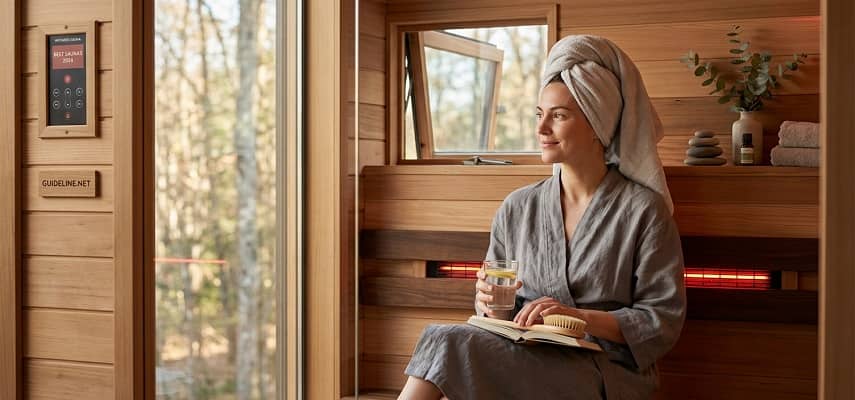
2026 home sauna buying guide · space, power & safety
The best infrared saunas are not simply the hottest or the most feature-packed. A home sauna has to fit your room, electrical circuit, delivery path and real number of users. For most indoor buyers, the Maxxus Seattle Elite is our best overall pick because its 48-by-42-inch cabin provides more credible two-person space while still using a documented 120V/15A dedicated circuit. This guide compares six current Amazon-listed cabins without treating “detox,” rapid weight loss or disease-treatment claims as proven benefits.
Quick picks
Best overall
Maxxus Seattle Elite
A roomier two-person far-infrared cabin with documented 120V/15A power requirements.
Best compact cabin
Dynamic Barcelona
A 39-by-36-inch footprint that makes more sense for a solo user or a tight room.
Best full spectrum
Maxxus MX-M206-01
A cedar two-person cabin combining far-infrared carbon panels with near-infrared elements.
JUMP TO A SECTION
How we chose the best infrared saunas
This is a specification-first buying guide. We started with sauna models that had a traceable Amazon US ASIN and current U.S. listing evidence, then compared the factors that determine whether a cabin actually works in a home: exterior size, realistic seating capacity, dedicated-circuit requirement, infrared heater type, wood construction, indoor placement and delivery/assembly burden. We cross-checked model details against manufacturer manuals, current manufacturer pages and established retailer documentation where available.
Our category labels are editorial judgments based on those specifications; they are not results from a head-to-head laboratory test. We also did not rank products higher because of broad “detox,” fat-loss, immune-boosting or disease-treatment marketing. Health claims are discussed separately using medical sources.
Start with your home, not the feature list. Before ordering a 250- to 400-pound cabin, confirm the electrical circuit, floor space, ceiling clearance, door swing, freight-delivery path and whether the sauna is approved for your intended indoor location.
Best infrared saunas at a glance
| Sauna | Best for | Capacity | Power | Heater setup | Price tier |
|---|---|---|---|---|---|
| Maxxus Seattle Elite | Best overall | 2 people | 120V / 15A dedicated | 6 far-IR carbon panels | $$$ |
| Dynamic Barcelona | Compact indoor cabin | 1–2 people; best as roomy solo | 120V / 15A dedicated | 6 far-IR carbon panels | $$ |
| Dynamic Andora | Value two-person layout | 2 people | 120V / 15A dedicated | 6 far-IR carbon panels | $$ |
| Maxxus Full Spectrum 2-Person | Near + far infrared | 2 people | 120V / 15A dedicated | 4 far-IR carbon + 2 near-IR elements | $$$$ |
| Maxxus 3-Person Hemlock | Straight-wall 3-person cabin | 3 people | 120V / 20A dedicated | 7 far-IR carbon panels | $$$ |
| Maxxus 3-Person Corner | Corner installation | 3 people | 120V / 20A dedicated | 9 far-IR carbon panels | $$$ |
The six best infrared sauna profiles
01 / BEST OVERALL
Maxxus Saunas Seattle Elite
The Maxxus Seattle Elite is our best overall infrared sauna for most indoor two-person buyers because its 48-inch width and 44-by-38-inch interior make the “two-person” label more believable than compact 39-inch cabins. It uses six far-infrared carbon panels and a documented 120V/15A dedicated circuit, so it offers useful cabin space without automatically moving you to a 20A model.
Key features
- 48″ W × 42″ D × 75″ H exterior
- 44″ W × 38″ D × 68″ interior
- 6 far-infrared carbon heating panels
- 120V / 15A dedicated circuit
- Canadian hemlock construction
- Indoor-only placement
Pros
- More credible two-adult interior than compact 1–2 person cabins
- Documented 15A dedicated-circuit requirement
- Straightforward far-infrared carbon-panel design
Cons
- Large freight item; published product weight is about 275 lb
- Far infrared only, not a full-spectrum heater setup
- Still needs about 14 square feet before clearance and door space
Best for: Couples or solo users who want a cabin that is meaningfully wider than the most compact models while staying with a 120V/15A dedicated circuit.
Who it is not for: Very small rooms, outdoor placement, or buyers specifically shopping for near-infrared/full-spectrum heating.
02 / BEST COMPACT CABIN
Dynamic Saunas Barcelona
The Dynamic Barcelona is the strongest compact-cabin option in this shortlist. Its published footprint is just 39″ wide by 36″ deep, and it uses six carbon heating panels on a 120V/15A dedicated circuit. The important caveat is capacity: the maker calls it a 1–2 person model, but the 36-inch-wide interior is far more comfortable as a solo sauna than as a regular two-adult cabin.
Key features
- 39″ W × 36″ D × 73″ H exterior
- 36″ W × 32″ D × 67″ interior
- 6 far-infrared carbon panels
- 120V / 15A dedicated circuit
- Canadian hemlock construction
- Manufacturer lists up to 140°F
Pros
- One of the smallest wooden cabins in the comparison
- 15A dedicated-circuit requirement
- Lower relative price tier than the larger Maxxus cabins
Cons
- Two adults will be close together
- Published weight is about 250 lb despite the small footprint
- No near-infrared elements
Best for: A solo user who wants a real wooden infrared cabin but has limited floor space.
Who it is not for: Buyers expecting relaxed side-by-side seating for two adults or anyone planning garage/outdoor installation without explicit manufacturer approval.
Capacity reality check: Treat “1–2 person” as a size category, not a comfort guarantee. Map the interior bench width against the bodies of the people who will actually use it.
03 / VALUE TWO-PERSON LAYOUT
Dynamic Saunas Andora
The Dynamic Andora is the better fit when you want a two-person Dynamic cabin but do not want the tighter Barcelona interior. The current manual identifies it as a two-person, indoor far-infrared sauna using a 120V/15A dedicated circuit, while product documentation describes six carbon heat emitters and Canadian hemlock construction.
Key features
- 2-person far-infrared cabin
- 6 carbon heat emitters
- 120V / 15A dedicated circuit
- Canadian hemlock construction
- Indoor use only
- Current manual notes backrests may be sold separately
Pros
- Dedicated 15A power requirement is clearly documented
- Two-person layout without moving into a 20A three-person cabin
- Established model with a traceable Amazon ASIN
Cons
- Far-infrared only
- Accessories can vary by model year
- Still a freight-size purchase that needs two-person assembly planning
Best for: Buyers who want a conventional two-person far-infrared cabin on a 15A dedicated circuit and prefer more usable seating than a compact 1–2 person model.
Who it is not for: Buyers who want full-spectrum heaters, an outdoor sauna, or a package where every accessory is guaranteed without checking the exact listing.
04 / BEST FULL SPECTRUM
Maxxus Full Spectrum 2-Person (MX-M206-01)
The Maxxus MX-M206-01 is the clear fit for buyers who specifically want a near- plus far-infrared heater configuration. Current model documentation lists four far-infrared carbon panels plus two near-infrared elements, Canadian red cedar construction and a 120V/15A dedicated circuit. It costs more relative to the far-infrared-only cabins, so the extra spectrum should be a feature you actually want.
Key features
- 50″ W × 42″ D × 75″ H exterior
- 4 far-infrared carbon panels + 2 near-infrared elements
- 120V / 15A dedicated circuit
- Canadian red cedar construction
- 2-person capacity
- Indoor use only
Pros
- Near- and far-infrared elements in one cabin
- Red cedar instead of hemlock
- Still documented for a 120V/15A dedicated circuit
Cons
- Highest relative price tier in this shortlist
- Larger footprint than compact two-person cabins
- “Full spectrum” does not prove better clinical outcomes
Do not confuse terms: A sauna with near-infrared heating elements is not automatically equivalent to a clinical photobiomodulation/red-light device. Wavelength, irradiance, distance and dose all matter, and “full spectrum” is a heater description rather than proof of a superior medical effect.
Best for: Buyers who deliberately want both near- and far-infrared heat in a two-person cedar cabin.
Who it is not for: Value-focused buyers who only want the basic far-infrared sauna experience.
05 / BEST STRAIGHT-WALL 3-PERSON
Maxxus 3-Person Hemlock (AMZ-MX-K306-01)
The Maxxus AMZ-MX-K306-01 is the practical upgrade when two-person cabins are simply too narrow. Its published dimensions are 63.5″ wide by 43.3″ deep by 74.8″ high, with seven far-infrared carbon panels. The tradeoff is electrical: this model calls for a 120V/20A dedicated circuit, so you should verify the receptacle and breaker before the freight order is placed.
Key features
- 63.5″ W × 43.3″ D × 74.8″ H
- 3-person capacity
- 7 far-infrared carbon panels
- 120V / 20A dedicated circuit
- Canadian hemlock construction
- Straight-wall footprint
Pros
- Substantially more bench width than 1–2 person cabins
- Straight-wall shape can be easier to place than a corner cabin
- Seven-panel heater layout
Cons
- Requires a dedicated 20A circuit rather than 15A
- Wide footprint demands more wall space
- Freight delivery and panel handling are more demanding
Best for: Households that want more seating width and have a suitable 20A dedicated circuit.
Who it is not for: Apartments, narrow rooms or buyers who have only a 15A circuit available and do not plan electrical work.
06 / BEST CORNER LAYOUT
Maxxus 3-Person Corner (AMZ-MX-K356-01)
The Maxxus AMZ-MX-K356-01 is the most useful layout when your available floor area is a corner rather than a long straight wall. It measures about 59.1″ by 59.1″ and uses nine far-infrared carbon panels. It still requires a 120V/20A dedicated circuit, and its approximately 390-pound published weight makes delivery planning especially important.
Key features
- 59.1″ W × 59.1″ D × 74.8″ H
- 3-person corner-oriented cabin
- 9 far-infrared carbon panels
- 120V / 20A dedicated circuit
- Canadian hemlock construction
- Bronze-tinted tempered glass
Pros
- Uses corner floor area efficiently
- Nine-panel heater layout
- Three-person capacity without a very long straight-wall footprint
Cons
- Extends almost five feet along both walls
- Requires a dedicated 20A circuit
- Heavy freight unit; assembly and glass handling need planning
Best for: A dedicated home-wellness room where a corner footprint fits better than a wide straight-wall sauna.
Who it is not for: Small rooms where a five-foot-by-five-foot corner footprint would block circulation or door clearance.
What should you look for when buying an infrared sauna?
The right infrared sauna is primarily a fit-and-installation decision. Choose the smallest cabin that comfortably fits the intended users, confirm the exact circuit before ordering, and compare heater type only after the practical constraints work. A feature-rich sauna that cannot be safely powered or delivered into the room is not a good buy.
1. Measure the full footprint, not just the cabin width
Exterior dimensions are only the starting point. Account for roof overhang, ventilation clearance, door swing, access to the power cord and enough ceiling room to assemble the roof panel. Also measure hallways, stair turns, elevators and the final doorway because freight cartons are much larger than a normal parcel.
2. Verify 15A versus 20A before you buy
Several compact two-person models in this guide specify a 120V/15A dedicated circuit, while the three-person Maxxus models specify 120V/20A dedicated service. “120V” alone does not mean any nearby household receptacle is suitable. Follow the exact manual and local electrical code, and use a qualified electrician if you are unsure what circuit is present.
3. Decide whether you actually need full spectrum
Far-infrared-only cabins are the most common in this Amazon shortlist. Full-spectrum models add near-infrared elements and usually cost more. There is no good reason to pay that premium merely because “more wavelengths” sounds healthier; choose it because you specifically want that heater configuration, not because the label guarantees better outcomes.
4. Treat person-count labels skeptically
A “1–2 person” sauna may technically seat two people while feeling cramped for regular shared sessions. Interior bench width is more useful than the headline capacity. For couples, the 44-inch interior width of the Seattle Elite is a more realistic starting point than the 36-inch Barcelona interior.
5. Compare heater placement, not only heater count
More panels do not automatically mean a better sauna. Look at where the heaters sit relative to the back, sides, calves, under-bench area and floor. A well-distributed smaller system can be more useful than a larger count concentrated in one area. The exact wattage, cabin volume and ambient room temperature also affect warm-up behavior.
6. Understand “low EMF” marketing
Do not compare EMF numbers unless the measurement method and distance are disclosed. Readings taken directly against a heater panel can differ greatly from readings taken several inches away, and brands use terms such as “low,” “ultra low” and “near zero” differently. We do not use those labels as a medical-safety score.
7. Check wood, glass and maintenance details
Hemlock is common in value and midrange cabins; red cedar usually costs more and has a distinct aroma. Whatever the wood, protect the bench with towels, allow the cabin to dry after use and follow the cleaning instructions. Tempered glass makes the cabin feel more open but increases panel weight during assembly.
8. Read the warranty and freight terms before checkout
Saunas are large freight purchases, so return logistics matter far more than they do for a small wellness device. Check whether delivery is curbside, whether damage must be reported immediately, what components the warranty covers and whether moving or disassembling the unit affects coverage.
Not ready for a full cabin? Whole-body heat is a very different purchase from a smaller recovery tool. For targeted warmth, see our neck and shoulder heating pad guide. For compact at-home relaxation options, compare foot spa massagers and leg massagers.
What benefits of infrared saunas are actually supported?
An infrared sauna uses infrared energy to heat the body more directly than a traditional sauna, which primarily heats the surrounding air. Mayo Clinic notes that this lets infrared saunas produce sweating and an increased heart rate at lower room temperatures. That difference can make the experience more tolerable for some people, but it does not mean every wellness claim made for infrared saunas has been proven.
The evidence is promising in places, but not definitive
Mayo Clinic says studies have explored infrared saunas for conditions including high blood pressure, heart failure, arthritis and other chronic problems, but larger and more rigorous studies are needed. A 2025 systematic review of randomized trials on broader passive heating also found small reductions in some blood-pressure measures while many other cardiometabolic outcomes showed no significant pooled effect. Those findings do not prove that any specific consumer sauna in this guide treats disease.
Do infrared saunas “detox” the body?
Sweating is a normal thermoregulatory response, but that is not the same as proving a clinically meaningful “detoxification” treatment. Cleveland Clinic notes that research on claims about sweating out toxins such as heavy metals is still in its infancy. We would not buy a sauna primarily for detox claims.
Do infrared saunas cause weight loss?
Saunas can temporarily lower the number on the scale because sweating reduces body water. Cleveland Clinic states that there is no clear evidence that sauna use causes meaningful fat loss; the short-term change is largely water weight and returns with rehydration. Claims that a brief sauna session burns hundreds of calories should not be treated as a weight-loss plan.
Can infrared heat help soreness or relaxation?
Many people use saunas because warmth feels relaxing and may temporarily ease muscle tension. Research into pain and chronic conditions exists, but evidence quality and protocols vary. Treat a home sauna as a wellness/heat-exposure device, not as a replacement for diagnosis, rehabilitation, medication or condition-specific treatment.
How can you use an infrared sauna more safely?
The main practical risks are heat stress, dehydration and using a sauna when a medical condition or medication makes heat exposure less appropriate. Cleveland Clinic recommends starting with lower temperatures and short sessions if you are new to infrared sauna use, staying hydrated and leaving immediately if you become dizzy or nauseated.
- Read the exact manual first. Follow its temperature, timer, ventilation, electrical and placement instructions rather than a generic sauna schedule.
- Start low and short. Cleveland Clinic’s infrared-sauna guidance suggests beginning around 110°F for roughly 5–10 minutes, then increasing only if you tolerate the heat well.
- Hydrate before and after. Sweating removes fluid. Avoid alcohol with sauna use because it adds dehydration and judgment risks.
- Exit for warning symptoms. Dizziness, nausea, unusual weakness, breathing difficulty or feeling unwell are reasons to get out and cool down.
- Ask a healthcare professional when appropriate. This is especially important if you are pregnant, have cardiovascular or neurologic conditions, have had a recent heart attack or stroke, take medications that affect blood pressure/heat tolerance, or have any condition your clinician says may interact with heat exposure.
Do not use a sauna to push through illness or alarming symptoms
Avoid sauna use when you are acutely ill or have been drinking alcohol. If heat exposure causes fainting, confusion, severe weakness, chest pain, severe shortness of breath or other concerning symptoms, stop the session and seek appropriate medical help. Pregnancy and several medical conditions warrant individualized guidance before sauna use.
Frequently asked questions
Are infrared saunas better than traditional saunas?
Not universally. Infrared saunas heat the body more directly and usually operate at a lower air temperature, which some people find easier to tolerate. Traditional saunas heat the surrounding air to higher temperatures. The better choice depends on the heat experience, installation and maintenance you prefer; current evidence does not prove that infrared is healthier for everyone. Mayo Clinic overview.
Do infrared saunas detox your body?
Sweating helps regulate body temperature, but evidence is not strong enough to treat an infrared sauna as a proven detoxification therapy. Cleveland Clinic says research on sweating out toxins such as heavy metals is still early. Buy a sauna for the heat and relaxation experience, not because a detox claim promises removal of specific toxins.
Can an infrared sauna help you lose weight?
Do not count on it for fat loss. Sweating can reduce body weight temporarily because you lose water, but that change normally reverses after you rehydrate. Cleveland Clinic says there is no clear evidence that sauna use itself produces meaningful weight loss. A sauna should not replace nutrition, activity or medical care for weight management.
How hot does an infrared sauna get?
Many home infrared cabins in this guide list maximum temperatures around 140°F, while Mayo Clinic notes that infrared saunas generally operate at lower air temperatures than traditional saunas. The thermostat setting is not a target you must reach. Follow the exact model manual and choose a temperature you can tolerate safely.
How long should a beginner stay in an infrared sauna?
Cleveland Clinic’s infrared-sauna guidance suggests starting low and slow—around 110°F for about 5–10 minutes—then increasing only as tolerated. It also advises keeping experienced sessions under 30 minutes. Your health status and the exact sauna manual matter, so do not treat a generic time limit as personal medical clearance.
Do home infrared saunas need a dedicated electrical circuit?
Many do. The Seattle Elite, Barcelona, Andora and Maxxus full-spectrum two-person model in this guide specify 120V/15A dedicated service, while the two Maxxus three-person models specify 120V/20A dedicated circuits. Verify the current manual for the exact model and have a qualified electrician assess the circuit if you are unsure.
Who should talk to a healthcare professional before using a sauna?
Anyone with a medical condition that may be affected by heat should ask a clinician first. Cleveland Clinic specifically highlights pregnancy, certain heart and neurologic conditions, medication use and other situations where individualized advice matters. People who are acutely ill or have been drinking alcohol should avoid sauna sessions.
This article is for general information only and is not medical, electrical or installation advice. Talk to a qualified healthcare professional about your health situation and a qualified electrician/installer about your home setup.