Shoes for Elderly With Balance Problems: 6 Picks (2026)
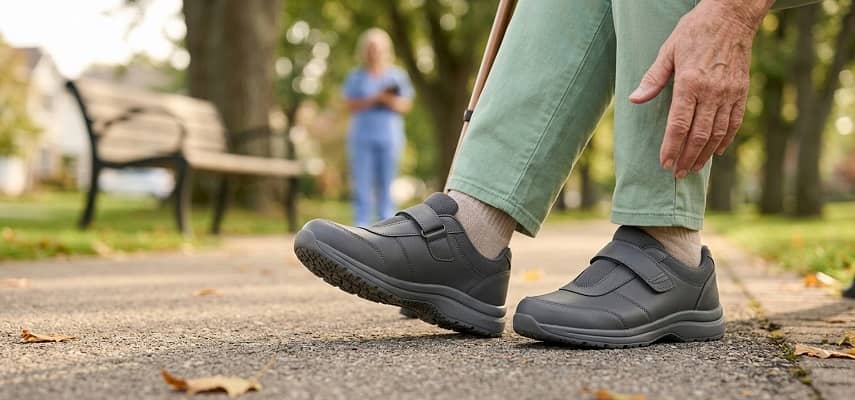
2026 senior footwear guide · stability, traction & fit
The best shoes for elderly people with balance problems are not “fall-proof” shoes. A safer starting point is a properly fitted shoe with a broad, stable base, secure fastening, a firm heel area, good traction, and enough cushioning for comfort without feeling excessively soft or unstable. This guide compares six current options that match different parts of that checklist, with clear limitations for each.
Quick picks
Best overall shortlist
Brooks Addiction Walker 2
Structured walking shoe with a certified slip-resistant outsole and versions for men and women.
Motion-control option
New Balance 928v3
ROLLBAR-supported walking platform with a leather upper, removable footbed and multiple widths.
Easiest hands-free entry
Orthofeet Kita
A women’s step-in option for people who struggle to bend down or manage laces, with important fit caveats.
How we chose these shoes
This is a desk-research comparison, not a hands-on clinical test. We prioritized features supported by current older-adult footwear guidance: secure fastening, a stable base, traction, a supportive heel area, appropriate fit and a construction that does not feel excessively unstable underfoot. We then checked current manufacturer specifications and live Amazon product pages for the exact models linked here.
The category labels are editorial judgments about construction and ease of use. They do not mean these shoes have been proven in head-to-head trials to prevent falls, and a shoe that works well for one person may be wrong for another person’s foot shape, gait, neuropathy, arthritis, brace, orthotic or medical condition.
What makes shoes helpful for older adults with balance problems?
Footwear can influence stability, but it is only one part of fall risk. A 2026 review in the Journal of the American Geriatrics Society reported that wide soles, medium-firm materials, low heels and supportive upper construction can improve stability measures, while treaded rubber outsoles and secure fastening can improve safety and function. A separate study in older adults found that appropriate-fitting footwear was associated with better balance and less fear of falling.
Falls are common — shoes are not the whole answer
The CDC reports that more than one in four adults age 65 and older falls each year. Because causes can include medications, vision, muscle weakness, blood-pressure changes, neurological conditions, inner-ear problems and environmental hazards, a new pair of shoes should not replace a fall-risk assessment when balance is changing or falls are recurring.
Shoes for elderly people with balance problems at a glance
| Shoe | Our category | Useful features | Important limitation |
|---|---|---|---|
| Brooks Addiction Walker 2 | Best overall shortlist | Structured support; certified slip-resistant outsole; lace-up fit | Heavier and stiffer than many modern walking shoes |
| New Balance 928v3 Lace-Up | Motion-control option | ROLLBAR system; leather upper; removable footbed; wide size range | Rubber outsole is not treated here as a certified slip-resistant work outsole |
| New Balance 928v3 Hook & Loop | Easy-fastening motion control | Adjustable straps; removable footbed; rubber outsole | Men’s listing checked; exact Amazon offers vary by size |
| Orthofeet Kita | Hands-free women’s option | Step-in entry; heel-retention design; slip-resistant listing | Soft/stretch construction may not suit someone who needs maximum structure |
| Propét LifeWalker Strap | Adjustable men’s strap shoe | Hook-and-loop straps; removable footbed; herringbone rubber tread | Bulkier, traditional walking-shoe feel |
| Propét Vista Strap | Dual-strap women’s option | Twin straps; leather upper; EVA midsole; herringbone rubber outsole | Older design and less streamlined than athletic alternatives |
Do not shop by cushioning alone. Very soft foam can feel comfortable yet unstable for some people. For balance concerns, prioritize a secure fit and predictable platform first, then choose enough cushioning for comfort.
Six shoes worth comparing in 2026
01 / BEST OVERALL SHORTLIST
Brooks Addiction Walker 2
The Brooks Addiction Walker 2 is the strongest all-round shortlist choice here because it combines a structured walking platform with a certified slip-resistant outsole. Brooks describes it as a maximum-support walking shoe and uses its Extended Progressive Diagonal Rollbar system to guide the stride. Men’s and women’s versions are sold separately.
Brooks Women’s Addiction Walker 2 — view on Amazon · Brooks Men’s Addiction Walker 2 — view on Amazon
Key features
- Structured support with an Extended Progressive Diagonal Rollbar
- Slip-resistant outsole certified to SATRA TM144:2011
- Leather upper and conventional lace-up closure
- Separate men’s and women’s versions with multiple widths
Pros
- One of the clearest traction claims in this comparison
- Secure lacing allows fit adjustment across the instep
- Structured rather than highly flexible underfoot
Cons
- Heavier and stiffer than lightweight mesh walking shoes
- Laces are inconvenient if bending or hand dexterity is limited
- Its 12 mm drop is not the lowest-heel configuration available
Best for: Older adults who want a traditional lace-up walking shoe with structured support and an explicitly slip-resistant outsole.
Who it is not for: Someone who cannot manage laces, needs an ultra-light shoe, or has been advised to use a different heel height or footwear design.
02 / MOTION-CONTROL OPTION
New Balance 928v3 Lace-Up
The New Balance 928v3 is a classic motion-control walking shoe. Its ROLLBAR stability post is designed to limit rear-foot movement, while the leather upper, removable PU footbed and broad width range make it easier to tailor the fit than many fashion sneakers.
New Balance Men’s 928 V3 Lace-Up — view on Amazon
Key features
- ROLLBAR rear-foot stability system
- ABZORB cushioning with a removable PU footbed
- Leather upper and rubber outsole
- Men’s widths listed from narrow through very wide on New Balance
Pros
- More motion-control structure than a neutral walking shoe
- Useful width selection for hard-to-fit feet
- Removable footbed can make room for some orthotics
Cons
- Substantial leather construction can feel heavy
- Amazon link here is the men’s version
- Do not assume the rubber outsole equals a certified slip-resistant work sole
Best for: Men who want a structured walking shoe with strong rear-foot motion control and several width choices.
Who it is not for: Someone prioritizing the lightest possible shoe or someone who specifically needs a certified slip-resistant outsole. New Balance also makes a women’s 928v3; check the exact women’s listing and fit separately.
For more brand-specific traction options, see our New Balance slip-resistant shoes guide.
03 / EASY-FASTENING MOTION CONTROL
New Balance 928v3 Hook and Loop
This version keeps the familiar 928 platform but replaces conventional laces with hook-and-loop straps. That makes it more practical for an older adult who can adjust straps but finds tying laces difficult. The Amazon listing identifies a leather upper, removable PU footbeds and a rubber outsole.
New Balance Men’s 928 V3 Hook and Loop — view on Amazon
Key features
- Adjustable hook-and-loop closure
- Leather upper
- Removable polyurethane footbeds
- Rubber outsole on the checked Amazon listing
Pros
- Easier to fasten than a standard lace-up shoe
- Can be re-adjusted quickly if feet swell during the day
- Secure closure is preferable to a loose backless slipper
Cons
- Straps still require hand strength and reach
- Men’s model in the verified Amazon listing
- Exact strap positioning matters for a secure fit
Best for: Men who want the 928’s structured walking platform without having to tie laces.
Who it is not for: Someone who cannot reach the straps or needs truly hands-free entry. For more easy-closure options, see our Velcro shoes for elderly adults guide.
04 / HANDS-FREE WOMEN’S OPTION
Orthofeet Kita Hands-Free
The women’s Orthofeet Kita is useful when bending down to tie or fasten shoes is the main obstacle. Its hands-free entry is designed so the wearer can step in after the laces are initially set, and the checked Amazon listing describes the shoe as slip-resistant. The trade-off is that its stretchable upper is less structured than a traditional leather walking shoe.
Orthofeet Kita Women’s Hands-Free Sneaker — view on Amazon
Key features
- Hands-free step-in entry
- Stretchable, water-repellent upper
- Slip-resistant labeling on the checked listing
- Designed to retain the heel after stepping in
Pros
- No repeated bending or knot tying once adjusted
- Useful for limited hand dexterity
- More heel retention than a backless slip-on
Cons
- Women’s model only in this recommendation
- Stretch upper may provide less sidewall structure than leather
- Hands-free entry does not guarantee the correct fit
Try the heel hold. A hands-free shoe is only useful for balance if the heel stays secure while walking. If the foot lifts, slides or rotates inside the shoe, try another size/width or a more adjustable closure.
Best for: Women whose main challenge is bending down or tying laces, provided the shoe fits securely around the heel and midfoot.
Who it is not for: Someone who needs a very firm upper, a brace-specific shoe, or a clinician-prescribed footwear design.
05 / ADJUSTABLE MEN’S STRAP SHOE
Propét LifeWalker Strap
The men’s Propét LifeWalker Strap uses adjustable hook-and-loop straps instead of laces and pairs them with a removable footbed and herringbone-pattern rubber outsole. It is a practical option for someone who values easy adjustment and a traditional, roomy walking-shoe format.
Propét Men’s LifeWalker Strap — view on Amazon
Key features
- Two adjustable straps for fit control
- Leather construction with padded interior
- Removable footbed
- Herringbone rubber tread on the checked Amazon listing
Pros
- Easy to loosen or tighten through the day
- Removable footbed adds fitting flexibility
- Available in extended widths on many Propét models
Cons
- Traditional shape is bulkier than a knit sneaker
- Men’s model in this recommendation
- Not a substitute for prescribed therapeutic footwear
Best for: Men who want secure straps, a removable footbed and a roomy traditional walking-shoe design.
Who it is not for: Someone seeking a lightweight athletic feel or a shoe independently certified for a specific workplace slip-resistance standard.
06 / DUAL-STRAP WOMEN’S OPTION
Propét Vista Strap
The women’s Propét Vista Strap is a straightforward dual-strap leather walking shoe. Its Amazon listing describes a full-grain leather upper, twin-strap closure, cushioned EVA midsole and herringbone-tread rubber outsole. It is less modern-looking than a knit sneaker, but the two straps allow deliberate adjustment across the foot.
Propét Women’s Vista Strap — view on Amazon
Key features
- Twin hook-and-loop strap closure
- Full-grain leather upper
- Cushioned EVA midsole
- Herringbone-tread rubber outsole
Pros
- Two straps allow more adjustment than a one-piece slip-on
- Leather upper offers more structure than very soft knit
- Simple design is easy to understand and fasten
Cons
- Older, more utilitarian design
- May feel warm compared with mesh
- Traction still needs to be checked on the surfaces you use most
Best for: Women who prefer a traditional leather walking shoe with adjustable twin straps.
Who it is not for: Someone wanting hands-free entry or a lightweight athletic-style upper.
What should you look for in shoes for an elderly person with balance problems?
1. Secure fastening that the wearer can actually use
A shoe can have excellent materials and still be unsafe if the foot slides inside it. Laces provide fine adjustment, while hook-and-loop straps may be easier for arthritis or limited dexterity. Hands-free shoes can help when bending is difficult, but only if the heel remains secure. Avoid assuming that “slip-on” automatically means safer.
2. A broad, stable base
A broader sole can provide a more stable platform than a narrow heel or fashion-oriented sole. The 2026 geriatric footwear review specifically identifies wide soles as useful for balance and fall-risk considerations. The shoe should still fit the actual foot width; buying an oversized shoe just to get a wider base can create sliding and trip risk.
3. Good traction without an aggressive, grabby edge
Look for a textured rubber outsole and replace shoes when the tread is worn smooth. “Slip-resistant” claims are most meaningful when the brand states a testing standard, as Brooks does for the Addiction Walker 2. At the same time, no outsole grips every wet, oily, icy or loose surface, so environmental fall prevention still matters.
If traction is your main concern, compare our New Balance slip-resistant shoes and slip-resistant work shoes guides.
4. Firm heel support and a comfortable upper
The heel should feel held rather than floating or lifting with every step. A firm heel counter and supportive upper can reduce unwanted movement, while the toe box should allow the toes to sit comfortably without compression. If swelling changes during the day, adjustable closures can be useful.
5. Moderate cushioning, not maximum softness at any cost
Comfort matters because painful shoes are unlikely to be worn, but more foam is not automatically better for balance. Some older adults prefer a firmer, more predictable platform that makes foot placement easier to sense. A shoe should feel comfortable and stable during real walking, turning and standing — not just soft when first stepped into.
6. The right width, length and volume
Feet can change with age, edema and medical conditions, so do not rely on an old shoe size. Measure both feet and fit the larger one, while checking heel hold and toe room. A 2021 older-adult study found better balance outcomes in the appropriate-fitting footwear group than in the ill-fitting footwear group, supporting the practical importance of fit.
If plantar-fascia pain is also a concern, our shoes for plantar fasciitis guide covers that separate use case.
Be careful with backless slippers, loose sandals and worn-out shoes. The 2026 geriatric footwear review advises against slippers and excessively elevated heels for older adults at risk of falls. If indoor footwear is needed, choose a secure heel and traction rather than a loose backless style.
How to check whether a shoe fits safely
- Measure both feet. Fit for the larger foot and use the manufacturer’s size/width guide rather than assuming the old size is still correct.
- Check heel hold. The heel should stay seated without repeated lifting or side-to-side sliding.
- Check toe room. Toes should not be squeezed, curled or rubbing the front, but the shoe should not be so long that it catches the floor.
- Walk and turn on a safe surface. If appropriate for the person, take several steps, stop, turn and stand still. Notice wobbling, pressure points, toe catching or heel slippage.
- Try the usual socks, brace or orthotic. A shoe that fits without an orthotic may become too tight once the actual daily setup is added.
- Recheck after some time on the feet. Swelling can change fit later in the day. Stop using shoes that cause new pain, numbness, skin injury or obvious instability.
One useful test is simple: if the wearer has to grip with the toes, shuffle to keep the shoe on, or feels the heel moving inside the shoe, the fit or closure needs attention.
What else can reduce fall risk besides changing shoes?
Footwear is only one part of fall prevention. The CDC’s STEADI program encourages screening, assessment and intervention for older adults at risk. Depending on the person, a clinician may review medications, vision, blood pressure, strength, gait, home hazards and whether a mobility aid is appropriate.
If walking support is already being considered, our best walkers for seniors guide explains common walker types and selection points. A cane or walker should be fitted and used correctly rather than added casually.
When should balance problems be checked by a healthcare professional?
Do not treat new or worsening imbalance as a shoe problem
Arrange medical assessment for new, worsening or unexplained balance problems, repeated falls, fainting, dizziness, new weakness or numbness, or a sudden change in walking. Seek emergency care for sudden neurological symptoms such as facial droop, one-sided weakness, trouble speaking, severe sudden headache, or loss of consciousness.
People with diabetes, loss of foot sensation, open sores, significant swelling or known circulation problems should also get individualized footwear guidance rather than relying only on an online roundup.
Frequently asked questions
What type of shoe is best for an elderly person with poor balance?
Start with a shoe that fits correctly, stays securely on the foot, has a broad stable sole, a supportive heel area and good traction. Current geriatric footwear guidance also favors moderate firmness and lower heels for balance concerns. The best exact model still depends on foot shape, gait, dexterity, swelling, braces and medical conditions.
Are slip-on shoes safe for seniors with balance problems?
They can be, but only if the heel stays secure and the foot does not slide inside the shoe. Backless slippers and loose loafers are a poor choice for someone who shuffles or has recurrent falls. A hands-free shoe with real heel retention is different from a loose slip-on, but it still needs to be tested for fit.
Are Velcro or hook-and-loop shoes better than laces for older adults?
Neither closure is automatically better. Laces offer fine adjustment, while hook-and-loop straps can be much easier for arthritis, limited hand dexterity or difficulty bending. The better option is the one the wearer can fasten snugly and consistently so the heel and midfoot stay secure during walking.
Should shoes for balance problems have a lot of cushioning?
They should be comfortable, but maximum softness is not necessarily ideal. Evidence-based footwear guidance for older adults emphasizes a stable platform and moderately firm materials as well as comfort. If a thick, soft midsole makes standing or turning feel wobbly, a firmer shoe may be the better choice.
Do slip-resistant shoes prevent falls?
No shoe can guarantee fall prevention. Slip-resistant tread can reduce one hazard — loss of grip — but falls can also result from medications, poor vision, weakness, dizziness, neurological conditions, obstacles and many other factors. Treat traction as one part of a broader fall-prevention plan.
How often should an older adult replace walking shoes?
Replace shoes when the outsole is worn smooth or uneven, the heel counter no longer holds its shape, the midsole feels compressed, closures stop securing the foot, or the shoe develops a new lean or wobble. There is no single replacement interval because wear depends on walking volume, body weight, surfaces and construction.
Sources and editorial scope
This guide was updated September 7, 2026. It is based on current public-health and peer-reviewed footwear evidence plus manufacturer and Amazon product pages. It does not claim hands-on testing, medical review, guaranteed fall prevention, or live Amazon inventory across every size and color.
- CDC — Facts About Falls (updated January 27, 2026)
- CDC STEADI — Older Adult Fall Prevention
- Cheever et al. — Evidence-Based Footwear Recommendations for Older Adults, J Am Geriatr Soc (2026)
- Maden et al. — Appropriate fitting footwear, balance and fear of falling, Geriatric Nursing (2021)
- Brooks Addiction Walker 2 specifications
- New Balance 928v3 specifications
- Orthofeet — senior footwear overview
- Propét — stability-shoe design context
This article is for general information only and is not medical advice. Talk to a qualified healthcare professional about persistent balance problems, falls, foot wounds, neuropathy, or the safest footwear for your specific situation.