Best Compression Socks for Men (2026): 7 Top Picks
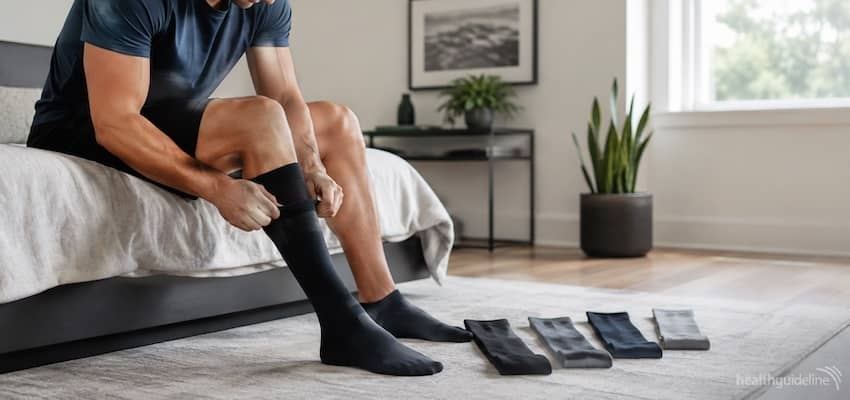
For most men, a 15–20 mmHg graduated sock is the right starting point for everyday wear, travel and long hours on your feet. Step up to firm 20–30 mmHg for workouts, recovery or a clinician’s advice. Our best all-round pick is SB SOX (20-30 mmHg) for its balance of firm support, comfort and value.
Medical note: This article is general information, not medical advice. Compression socks help many people, but they are not right for everyone. If you have a circulation problem, diabetes, significant or sudden swelling, or your doctor has recommended a specific compression level, talk to a qualified healthcare professional before choosing a pair.
JUMP TO A SECTION
Compression socks for men at a glance
All seven picks below are real products currently sold on Amazon. We’ve grouped them by who each pair suits best, because the “best” compression sock depends entirely on why you’re wearing it. Prices are approximate and move often, so always check the live listing before you buy.
| Sock | Best for | Compression | |
|---|---|---|---|
| SB SOX | Best overall / all-rounder | 20-30 mmHg (also 15-20) | Firm support, cushioned sole, affordable |
| CHARMKING | Best budget multipack | 15-20 mmHg | 3–8 pairs per pack, everyday level |
| Amazon Essentials | Best for first-timers | Mild graduated | Light, cotton-blend, easy to find |
| Sockwell Circulator | Best for comfort & odor | 15-20 mmHg | Merino blend, made in USA |
| Physix Gear Sport | Best for the gym & recovery | 20-30 mmHg | Durable, holds compression after washing |
| CEP Core Run 5.0 Tall | Best for serious runners | 20-30 mmHg | Targeted shin/Achilles support, blister-resistant |
| JOBST forMen | Best medical brand | 15-20 mmHg (also firmer) | Clinical heritage, discreet dress-sock look |
How we chose
We started with what the medical literature and clinicians actually say compression socks do well, then shortlisted established, widely available brands on Amazon that match real use cases: everyday wear, travel, long shifts on your feet, athletic recovery and clinician-recommended use. We prioritised graduated compression (tightest at the ankle), a clearly stated mmHg level, a sensible size range and durable construction. We did not test every pair in a lab, and we don’t quote specific star ratings or review counts here because those numbers change daily. Where support is genuinely mixed or overhyped — such as marketing claims around running performance — we say so.
The 7 best compression socks for men
01 / BEST OVERALL / ALL-ROUNDER
SB SOX Compression Socks (20-30 mmHg)
SB SOX has been a go-to knee-high on Amazon since 2016, and it earns the top spot for hitting the hardest balance to strike: firm, genuinely supportive 20–30 mmHg pressure at a price that doesn’t sting. The nylon-spandex knit has a cushioned, reinforced heel and toe, comes in a wide size range (including wide-calf fits) and is available in both firm 20–30 mmHg and a gentler 15–20 mmHg option. It’s the pair we’d point most men to first for travel, long shifts or all-day desk work.
Pros
- Firm, effective graduated support
- Comfortable cushioned sole
- Regular and wide-calf sizing
- Affordable for a 20-30 mmHg sock
- Choice of 15-20 or 20-30 mmHg
Cons
- 20-30 mmHg can feel strong for first-timers
- Plain, athletic look
- Popular sizes sell out
Who it’s for: travellers, nurses, retail and warehouse workers, anyone who wants real 20-30 mmHg support without premium pricing.
Who it’s not for: men who only want the lightest everyday squeeze — choose the 15-20 mmHg version or Amazon Essentials.
02 / BEST BUDGET MULTIPACK
CHARMKING Compression Socks (15-20 mmHg)
If you want a fresh pair in every drawer without overspending, CHARMKING’s multipacks are the value benchmark. The 15–20 mmHg pressure is the sweet spot for everyday circulation support, travel and light swelling, and the colourful packs make them easy to actually reach for. They’re thinner and less structured than premium socks, but for the price per pair they’re hard to beat.
Pros
- Very low cost per pair
- Multipacks (3, 4 or 8 pairs)
- Everyday 15-20 mmHg level
- Wide range of colours
Cons
- Thinner knit, less long-term durability
- Minimal cushioning
- General/unisex sizing, so fit varies
Who it’s for: budget-minded buyers, first-timers, anyone stocking up or packing for travel.
Who it’s not for: men with very large calves or those who need firm, medical-level support or a cushioned athletic feel.
03 / BEST FOR FIRST-TIMERS
Amazon Essentials Men’s Knee High Graduated Compression Socks
New to compression and not sure you’ll like the feeling? Start light and cheap. Amazon Essentials’ knee-high graduated socks use a cotton-blend with moisture management and mesh venting, plus arch support, in a simple 3-pack. The mild pressure is gentle enough for a first try while still nudging circulation on long travel days or at a desk — a low-risk way to find out whether compression suits you before spending more.
Pros
- Inexpensive and easy to find
- Gentle enough for anyone new to compression
- Cotton-blend feel with mesh venting
- Three pairs per pack
Cons
- Light support only
- Not for real swelling or medical needs
- Thinner durability than premium knits
Who it’s for: office workers, casual travellers and anyone curious about compression without a big commitment.
Who it’s not for: managing diagnosed vein disease, noticeable swelling or athletic recovery — you’ll want firmer graduated compression.
Amazon Essentials Men’s Knee High Graduated Compression Socks — view on Amazon
04 / BEST FOR COMFORT & ODOR CONTROL
Sockwell Men’s Circulator (15-20 mmHg)
When comfort and all-day wearability matter as much as the compression, the Sockwell Circulator is the pick. Made in the USA from a merino wool–bamboo rayon blend, it manages moisture, regulates temperature and resists odour far better than a plain synthetic knit, so it holds up to long days. An ultra-light cushion sole, arch support and seamless toe make it easy to wear from morning to night, and the 15–20 mmHg pressure suits daily wear, travel and minor varicose-vein symptoms.
Pros
- Soft merino blend, breathable and warm
- Excellent temperature and odour control
- Ultra-light cushion sole and arch support
- Stylish colours and patterns; made in USA
Cons
- Premium price, sold as single pairs
- This model is 15-20 mmHg only
- Wool needs gentler care
Who it’s for: men who prioritise comfort, have warm or sweaty feet, want a dress-casual look or have sensitive skin.
Who it’s not for: bargain hunters, or anyone needing firm 20-30 mmHg support (see Sockwell’s firm line or SB SOX).
05 / BEST FOR THE GYM & RECOVERY
Physix Gear Sport Compression Socks (20-30 mmHg)
Physix Gear’s Stamina sock is a long-time athletic favourite for firm 20–30 mmHg support aimed at circulation and muscle recovery. The Lycra knit is durable and holds its compression through repeated washes, with a snug arch-to-calf fit that many lifters and runners like for taking the edge off that heavy-leg feeling after training. It’s a straightforward, affordable performance sock rather than a fashion piece.
Pros
- Firm 20-30 mmHg support
- Durable Lycra that holds compression after washing
- Budget-friendly for the level
- Snug athletic fit
Cons
- Several similar listings can be confusing — check you’re on the right one
- Can run snug and warm
- Plain sporty styling
Who it’s for: gym-goers, budget-conscious runners and anyone wanting firm recovery support.
Who it’s not for: men who want a light everyday squeeze or a dress-sock look.
Physix Gear Sport Compression Socks (20-30 mmHg) — view on Amazon
06 / BEST FOR SERIOUS RUNNERS
CEP Core Run 5.0 Tall (20-30 mmHg)
CEP is the performance arm of medi, a German medical-compression maker with decades of clinical experience, and it shows. The Core Run 5.0 delivers precise 20–30 mmHg graduated pressure with targeted Achilles, shin and arch support, a quick-drying breathable fabric and a genuinely blister-resistant anatomical fit. If you’re logging real miles or fighting shin splints, this is the specialist pick — you pay a premium, but the engineering is a clear step above generic athletic socks.
Pros
- Precise, medical-grade compression
- Targeted shin, Achilles and arch support
- Breathable, quick-dry, blister-resistant fit
- Trusted performance brand
Cons
- Expensive
- Sized by calf circumference — measure carefully
- Tall, athletic look only; single pairs
Who it’s for: dedicated runners, shin-splint sufferers and endurance athletes.
Who it’s not for: casual everyday users or budget buyers.
07 / BEST CLINICALLY ESTABLISHED BRAND
JOBST forMen Knee High (15-20 mmHg)
JOBST practically invented modern graduated compression — founder Conrad Jobst developed the first gradient stockings to manage his own venous condition — and the brand is still a clinical standard. The forMen line looks like a normal ribbed trouser sock, with a non-binding comfort band, smooth toe seam and moisture-wicking microfibre, and it’s offered in 15–20 mmHg and firmer levels. If a doctor recommended compression, or you simply want a trusted medical brand in a discreet men’s design, start here.
Pros
- Clinically trusted brand with real heritage
- Discreet dress-sock look
- Comfortable, non-binding top band
- Wide range of levels (15-20, 20-30, 30-40 mmHg)
Cons
- Premium per-pair price; sold singly
- Some wearers find the top can slip over a long day
- Medical rather than athletic styling
Who it’s for: men advised by a clinician to wear compression, dress-code wearers and those managing mild vein symptoms.
Who it’s not for: bargain multipack shoppers or athletes wanting cushioned performance socks.
How do compression socks work?
Compression socks are close-fitting socks that gently squeeze your legs to help blood flow. The Cleveland Clinic describes them as being designed to squeeze your legs and stop blood from pooling in the lower limbs. Most are graduated, meaning the pressure is strongest at the ankle and eases as it moves up the calf, which helps push blood back up toward the heart against gravity. The Cleveland Clinic notes there are two broad types: everyday graduated compression socks, and anti-embolism socks, which are aimed at people who are largely immobile, such as after surgery.
Do compression socks actually work? The honest evidence
They help most for what they were designed to do, and less for some of the things they’re marketed for. Here’s the balanced picture:
Swelling, tired legs and vein conditions — strong support. Reducing leg swelling and easing tired, achy legs is one of the best-supported uses, and graduated compression is a standard part of managing chronic venous insufficiency and varicose veins.
Long flights and blood clots — nuanced. There’s a widespread belief that compression socks prevent clots on long flights. As Harvard Health’s Dr. Robert Shmerling explains, that claim isn’t backed by compelling evidence except for people who are already at high risk of clots. Harvard also points out there isn’t broad medical consensus that the average person needs to wear compression at all.
Athletic performance — mixed; recovery — modest. An analysis of nearly a thousand studies summarised by WebMD found only some studies showed a performance benefit, while most pointed to faster recovery right after exercise. Plenty of runners simply like how the support feels.
In other words, if you want relief from swelling and heavy legs, compression socks are a sensible, low-cost option. If you’re buying them purely to run faster, keep your expectations realistic.
What compression level (mmHg) do you need?
Compression is measured in millimetres of mercury (mmHg) — the same unit used for blood pressure — and it’s written as a range, such as 15–20 mmHg. Higher numbers mean firmer squeeze. Here’s how the common levels are generally used:
| Level | Feel | Commonly used for | Availability |
|---|---|---|---|
| 8-15 mmHg | Light | Mild tired, achy legs; a gentle first try; light everyday wear | Over the counter |
| 15-20 mmHg | Moderate | Everyday wear, travel, standing or sitting all day, mild swelling, minor varicose veins, pregnancy | Over the counter |
| 20-30 mmHg | Firm | The most commonly recommended therapeutic level — moderate swelling, varicose veins, athletic recovery, post-procedure support | OTC, but often clinician-guided |
| 30-40 mmHg+ | Extra firm | More significant venous conditions, lymphoedema and similar — under medical direction | Usually fitted or prescribed |
A simple rule of thumb: start at 15–20 mmHg for general everyday use, and only go to 20–30 mmHg or higher for a specific reason or on professional advice. Whatever the level, it should feel like a firm, supportive hug — snug and noticeable, never a painful pinch.
How to choose: fit, length and material
Get the size right. Graduated socks only deliver their stated pressure if they fit. Many brands size by shoe size and calf circumference — measure your calf at its widest, ideally in the morning before any swelling, and size up if you’re between sizes.
Pick a length. Knee-high is the standard for calves and general circulation. Ankle or crew lengths focus on the foot and arch. Thigh-high and firmer medical lengths are usually clinician-directed.
Material matters for comfort. Nylon-spandex knits are durable and affordable; merino blends (like Sockwell) breathe better and control odour for long days; cotton blends feel soft but can hold moisture.
Open vs closed toe. Closed toe is most common and warmer; open toe suits larger feet, warm climates or wearing with sandals.
Budget. Expect roughly $10–$100 per pair. Multipacks are cheapest per pair; premium performance and merino socks cost more but often last longer.
Who should be cautious with compression socks?
Used correctly, compression socks are safe for most people — but not everyone. The Cleveland Clinic advises caution or medical supervision if you have peripheral artery disease (PAD), and warns against wearing them for severe or sudden, unexplained swelling, including swelling linked to conditions like heart failure or kidney disease. Healthline adds that fragile or easily irritated skin needs extra care, and that ill-fitting or overly tight socks can chafe the skin or restrict circulation rather than help it. If you have diabetes, reduced sensation in your feet, an active skin infection, or a suspected blood clot (sudden, painful swelling in one leg), see a healthcare professional before using compression, and choose your level with their guidance.
How to wear and care for them
Put compression socks on in the morning, before your feet and ankles start to swell, and take them off before bed. If you’re new to them, wear them for a shorter stretch at first and build up, and take them off if they become uncomfortable. As for sleeping in them, the Cleveland Clinic notes there’s generally no benefit, because the effect relies on gravity while you’re upright — and wearing them around the clock can be hard on your skin, so nighttime is a good moment to take them off and let your legs breathe. Most pairs are machine washable; wash them regularly to keep the fibres springy, and follow the label so they hold their compression.
Frequently asked questions
What compression level (mmHg) do men need?
For everyday wear, travel and long hours standing, 15–20 mmHg suits most men and is sold over the counter. Step up to firm 20–30 mmHg for athletic recovery, more noticeable swelling or varicose-vein symptoms. Levels of 30–40 mmHg and above are medical-grade and should be fitted or prescribed by a professional.
Should you wear compression socks all day?
Most healthy people can wear graduated compression socks for several hours or a full active day, according to the Cleveland Clinic. Put them on in the morning before swelling starts and take them off before bed. Start with shorter sessions, and remove them sooner if they pinch, dig in or feel uncomfortable.
Can you sleep in compression socks?
There’s usually no benefit to sleeping in them. The Cleveland Clinic explains that compression works with gravity while you’re upright and moving, so lying down removes most of the effect. Wearing them around the clock can also irritate skin, so nighttime is a good time to take them off and let your legs breathe.
Do compression socks really reduce swelling and tired legs?
Yes — easing leg swelling and tired, achy legs is one of their best-supported uses. Graduated compression helps push blood and fluid back up toward the heart, which limits pooling in the lower legs. If the sizing is right, swelling in your feet and ankles should be noticeably better by the end of the day.
Are compression socks good for running and workouts?
They may help you recover a little faster and can make legs feel less fatigued, but the performance evidence is mixed. A large research review found compression mainly supported quicker post-exercise recovery, with only some studies showing performance gains. Many runners simply like how the targeted support feels during and after training.
Can compression socks be harmful, and who shouldn’t wear them?
Used correctly they’re safe for most people, but they aren’t for everyone. The Cleveland Clinic advises caution with peripheral artery disease and with severe or unexplained swelling, including from heart or kidney disease. Ill-fitting or overly tight socks can irritate skin or restrict circulation. If you’re unsure, check with your doctor first.
How tight should compression socks be?
They should feel like a firm, supportive hug — snug and noticeable, but never painful. Correctly sized socks stay smooth without digging in, rolling down or leaving deep marks. If your toes tingle or the band bites, they’re too tight or the wrong size, so measure your calf and shoe size before buying.
How much do compression socks cost?
Expect roughly $10 to $100 per pair. Budget multipacks from brands like CHARMKING sit at the low end, mainstream 20–30 mmHg options land in the middle, and premium merino or performance-running socks such as Sockwell and CEP cost more. Prices change often, so check the current listing before you buy.
The bottom line
For most men, the right first pair is a well-fitting 15–20 mmHg graduated sock — and if you just want one dependable, affordable all-rounder, SB SOX is the easy recommendation. Buying on a budget? Grab a CHARMKING multipack. Want the most comfortable long-day sock? Sockwell. Training seriously? CEP or Physix Gear. And if a clinician has recommended compression, JOBST is the trusted medical name. Whichever you choose, match the mmHg level to your reason for wearing them, get the fit right, and check with a healthcare professional if you have any circulation or vein concerns. You may also want to read our guides on plantar fasciitis relief and varicose vein treatment.
This article is for general information only and is not medical advice. Talk to a qualified healthcare professional about your specific situation.