Best Kegel Exercise Devices for 2026: Tested Picks for a Stronger Pelvic Floor
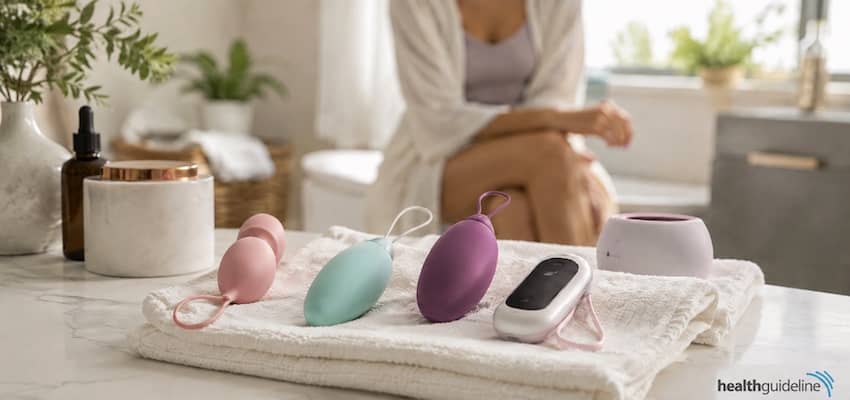
A Kegel exercise device helps you strengthen the pelvic floor muscles that support your bladder, bowel, and (in women) the uterus. For most people the best all-round pick is the Perifit Care+, a smart biofeedback trainer whose app confirms you are contracting correctly. If you prefer a simple, non-electronic option, the doctor-designed Intimate Rose Kegel Exercise Weights are the best value for beginners.
Key takeaways
Best overall
Perifit Care+
Gamified app + dual-sensor biofeedback keeps you consistent and confirms good technique.
Best for beginners / best value
Intimate Rose Weights
FDA-cleared, doctor-designed, no app or charging.
Best “effortless” option
K-fit Kegel Toner
Electrical stimulation does the contractions for you if you can’t isolate the muscles.
Best for men
EMS device aimed at male incontinence and post-prostate-surgery recovery.
Reality check: devices help you train, but the exercise does the work. Kegels are less effective for severe leakage, and anyone with prolapse, pelvic pain, pregnancy, or an implanted electronic device should talk to a clinician first.
How we chose
We focused on real products currently sold on Amazon (US) that are made from body-safe, medical-grade materials — or are FDA-registered/cleared where they make a medical claim — and that answer genuinely different needs: beginner versus advanced, app versus no-app, women versus men, and active training versus effortless stimulation. Selections favor devices designed with pelvic-health professionals or with a credible track record. We accepted no payment and the links below carry no affiliate tag. Because prices and stock change constantly, we list approximate price bands and link straight to each live Amazon listing so you can confirm the current price before buying.
What is a Kegel exercise device?
A Kegel exercise device (also called a pelvic floor trainer) is a tool that helps you find, exercise, and strengthen your pelvic floor muscles. According to the Cleveland Clinic, these muscles support the bladder, bowel, and vagina, and strengthening them can improve bladder and bowel control and support sexual function. The Mayo Clinic notes that the exercises can help with stress incontinence (leaking when you cough, sneeze, or laugh) and urge incontinence, and are commonly recommended during pregnancy and after childbirth.
Devices fall into a few families:
- Biofeedback trainers — a sensor you insert connects to a phone app and shows your contractions in real time (often as a game), so you know you’re squeezing correctly.
- Weighted trainers (“Kegel weights”/vaginal cones) — you hold progressively heavier weights in place with your muscles; the Mayo Clinic lists weighted vaginal cones and biofeedback among the tools that may help.
- Electrical stimulation (EMS/e-stim) — the device gently contracts the muscles for you, useful if you struggle to perform a voluntary Kegel.
- External devices — worn on the skin (no insertion) and often FDA-cleared for treating specific types of incontinence.
Why use a device at all? Because doing Kegels correctly is harder than it sounds. The Mayo Clinic reports that around 40% of people don’t contract the right muscles on their first attempt — squeezing the abdomen, thighs, or buttocks instead. A device that gives feedback (or does the contraction for you) helps close that gap.
Comparison: best Kegel exercise devices at a glance
| Device | Best for | Type | Standout feature | Approx. price |
|---|---|---|---|---|
| Perifit Care+ | Most people / motivation | Smart biofeedback (app) | Gamified app + dual-sensor feedback | ~$150–180 |
| Elvie Trainer | A compact premium trainer | Smart biofeedback (app) | Very small; detects incorrect squeezes | ~$199 |
| Intimate Rose Weights | Beginners / value | Weighted set (no tech) | 6 progressive FDA-cleared weights | ~$35–45 |
| K-fit Kegel Toner | Can’t isolate the muscles | Electrical stimulation | Does the Kegels for you; 8 programs | Check price |
| TensCare KegelFit Men | Men / post-prostate surgery | Electrical stimulation (EMS) | Built for the male pelvic floor | Check price |
The best Kegel exercise devices, reviewed
01 / BEST OVERALL
Perifit Care+
The Perifit Care+ is a Bluetooth pelvic floor trainer that pairs with a smartphone app and turns Kegels into simple video games: when you contract, an on-screen bird rises; when you relax, it drops. It uses dual pressure sensors to gauge the quality of each contraction, and its programs were developed with pelvic floor physical therapists. Perifit describes the Care and Care+ as devices intended to help with stress, mild-to-moderate urge, and mixed urinary incontinence in women by strengthening the pelvic floor.
What makes it our top pick is consistency. The biggest reason home Kegel routines fail is that people quietly stop doing them — or aren’t sure they’re doing them right. Real-time feedback solves both, which is why we recommend it for beginners and for anyone rebuilding strength postpartum (after a clinician’s clearance).
Pros
- App confirms you’re contracting the correct muscles
- Gamified sessions keep you consistent
- Designed with pelvic-floor PTs; strong user reviews
- Manufacturer offers a long home trial window
Cons
- Needs a smartphone and Bluetooth
- Requires insertion (not for everyone)
- Pricier than a weighted set
- Only works if you actually use it regularly
Who it isn’t for: anyone who wants a no-app, no-tech option, or who can’t or would rather not insert a device.
02 / BEST PREMIUM SMART TRAINER
Elvie Trainer
The Elvie Trainer is a small, egg-shaped biofeedback exerciser that Elvie bills as the world’s smallest Kegel trainer. It ships with an optional cover for custom sizing and a pocket-sized case that doubles as a wireless charger. Through its app, it guides five-minute workouts, visualizes your contractions in real time, and — usefully — flags when you’re bearing down instead of lifting, a common mistake. It’s made from medical-grade silicone and is waterproof.
If the Perifit is the value-for-feedback champion, the Elvie is the polish champion: smaller, quieter, and more discreet, with a refined app. Independent reviewers note it can deliver results within about four weeks with consistent use, while flagging occasional app or Bluetooth connectivity hiccups.
Pros
- Compact and comfortable to wear
- Detects incorrect (bearing-down) contractions
- Portable wireless-charging case
- Award-winning design; widely reviewed
Cons
- Premium price (around $199)
- Occasional app/connectivity complaints
- Requires a smartphone and insertion
- Consistency still required for results
Who it isn’t for: budget shoppers, and — per Elvie’s own guidance — anyone with a pelvic health condition such as prolapse or pelvic pain who hasn’t first consulted a health professional.
03 / BEST FOR BEGINNERS / VALUE
Intimate Rose Kegel Exercise Weights
The Intimate Rose Kegel Exercise Weights are a set of six progressive silicone weights (roughly 25–125 grams) that you insert and hold in place for about 15 minutes a day, moving to a heavier weight as you get stronger. Intimate Rose says the weights are FDA-cleared to strengthen pelvic floor muscles, were designed with pelvic-health doctors, and are used in Academy of Pelvic Health training courses. There’s no app, no charging, and no electronics.
This is the pick we’d hand a beginner who wants a proven, low-fuss system — or anyone who dislikes apps. The progressive set matters: a single weight doesn’t leave room to advance. Holding the weight against gravity also gives you a form of tactile feedback that you’re engaging the right muscles.
Pros
- Simple — no app, battery, or charging
- Six progressive weights for lasting progress
- FDA-cleared; doctor-designed; body-safe silicone
- Much cheaper than smart trainers
Cons
- No digital biofeedback or on-screen guidance
- Requires insertion
- Less help if you struggle to contract at all
- Progress depends on daily consistency
Who it isn’t for: people who specifically want app-guided feedback or automatic stimulation.
04 / BEST “EFFORTLESS” OPTION
K-fit Kegel Toner
The K-fit Kegel Toner takes a different approach: it’s a battery-operated electrical-stimulation device with an insertable probe that contracts your pelvic floor muscles for you. It offers eight programs aimed at different symptoms and is FDA-registered for the treatment of incontinence in women. Because it does the work, it’s the option we’d point to for people who can’t reliably isolate or contract the pelvic floor on their own — a genuinely common problem.
The trade-off is the sensation (mild pulsing that takes getting used to) and some firm safety rules: the manufacturer says not to use it during pregnancy, and not at all if you have an implanted electronic device such as a pacemaker or insulin pump. Always read the included guidance and, ideally, check with a clinician first.
Pros
- Contracts the muscles for you — no technique needed
- Multiple programs for stress, urge, and mixed symptoms
- FDA-registered for treating incontinence in women
- Helpful when voluntary Kegels haven’t worked
Cons
- E-stim sensation isn’t for everyone
- Not for use in pregnancy or with a pacemaker/implanted device
- Requires inserting a probe
- Some people prefer to actively train the muscle
Who it isn’t for: anyone who is pregnant or has an implanted electronic/cardiac device, and those who’d rather do the exercises themselves.
05 / BEST FOR MEN
TensCare KegelFit Men
Pelvic floor training isn’t only for women. The TensCare KegelFit Men is a rechargeable, drug-free EMS device designed specifically for the male pelvic floor, marketed for incontinence — including after prostate surgery — and to support erectile function. The Mayo Clinic notes that pelvic floor muscles in men support the bladder, prostate, and rectum, and can weaken with age, diabetes, an overactive bladder, or a radical prostatectomy, which is exactly the audience this device targets.
It’s one of relatively few branded, purpose-built male options, from an established maker of stimulation devices. As with any e-stim device, it uses a probe and carries the usual contraindications (for example, an implanted cardiac device), and after prostate surgery you should follow your surgeon’s guidance on when it’s safe to begin.
Pros
- Purpose-built for the male pelvic floor
- Targets post-surgery incontinence and ED support
- Rechargeable and drug-free
- From an established stimulation-device brand
Cons
- Uses an anal probe, which some find off-putting
- Contraindicated with a pacemaker/implanted device
- Best used with clinician guidance, especially post-surgery
- E-stim sensation takes adjustment
Who it isn’t for: men who prefer voluntary Kegels (which the Mayo Clinic confirms are effective on their own), and anyone with a contraindication to electrical stimulation.
How to choose the right Kegel device for you
Start with your goal and your comfort level.
- If you’re new or unsure you’re doing Kegels correctly: choose a biofeedback trainer (Perifit Care+ or Elvie Trainer). Seeing the contraction removes the guesswork.
- If you want something simple, affordable, and screen-free: choose a progressive weighted set (Intimate Rose).
- If you can’t seem to contract the muscles at all: consider electrical stimulation (K-fit), which does the contraction for you.
- If you’re a man, especially recovering after prostate surgery: a male-specific device (TensCare KegelFit Men) — with your clinician’s input.
- If insertion isn’t an option for you (discomfort, certain conditions, or preference): look into an external device worn on the skin. Elitone, for example, is an external, no-insertion system that is FDA-cleared to treat stress urinary incontinence in women; it’s mainly sold through the manufacturer rather than as a standard Amazon listing, so buy directly from a verified source and check suitability first.
Also weigh: body-safe materials (medical-grade silicone), whether you want app tracking or none, battery/charging needs, discretion and size, and — importantly — any medical condition that calls for professional guidance.
How to use a Kegel device correctly
Whatever device you use, the underlying exercise is the same. The Mayo Clinic’s basic technique for finding and training the muscles is straightforward:
- Find the muscles: imagine stopping the flow of urine or holding back gas — those are your pelvic floor muscles. (Don’t make a habit of stopping urine midstream; it’s only a one-off way to locate the muscles.)
- Contract and release: tighten for about three seconds, then relax for three seconds. As you get stronger, work up toward holding for up to 10 seconds.
- Keep it isolated: don’t clench your abdomen, thighs, or buttocks, and don’t hold your breath.
- Don’t overdo it: the Mayo Clinic cautions that doing more than about 40 Kegels a day, or holding each longer than 10 seconds, can fatigue the muscles and actually worsen symptoms.
A device layers feedback or resistance on top of this. With a biofeedback trainer you follow the app; with weights you simply hold the weight in place during the contraction; with e-stim the device paces the contractions for you. The Mayo Clinic says that with regular practice, most people can expect results — such as less frequent leaking — within a few weeks to a few months, and that continued benefit means keeping Kegels a permanent habit.
Do Kegel devices really work — and when do they fall short?
Used consistently, pelvic floor training has solid support for stress and urge urinary incontinence, and both the Mayo Clinic and Cleveland Clinic list it as a first-line, non-surgical approach. Cleveland Clinic also notes benefits for pelvic organ prolapse support and for sexual health, including orgasm.
That said, honesty matters. The Mayo Clinic is clear that Kegels are less helpful for people who leak large amounts of urine, and aren’t the right fix for overflow incontinence (small leaks from a full bladder). Devices marketed for “tightening” or as a cure for erectile dysfunction can overstate the case — pelvic floor training may help, but results vary and it isn’t a guaranteed fix. If your symptoms are significant, persistent, or worsening, a pelvic health physical therapist or physician can assess the cause and tailor treatment far more precisely than any at-home gadget.
Frequently asked questions
Do Kegel exercise devices actually work?
Yes, for the right problems. The Mayo Clinic and Cleveland Clinic both list pelvic floor exercise as a first-line, non-surgical treatment for stress and urge urinary incontinence, and it can support prolapse and sexual function. A device adds feedback, resistance, or stimulation to help you train correctly and stay consistent. It’s less effective for very heavy leakage or overflow incontinence.
What is the best Kegel exercise device for beginners?
For most beginners, a biofeedback trainer like the Perifit Care+ is ideal because its app shows whether you’re contracting the correct muscles — the mistake roughly 40% of people make at first, per the Mayo Clinic. If you’d rather skip apps and screens, the FDA-cleared, doctor-designed Intimate Rose weighted set is a simple, affordable starting point.
Are smart biofeedback trainers better than weighted Kegel balls?
Neither is universally “better” — they suit different people. Smart trainers (Perifit, Elvie) confirm in real time that you’re squeezing correctly and help with motivation, which is valuable if you’re unsure of your technique. Weighted sets (Intimate Rose) are simpler, cheaper, and screen-free, relying on the muscles holding the weight in place. Choose based on whether you want feedback or simplicity.
Can men use Kegel exercise devices?
Yes. The Mayo Clinic confirms men have the same pelvic floor muscles supporting the bladder, prostate, and rectum, and that Kegels can help with incontinence — including after prostate surgery — and with sexual function. Men can train with voluntary Kegels alone, or use a male-specific device such as the TensCare KegelFit Men, ideally alongside guidance from a clinician.
How long until I see results from a Kegel device?
The Mayo Clinic says most people who do pelvic floor exercises regularly can expect noticeable results, such as less frequent leaking, within a few weeks to a few months. Consistency is the key variable. Benefits also fade if you stop, so pelvic floor training works best as a permanent daily habit rather than a short-term fix.
Are Kegel exercise devices safe, and who shouldn’t use one?
For most healthy adults, body-safe devices used as directed are considered safe. But electrical-stimulation devices should not be used during pregnancy or by anyone with an implanted electronic device like a pacemaker. Anyone with pelvic organ prolapse, pelvic pain, or who is recovering from childbirth or surgery should consult a healthcare professional before starting.
Do I even need a device, or can I do Kegels without one?
You can absolutely do Kegels with no equipment — the Mayo Clinic’s technique needs nothing at all. A device helps mainly if you’re unsure you’re using the right muscles, need motivation to stay consistent, or can’t contract the muscles voluntarily. If plain Kegels are working for you, a device is optional, not essential.
This article is for general information only and is not medical advice. Kegel devices are exercise or medical devices, not a substitute for professional care. Talk to a qualified healthcare professional about your specific situation — especially if you are pregnant, recently gave birth or had surgery, have pelvic organ prolapse or pelvic pain, or use an implanted electronic device such as a pacemaker.