Best Ankle Brace for Achilles Tendonitis (2026 Picks)
2026 buying guide · Achilles tendon support
Achilles tendonitis pain flares with every push-off, and the right support can take real load off the tendon while you heal. Below are six braces and supports that genuinely fit the condition — from a slip-on compression sleeve for everyday relief to a night splint for those brutal first steps in the morning — with honest pros, cons and who each one is (and isn’t) for.
What is the best ankle brace for Achilles tendonitis?
For most people, the Aircast AirHeel is the best all-round ankle brace for Achilles tendonitis: its two connected air cells pump gentle compression into the arch and around the tendon with every step, easing swelling without bulk. If you mainly want cheap daytime relief, a Sleeve Stars compression sleeve is the value pick; for morning pain, add a night splint. No brace cures tendonitis — it supports the tendon alongside rest, calf-strengthening exercises and professional care.
Quick Picks
Best for runners & active use
Bauerfeind Sports Achilles Support
breathable knit with a targeted tendon zone.
Best low-cost heel relief
Tuli’s Gel Heel Cups
podiatrist-preferred, lifts the heel to reduce tendon pull.
Best for severe/post-surgical (doctor-directed)
United Ortho Short Air CAM Walker Boot
How we chose
We started from how clinicians actually treat Achilles tendonitis — compression to calm swelling, heel elevation to reduce pull on the tendon, an overnight stretch for morning stiffness, and full immobilization only for severe cases — then matched real products to each of those jobs. Every pick below is a product currently listed on Amazon.com from an established brand, chosen to span budgets and severity levels rather than to chase the flashiest listing. We prioritized honest fit over popularity, and we flag who each option isn’t for. Prices and stock change constantly, so we link to the live listing instead of quoting a number that will be stale next week.
Top picks at a glance
| Product | Type | Best for | Approx. price* |
|---|---|---|---|
| Aircast AirHeel | Air-cell compression brace | Best overall — tendon + arch relief | ~$40–55 |
| Bauerfeind Sports Achilles Support | Knit compression sleeve | Runners & active wear | ~$35–45 |
| Sleeve Stars Ankle Brace | Compression sleeve + strap | Budget everyday support | ~$15 |
| Vive Dorsal Night Splint | Night splint | Morning pain & stiffness | ~$25–35 |
| Tuli’s Classic Gel Heel Cups | Heel lift / cushion | Low-cost heel-pull relief | ~$12–15 |
| United Ortho Short Air CAM Walker | Walking (CAM) boot | Severe / post-surgical (doctor-directed) | ~$50–75 |
*Approximate price bands at time of writing. Amazon pricing changes frequently — check the current price on each listing before you buy.
The 6 best ankle braces and supports for Achilles tendonitis
01 / BEST OVERALL
Aircast AirHeel
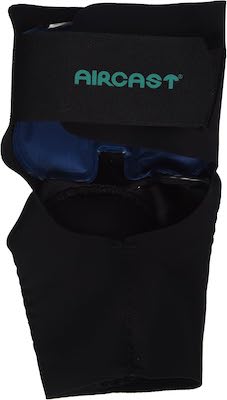
The AirHeel is the pick most likely to help the widest range of people. Two connected air cells — one under the arch, one behind the heel — trade air back and forth as you walk, applying pulsating compression that helps reduce swelling and eases strain on the Achilles tendon. It slips on like a sock, adjusts with a single strap and fits inside most shoes.
Key features
- interconnected air-cell technology
- targets both the Achilles tendon and plantar fascia
- latex-free compression fabric
- universal left/right fit
- versions with or without medial/lateral stabilizers.
Pros
- genuinely tendon-focused rather than a generic ankle wrap
- low-profile enough for shoes
- no pump needed.
Cons
- pricier than a basic sleeve
- the compression is gentle, so it’s support rather than immobilization
- sizing runs by shoe size, so check the chart.
Best for: mild-to-moderate Achilles tendonitis, especially when heel pain or plantar fasciitis is also in the picture.
02 / BEST FOR RUNNERS AND ACTIVE USE
Bauerfeind Sports Achilles Support
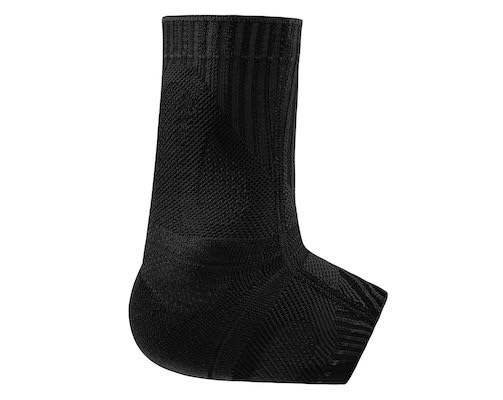
If you want to keep moving while the tendon settles, Bauerfeind’s German-made knit support is built for it. Different knitted zones deliver targeted compression around the Achilles while staying breathable and light, and the seam is offset to the side so nothing rubs under the foot. It’s a step up in quality (and price) from a generic sleeve, aimed at runners and gym-goers who want support that survives repeated washing.
Key features
- 3D AirKnit fabric
- anatomically contoured compression zones
- side-offset seam to prevent friction
- machine washable.
Pros
- comfortable enough for long training sessions
- durable
- supports proprioception without limiting movement.
Cons
- firm fit means you must size carefully
- not for severe pain that needs immobilization. For deeper, therapeutic relief, Bauerfeind’s step-up AchilloTrain adds a visco-elastic pad that massages the tendon area (it comes in left/right and numbered sizes, and costs more).
Best for: active people and runners with mild-to-moderate midportion tendon pain.
03 / BEST BUDGET EVERYDAY SLEEVE
Sleeve Stars Ankle Brace
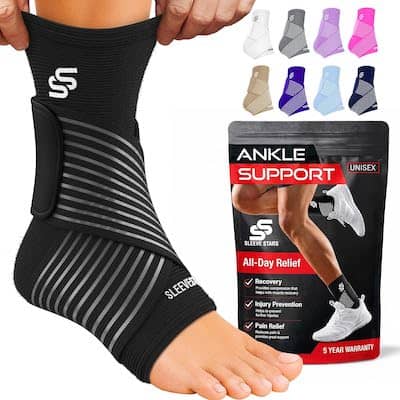
An Amazon best seller for a reason: it does the basics well for a fraction of the cost of a medical brace. The stretchy sleeve delivers all-day compression to help with swelling and soreness, and the included figure-eight strap lets you dial in extra support. It’s thin enough to wear under a sock and in most shoes, which makes it easy to keep on — the single biggest factor in whether a brace actually helps.
Key features
- breathable compression sleeve
- removable adjustable support strap
- one-size-adjustable fit
- sold as a single or pair.
Pros
- inexpensive
- comfortable for everyday wear
- easy on and off.
Cons
- light support only — not for acute injuries or instability
- heavy daily users report it wears out faster than a premium brace.
Best for: mild, ongoing tendon soreness and anyone who wants low-cost daytime compression.
04 / BEST FOR MORNING PAIN
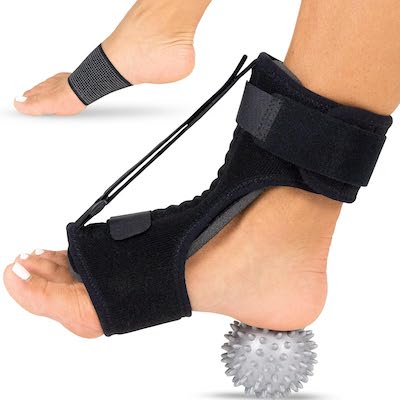
Vive Dorsal Night Splint
Achilles pain is often worst in the first steps out of bed, because the tendon shortens overnight while your foot points down. A night splint holds the foot near a 90° angle so the tendon and calf get a gentle, sustained stretch while you sleep. Vive’s dorsal design keeps the hardware on the front of the leg, leaving the sole open, which most people find far more comfortable than a bulky boot-style splint.
Key features
- bendable aluminum stay adjustable up to 90°
- low-profile open-heel design
- padded, breathable lining
- fits most adults up to a 15.5″ ankle.
Pros
- targets morning stiffness specifically
- lighter and less claustrophobic than posterior boots.
Cons
- takes some nights to get used to
- a night-time tool only — it’s not made for walking.
Best for: anyone whose worst pain is first thing in the morning (very common with Achilles tendonitis and plantar fasciitis).
05 / BEST LOW-COST HEEL RELIEF
Tuli’s Classic Gel Heel Cups
The cheapest, simplest option here — and a smart add-on to any brace. Slipping a gel heel cup into your shoe raises the heel slightly, which shortens the working length of the Achilles and reduces the pull on it as you walk, while the multi-layer gel absorbs impact. Tuli’s is the podiatrist-preferred name in this category and the cups drop into most everyday and athletic shoes.
Key features
- multi-cell shock-absorbing gel
- slight heel lift
- fits inside most closed shoes
- sold as a pair.
Pros
- very affordable
- pairs well with a compression sleeve
- useful for insertional pain right at the heel bone.
Cons
- cushioning and a small lift only — no ankle support
- a dedicated adjustable heel wedge gives more lift if you need it
- not ideal for quick cutting sports, where the foot can shift in the shoe.
Best for: mild heel-end (insertional) Achilles pain and on-your-feet-all-day comfort.
06 / BEST FOR SEVERE OR POST-SURGICAL CASES
United Ortho Short Air CAM Walker Boot
This is the heavy-duty end of the spectrum, and it belongs on this list only with a caveat: a CAM boot is for severe tendonitis, a suspected partial tear, or post-surgical recovery — and it should be used on the advice of a clinician, not self-prescribed. It firmly holds the ankle to limit movement while a rocker sole and shock-absorbing insole let you walk with a more natural gait. Air cells adjust to swelling as it changes through recovery.
Key features
- steel-reinforced molded uprights
- adjustable air cells
- rocker sole for natural gait
- shock-absorbing insole
- universal left/right fit
- rated to ~300 lb.
Pros
- serious immobilization and protection
- established, long-standing brand
- lets you stay mobile during recovery.
Cons
- bulky and warm
- overkill for everyday tendonitis
- get sizing and the go-ahead from a professional first.
Best for: severe cases, post-op rehab, or when a doctor prescribes immobilization.
How to choose an ankle brace for Achilles tendonitis
Match the brace to where it hurts
Achilles tendonitis shows up in two main spots, and the best support differs for each. Insertional pain sits right where the tendon meets the heel bone; heel lifts and night splints help most by easing tension at that attachment point. Midportion pain sits a couple of inches up the tendon; compression sleeves and support braces target that area better. If you’re not sure which you have, that’s a good thing to confirm with a clinician.
Compression vs. immobilization
Most people need support, not lockdown. A compression sleeve or an air-cell brace calms swelling and reassures the tendon while you keep moving gently. Full immobilization in a CAM boot is reserved for severe pain, suspected tears or post-surgery — and should be a clinician’s call.
Day vs. night
These are different tools. During the day, a low-profile sleeve or brace supports the tendon through activity. At night, a splint holds the foot in a gentle stretch to reduce that first-step morning pain. Many people use both.
Fit and footwear
A brace only works if you’ll actually wear it, so comfort and a correct size matter more than maximum stiffness. Follow each brand’s measuring guide — sizing is sometimes by ankle circumference, sometimes by shoe size. If you use a heel lift, use one in both shoes to avoid creating a leg-length difference. It also helps to pair any brace with a well-cushioned, supportive shoe; see our guide to the best shoes for Achilles tendonitis.
About Achilles tendonitis (and what a brace can and can’t do)
Achilles tendinitis is inflammation of the Achilles tendon, the band of tissue connecting your calf muscles to your heel bone. It’s a common overuse injury — especially in runners — that develops when repetitive stress outpaces the tendon’s recovery, and it typically causes pain, stiffness and tenderness along the back of the heel or lower calf. According to the Cleveland Clinic, most mild-to-moderate cases can be managed without surgery, using rest, ice, compression and elevation, over-the-counter anti-inflammatories, gentle calf stretching and eccentric strengthening, and supportive devices such as a heel lift, brace or boot.
That’s the key point about bracing: a brace is one supportive piece of the plan, not a cure. It can reduce strain, calm swelling and make daily movement more comfortable, but the tendon heals through appropriate rest and progressive loading (calf exercises), usually guided by a physical therapist. Used that way — support plus rehab — a brace earns its place.
When to see a professional
See a doctor or physical therapist if pain is severe, doesn’t improve after a couple of weeks of self-care, keeps returning, or limits your normal walking. Seek prompt care if you felt or heard a sudden “pop” at the back of the ankle, have sudden severe pain, or can’t push off or rise onto your toes — these can be signs of an Achilles tendon rupture, which needs urgent evaluation. A clinician can also tell you whether your pain is insertional or midportion, which changes the best treatment and the best brace. This article is for general information only and is not medical advice.
Frequently asked questions
Does an ankle brace actually help Achilles tendonitis?
Yes, as support rather than a cure. Compression braces help reduce swelling and strain, heel lifts reduce pull on the tendon, and night splints ease morning pain. Clinicians often recommend bracing alongside physical therapy. The tendon itself heals through rest and progressive calf-strengthening exercises, so a brace works best as one part of that plan.
Should I wear an Achilles brace during the day or at night?
Both serve different purposes. During the day, a low-profile compression sleeve or air-cell brace supports the tendon through activity and helps with swelling. At night, a splint holds your foot near 90° for a gentle stretch, which reduces the sharp first-step pain many people feel in the morning. Many people use a daytime brace and a night splint together.
Can I run or exercise while wearing an Achilles tendonitis brace?
A thin compression sleeve or a purpose-built Achilles support can be worn during activity, and many runners do. But bracing doesn’t replace reducing your load while the tendon is irritated. Avoid heel lifts for quick cutting sports, since they can let the foot shift in the shoe. If pain is significant, check with a clinician before training.
How long should I wear a brace for Achilles tendonitis?
It varies with severity, typically over several weeks while symptoms settle and you rebuild calf strength. A brace supports recovery but shouldn’t become a permanent crutch that replaces rehab exercises. If you’re relying on it for months with no improvement, that’s a sign to get a professional assessment rather than simply bracing longer.
When do I need a walking boot instead of a brace?
A CAM walking boot is for severe pain, a suspected partial tear or rupture, or post-surgical recovery — situations where the tendon needs true immobilization. It’s not for everyday tendonitis, and it should be used on a clinician’s advice, with the right size and duration. For mild-to-moderate cases, a compression brace or night splint is usually the better fit.
Medical disclaimer: This article is for general information only and is not medical advice. Talk to a qualified healthcare professional about your specific situation before starting or changing any treatment.