K-Laser Therapy: What It Is, What It Treats, and What to Expect
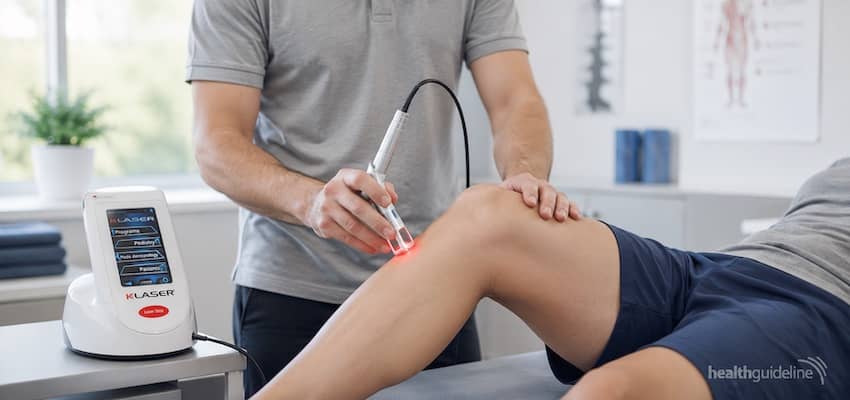
K-Laser therapy is a Class IV (high-power) laser treatment a trained clinician applies to painful or injured tissue. It uses red and near-infrared light — a process called photobiomodulation — to try to ease pain and support healing. The evidence is genuinely mixed: some conditions show modest benefit, others little to none. It is generally low-risk but is not a cure-all.
If you have been offered K-Laser therapy for back pain, a joint problem, tendinitis, or a stubborn injury and you are wondering whether it is worth the time and money, this guide lays out what the treatment actually is, what the research does and does not support, whether it is safe, and what a realistic course looks like — without hype.
What is K-Laser therapy?
K-Laser is a brand of Class IV therapeutic laser used by chiropractors, physical therapists, and some physicians to treat musculoskeletal pain and support tissue recovery. “Class IV” simply means a higher-powered laser (generally above 500 milliwatts) that can deliver energy deeper and faster than the older, lower-powered “cold” lasers. Treatment is applied in a clinic over a few minutes per area and usually feels like gentle warmth.
The underlying technique is called photobiomodulation (PBM), which was previously known as low-level laser therapy (LLLT). Specific wavelengths of light are absorbed by molecules in your cells called chromophores; the idea is that this stimulates energy (ATP) production, increases local blood flow, and dampens pain signaling. K-Laser systems typically use several wavelengths in the red-to-near-infrared range (roughly 600–1000 nm) to reach different tissue depths.
How does K-Laser therapy work?
The laser delivers light energy into tissue, where it is absorbed by cells and — in theory — kick-starts processes involved in repair, circulation, and inflammation control. Because a Class IV device is more powerful, the clinician keeps the handpiece moving over the treatment area so heat does not build up in one spot.
It is worth being clear-eyed about the mechanism: photobiomodulation is a real and actively studied biological effect, but the precise “dose” (wavelength, power, and energy density) that produces a benefit is still debated, and treatment protocols vary a lot between clinics. That variability is one reason study results are inconsistent.
What does K-Laser therapy treat, and does it actually work?
It is most often used for musculoskeletal pain — low back pain, knee osteoarthritis, tendinopathies, neck pain, plantar fasciitis, and post-surgical soreness. Research shows modest benefit for some of these and little to no benefit for others, with the overall quality of evidence rated low.
A 2026 systematic review in Sport Sciences for Health pooled 53 clinical trials (about 2,800 patients) and reported that photobiomodulation reduced average pain scores by roughly a third in conditions such as knee osteoarthritis, tendinopathies, low back pain, and postoperative pain. A landmark 2009 meta-analysis in The Lancet found low-level laser therapy reduced pain in people with neck pain. For knee osteoarthritis, reviews suggest laser therapy may add some benefit on top of exercise rather than replacing it.
But the picture is far from settled. For non-specific low back pain in particular, findings conflict: a 2015 meta-analysis found laser therapy lowered pain versus placebo but did not improve function or disability, while a 2020 systematic review in the Journal of Physiotherapy concluded that photobiomodulation does not meaningfully reduce pain or disability in this group at all. Reviews of sports and recovery uses reach broadly favorable conclusions but repeatedly note the same limitation: the primary studies are small and of low quality.
The takeaway is that K-Laser therapy is plausibly helpful as one part of a treatment plan for certain pain conditions, but it is not a proven stand-alone cure, and results vary from person to person. Ask your provider what the evidence looks like for your specific condition before committing to a package.
In-clinic K-Laser vs. at-home laser/light devices — at a glance
| Feature | In-clinic K-Laser (Class IV) | At-home red light / "cold laser" devices |
|---|---|---|
| Power | High-power (Class IV, >500 mW); deeper, faster dosing | Much lower power (LED panels or low-class lasers) |
| Who applies it | Trained clinician, with eye protection | You, at home, following the manual |
| What evidence suggests | Modest benefit for some pain conditions; quality of evidence low | More limited; not equivalent to in-clinic dosing |
| Typical cost | Commonly ~$50–$150 per session; often sold in packages | One-time device purchase; wide range |
Is K-Laser therapy safe? Side effects and who should avoid it
For most people, laser therapy is considered low-risk when performed properly by a trained provider, and in clinical trials side effects have generally been no different from a sham (placebo) device. The single most important hazard is eye injury, which is why goggles are worn.
Because a Class IV laser is powerful, the main practical risks are eye damage from direct exposure and, rarely, a mild thermal burn if the beam is held too long in one place — both avoidable with correct technique. Laser therapy organizations advise some common-sense precautions and relative contraindications, including:
- Eyes: never aim the laser at the eyes; everyone in the room wears appropriate eyewear.
- Over known cancer sites: avoid treating directly over a diagnosed tumor or metastasis unless a doctor specifically directs it.
- Pregnancy: avoid treating directly over a developing fetus.
- Photosensitivity / epilepsy: use caution if you are photosensitive or have light-triggered seizures, and tell your provider about any light-sensitizing medications.
- Other: discuss active bleeding, infections, or implanted devices with your clinician so treatment can be tailored to you.
Note that some clinic and manufacturer materials describe laser therapy as having “no known side effects.” That is broadly consistent with trial data, but “few reported side effects” is a more accurate way to put it than “none,” and it should never be read as evidence that the treatment works.
How many sessions will I need, and what does it cost?
A typical course runs about 6–12 sessions over several weeks, scheduled two to three times a week early on, then tapered. In the U.S., individual sessions commonly cost around $50–$150, and many clinics sell discounted multi-session packages.
Actual numbers vary widely with your condition, the body area, session length, and the clinic. Acute problems may need fewer visits; chronic issues often need more. Because prices and packages change and differ by location, treat any figure here as a ballpark and confirm current pricing directly with the clinic. Laser therapy is often considered elective, so it may not be covered by insurance — ask before you start.
What to look for if you’re considering K-Laser therapy
A few practical, non-prescriptive pointers:
- Get a diagnosis first. Laser therapy treats symptoms; it does not replace figuring out what is actually wrong. Start with a proper evaluation.
- Choose a qualified provider who is trained in laser protocols and can explain what they are treating and why.
- Set realistic expectations. Think “possible modest help as part of a plan,” not “guaranteed fix.” Ask what improvement would look like and by when.
- Combine it with the basics. For most musculoskeletal pain, the strongest evidence still favors movement, targeted exercise, and physical therapy. Laser is usually an add-on. Drug-free tools like a TENS unit or a percussion massager are other at-home options people use alongside professional care.
- Watch the value. If a large upfront package is pushed before you have tried a session or two, that is a reasonable moment to pause and ask questions.
Are at-home red light and “cold laser” devices the same thing?
No. Consumer red light panels and low-powered home lasers are far weaker than an in-clinic Class IV K-Laser, the evidence behind them is more limited, and they are not a substitute for professional evaluation or care. They may appeal to people managing mild, self-limiting aches at home, but they should not be used in place of getting a real problem properly assessed.
If you do decide to shop for a home device, look for one that lists its wavelength (red/near-infrared, roughly 600–1000 nm) and its power or irradiance, is FDA-cleared for the use you have in mind, and makes realistic claims rather than promising to cure conditions. Depending on the problem you are dealing with, simpler and better-studied options may serve you just as well — for example plantar fasciitis insoles for foot pain, an inversion table for some back complaints, or a knee brace for knee support. Whatever you try at home, run it past a clinician if pain is significant, persistent, or getting worse.
When to see a professional
Skip the home-remedy route and get checked promptly if you have any of these red flags: pain after a significant injury or fall; severe or rapidly worsening pain; numbness, tingling, or weakness; loss of bladder or bowel control; pain that wakes you at night; or pain accompanied by fever, redness and swelling, or unexplained weight loss. These can signal problems that need real medical evaluation, not a light-based treatment. This article is general information, not medical advice.
Frequently asked questions
Does K-Laser therapy hurt?
No — most people feel nothing more than gentle warmth as the handpiece moves over the skin, and there are no needles or incisions. The clinician keeps the beam moving to prevent any heat from concentrating in one spot. If a particular spot ever feels uncomfortably hot, tell your provider so they can adjust.
Is K-Laser therapy FDA-approved?
Class IV therapeutic lasers are FDA-cleared to be marketed for temporary relief of minor muscle and joint pain and stiffness and to increase local blood circulation. Clearance means the device may be sold for those uses — it is not the same as “approval,” and it is not proof that the treatment cures any condition.
How quickly does it work?
It varies. Some people notice easing of pain within the first few sessions, while others feel little change. Because effects tend to be cumulative and modest, most clinics reassess after two to four visits. If you have seen no benefit partway through a planned course, that is a fair point to revisit the plan with your provider.
Is laser therapy covered by insurance?
Often not — many insurers treat it as elective, so it is frequently offered as cash-pay, sometimes in discounted packages. Coverage and pricing differ by clinic, plan, and location. Ask the clinic for current costs and check with your insurer before committing to a multi-session package.
Can I get the same results with a home device?
Unlikely in the same way. Home red light and low-powered laser devices are much weaker than an in-clinic Class IV system, and the evidence supporting them is more limited. They may help with mild aches for some people, but they are not a replacement for professional assessment when pain is significant or persistent.
Medical disclaimer: This article is for general information only and is not medical advice. Talk to a qualified healthcare professional about your specific situation.