8 Best Filtered Water Bottle For Travel 2023
2026 travel buying guide · filters vs. purifiers
The best filtered water bottle for travel depends first on the water you expect to use. For international trips or other places where viral contamination is a realistic concern, a true purifier such as the GRAYL GeoPress offers broader pathogen protection than a standard microfilter. For treated tap water, lighter and less expensive bottles can be the better choice.
Quick picks
Best overall for higher-risk travel
GRAYL GeoPress
A 24-ounce press purifier designed to address viruses as well as bacteria and protozoa, with activated-carbon media for taste and other contaminants.
Best balance for everyday travel
LifeStraw Go Series
Lighter and less expensive than purifier bottles, with membrane filtration for bacteria and parasites plus carbon for improved taste.
Best budget for treated tap water
Brita Premium
A simple choice when the tap water is already microbiologically safe and your main goal is reducing chlorine taste, odor and particulates.
How we chose these filtered water bottles
We checked current manufacturer specifications, U.S. Amazon product pages and public-health guidance from the CDC. We prioritized the treatment method, whether the product is designed to address viruses, bacteria and protozoa, the type of source water it is intended for, capacity, packability, filter life and replacement cost. We did not award points for unverified star ratings or marketing claims that could not be matched to current product documentation.
Best filtered water bottles for travel at a glance
| Bottle | Best for | Treatment | Virus protection? | Capacity | Price note |
|---|---|---|---|---|---|
| GRAYL GeoPress | Higher-risk international travel | Press purifier + activated carbon | Yes, per manufacturer purifier claim | 24 oz / 710 mL | Premium; around $100 list |
| GRAYL UltraPress | Compact purifier | Press purifier + activated carbon | Yes, per manufacturer purifier claim | 16.9 oz / 500 mL | Premium; around $90 list |
| LifeStraw Go Series | Everyday travel + hiking | 0.2-micron membrane + carbon | No reliable virus removal listed | 22 oz / 650 mL | Midrange; around $45 |
| Katadyn BeFree AC | Ultralight hiking and fast refills | 0.1-micron hollow fiber + carbon | No | 1.0 L | Midrange; around $60 MSRP |
| Clearly Filtered 32 oz | Treated tap water + broad contaminant reduction | Adsorptive filtration media | Not intended as a pathogen purifier | 32 oz | Premium; around $75 |
| Brita Premium 26 oz | Budget taste improvement from treated tap | Carbon bottle filter | No | 26 oz | Budget; around $24 |
Filter is not the same as purifier. The CDC notes that most portable filters do not reliably remove viruses. If you are unsure whether water is safe, CDC guidance says boiling is best; the next-best general approach is to filter and then disinfect. Choose a bottle only for the hazards its documentation says it is designed to address.
The six best filtered water bottles for travel
01 / BEST OVERALL FOR HIGHER-RISK TRAVEL
GRAYL GeoPress 24 oz Water Purifier Bottle
The GeoPress is the strongest all-round choice here when your itinerary includes places where microbiological water safety is uncertain. GRAYL specifies removal of viruses, bacteria and protozoa, while its purifier cartridge also targets particulates and a range of chemical contaminants. The trade-offs are weight, bulk, price and the physical effort of pressing each batch.
Key features
- 24 fl oz / 710 mL inner capacity
- About 8 seconds per press under manufacturer test conditions
- Cartridge rated for about 350 presses / 250 L / 65 gal
- Manufacturer specifies virus, bacteria and protozoa removal
- Activated-carbon media improves taste, smell and clarity
- One-way valve supports electrolyte or drink-mix use after purification
Pros
- Broader pathogen scope than ordinary microfilter bottles
- Fast batch treatment with no batteries or chemical wait time
- Useful capacity for travel days and camp refills
Cons
- Heavier and more expensive than membrane-only bottles
- Pressing becomes harder as the cartridge approaches end of life
- Not a solution for seawater or known chemical/toxic contamination
Best for: International travelers, overlanders and outdoor users who want a bottle-format purifier with virus protection rather than a basic filter.
Who it is not for: Ultralight packers, travelers who only refill from reliably treated municipal water, or anyone who has difficulty applying downward pressure.
Approx. price: around $100 list price — check the current Amazon offer.
02 / BEST COMPACT PURIFIER
GRAYL UltraPress 16.9 oz Purifier Bottle
The UltraPress uses the same basic fill-press-drink idea as the larger GeoPress but in a 16.9-ounce format that is easier to fit in a pack pocket or cup holder. It is the better GRAYL choice if compact size matters more than batch capacity, while still retaining the manufacturer’s virus, bacteria and protozoa purifier claims.
Key features
- 16.9 fl oz / 500 mL capacity
- About 10 seconds per press under manufacturer test conditions
- Cartridge rated for about 300 presses / 150 L / 40 gal
- Manufacturer specifies viruses, bacteria and protozoa removal
- Activated carbon for taste, odor and selected contaminants
- Manual operation; no battery required
Pros
- Compact purifier for carry-on and daypack use
- Broader pathogen protection than microfilter-only bottles
- No charging, pumping hoses or chemical dwell time
Cons
- Smaller batch means more frequent pressing
- Still much heavier than a soft-flask microfilter
- Premium replacement-cartridge cost
Best for: Travelers who want purifier-level pathogen coverage in the most compact GRAYL bottle.
Who it is not for: People who dislike the press action or need to treat a liter at a time.
Approx. price: around $90 list price — check the current Amazon offer.
03 / BEST BALANCE FOR EVERYDAY TRAVEL
LifeStraw Go Series 22 oz Water Filter Bottle
The LifeStraw Go Series is the best middle-ground option for travelers who want a conventional sip-through bottle with stronger microbial filtration than a carbon-only bottle. Its membrane microfilter is designed for bacteria, parasites and microplastics, while the carbon stage reduces chlorine and odors. It is not a reliable virus-removal choice, which matters for some international destinations.
Key features
- 22 fl oz / 650 mL BPA-free bottle
- 0.2-micron membrane microfilter
- Membrane rated up to 1,000 gal / 4,000 L
- Activated-carbon stage for chlorine, odors and organic chemical matter
- Manufacturer specifies bacteria, parasites, microplastics, silt and sand reduction
- Replaceable filter components
Pros
- Simple fill-and-sip routine
- Long membrane service life
- Useful for treated taps and many freshwater hiking situations
Cons
- Does not provide reliable virus removal
- Sipping through a filter requires more suction than a normal straw
- Carbon filter needs replacement much sooner than the membrane
Best for: General travel, road trips, airports and hiking when your risk assessment does not require virus removal.
Who it is not for: Travelers relying on one bottle as their only treatment method where viral contamination is a meaningful concern.
Approx. price: around $45 — check the current Amazon offer.
Important: LifeStraw lists bacteria and parasite removal for the Go Series, not virus removal. Do not interpret “microfilter” as “purifier.”
04 / BEST ULTRALIGHT HIKING FILTER
Katadyn BeFree AC 1.0L Water Filter Bottle
The BeFree AC is the lightest high-capacity option in this roundup and a strong choice for day hikes or active trips where pack weight matters. Its 0.1-micron hollow-fiber membrane targets bacteria, protozoa and microplastics, while a replaceable activated-carbon stage improves taste and reduces chlorine and odors. It is a filter, not a virus purifier.
Key features
- 1.0-liter double-layer soft flask
- 0.1-micron EZ-Clean hollow-fiber membrane
- Up to 2 L/min rated flow
- Membrane capacity up to 1,000 L depending on water quality
- Replaceable carbon rated up to 200 L depending on water quality
- Listed weight about 85 g for the black 1.0L model
Pros
- Excellent capacity-to-weight ratio
- Fast flow for refilling on the move
- Soft flask collapses as you drink
Cons
- No virus removal
- Soft bottle is less rigid than a hard travel bottle
- Silty water can shorten effective filter life and reduce flow
Best for: Hikers, trail travelers and minimalist packers who want fast bacteria/protozoa filtration and a collapsible 1-liter container.
Who it is not for: Trips where viral contamination is a central concern or people who prefer the durability and cup-holder shape of a hard bottle.
Approx. price: around $60 MSRP for the black 1.0L model — check the current Amazon offer.
05 / BEST FOR TREATED TAP CONTAMINANTS
Clearly Filtered 32 oz Stainless Steel Water Bottle
Clearly Filtered is aimed at a different travel problem: improving already treated municipal water by reducing a broad list of chemical and particulate contaminants. The company says the 32-ounce bottle is designed for municipal or tap water and targets chlorine, fluoride, lead and many other substances. It should not be treated as a substitute for pathogen treatment of unsafe natural water.
Key features
- 32-ounce double-wall stainless-steel bottle
- Affinity filtration media
- Manufacturer lists 200+ targeted contaminants
- Designed for municipal or tap water
- Filter life rated at 25 gallons, affected by local water conditions
- Insulated hard-bottle construction
Pros
- Targets more than taste and odor
- Large capacity for airports, hotels and road trips
- Insulated stainless-steel body
Cons
- Not intended as a microbiological purifier
- Heavier than plastic or soft-flask options
- Shorter gallon rating than long-life membrane filters
Best for: Travelers who trust the local municipal disinfection but want additional contaminant reduction and cold water in an insulated bottle.
Who it is not for: Backcountry streams, wells or destinations where the microbiological safety of tap water is uncertain.
Approx. price: around $75 — check the current Amazon offer.
06 / BEST BUDGET FOR TREATED TAP WATER
Brita Premium Filtering Water Bottle, 26 oz
The Brita Premium is the budget pick only when the source water is already treated and microbiologically safe. Its bottle filter is designed to reduce chlorine taste and odor and particulates as you drink. That makes it useful for airports, offices and hotels with safe tap water, but it is not appropriate as your sole protection from bacteria, parasites or viruses.
Key features
- 26-ounce hard-sided bottle made without BPA
- Filters as you sip through an enclosed straw
- WQA-certified reduction of chlorine taste/odor and particulates
- Filter rated for 40 gallons or about two months
- Top-rack dishwasher-safe bottle after filter removal
- Built-in carrying loop and one-handed lid
Pros
- Lowest-cost option in this roundup
- Simple replacement filters are widely available
- Good fit for chlorine taste and odor in treated tap water
Cons
- Not a bacteria, parasite or virus purifier
- Limited value where tap water already tastes good
- Not suitable for rivers, lakes or questionable wells
Best for: Budget-conscious travelers who refill from treated municipal taps and mainly want better taste.
Who it is not for: Anyone who needs microbiological treatment of questionable water.
Approx. price: around $24 — check the current Amazon offer.
How to choose a filtered water bottle for travel
1. Start with the water source, not the product
Ask where you will refill most often. If you will use treated municipal taps, your goal may simply be chlorine taste, odor, lead or other chemical reduction. If you will use natural freshwater or travel where sanitation is unreliable, microbial treatment becomes more important. No one bottle is the “best” across both scenarios unless its treatment claims match the actual risk.
2. Know the difference between a filter and a purifier
A membrane filter can be excellent for bacteria and protozoa yet still fail to reliably remove viruses because viruses are much smaller. CDC’s Yellow Book notes that many portable microfilters do not reliably remove enteric viruses. GRAYL markets the GeoPress and UltraPress as purifiers and publishes virus, bacteria and protozoa removal claims; LifeStraw Go and Katadyn BeFree AC are membrane filters without reliable virus removal.
3. Do not confuse carbon filtration with pathogen treatment
Activated carbon is useful for taste, odor and certain chemicals, but a carbon-only bottle should not be assumed to make microbiologically unsafe water safe. Brita’s bottle documentation focuses on chlorine taste/odor and particulates. Clearly Filtered is designed for municipal or tap water and a broad contaminant list, not untreated backcountry water.
Simple rule: If a product page does not explicitly document the organism or contaminant you are worried about, do not assume the filter removes it.
4. Compare capacity with carried weight
Large bottles reduce refill frequency but take up more room and weigh more when full. A 24- to 32-ounce hard bottle is convenient for airports and hotels, while a 1-liter soft flask can be more packable on hikes. If you travel with children, our insulated water bottle for kids guide covers family-friendly bottle features beyond filtration.
5. Calculate replacement-filter cost before you buy
The cheapest bottle can become expensive if its cartridges are short-lived, while a premium purifier may be cost-effective only if you regularly need its broader treatment. Compare the bottle price, cartridge price, rated gallons or liters, availability of replacements and your expected refill volume. Our water bottle cost guide gives additional context on bottle expenses.
6. Choose a cleaning routine you will actually follow
Filtered bottles need more maintenance than ordinary bottles. Remove or protect the filter exactly as the manufacturer instructs, clean the bottle and mouthpiece, let parts dry when appropriate, and follow long-term storage directions for the filter. Do not put a filter cartridge in a dishwasher unless the manufacturer explicitly says it is safe.
What travelers should know about water safety
A bottle cannot make every water source safe
The CDC says boiling is the most reliable way to kill germs when water safety is uncertain. If boiling is not possible, CDC guidance says the next-best general approach is to filter and then disinfect. Clear water can still contain disease-causing organisms, and ordinary portable filters may not remove viruses.
Do not use a travel bottle to “rescue” water known or suspected to contain harmful chemicals, toxins or radioactive material. Boiling and disinfection do not make that water safe. These bottles are also not desalination systems, so seawater is not an appropriate source.
CDC’s Yellow Book also explains an important detail about the word purifier: manufacturers using the EPA purifier designation conduct their own performance testing to show the required pathogen reductions; the EPA does not independently test the validity of each claim. That makes current manufacturer documentation and correct use especially important.
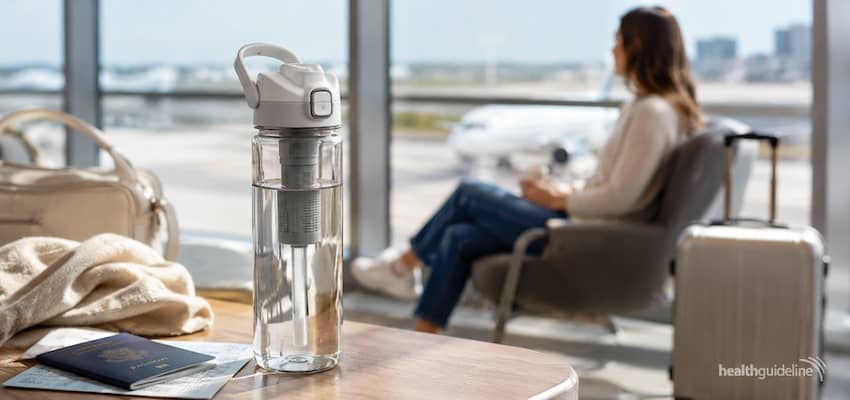
How to travel with a filtered water bottle at airports
- Empty it before U.S. security. TSA’s “What Can I Bring?” guidance lists empty water bottles as permitted in carry-on and checked bags.
- Refill after the checkpoint. Use a filling station or tap only if you are comfortable with the local water quality and your bottle’s treatment capability.
- Keep a dry backup plan. On long journeys, consider manufacturer-approved spare cartridges or a separate treatment method appropriate to your destination.
- Keep the mouthpiece clean. A filter cannot prevent contamination introduced by dirty hands, an unclean straw or a contaminated cap.
If your bigger challenge is simply remembering to drink during flights or road trips, see our water bottle reminder guide.
Frequently asked questions
What is the best filtered water bottle for international travel?
For trips where viral contamination is a realistic concern, the GRAYL GeoPress is the strongest fit in this roundup because the manufacturer specifies removal of viruses as well as bacteria and protozoa. If the local tap water is already microbiologically safe, a lighter filter such as LifeStraw Go or a treated-tap bottle may be more practical.
Does the LifeStraw Go Series remove viruses?
No reliable virus removal is listed for the LifeStraw Go Series. LifeStraw specifies a membrane microfilter for bacteria, parasites, microplastics, silt and sand, plus an activated-carbon stage for chlorine, odors and organic chemical matter. If viruses are part of your risk assessment, choose a treatment method specifically designed and documented for viruses.
Is a Brita filtered bottle enough for international travel?
Only when the water source is already safe from a microbiological standpoint. Brita’s bottle filter is designed to reduce chlorine taste/odor and particulates; it is not a bacteria, parasite or virus purifier. Do not rely on it as your sole treatment for questionable tap water, wells, rivers or lakes.
Can I drink river or lake water through a filtered bottle?
Only when the treatment method is appropriate for the hazards in that water and you follow the manufacturer’s directions. The CDC says clear natural water can still contain germs, and most portable filters do not reliably remove viruses. For uncertain water, boiling is best; filtering followed by disinfection is the next-best general approach.
Can a travel water filter bottle make seawater drinkable?
No. The bottles in this guide are not reverse-osmosis desalination systems and should not be used for seawater. They also should not be used to make water with known chemical, toxin or radioactive contamination safe. When a source is chemically contaminated, choose a different known-safe water source.
Can I take a filtered water bottle through airport security?
In the United States, TSA lists empty water bottles as permitted in carry-on bags. Empty the bottle before the checkpoint, then refill it afterward. Security rules and local procedures can differ outside the United States, so check the airport or aviation authority for your route when traveling internationally.
How often should I replace a filtered bottle cartridge?
Follow the exact model’s rated capacity and replacement instructions because the intervals vary widely. GRAYL rates GeoPress at about 250 L and UltraPress at about 150 L; LifeStraw rates the Go membrane up to 4,000 L; Katadyn rates the BeFree AC membrane up to 1,000 L; Brita rates its bottle filter for 40 gallons. Water quality can shorten real-world life.
Medical disclaimer: This article is for general information only and is not medical advice. Talk to a qualified healthcare professional about your specific health or travel-risk situation.