Insulated Water Bottle for Kids: 5 Best in 2026
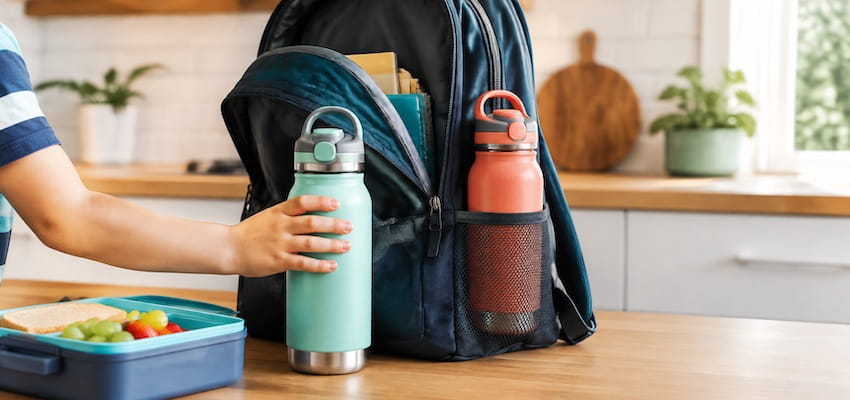
The best insulated water bottle for kids is easy for the child to open, simple for an adult to clean, and secure enough for its actual carrying position. The Hydro Flask Kids 12 oz is our best overall starting point; the Thermos FUNtainer is the value pick, while Owala suits children who want more capacity.
A good kids’ bottle should make cold water easy to reach without becoming the hardest item in the lunch kit to maintain. This guide compares five current stainless-steel bottles using manufacturer specifications, child-safety notes and verified U.S. Amazon listings. We have not hands-on tested these bottles, so our categories are editorial judgments—not laboratory rankings.
Quick picks
Best overall
Hydro Flask Kids 12 oz
A slim, age-3-plus bottle with a straw cap, protective boot and fully dishwasher-safe design.
Best value
Thermos FUNtainer 12 oz
A straightforward school bottle with a covered soft straw, handle and top-rack dishwasher care.
Larger capacity
Owala Kids FreeSip 16 oz
A 16-ounce option with two ways to drink and a locking, covered spout.
How did we choose these kids’ bottles?
We looked for current insulated stainless-steel models sold in the United States, then checked capacity, lid design, cleaning instructions, age warnings, cold-retention claims and pack limitations against each maker’s page. We favored practical differences over colors, popularity or unverified reviews. Amazon links were verified on September 4, 2026, but offers and sellers can change.
How to use this guide: Start with the lid your child can operate and the parts you can clean reliably. Then check fit in the backpack pocket, lunch bag and cupholder. A longer insulation claim does not compensate for a bottle that is too heavy, hard to open or awkward to wash.
Which insulated water bottle for kids is best?
For most children age three and older, the Hydro Flask Kids 12 oz offers the most balanced specification set: a narrow body, straw cap, protective boot and dishwasher-safe construction. Choose the Thermos for value, Owala for a 16-ounce capacity, Klean Kanteen for a versatile flip cap, or YETI for rugged dishwasher-safe construction.
| Bottle | Best for | Capacity | Lid and care | Know before buying |
|---|---|---|---|---|
| Hydro Flask Kids | Best overall | 12 oz | Straw cap; dishwasher safe | Age 3+; not for hot liquids |
| Thermos FUNtainer | Best value | 12 oz | Covered soft straw; top-rack dishwasher safe | Not for hot liquids |
| Owala Kids FreeSip | Larger capacity | 16 oz | Straw-or-swig spout; hand-wash cup | Not for hot liquids |
| Klean Kanteen Kid’s Classic | Versatile flip cap | 12 oz | Flip Seal cap with removable steel straw; dishwasher safe | Cap not for age 3 and under |
| YETI Rambler Jr. | Rugged build | 12 oz | Straw cap; dishwasher safe | Age 3+; maker says cap is not packable |
The five best insulated kids’ water bottles
01 / BEST OVERALL
Hydro Flask Kids 12 oz Bottle
The Hydro Flask Kids 12 oz is our best overall starting point because its practical features work together: the body is slim for smaller hands, the included boot cushions the base, and every part is dishwasher safe. Hydro Flask rates it for ages three and older and says its double-wall insulation keeps drinks cold for up to 24 hours.
Key features
- 12-ounce stainless-steel bottle
- Straw cap and protective Bottle Boot
- Slim profile that fits most cupholders
- Dishwasher safe; intended for ages 3+
Pros
- Balanced size for school and short outings
- Protective boot is included
- Simple dishwasher care
Cons
- 12 ounces may require a refill on long or hot days
- Premium price tier
- Straw caps require cleaning around small parts
Best for: Families who want one broadly practical 12-ounce school bottle and prefer dishwasher care. It is not the best choice for children under three or anyone who needs a larger capacity.
02 / BEST VALUE
Thermos FUNtainer 12 oz Water Bottle
The Thermos FUNtainer keeps the design straightforward: a 12-ounce vacuum-insulated body, push-button lid, covered silicone straw and integrated handle. Thermos says it keeps drinks cold for up to 12 hours and is top-rack dishwasher safe. It earns our value category because it covers school-day essentials without adding a complex drinking system.
Key features
- 12-ounce vacuum-insulated stainless steel
- Push-button lid covers the soft silicone straw
- Integrated soft-touch carry handle
- Top-rack dishwasher safe; not for hot liquids
Pros
- Covered, child-friendly straw format
- Replacement straw sets are sold by Thermos
- Usually positioned below premium bottles
Cons
- Lower cold-retention claim than some rivals
- Soft straw and small lid parts need thorough cleaning
- Licensed prints can vary by listing
Best for: A value-conscious family that wants a familiar push-button straw bottle. It is not for hot drinks, and buyers should confirm the exact print and included parts.
03 / BEST LARGER CAPACITY
Owala Kids FreeSip 16 oz
The Owala Kids FreeSip gives an older or thirstier child four more ounces than the 12-ounce picks. Its protected FreeSip spout supports upright sipping through the built-in straw or tilting to drink from the wider opening. The lid locks, the carry loop doubles as the lock, and Owala claims up to 24 hours of cold retention.
Key features
- 16-ounce insulated stainless-steel body
- Two drinking modes: built-in straw or wider opening
- Push-button lid with locking carry loop
- Hand-wash cup; dishwasher-safe lid
Pros
- More capacity without moving to an adult-size bottle
- Spout stays covered between drinks
- Lock helps prevent accidental opening
Cons
- Heavier when full than a 12-ounce bottle
- The cup is not listed as dishwasher safe
- More lid geometry to inspect and clean
Best for: School-age children who can comfortably handle a 16-ounce bottle and want the choice to sip or swig. It is not for hot liquids, and it is less convenient for families that dishwasher-clean every component.
04 / BEST VERSATILE FLIP CAP
Klean Kanteen 12 oz Kid’s Classic Insulated
Klean Kanteen’s 12-ounce insulated bottle stands out for a Flip Seal Sport Cap that works with or without the removable stainless-steel straw. The maker calls the closed cap fully leakproof and rates the bottle to keep contents iced for up to 40 hours. Its narrow body is dishwasher safe and sized for smaller hands.
Key features
- 12-ounce insulated 18/8 stainless-steel bottle
- Flip Seal Sport Cap with removable steel straw
- Narrow, cupholder-friendly profile
- Dishwasher safe; cap warning for age 3 and under
Pros
- Can be used with or without the internal straw
- Strongest published iced-retention claim here
- Dishwasher-safe components
Cons
- Cap is not intended for children age three and under
- Stainless-steel straw will not suit every child’s preference
- Long cold-retention claim may be unnecessary for a school day
Best for: Families who value a leakproof closed cap and the option to remove the straw. It is not for children age three and under, chewing or teething; follow the maker’s adult-supervision warning.
Klean Kanteen 12 oz Kid’s Classic Insulated — view on Amazon
05 / BEST RUGGED BUILD
YETI Rambler Jr. 12 oz Kids Bottle
The YETI Rambler Jr. pairs a 12-ounce 18/8 stainless-steel body with double-wall vacuum insulation and a dishwasher-safe straw cap. YETI positions it for children age three and older and emphasizes its resistance to everyday tumbles. The important caveat is unusually clear: YETI says the straw cap can open when jostled and is not packable.
Key features
- 12-ounce 18/8 stainless-steel bottle
- Double-wall vacuum insulation
- Leakproof-when-closed straw cap
- Bottle and cap are dishwasher safe; intended for ages 3+
Pros
- Rugged stainless-steel construction
- Easy dishwasher care
- Wide handle is easy to grab
Cons
- Premium price tier
- Maker says the straw cap is not packable
- Not for hot, carbonated or pulpy drinks
Backpack warning: “Leakproof when closed” is not the same as safe loose inside a bag. YETI specifically says this straw cap is not packable because it can open when shaken or jostled. Use an upright exterior pocket and test the exact carrying setup.
Best for: A rugged bottle carried upright in a cupholder or exterior bottle pocket. It is not our choice for loose transport inside a backpack or lunch bag.
What should you look for in a kids’ insulated bottle?
Choose in this order: safe age range, lid usability, cleanability, carrying position, capacity and only then insulation time. The winning bottle is the one your child can use and your household can maintain. Before buying, measure the bag pocket and cupholder, then read the exact model’s care and beverage restrictions.
Can your child open, close and drink from it?
A bottle can be technically leakproof and still fail in daily use if the child cannot fully close it. Let your child try a push button, flip seal or locking loop if possible. Also consider whether they prefer a soft straw, firm straw or open spout, and whether they can lift the bottle comfortably when full.
Is the lid truly bag-safe?
Read the exact wording. “Spill-resistant when open,” “leakproof when closed” and “packable” describe different situations. A cap that can be bumped open should travel upright in an exterior pocket. At home, fill the bottle with cold water, close it, dry the exterior and test it over a sink before trusting it near books or electronics.
Is 12 or 16 ounces better?
A 12-ounce bottle is lighter and easier for small hands; a 16-ounce bottle carries one-third more water but weighs more when full. The right size depends on refill access, weather, activity and the child’s ability to carry it. The American Academy of Pediatrics notes that fluid needs vary with activity, heat and humidity.
How much insulation do you actually need?
Published claims here range from 12 hours cold to 40 hours iced, but they are manufacturer claims under unspecified everyday conditions—not a common independent test. For a normal school day, lid reliability and cleaning may matter more. Expect results to change with starting temperature, ice, refill frequency, sunlight and how often the bottle is opened.
Can every part be cleaned and replaced?
Check whether the cup, cap, gasket and straw share the same dishwasher instructions; they often do not. Look for removable parts, replacement straws and a lid design you can inspect. If a seal becomes damaged, retains odor or no longer stays secure, replace the compatible part or retire the bottle rather than improvising a fit.
For broader bottle decisions, see our guides to the cost of a water bottle, water bottles that remind you to drink and filtered water bottles for travel.
How should you clean and use a kids’ bottle?
Follow the instructions for the exact bottle and lid. Empty it daily, separate removable components, wash the surfaces that contact the mouth or drink, rinse well and let every part dry completely before reassembly. Inspect hidden areas around gaskets and valves, and never use a dishwasher for a component the maker labels hand-wash only.
- Check the manual first. Care rules differ even within the same brand. Owala lists the Kids FreeSip cup for hand washing, while the other four bottles in this guide are listed as dishwasher safe with model-specific rack guidance.
- Disassemble only as directed. Remove the straw and any maker-designated removable seals. Do not pry out parts that the instructions say should remain installed.
- Wash and inspect. Clean the spout, straw, cap threads and gasket channels with appropriately sized tools. Check for residue, odor, cracks, bite damage or a loose seal.
- Air-dry fully. Leave the bottle and lid open and separated until dry. Reassembling damp parts can trap moisture in areas that are hard to see.
- Use only approved drinks. Several kids’ straw caps explicitly prohibit hot liquids; YETI also excludes carbonated and pulpy drinks. Follow the exact maker’s restrictions.
Age and supervision matter. Hydro Flask and YETI specify ages three and older. Klean Kanteen says its Flip Seal cap is not intended for children age three and under, chewing or teething, and calls for adult supervision. Treat detachable or damaged parts as a reason to stop use and check the maker’s guidance.
How much water do kids need?
A bottle capacity is not a daily hydration prescription. The American Academy of Pediatrics gives general daily fluid estimates of about four cups for ages one to three, five cups for ages four to eight, and seven to eight cups for older children, including water or milk. Individual needs change with activity, heat and humidity.
A bottle helps only when it is usable and refilled
The AAP recommends making water readily available and drinking before, during and after sports or active play. A smaller bottle with dependable refill access can work better than a large bottle a child avoids carrying. Plain water is usually the sensible default; follow your pediatrician’s advice for individual needs.
When should you get medical help for dehydration?
A water bottle does not treat significant dehydration or heat illness. The AAP lists dry or sticky mouth, less or dark urine, sleepiness, irritability and flushed skin among signs in older children. Contact a pediatrician with concerns; seek emergency help if a child is extremely lethargic or unresponsive, vomits, stops sweating or has severe abdominal pain.
Frequently asked questions
Are stainless-steel water bottles safe for kids?
Kids’ stainless-steel bottles can be practical when the exact model is age-appropriate, intact and used according to its instructions. Check the maker’s materials statement, cap warning and beverage restrictions. Inspect the lid, gasket and straw for damage, supervise younger children, and stop using any component that is cracked, loose or being chewed.
What size insulated water bottle is best for school?
Twelve ounces is a manageable starting point for many younger children, while 16 ounces reduces refill frequency for older children but is heavier when full. Measure the school’s permitted bottle area, backpack pocket and cupholder. Also consider the child’s grip and access to refills; capacity alone does not determine adequate hydration.
Do insulated kids’ bottles leak?
No reusable bottle should be assumed leakproof in every position. Leakage depends on the cap being fully closed, parts being correctly installed and seals remaining undamaged. Read whether the maker says “leakproof when closed,” “spill-resistant” or “packable.” Test the filled bottle over a sink before putting it near schoolwork or electronics.
Can you put milk or juice in an insulated kids’ bottle?
Use only beverages permitted by the exact manufacturer and school. Water is the simplest choice because sugary or pulpy drinks can leave more residue, and some straw caps specifically exclude pulpy or perishable contents. If another drink is allowed, keep it at a safe temperature, limit holding time and clean every contact part promptly.
Can insulated kids’ bottles hold hot drinks?
Do not use hot liquids unless the exact bottle and cap instructions explicitly permit them for that child. Hydro Flask, Thermos and Owala say the models featured here are not intended for hot liquids, and YETI prohibits hot beverages with its Bottle Straw Cap. A vacuum-insulated body does not make a straw lid suitable for heat.
How often should a child’s water bottle be cleaned?
Empty and wash a daily-use bottle after each day, or sooner if the drink, environment or maker’s instructions call for it. Separate removable parts, clean mouth-contact surfaces and hidden channels, rinse thoroughly and let everything dry before reassembly. Replace damaged or persistently odorous parts with compatible components rather than continuing to use them.
Editorial note: Health Guideline’s editorial team compares current product specifications, safety instructions and practical tradeoffs to help readers make informed choices. We do not present manufacturer claims as independent test results.