Best Insoles for Flat Feet: 8 Top Picks (2026)
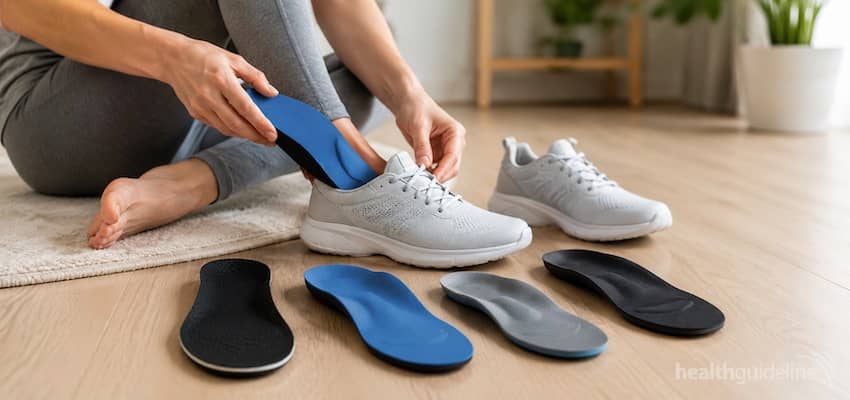
If you have flat feet or fallen arches, the right insole can take real strain off your feet, ankles, knees and lower back throughout the day. This guide rounds up eight of the best insoles for flat feet you can buy right now, matched to different needs — everyday wear, a tight budget, dress shoes, long shifts on hard floors, wide feet, running and a near-custom fit. Every product below is currently sold on Amazon in the US.
Quick Picks
Best overall
PowerStep Pinnacle
The best balance of firm arch support and cushioning for most people with flat feet.
Best budget
Dr. Scholl’s Stability Support
Under ~$20 and made specifically for flat feet and overpronation.
Best for standing all day
Spenco Total Support Max.
Longest-lasting
Tread Labs Pace
The rule that matters: flat feet need structured arch support and a deep heel cup — not just soft cushioning.
What are the best insoles for flat feet?
The best insoles for flat feet combine firm, structured arch support with a deep heel cup to control overpronation — not just soft foam cushioning. For most people the PowerStep Pinnacle is the best all-round choice, thanks to its balance of support and comfort. On a budget, Dr. Scholl’s Stability Support is designed specifically for flat feet and overpronation.
How we chose
We prioritized insoles with genuine structural arch support, a stabilizing (deep) heel cup and motion control, since those are the features that address the two main pain drivers of flat feet: a collapsing arch and inward-rolling overpronation. We cross-referenced current podiatrist-authored roundups and manufacturer specifications, favored brands with clear fit guidance (arch heights, widths, trim-to-fit), and confirmed each pick is currently listed on Amazon in the US. Prices move constantly, so we give approximate bands rather than fixed numbers — always check the live listing. The Amazon links here are standard product links; we don’t use affiliate tags or earn a commission on purchases.
Top picks at a glance
| Insole | Best for | Arch profile | Approx. price | Link |
|---|---|---|---|---|
| PowerStep Pinnacle | Best overall | Neutral, semi-rigid | ~$35–$45 | View |
| Dr. Scholl's Stability Support | Best budget | Supportive, stabilizing shell | ~$15 | View |
| Superfeet Low Arch (Black) | Dress & low-profile shoes | Low arch, extra-firm | ~$45–$55 | View |
| Tread Labs Pace | Longest-lasting | Firm; 4 arch heights (pick Low) | ~$75–$90 | View |
| Spenco Total Support Max | Standing all day | Firm, higher-profile | ~$40–$50 | View |
| PowerStep Pinnacle Wide Fit | Wide feet (3E–6E) | Neutral, semi-rigid, wide | ~$35–$40 | View |
| Superfeet Run Cushion Low Arch | Running & training | Low arch, cushioned | ~$55 | View |
| SOLE Active (moldable) | Near-custom fit | Molds to your arch | ~$50 | View |
01 / BEST OVERALL
PowerStep Pinnacle
The PowerStep Pinnacle pairs a semi-rigid arch shell with two layers of cushioning and a deep heel cradle, giving flat feet real structural support without feeling like a plank underfoot. It’s the #1 podiatrist-recommended orthotic brand, carries the APMA Seal of Acceptance, and is sized by shoe size, so there’s no trimming for most people.
Key features
- Semi-rigid supportive shell
- dual-layer foam cushioning
- deep heel cradle
- anti-microbial top cover
- made in the USA
- HSA/FSA eligible.
Arch profile: Neutral height, semi-rigid — good for mild-to-moderate overpronation.
Pros
- Excellent support-to-comfort balance
- works in athletic, walking, work and many casual shoes
- no trimming needed
- widely available.
Cons
- The arch can feel firm for the first few days
- standard width may be snug for very wide feet
- needs a shoe with a removable factory insole.
Best for: Most people with flat feet who want dependable daily support in sneakers, walking or work shoes.
Heavier or severe overpronation? The PowerStep Pinnacle Maxx adds an angled (posted) heel for extra motion control — view the Maxx on Amazon.
02 / BEST BUDGET
Dr. Scholl’s Stability Support
Dr. Scholl’s Stability Support insoles are engineered specifically for flat feet, low or fallen arches and overpronation, using a motion-control stabilizing shell and a shock-absorbing heel cup. At roughly $15 and available in most pharmacies and big-box stores, they’re the easiest low-risk way to see whether structured support helps your feet.
Key features
- Motion-control stabilizing shell
- shock-absorbing heel cup
- contoured arch support
- trim-to-fit.
Arch profile: Supportive with a stabilizing shell; moderate.
Pros
- Very affordable
- sold almost everywhere (no waiting on delivery)
- purpose-built for flat feet and overpronation
- separate men’s and women’s versions.
Cons
- Cushioning compresses faster than premium picks
- may not be enough correction for moderate-to-severe flatfoot
- plan to replace roughly every six months.
Best for: Mild flat feet, first-time insole users and budget shoppers in casual footwear.
03 / BEST FOR DRESS & LOW-PROFILE SHOES
Superfeet All-Purpose Support Low Arch (Black)
Getting structured support into slim shoes is hard, and that’s exactly what the low-profile Superfeet Black (now “All-Purpose Support Low Arch”) does. A reinforced stabilizer cap and deep heel cup deliver firm control in a thin footbed that fits loafers, flats and slim sneakers where thicker orthotics simply won’t go.
Key features
- Low-volume design
- reinforced stabilizer cap
- deep heel cup
- high-density closed-cell foam
- trim-to-fit.
Arch profile: Low arch, extra-firm — designed for lower-arched feet.
Pros
- Fits dress and low-profile shoes
- firm, durable structured support
- long-lasting foam.
Cons
- Minimal cushioning
- the firmness isn’t for everyone
- very severe flatfoot may need more.
Best for: Flat feet that need support inside dress shoes, flats or slim casual footwear.
Note on Superfeet colors: the popular Green insole is actually Superfeet’s high-arch model — great if you want maximum firm support in roomy shoes, but for lower arches the Black (or the more-cushioned Copper) is the better match.
04 / BEST FOR LONG-TERM DURABILITY
Tread Labs Pace
Most insoles slowly flatten as their foam breaks down. Tread Labs solves that with a two-part system: a firm molded arch support backed by a million-mile guarantee, plus a replaceable top cover. It comes in four arch heights — choose the Low profile for flat feet — and holds its shape step after step.
Key features
- Firm molded polypropylene arch support (million-mile guarantee)
- replaceable top cover
- deep heel cup
- APMA Seal of Acceptance
- four arch heights.
Arch profile: Firm and structural — select the Low arch height for flat feet.
Pros
- Doesn’t compress like foam-only insoles
- replaceable covers extend its life
- precise arch-height fit
- strong warranty and returns.
Cons
- Premium price
- a firm break-in period
- can feel bulky in low-volume shoes.
Best for: People on their feet all day, heavier users, and anyone who burns through insoles and wants long-term value.
05 / BEST FOR STANDING ALL DAY
Spenco Total Support Max
The Spenco Total Support Max is one of the most cushioned structured insoles you can buy, combining a rigid arch and deep heel cup with a multi-density base and a forefoot crash pad. That mix of firm control plus generous padding is built for long hours on hard floors, and it carries the APMA Seal of Acceptance.
Key features
- Rigid orthotic arch
- deep heel cup
- 3-POD multi-density support
- PU forefoot crash pad
- built-in metatarsal support
- ventilation channels
- antimicrobial top cover.
Arch profile: Firm and higher-profile — Spenco lists this as a high-arch model that also controls overpronation, so check the arch height suits your foot.
Pros
- Lots of cushioning without giving up structure
- slows overpronation
- comfortable through long shifts.
Cons
- Bulky in narrow or low-profile shoes
- the firmer/taller arch can be too much for some very low arches
- the cushion softens faster than the frame wears.
Best for: Retail, healthcare and warehouse workers — anyone standing or walking on hard surfaces all day who wants firm support plus padding.
06 / BEST FOR WIDE FEET
PowerStep Pinnacle Wide Fit
Standard insoles are often too narrow for wide feet, leaving them to bunch or slide. The PowerStep Pinnacle Wide Fit puts the same trusted PowerStep arch shape and deep heel cup on a wider platform sized for 3E–6E shoes, with a firmer arch calibrated to resist “bottoming out” under weight.
Key features
- Wider full-length platform (fits 3E–6E)
- signature semi-rigid PowerStep arch
- deep heel cup
- firmer arch to resist compression
- anti-microbial top cover
- made in the USA.
Arch profile: Neutral, semi-rigid, on a wide base.
Pros
- Fits wide and extra-wide shoes without bunching
- stays put for consistent support
- structured yet cushioned.
Cons
- Neutral arch height may feel low for severe flatfoot
- less cushioning than the Total Support Max
- give it a break-in period.
Best for: People with flat feet and wide or extra-wide feet.
07 / BEST FOR RUNNING & TRAINING
Superfeet Run Cushion Low Arch
Built for lower arches, the Superfeet Run Cushion Low Arch adds impact cushioning to a lightly structured, flexible footbed that moves with your stride for a smooth heel-to-toe transition. It fits running and athletic shoes (including zero-drop) without adding bulk, and it won a Good Housekeeping 2023 Fitness Award for supportive inserts.
Key features
- Low-arch profile
- Adaptive Comfort Technology that flexes with the foot
- dual-layer cushioning
- stabilizer
- moisture-wicking top cover
- trim-to-fit.
Arch profile: Low arch — lightly structured and cushioned.
Pros
- Cushioning plus support for impact activity without feeling bulky
- natural, flexible running feel
- award-winning.
Cons
- Less rigid motion control than a firm-shell orthotic
- severe overpronators may want more structure
- cushioning softens over time.
Best for: Runners, gym-goers and active people with flat or low arches.
08 / BEST NEAR-CUSTOM FIT
SOLE Active (moldable)
SOLE’s footbeds are heat- or wear-moldable, so they conform to your actual arch — a useful trick when a flat foot doesn’t match a pre-shaped insole. A firm supportive base and deep heel cup sit under adaptable Softec cushioning, and they come in several thicknesses so you can match the insole to your shoe.
Key features
- Heat- or wear-moldable footbed that adapts to any arch height
- deep heel cup
- firm base with Softec cushioning
- moisture-wicking top
- recycled cork base
- multiple thickness options.
Arch profile: Molds to your arch — works for low/flat arches.
Pros
- Near-custom fit at an over-the-counter price
- genuinely conforms to flat arches
- thickness choices for different shoes.
Cons
- Molding isn’t reversible, so follow the instructions carefully
- base support is modest next to a rigid shell
- you have to pick the right thickness for your footwear.
Best for: Between-mild-and-moderate flatfoot, hard-to-fit arches, and anyone who wants a closer-to-custom feel without a podiatrist visit.
About flat feet (and how insoles help)
Flat feet, also called fallen arches or pes planus, means one or both feet have little to no arch, so more of the sole presses into the ground when you stand. According to the Cleveland Clinic, all babies are born flat-footed, arches usually form by around age 6, and roughly 2 in 10 children still have flat feet as adults. Others develop “fallen arches” later in life — most commonly when the posterior tibial tendon that supports the arch weakens or is injured.
Flat feet often cause no problems at all. When they do, it’s usually because the arch collapses inward as you walk (overpronation), which can lead to arch and heel pain, tired feet and knock-on strain in the ankles, knees, hips and lower back. An insole doesn’t cure or permanently correct flat feet — but a supportive one can reduce that inward roll, improve stability and make walking and standing more comfortable. It also can’t replace medical care for a painful or worsening foot.
What to look for in insoles for flat feet
Structured support, not just softness
This is the single most important factor. Flat feet need firm structural support that holds the arch and stabilizes the heel; soft, squishy foam alone feels nice for a minute but collapses under your weight and does little to control overpronation. Look for a semi-rigid or rigid arch shell.
A deep heel cup and motion control
A deep heel cup cradles and steadies the heel, and features like a stabilizer cap or a slightly angled (posted) heel help limit the inward rolling that drives flat-foot pain.
The right arch height for your foot
Support has to match the shape of your foot. For flat feet that usually means a low-but-supportive arch that follows your contours; too tall an arch can feel like pressure in the wrong place. Brands like Tread Labs and Superfeet offer specific low-arch profiles for exactly this reason. If you’re between options, most retailers have generous return windows — use them.
Fit, size and shoe volume
Remove your shoe’s factory insole before inserting a new one, and trim to the guides if the insole is trim-to-fit. Thicker, more supportive insoles need a roomier shoe; slim shoes call for a low-profile footbed. If you have wide feet, choose a wide-fit model so the insole doesn’t bunch or slide.
Expect a break-in period
Structured insoles change how your foot sits, so give your body time to adjust. A common approach is to wear them about an hour the first day and add roughly an hour a day over a week; many people feel the benefit within a few weeks.
Other ways to ease flat-foot pain
Insoles are one piece of the picture. For flat-foot discomfort, foot-and-ankle specialists generally start with conservative steps: wearing supportive shoes (even at home), using over-the-counter orthotic inserts, resting and icing during flare-ups, and calf and arch stretches plus ankle-strengthening work. As the team at arch pain on the foot and general medical guidance both note, the goal of conservative care is usually to ease symptoms and limit progression rather than to rebuild the arch itself. If your pain centers on the ball of the foot, our guide to ball of foot pain relief may also help. None of this is a substitute for a professional assessment if pain persists.
When to see a professional
See an orthopedist or podiatrist if you have flat feet along with any of the following: pain that persists or worsens despite supportive shoes and insoles; swelling, stiffness or difficulty walking; pain spreading to your ankles, knees, hips or lower back; or a noticeable, relatively sudden flattening of the arch in one foot, which can signal posterior tibial tendon dysfunction and is worth evaluating promptly. For chronic or severe flatfoot, a professional can assess your gait and may recommend custom orthotics or other treatment. This article is for general information only and is not medical advice.
Frequently asked questions
Do insoles fix or cure flat feet?
No. Insoles don’t rebuild your arch or permanently correct flat feet — they support the foot, control overpronation and reduce discomfort while you wear them. The Cleveland Clinic notes that orthotics and stretching can help manage symptoms, and that flat feet only need treatment when they cause pain or other problems.
What kind of arch support is best for flat feet?
Firm, structured support with a deep heel cup — and an arch height that matches your foot, typically a low but supportive arch that follows your contours. Soft cushioning alone isn’t enough, because it compresses under your weight and doesn’t limit the inward rolling that causes most flat-foot pain.
How long do insoles take to get used to?
Usually a short break-in. A common approach is to wear new insoles for an hour or two the first day and add time gradually over about a week, letting your feet, knees and back adjust to the improved support. Many people feel the benefit within a few weeks; if pain increases instead, stop and reassess.
Are expensive insoles worth it over drugstore ones?
Not always. For mild flat feet, an inexpensive purpose-built option like Dr. Scholl’s Stability Support helps many people. Premium insoles such as Tread Labs Pace or Superfeet earn their price mainly through durability, replaceable parts and precise arch-height fitting — useful if you’re on your feet all day or wear insoles out quickly.
Over-the-counter or custom orthotics?
Over-the-counter insoles work well for mild-to-moderate flat feet and are the sensible first step. Custom orthotics, made by a podiatrist from a scan or mold of your foot, are worth considering for chronic or severe flatfoot, significant pain, or when several good over-the-counter options haven’t helped.
Can flat feet cause knee or back pain?
They can. When the arch collapses and the ankle rolls inward, it changes alignment further up the chain, which may contribute to knee, hip or lower-back discomfort for some people. Supportive insoles that reduce overpronation can help, but persistent pain should be evaluated by a professional.
Medical disclaimer: This article is for general information only and is not medical advice. Talk to a qualified healthcare professional about your specific situation.