Compression Socks With Zipper: 5 Best Picks for 2026
2026 buying guide · zipper fit, pressure & safety
Compression socks with a zipper can make a snug knee-high stocking easier to open and close, but the zipper does not decide how much compression your leg needs. The most important choices are the listed pressure range, accurate ankle-and-calf sizing, open versus closed toe, and whether the zipper closes smoothly without pinching, bunching or creating a pressure point.
Quick picks
Best all-round value
bropite Zipper Compression Socks
A 2-pair, open-toe 15–20 mmHg listing that covers the most common features shoppers want from a basic zipper stocking.
Closed-toe pick
cerpite Zipper Compression Socks
A 2-pair 15–20 mmHg option for shoppers who prefer full foot coverage instead of an open toe.
Wide-calf option
Hillban Zipper Compression Socks
A seller-listed 15–25 mmHg, wide-calf 2-pair option. Measure carefully and do not treat the unusual pressure range as a prescription.
How we chose these compression socks with zipper
This is a desk-research buying guide, not a hands-on wear test. We checked current Amazon US product pages for zipper-equipped knee-high compression stockings, then compared the listed pressure range, toe style, pack format and fit positioning. We favored products that give shoppers a meaningfully different choice instead of filling the list with near-identical variants.
For the health and fitting sections, we cross-checked general compression guidance from Cleveland Clinic, Guy’s and St Thomas’ NHS Foundation Trust, and the CDC. Product categories such as “best value” or “best wide-calf option” are editorial judgments based on currently listed features; they are not findings from a clinical head-to-head trial.
Best zipper compression socks at a glance
| Product | Our category | Listed compression | Toe / format | Before you buy |
|---|---|---|---|---|
| bropite Zipper Compression Socks | Best all-round value | 15–20 mmHg | Open toe · 2 pairs | Check ankle/calf fit and open-toe comfort |
| Ailaka Medical Zipper Compression Socks | Simple 15–20 pick | 15–20 mmHg | Closed toe · knee high | Confirm exact size chart for the selected variant |
| cerpite Zipper Compression Socks | Closed-toe 2-pack | 15–20 mmHg | Closed toe · 2 pairs | Useful if you prefer full-foot coverage |
| TheraMagic Zipper Compression Socks | Firmer option | 20–30 mmHg | Closed toe · graduated | Choose firmer compression deliberately, not by default |
| Hillban Zipper Compression Socks | Wide-calf option | 15–25 mmHg (seller-listed) | Wide-calf · 2 pairs | Unusual pressure range; confirm whether it fits your plan |
Do not choose by zipper alone. A zipper can change how the stocking opens, but compression still depends on garment construction, pressure range and fit. If a clinician prescribed compression for a medical condition, match the prescribed strength and garment type rather than substituting a different range because it looks easier to put on.
Five compression socks with zipper to compare
01 / BEST ALL-ROUND VALUE
bropite Zipper Compression Socks
bropite Zipper Compression Socks — view on Amazon are a straightforward open-toe option listed at 15–20 mmHg and sold as two pairs. They make the most sense for shoppers who specifically want the toe area uncovered and would rather open a side zipper than pull an entire snug stocking over the calf in one motion.
Key features
- Listed at 15–20 mmHg
- Open-toe, knee-high design
- Two-pair pack on the checked Amazon listing
- Side zipper for opening and closing the calf section
Pros
- Open toe leaves the toes uncovered
- Two pairs give you a spare for wash rotation
- Moderate listed pressure rather than the firmer 20–30 mmHg range
Cons
- Open toe will not suit shoppers who want full foot coverage
- A side zipper can still be awkward if hand reach or grip is limited
- Fit must be checked carefully so the zipper area does not press or bunch
Best for: Shoppers who want an open-toe 15–20 mmHg zippered stocking and a two-pair pack.
Who it is not for: Anyone who has been told to use a different compression strength, or who needs a closed-toe garment.
02 / SIMPLE 15–20 MMHG PICK
Ailaka Medical Zipper Compression Socks
Ailaka Medical Zipper Compression Socks — view on Amazon are listed as a knee-high 15–20 mmHg closed-toe stocking. This is the simplest single-product choice in the group if you want a conventional sock-like toe rather than an open-toe design and do not need the firmer 20–30 mmHg listing.
Key features
- Listed at 15–20 mmHg
- Closed-toe, knee-high format
- Side zipper
- Available through a current Amazon US product page at the time of research
Pros
- Full foot coverage
- Common 15–20 mmHg consumer listing range
- Simple design without requiring an open toe
Cons
- Closed toe can feel less appealing if you prefer sandals or uncovered toes
- The zipper does not eliminate the need to position the heel and fabric correctly
- Seller wording includes medical-use claims that should not replace individual advice
Best for: Shoppers comparing a basic closed-toe, 15–20 mmHg zipper stocking.
Who it is not for: People who need an open-toe style, a different prescribed pressure, or a garment professionally fitted for a specific circulation problem.
03 / CLOSED-TOE 2-PACK
cerpite Zipper Compression Socks
cerpite Zipper Compression Socks — view on Amazon are listed as two pairs of 15–20 mmHg closed-toe compression stockings. The main reason to choose them over bropite is toe coverage: this format behaves more like a conventional knee-high sock while still giving you a zipper along the leg.
Key features
- Listed at 15–20 mmHg
- Closed-toe construction
- Two-pair pack
- Knee-high zipper format
Pros
- Two pairs for rotation
- Closed toe gives full foot coverage
- Listed pressure matches the more moderate group in this comparison
Cons
- Less toe ventilation than an open-toe design
- Size names can vary by color/variant, so do not assume one chart fits every listing option
- Still requires careful smoothing around the ankle and zipper
Best for: Buyers who want full foot coverage plus a second pair.
Who it is not for: Shoppers who specifically want open toes or who need a firmer prescribed compression range.
04 / FIRMER 20–30 MMHG OPTION
TheraMagic Zipper Compression Socks
TheraMagic Zipper Compression Socks — view on Amazon are listed as a closed-toe, graduated 20–30 mmHg stocking with a zipper and fabric skin guard. They stand apart because their pressure range is firmer than most of this shortlist, which makes correct sizing and an appropriate reason for using that level especially important.
Key features
- Listed at 20–30 mmHg graduated compression
- Closed-toe, knee-high design
- YKK zipper listed by the seller
- Fabric guard behind the zipper listed to separate hardware from skin
Pros
- Firmer listed compression for people specifically seeking 20–30 mmHg
- Closed toe for full foot coverage
- Skin-guard feature addresses a practical zipper-contact concern
Cons
- 20–30 mmHg is not the right default for every shopper
- A firmer stocking can be harder to position even with a zipper
- Seller claims about relief or medical use should not be treated as a diagnosis or prescription
Pressure matters more than convenience. Cleveland Clinic advises involving a healthcare provider when choosing compression for a medical condition and notes that some people need specific guidance or supervision. If 20–30 mmHg was not already part of your plan, do not select it simply because it sounds “stronger.”
Best for: Shoppers who already know that a 20–30 mmHg knee-high stocking is appropriate for them and want a zipper plus a closed toe.
Who it is not for: Someone choosing compression strength for the first time because of unexplained swelling, pain or a suspected circulation problem.
05 / WIDE-CALF OPTION
Hillban Zipper Compression Socks
Hillban Zipper Compression Socks — view on Amazon are sold as a two-pair wide-calf option and are listed at 15–25 mmHg. The wider-calf positioning is the reason they make this shortlist, but the seller’s 15–25 mmHg label is less conventional than the 15–20 or 20–30 ranges shown by the other products.
Key features
- Seller-listed 15–25 mmHg range
- Wide-calf / plus-size positioning
- Two-pair pack
- Zippered knee-high format
Pros
- Specifically marketed for wider calves
- Two pairs for wash rotation
- Offers a fit-focused alternative to standard-calf zipper socks
Cons
- 15–25 mmHg is an unusual seller-listed range
- “Wide calf” still requires actual measurement; the label alone does not guarantee fit
- Do not substitute this range for a prescribed garment without checking
Best for: Shoppers whose calf measurements fall outside many standard zipper-sock charts and who want to compare a wider-calf listing.
Who it is not for: Anyone who needs an exact prescribed pressure class that does not match the seller’s stated range.
Are compression socks with a zipper actually easier to put on?
Often, but not automatically. A zipper lets the leg opening spread wider, so you may have less fabric to pull over the calf at once. You still need to position the foot and heel, smooth the stocking evenly, hold the zipper area flat and close it without catching skin. Hand strength, reach, swelling and the exact fit can all change whether a zipper feels easier.
The biggest practical advantage is access: opening the zipper can reduce how much the stocking needs to stretch while it passes over the widest part of the calf. That can be useful for some older adults, people with limited grip or people who simply struggle with conventional tight knee-highs. But a zipper is not a universal accessibility solution. A small pull tab can still be difficult if you have arthritis, tremor or limited hip flexibility.
A zipper is an aid, not a sizing shortcut. If the stocking is too small, the zipper can become harder to close and may create localized pressure. If it is too large, the fabric can wrinkle and the intended compression may not be distributed as designed.
If you are still deciding whether a zipper is necessary, compare the broader options in our compression socks guide. For people specifically shopping for knee-high coverage, our knee-high compression socks guide may also help.
What compression level should you choose?
There is no single “best” mmHg level for everyone. Compression strength should match why you are wearing the stocking, your circulation and any instructions from a healthcare professional. In this roundup, most listings are in the 15–20 mmHg range; TheraMagic is listed at 20–30 mmHg, and Hillban uses a seller-listed 15–25 mmHg range.
Compression is commonly described in millimeters of mercury (mmHg). Graduated stockings are designed to apply more pressure lower on the leg and less higher up. Cleveland Clinic explains that compression therapy is used for several venous and swelling-related situations, but the type and strength should be chosen with the person’s health context in mind.
| Listed range | Products here | How to think about it |
|---|---|---|
| 15–20 mmHg | bropite, Ailaka, cerpite | A more moderate listed range in this roundup. Still choose it for a reason, not just because it is common. |
| 20–30 mmHg | TheraMagic | Firmer listed compression. If you are treating a medical problem or were prescribed compression, confirm this is the correct range. |
| 15–25 mmHg | Hillban | A seller-listed range that does not match the other standard increments shown here. Verify the exact product and whether it fits your intended use. |
Do not self-treat unexplained swelling by simply buying stronger socks. Sudden or severe swelling can have causes that need assessment. If swelling is your main concern, our compression socks for swelling guide gives more background, but new or one-sided symptoms still deserve medical attention.
Open toe or closed toe: which zipper sock is better?
Neither is universally better. Open-toe zipper socks leave the toes uncovered and can feel less restrictive around the forefoot, while closed-toe styles cover the whole foot and feel more like a conventional sock. Choose based on comfort, footwear, toe sensitivity and the exact garment you have been advised to wear.
In this list, bropite is the clear open-toe option, while Ailaka, cerpite and TheraMagic are listed as closed toe. Do not cut the toe off a closed-toe compression stocking or otherwise alter the garment; changing its construction can affect fit and how the fabric behaves.
How do you measure for zipper compression socks?
Measure your leg and follow the chart for the exact product. Compression hosiery is commonly sized using ankle and calf measurements, with some garments also using foot size or leg length. Measure when swelling is at its lowest if your clinician has advised that timing, and recheck if your leg size changes substantially.
- Read the product’s own chart first. Do not assume that “medium” means the same thing across brands.
- Measure the ankle where the chart directs. For many compression garments, ankle circumference is a key measurement.
- Measure the widest part of the calf. This is especially important for zipper socks because the closure has to lie flat over the leg.
- Check any required length or shoe-size measurement. Some charts use additional dimensions to prevent the stocking from being too short or too long.
- If one leg is significantly different from the other, do not guess. Ask the supplier or a clinician which measurement should guide the size, especially when swelling is changing.
NHS compression-treatment guidance illustrates why clinical hosiery may be professionally assessed, measured and fitted. If your stockings are part of treatment for venous disease, post-thrombotic symptoms, lymphedema or another diagnosed condition, use the sizing process recommended by your care team rather than relying only on an online clothing chart.
How do you put on zippered compression socks without pinching skin?
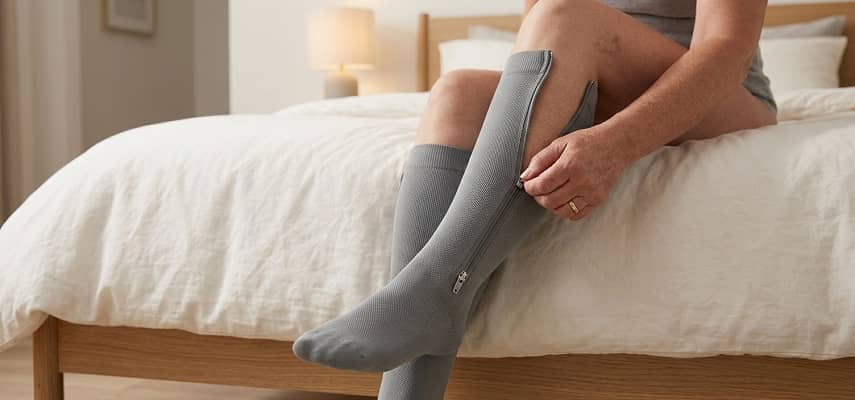
Open the zipper fully, seat the heel first, smooth the stocking, and close the zipper slowly while keeping skin and loose fabric away from the teeth. The stocking should lie flat without folds. If the zipper is difficult to close, do not force it: recheck alignment and size instead of pulling harder.
- Start with dry skin and the zipper fully open. Remove jewelry that could snag the fabric.
- Place the foot and heel correctly. An open zipper does not fix a heel that is sitting too high or low.
- Smooth the fabric upward. Avoid twisting, rolling or leaving creases around the ankle.
- Flatten the zipper guard, if the garment has one. Keep fingers between the zipper and skin as you begin closing if that can be done safely and comfortably.
- Close the zipper slowly. Stop if it catches skin, becomes unusually hard to pull, or creates sharp pressure.
- Recheck the leg after a few minutes. Remove the stocking and seek advice if you develop persistent pain, numbness, tingling, marked skin discoloration or a cold foot.
Guy’s and St Thomas’ NHS guidance similarly emphasizes keeping compression stockings smooth rather than folded or wrinkled. That matters with zipper styles too: the closure should not become a reason to accept bunching elsewhere in the garment.
Can you wear zipper compression socks all day or while sleeping?
Follow the wearing schedule for your condition and garment. Many compression stockings are used during the day and removed for sleep, but individual instructions can differ. Guy’s and St Thomas’ NHS specifically advises not wearing compression stockings to bed unless a doctor or specialist nurse has told you otherwise.
If you work long shifts and are comparing daytime options, see our compression socks for nurses guide. If your question is specifically about nighttime use, read our compression socks for sleeping guide before assuming that an “all-day” seller description also means overnight wear.
When should you ask a healthcare professional before using compression socks?
Ask for medical guidance when compression is being used to manage a diagnosed condition, when symptoms are new or severe, or when circulation or skin health may make compression unsafe. Cleveland Clinic specifically flags situations such as severe swelling, peripheral artery disease and certain skin problems as reasons to get provider guidance rather than treating compression stockings as a routine clothing purchase.
Get advice before relying on compression if you have:
- Sudden, severe or unexplained leg swelling
- Known peripheral artery disease or another significant circulation problem
- Open wounds, a skin infection, fragile skin or a new rash under the stocking area
- Marked pain, numbness, tingling, discoloration or a cold foot while wearing the garment
- A prescribed compression plan where you are considering changing the pressure range or garment type
Pregnancy is another situation where symptoms and risk factors vary. If that is your use case, our compression socks for pregnancy guide gives a more focused overview, but new one-sided swelling or pain should not be dismissed as a normal pregnancy symptom.
When is leg swelling an emergency?
Do not use compression socks as a substitute for assessment of possible blood-clot symptoms. The CDC lists swelling, pain or tenderness, warmth and skin discoloration among possible signs of deep vein thrombosis (DVT). Difficulty breathing, chest pain, coughing up blood, a fast or irregular heartbeat, lightheadedness or fainting can be signs of pulmonary embolism and need immediate medical help.
Urgent safety point: If you have sudden one-sided leg swelling or pain, especially with risk factors for a blood clot, seek prompt medical assessment. If you develop chest pain, difficulty breathing, coughing up blood, severe lightheadedness or fainting, seek emergency medical help immediately.
Frequently asked questions
Does a zipper make compression socks less effective?
Not necessarily. A zipper is a closure feature; the garment still needs to be designed for its stated compression and fit your leg correctly. Problems are more likely when the stocking is the wrong size, the zipper does not close flat, or fabric bunches around the ankle or calf. Follow the exact product’s sizing and application instructions.
Are zipper compression socks good for seniors?
They can be easier for some older adults because the leg opening can spread wider, but they are not automatically easier for everyone. A small zipper pull may still be difficult with arthritis, tremor or limited reach. The correct compression level, size, skin condition and circulation are more important than age alone.
What mmHg should zipper compression socks be?
There is no universal mmHg target for zipper socks. The zipper does not determine pressure. Choose the range that matches your use case and any clinical advice you have received. This guide includes products listed at 15–20 mmHg, 20–30 mmHg and one seller-listed 15–25 mmHg option.
Are open-toe or closed-toe zipper compression socks better?
Choose based on fit and comfort rather than assuming one style compresses better. Open-toe stockings leave the toes free, while closed-toe stockings cover the full foot. Your footwear, toe sensitivity and any instructions from a healthcare professional can help determine which format is more practical.
Can I wear zipper compression socks to bed?
Do not assume so. Many compression stockings are intended for daytime wear, and Guy’s and St Thomas’ NHS advises not wearing them to bed unless a doctor or specialist nurse has told you otherwise. Follow the instructions for your condition and the exact garment you are using.
Can zipper compression socks prevent or treat a DVT?
Do not rely on an over-the-counter zipper sock to diagnose, prevent or treat a suspected DVT on your own. Compression may be used in selected medical situations, but blood-clot risk and treatment are individualized. Sudden one-sided swelling or pain needs prompt assessment; chest pain or difficulty breathing needs emergency help.