Hydrocollator Moist Heat Packs: 6 Best Picks (2026)
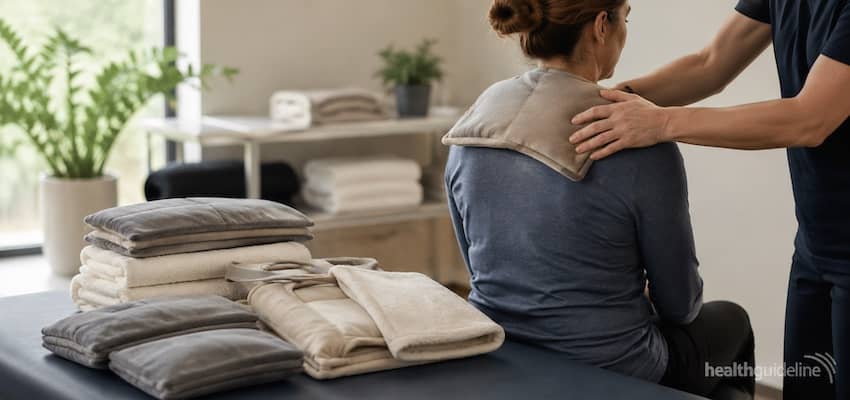
2026 buying guide · moist heat packs, sizing & safety
Quick answer: For most people comparing Hydrocollator moist heat packs, the Chattanooga Standard 10″ x 12″ HotPac is the most versatile starting point. Choose a contour or larger size only when it better matches the treatment area. These packs become very hot in a Hydrocollator unit, so they require an insulating cover or towel barrier and careful skin checks.
What are the best Hydrocollator moist heat packs?
The best pack is the one that covers the intended area without being unnecessarily large or awkward. Chattanooga currently offers seven HotPac shapes and sizes. For general use, the Standard size is the simplest choice; the Neck Contour and Knee/Shoulder designs make more sense when their shape matches the body area you plan to treat.
Best overall
Chattanooga Standard
A versatile 10″ x 12″ pack for buyers who do not need a specialized contour.
Best for neck contour
Chattanooga Neck Contour
A 24-inch contour intended to sit more naturally around the neck and upper shoulder area.
Best large-area option
Chattanooga Oversize
A 15″ x 24″ pack when broad coverage matters more than portability or easy handling.
JUMP TO A SECTION
How did we choose these Hydrocollator packs?
We checked current manufacturer specifications, confirmed the featured products have identifiable Amazon US listings, and compared size, shape, intended coverage, handling and safety considerations. We did not use unverified star ratings, review counts or fixed prices as ranking criteria because those change. Category labels such as “best overall” are editorial judgments, not findings from a head-to-head clinical trial.
Which Hydrocollator pack size should you buy?
Start with the body area, then choose the smallest shape that gives useful coverage without folding, bunching or hanging far beyond the target. A larger pack is not automatically better: when saturated and heated, it is heavier and can be harder to position safely. The exact heating unit and protective cover must also accommodate the pack you choose.
| Pack | Our category | Size | Best reason to choose it |
|---|---|---|---|
| Chattanooga Standard | Best overall | 10″ x 12″ | Versatile medium-size starting point |
| Chattanooga Neck Contour | Best for neck contour | 24″ long | Purpose-shaped for neck/upper-shoulder coverage |
| Chattanooga Oversize | Best large-area option | 15″ x 24″ | Broad coverage for larger treatment areas |
| Chattanooga Spinal | Best long rectangular option | 10″ x 18″ | More length than the Standard without Oversize width |
| Chattanooga Knee/Shoulder | Best joint-contour option | 10″ x 20″ | Purpose-shaped format for knee or shoulder positioning |
| Relief Pak Standard | Best alternative brand | 10″ x 12″ | Comparable standard format from another established rehab supplier |
Do not shop by temperature. Chattanooga’s professional Hydrocollator heating units maintain their water and HotPacs at about 160–165°F (71–74°C). That is the unit temperature, not a safe temperature for bare-skin contact. Always use the recommended cover/barrier and monitor your skin.
The six best Hydrocollator moist heat packs to compare in 2026
01 / BEST OVERALL
Chattanooga Hydrocollator Standard HotPac 10″ x 12″
The Standard 10″ x 12″ HotPac is our first choice for most buyers because it is the middle-ground Chattanooga format: large enough for useful coverage, but easier to handle than the Oversize model. It uses the same reusable bentonite-hydrocolloid filling and cotton construction as the rest of the current HotPac family.
Key features
- 10″ x 12″ standard size
- Natural bentonite hydrocolloid filling
- Cotton banding construction
- Reusable with a compatible Hydrocollator heating setup
Pros
- Versatile size for general moist-heat use
- Less bulky than large-area formats
- Easy size to pair with standard protective covers
Cons
- Not contoured specifically for the neck or knee
- Still requires a proper heating method and insulation
Best for: Buyers who want one broadly useful Hydrocollator pack rather than a specialized shape.
Who it is not for: People who want a plug-in heating pad or a pack designed to drape around the neck.
Approx. price: Varies by seller and stock; check the current Amazon price before ordering.
02 / BEST FOR NECK CONTOUR
Chattanooga Hydrocollator Neck Contour HotPac
The 24-inch Neck Contour HotPac is the better Chattanooga choice when a rectangular pack slides away from the neck or fails to cover both sides comfortably. Its value is the shape, not a stronger heating effect. If your discomfort is localized elsewhere, the Standard pack is simpler and usually easier to position.
Key features
- 24-inch neck-contour format
- Reusable bentonite-hydrocolloid filling
- Cotton construction
- Part of Chattanooga’s current seven-size HotPac line
Pros
- More natural drape around the neck than a small rectangle
- Useful when bilateral upper-shoulder coverage is desired
Cons
- Less versatile for unrelated body areas
- Its longer shape can be awkward to handle when saturated
Best for: Neck and upper-shoulder coverage when a clinician has recommended superficial heat.
Who it is not for: Buyers who mainly want a multipurpose rectangular pack.
Approx. price: Varies by seller and stock; check the current Amazon price.
Prefer an electric option? Compare our neck and shoulder heating pad guide.
03 / BEST LARGE-AREA OPTION
Chattanooga Hydrocollator Oversize HotPac 15″ x 24″
The Oversize 15″ x 24″ HotPac is the large-coverage pick. It makes sense when a Standard pack leaves too much of the intended area uncovered, but the tradeoff is weight and handling: a large saturated pack is less convenient to lift, insulate and position. Confirm that your heating unit and cover can accommodate it.
Key features
- 15″ x 24″ oversize format
- Broad rectangular coverage
- Reusable hydrocolloid filling
- Designed for Hydrocollator moist-heat use
Pros
- Covers a much larger area than the Standard pack
- Useful when broad rather than targeted heat is intended
Cons
- Heavier and harder to reposition when wet
- Needs a suitably large cover and heating setup
Best for: Broad treatment areas where a clinician recommends moist superficial heat.
Who it is not for: Anyone who struggles to lift or safely position a large, hot, saturated pack.
Approx. price: Varies by seller and stock; larger packs generally cost more, so check the live listing.
04 / BEST LONG RECTANGULAR OPTION
Chattanooga Hydrocollator Spinal HotPac 10″ x 18″
The 10″ x 18″ Spinal HotPac fills the gap between Chattanooga’s 10″ x 12″ Standard and 15″ x 24″ Oversize packs. Its extra length gives broader longitudinal coverage without the full width and bulk of the Oversize. It is a sensible choice when the Standard feels too short but a giant pack would be cumbersome.
Key features
- 10″ x 18″ rectangular format
- Longer than the Standard size
- Reusable bentonite-hydrocolloid filling
- A second 10″ x 24″ spinal size also exists in Chattanooga’s line
Pros
- Useful middle size for longer areas
- Less bulky than the 15″ x 24″ Oversize
Cons
- Still not a contoured pack
- Longer shape can be unnecessary for a small treatment area
Best for: Buyers who want more length than a Standard HotPac without moving to the widest Oversize format.
Who it is not for: People who need a small joint or neck-specific contour.
Approx. price: Check the current Amazon price; prices vary by seller and availability.
05 / BEST JOINT-CONTOUR OPTION
Chattanooga Hydrocollator Knee/Shoulder HotPac 10″ x 20″
The Knee/Shoulder 10″ x 20″ HotPac is the purpose-shaped Chattanooga option for buyers who find flat rectangles awkward around a joint. Its advantage is positioning rather than extra heat. It is especially worth comparing when a Standard pack does not conform well enough to the knee or shoulder area you were told to treat.
Key features
- 10″ x 20″ knee/shoulder format
- Purpose-shaped for joint positioning
- Reusable hydrocolloid construction
- Current Chattanooga HotPac model
Pros
- More joint-friendly shape than a plain rectangle
- Useful when wraparound positioning matters
Cons
- Specialized shape is less useful for flat body areas
- Heat is not appropriate for every new, swollen joint injury
Best for: Knee or shoulder positioning after a clinician has confirmed heat is appropriate.
Who it is not for: A brand-new hot, swollen or bruised injury where cold or another plan may be more appropriate.
For cold-therapy options, see our ice packs for knees guide.
Approx. price: Check the current Amazon price; seller and stock can change.
06 / BEST ALTERNATIVE BRAND
Relief Pak Moist Heat Pack Standard 10″ x 12″
Relief Pak is the useful alternative if you want a standard 10″ x 12″ reusable moist-heat pack but do not specifically need Chattanooga branding. Performance Health currently lists Standard, Cervical, Oversize, Half and Circular Relief Pak shapes and instructs users to apply the heated pack with a cover or heavy towel for protection.
Key features
- 10″ x 12″ standard size
- Reusable moist-heat format
- Multiple shapes available in the same Relief Pak family
- Manufacturer recommends a cover or heavy towel during application
Pros
- Comparable standard-size alternative
- Clear current manufacturer guidance to use a protective barrier
Cons
- Not a Chattanooga Hydrocollator-branded HotPac
- You still need to follow the exact heating instructions for the product and equipment you use
Best for: Buyers comparing a second established rehab-supply brand in the same standard size.
Who it is not for: Clinics standardizing specifically on Chattanooga HotPac sizes, accessories and workflows.
Approx. price: Performance Health and Amazon pricing varies by size and seller; check the live listing.
What is a Hydrocollator, exactly?
A Hydrocollator is Chattanooga’s thermostatically controlled hot-water heating system for reusable moist-heat HotPacs. The stainless-steel tanks are commonly used in rehabilitation and athletic settings, while “Hydrocollator” is also often used informally to describe the heated packs themselves. The tank and the HotPac are separate products, so make sure you know which one a listing actually includes.
Home-buyer reality check: Current Chattanooga E-2 product information describes Hydrocollator heating units as equipment for professional rehabilitation and athletic facilities. If you only want occasional home heat, a conventional electric heating pad may be simpler, cheaper and easier to control than buying and maintaining a clinical tank.
How hot is a Hydrocollator unit?
Current Chattanooga specifications list a 160–165°F (71–74°C) operating range for its professional heating units. That temperature is used to maintain the water bath and HotPacs; it should never be interpreted as a safe bare-skin target. A heated Hydrocollator pack requires insulation between the pack and your skin, and the application should feel comfortably warm rather than painfully hot.
Do you need a special cover?
You need an adequate heat barrier. Performance Health specifically says Chattanooga Hydrocollator HotPacs should not be applied directly to the skin, and Relief Pak instructions recommend a cover or heavy towel. A purpose-made terry cover is convenient, but the key safety principle is sufficient insulation plus frequent skin checks. Do not sit or lie on a Hydrocollator HotPac.
How should you care for a reusable moist heat pack?
Follow the instructions for your exact pack and heating system rather than copying a generic online routine. Inspect the fabric, seams and contents before use, and retire a leaking or damaged pack. Do not assume a Chattanooga Hydrocollator HotPac is microwave-safe simply because some other moist-heat packs are; use only heating methods explicitly allowed by the product instructions.
How do you use moist heat safely?
Use superficial heat only when it fits the problem you are treating. Keep a towel or approved cover between the hot pack and bare skin, check the skin during treatment, and stop if the heat becomes uncomfortable. Hospital guidance commonly limits a heat session to roughly 20–30 minutes, while Cleveland Clinic suggests about 20 minutes or fewer for home heat or ice sessions.
- Confirm heat is appropriate. A new injury that is hot, swollen or bruised may be better served by cold initially; diagnosis and individual instructions matter.
- Use a barrier. Never put a Hydrocollator HotPac directly on bare skin. Use the compatible cover and/or enough toweling to keep the heat comfortable.
- Check sensation and circulation. Heat is riskier when you cannot reliably feel temperature or have impaired circulation. Ask a clinician before use if that applies to you.
- Monitor the skin. Stop for burning, marked redness, pain, numbness, dizziness or any other concerning reaction.
- Stay awake. Do not sleep with a hot pack in place, and do not lie or sit on a Hydrocollator pack.
Extra caution with reduced sensation
If you have numbness, neuropathy or reduced ability to sense temperature, do not treat heat as a routine self-care tool without professional guidance. MedlinePlus specifically warns people with diabetes not to use heating pads or hot-water bottles on their feet because reduced heat sensation can lead to severe burns.
For new knee injuries where cold is more appropriate, our ice packs for knees guide explains practical cold-pack options. For a simpler dry-heat alternative, see the neck and shoulder heating pad guide.
Does moist heat actually help pain and stiffness?
Superficial heat can provide short-term relief for some musculoskeletal pain and stiffness, but it is an adjunct rather than a cure. A systematic review and meta-analysis found immediate benefits from local heat applications for pain and some functional outcomes, while more recent reviews emphasize selecting the right condition and combining heat with an appropriate broader treatment or rehabilitation plan.
What the evidence means for a buyer
Buying a larger, hotter or more expensive pack does not prove it will work better. The evidence supports superficial heat as a symptom-management option in selected musculoskeletal situations; it does not show that one Hydrocollator size or brand is clinically superior to another. Choose based on fit, safe handling and the treatment plan you actually need.
When should you see a healthcare professional instead of self-treating?
Get medical advice when pain is severe, follows a significant injury, keeps worsening, repeatedly returns, or comes with marked swelling, weakness, numbness, fever, unexplained redness or loss of normal function. Heat can temporarily change how an area feels, but it cannot tell you whether the underlying problem is a strain, fracture, nerve issue, infection or another condition that needs different care.
Do not use heat to push through warning signs. If an area is newly injured, very swollen, unusually hot/red, numb, poorly perfused or has an open wound, get appropriate guidance before applying a Hydrocollator pack.
Frequently asked questions about Hydrocollator packs
What temperature should a Hydrocollator be?
Current Chattanooga professional heating units are specified to maintain the water bath and HotPacs at about 160–165°F (71–74°C). That is not a safe bare-skin temperature. The heated pack must be insulated with the recommended cover or towels, and you should monitor comfort and skin response throughout the application.
How long should a Hydrocollator HotPac stay on?
Do not use “how long the pack stays warm” as your treatment timer. Chattanooga says HotPacs can provide up to 30 minutes of heat, while hospital and Cleveland Clinic home guidance generally keeps heat sessions around 20–30 minutes or about 20 minutes or fewer. Follow your clinician’s and product’s instructions if they differ.
Can you put a Hydrocollator HotPac directly on skin?
No. Current Performance Health guidance for Chattanooga HotPacs says not to apply them directly to the skin. Use a suitable terry cover or adequate toweling, check the skin during treatment, and stop if the pack feels painfully hot. Do not sit or lie on the pack because pressure can increase heat transfer and burn risk.
Can you microwave a Chattanooga Hydrocollator HotPac?
Do not assume you can. Chattanooga’s current HotPac information describes use with Hydrocollator Heating Units, and different reusable moist-heat products can have different heating instructions. Use only a heating method explicitly permitted for your exact model. A microwave method found for another brand or pack should not be transferred to a Chattanooga HotPac.
Is moist heat better than dry heat?
Not universally. Both are forms of superficial heat, and the better choice often comes down to comfort, convenience, the body area and your treatment plan. A Hydrocollator pack provides moist heat but needs heating, handling and insulation; an electric heating pad is easier for many home users and offers more direct temperature control.
Should you use heat or ice on a new sprain?
Brand-new injuries such as bruises and sprains are often better served initially by cold, especially when heat and swelling are prominent. Heat is more commonly used for stiffness and muscle tightness. The right choice still depends on the injury and your medical situation, so seek assessment for severe pain, major swelling or loss of function.
Can you sleep with a Hydrocollator pack?
No. Hospital heat-safety guidance advises not leaving heat in place while asleep. Staying awake allows you to notice excessive warmth, skin changes or numbness and remove the pack promptly. Hydrocollator packs also should not be sat or lain on, because added pressure can make heat exposure less predictable.
Medical disclaimer: This article is for general information only and is not medical advice. Talk to a qualified healthcare professional about your specific condition, whether heat is appropriate, and how to use a hot pack safely.