Best Kneeling Chair: 6 Ergonomic Picks for 2026
2026 buying guide · posture, fit & comfort
A kneeling chair can be a useful alternative sitting position for desk work, but it is not a treatment for back pain and it is not automatically more ergonomic than a well-fitted office chair. For most buyers, the best choice is a model that fits both your body and desk, lets you change position easily, and does not create painful pressure on your shins or knees. This guide compares six current kneeling chairs with different strengths, from rocking designs to adjustable wheeled frames.
The best kneeling chairs at a glance
Best overall
Varier Variable
A refined rocking design with no mechanical adjustment parts and unusually good freedom to shift how you place your legs.
Best value rocker
VIVO Wooden Rocking
Thick cushions, a 250-pound listed capacity and a simple wood rocker at a much lower price than premium designs.
Best wheeled option
DRAGONN by VIVO
An adjustable metal-frame model with casters for buyers who prefer mobility over a rocking base.
How we chose these kneeling chairs
This is a desk-research comparison, not a hands-on test. We started with models that are currently sold in the United States and have a verifiable Amazon listing, then checked manufacturer specifications where available. We prioritized fit range, adjustability, ability to change position, cushion design, mobility, storage, frame construction and clearly stated limitations. Category labels such as “best overall” are editorial judgments based on those features, not results from a clinical head-to-head trial.
Important: A chair becomes “ergonomic” only when it suits the person, workstation and task. OSHA and CCOHS both emphasize fit, adjustability and changing position rather than treating one chair style as universally best.
Best kneeling chairs in 2026: comparison table
| Chair | Best for | Design | Key fit point | Typical price band* |
|---|---|---|---|---|
| Varier Variable | Best overall / premium | Wooden rocking Balans-style | No mechanical height adjustment; intended for standard-height tables | $$$$ |
| NYPOT Ergonomic Kneeling Chair | Adjustable rocking | Engineered-wood rocker | Amazon lists adjustable seats and 250-lb support | $$$ |
| VIVO Wooden Rocking | Best value rocker | Beech-wood rocker | Fixed overall geometry; 250-lb listed capacity | $$ |
| DRAGONN by VIVO | Wheeled adjustability | Metal X-frame + casters | Manufacturer lists 21–31 in height adjustment | $$ |
| Sleekform Austin | Design-focused rocker | Birchwood rocking frame | Brand recommends roughly 5’2″–6’2″ users | $$$ |
| Master Massage Foldable | Storage and portability | Foldable beech-wood frame + casters | Manual seat/knee-pad adjustment; verify current capacity figure | $$$ |
The six kneeling chairs we would shortlist
01 / BEST OVERALL
Varier Variable Original Kneeling Chair
The Varier Variable is our best overall pick for buyers who specifically want the classic rocking kneeling-chair experience. Peter Opsvik’s 1979 design uses curved wooden runners and an open frame instead of wheels, gas lifts or locking mechanisms. That simplicity makes it easy to shift between shin support, one-foot-down and other positions, but it also means you cannot dial in seat height the way you can on an X-frame model.
Key features
- Curved runners allow gentle rocking
- Tilted seat with two separate shin cushions
- Beech and ash veneer construction
- Approx. 20.47 x 28.4 x 20 inches according to Varier
Pros
- Encourages frequent small position changes through rocking
- Separate shin rests give more leg-placement options than one large pad
- Lightweight, mechanically simple design
Cons
- Premium price
- No casters or mechanical height adjustment
- Not the best choice if your desk height cannot accommodate its fixed geometry
Best for: Buyers who value movement, simple construction and the original Balans-style design more than height adjustment.
Who should skip it: Anyone who needs wheels, quick height changes, or a lower-cost first experiment with kneeling seating.
02 / BEST ADJUSTABLE ROCKER
NYPOT Ergonomic Kneeling Chair
The NYPOT is the more adjustable rocking option in this group. Its current Amazon listing identifies an engineered-wood frame, adjustable seats, rocking construction, a 250-pound supported weight and a five-year warranty. Compared with a fixed rocker, the appeal is straightforward: you have more fit tuning without giving up the gentle movement that attracts many people to Balans-style chairs.
Key features
- Rocking kneeling-chair format
- Adjustable seat configuration
- Amazon lists 250-lb support
- Amazon lists dimensions of about 33 x 16.5 x 20.5 inches
Pros
- More fit adjustment than simple fixed wooden rockers
- Rocking base encourages position changes
- Long stated warranty on the current Amazon listing
Cons
- No casters for rolling between work areas
- Most detailed current specifications are seller/listing based rather than a robust manufacturer documentation page
Best for: People who like a rocking chair but want more adjustment than a fixed-frame design provides.
Who should skip it: Buyers who need a high documented weight capacity, casters, or extensive manufacturer technical documentation.
03 / BEST VALUE ROCKER
VIVO Wooden Rocking Kneeling Chair
VIVO’s CHAIR-K04R is a straightforward wooden rocker with unusually thick listed cushions for its price range. The manufacturer specifies a 250-pound capacity, a 3.8-inch seat cushion and a 4-inch knee cushion. It is a strong value pick if you want a rocking frame but do not need mechanical height adjustment.
Key features
- Beech-wood rocking frame
- 250-lb manufacturer-listed capacity
- 3.8-in seat cushion and 4-in knee cushion
- Approx. 17.3 x 28 x 22.3 inches
Pros
- Thick cushioning compared with many simple wooden models
- Rocking movement without complicated hardware
- Manufacturer currently lists a one-year warranty
Cons
- No caster mobility
- Fixed geometry gives less fit adjustment than an X-frame chair
Best for: First-time rocker buyers who want thick cushions and a simpler price point.
Who should skip it: People who need to fine-tune seat height to a nonstandard desk or roll frequently around a workspace.
04 / BEST WHEELED OPTION
DRAGONN by VIVO Adjustable Ergonomic Kneeling Chair
The DRAGONN by VIVO is the best fit here for someone who wants a conventional adjustable X-frame rather than a wooden rocker. VIVO lists a 21–31-inch height range, a 250-pound capacity, a 90-degree seat angle and a metal base. The current Amazon listing also shows brake casters, making this model easier to reposition at a desk.
Key features
- 21–31 in listed height adjustment
- 250-lb manufacturer-listed capacity
- Metal X-frame construction
- Brake casters on the current Amazon listing
Pros
- More height adjustment than fixed rockers
- Casters make it easy to move away from the desk
- Current Amazon listing shows it in stock from VIVO at the time of research
Cons
- Does not provide the continuous rocking movement of a curved-wood base
- More moving parts and adjustment hardware than a simple wooden chair
Best for: Home-office users who need chair mobility and height tuning.
Who should skip it: Buyers who specifically want a rocking base or the look and feel of a wood Balans-style chair.
05 / BEST DESIGN-FOCUSED ROCKER
Sleekform Austin Kneeling Chair
The Sleekform Austin is a design-forward rocking kneeling chair with a birchwood frame and separate leg cushions. Sleekform lists a 265-pound capacity, dimensions of about 22 x 28 x 21 inches and a recommended user-height range of roughly 5’2″ to 6’2″. The separate knee supports make it easier to vary leg position than on a single-pad chair.
Key features
- Rocking birchwood frame
- Separate leg cushions
- 265-lb manufacturer-listed capacity
- Brand-recommended user height: about 5’2″–6’2″
Pros
- Furniture-like appearance for a home office
- Rocking base encourages small position changes
- Separate leg pads allow more leg-position variety
Cons
- Not intended as a one-size-fits-all chair; brand publishes a specific height range
- No casters and limited mechanical adjustment
- Higher price than basic VIVO models
Best for: Buyers within the stated fit range who want a rocking wooden chair that looks at home in a living space.
Who should skip it: People outside the brand’s stated height range or anyone who needs caster mobility.
06 / BEST FOLDABLE
Master Massage Ergonomic Wooden Foldable Kneeling Chair
The Master Massage wooden kneeling chair is the storage-friendly choice. Its beech-wood frame folds, rolls on universal casters and provides manual adjustment for both seat height and knee-pad height. The manufacturer lists a 16–26-inch adjustable height range and 2-inch foam. One caution: the same manufacturer page currently gives conflicting load-capacity figures, so we would verify the current Amazon listing before relying on any exact number.
Key features
- Foldable beech-wood frame
- Seat and knee-pad height adjustment
- Universal casters
- 2-in foam system with wipe-clean upholstery
Pros
- Folds for storage
- More manual fit adjustment than fixed rockers
- Casters make relocation easier
Cons
- Manual hole-based adjustment is slower than a pneumatic lift
- Manufacturer page currently contains inconsistent maximum-load figures
Specification check: Master Massage currently lists different load-capacity figures in separate parts of the same product page. Because that affects safety and fit, confirm the capacity shown on the exact current product listing before purchase.
Best for: Small spaces, shared rooms and buyers who want to fold the chair away between work sessions.
Who should skip it: Anyone who wants a fast one-touch height adjustment or needs a clearly documented high-capacity rating without ambiguity.
Are kneeling chairs actually good for your back?
The evidence is more modest than many product pages suggest. Kneeling chairs can change pelvic and lumbar posture, and some laboratory studies report favorable changes in lumbar curvature, muscle activity or short-term discomfort. But that does not prove they cure back pain, prevent sciatica, strengthen your core in a clinically meaningful way, or work better than a properly adjusted office chair for everyone.
What research has found
A 2015 pilot study compared 10 people with chronic nonspecific low-back pain with 10 healthy controls. Sitting on a kneeling chair reduced lumbar lordosis less than sitting on a usual flat chair. That is a posture finding—not proof of pain relief or a reason to replace medical treatment.
A 2026 laboratory study comparing one traditional sitting setup with four kneeling-chair angle combinations reported lower lumbar erector-spinae activity and perceived discomfort in kneeling configurations. The authors also emphasized that results depended on chair-angle combinations, reinforcing the importance of fit.
CCOHS takes a balanced position: a kneeling chair may help some people maintain posture or reduce lower-back load, but it can also make the knees and shins bear weight, over-flex the knees, create static muscle loading, restrict sitting positions, cause earlier fatigue and make getting in or out awkward. In other words, the “best” chair is the one you can fit correctly and move out of when your body wants a different position.
OSHA makes a similar practical point for computer workstations: chair fit is only one part of the setup. Monitor height, keyboard position, desk clearance and the ability to vary posture all matter. If your desk forces you to reach forward or shrug your shoulders, a kneeling chair will not fix the workstation by itself.
For a conventional alternative, see our back-support office chair guide. If you are rebuilding the whole desk setup, our adjustable laptop stand guide may also help.
What should you look for when buying a kneeling chair?
Prioritize fit and position changes over marketing claims. The main questions are whether the chair lets your hips and torso sit comfortably at your desk height, whether the shin supports avoid painful pressure, whether you can get in and out safely, and whether the design gives you enough ways to change position during the day.
1. Rocking frame or adjustable X-frame?
Rocking wooden chairs such as the Varier, NYPOT, VIVO Wooden Rocking and Sleekform Austin encourage gentle movement and usually have fewer mechanisms. X-frame designs such as the DRAGONN provide more direct height adjustment and often add casters. Neither type is automatically more ergonomic; the better choice is the one that fits your desk and allows comfortable posture changes.
2. Seat and shin-pad fit
Your body weight should remain primarily supported by the seat rather than being dumped onto the knees. The lower pads are better thought of as shin supports. If you feel concentrated knee pressure, numbness, tingling or rapidly increasing discomfort, stop and readjust rather than assuming you need to “get used to it.”
3. Desk compatibility
A kneeling chair can place you higher and farther forward than a standard task chair. Check that your keyboard and mouse can stay close enough that your elbows remain near your body and your shoulders can relax. Your monitor should also remain at a comfortable viewing height. A chair that fits your body but not your desk is still a poor workstation fit.
4. Adjustment range
If multiple people will use the chair—or if your desk is unusually high or low—an adjustable model is easier to fit. Fixed rocking chairs can still work very well, but measure the chair dimensions and desk clearance before ordering. Published “recommended height” ranges, where provided, are useful screening tools rather than guarantees.
5. Cushioning and pressure points
Thicker foam may feel more comfortable initially, but thickness alone does not tell you whether a pad will suit your legs. Pay attention to pad width, edge shape, firmness and whether your shins can shift. Separate left/right shin pads can provide more position options than a single full-width support.
6. Mobility and storage
Casters are useful if you often roll between a computer and nearby work surface. Rockers are better for small fore-and-aft movement while seated. A foldable frame is valuable in a shared room, but folding hardware and manual adjustment add parts you should periodically check for tightness and wear.
How do you sit on a kneeling chair correctly?
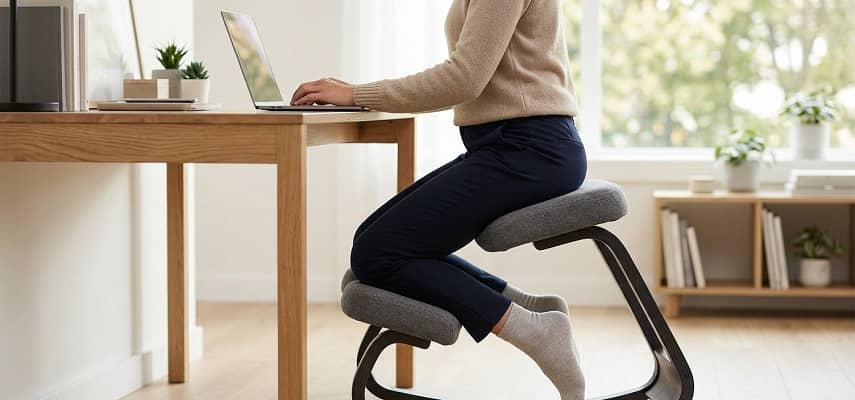
Start by sitting on the seat first, then place your shins on the lower support without forcing your knees into the pad. Adjust the chair so you can work with relaxed shoulders, elbows near your body and the screen in a comfortable line of sight. Use short sessions initially and alternate with standing, walking or another chair.
- Sit on the upper seat first. Do not climb onto the shin pad as if you were kneeling on the floor.
- Slide your shins onto the supports. The pads should stabilize your lower legs without creating sharp pressure on the kneecaps.
- Adjust height or angle if the chair allows it. Aim to keep your keyboard close, shoulders relaxed and wrists roughly neutral.
- Change position. Put one foot down, rock gently, stand, walk or switch chairs when your body becomes uncomfortable.
- Stop if symptoms build. Persistent knee pain, numbness, tingling, weakness or worsening back pain deserves reassessment rather than longer exposure.
There is no evidence-based rule that everyone should use a kneeling chair all day. CCOHS recommends avoiding prolonged static kneeling/sitting and standing up or walking whenever possible. Even VIVO’s own rocker instructions suggest introducing this seating style in increments and combining it with regular sitting or standing.
Who may be better off with a conventional ergonomic chair?
A kneeling chair may be a poor fit if the shin supports cause pain, if deep knee flexion is uncomfortable, if you have difficulty getting in and out, or if your work requires frequent wide reaching and turning. People dealing with an active knee problem, significant mobility limitation or persistent pain should ask a qualified clinician or ergonomics professional before using a new chair as a health intervention.
For all-day seated work, a well-adjusted office chair with a supportive backrest may offer more postural variety. See our back-support office chair guide. If your main goal is comfort rather than changing posture, our back massager for chair guide covers a different category of desk accessory.
When to seek professional advice: A chair should not be used to self-treat unexplained or worsening back, hip, knee or nerve symptoms. Seek medical advice for persistent pain, weakness, numbness, tingling, loss of function, or symptoms after an injury.
Frequently asked questions
Do kneeling chairs help back pain?
They may feel better for some people, and small studies show that kneeling chairs can preserve lumbar curvature differently from flat chairs. However, the evidence does not establish a kneeling chair as a treatment for back pain. If pain is persistent or worsening, get it assessed rather than relying on a chair to correct it.
Can you use a kneeling chair all day?
There is no universal evidence-based all-day schedule. Alternative chairs can create their own pressure points and static loads, so changing position matters. Start with shorter sessions, stand or walk regularly, and keep another sitting option available. If your shins, knees or back become increasingly uncomfortable, switch positions rather than pushing through.
Should your knees carry your weight on a kneeling chair?
No. Despite the name, a kneeling chair is designed to support most of your weight through the seat, while the lower pads help stabilize the shins. If you feel that you are hanging your body weight directly on the kneecaps, the chair may be adjusted poorly or may not fit your body.
Are rocking kneeling chairs better than wheeled X-frame chairs?
Not universally. Rocking chairs encourage small movements and usually have simple frames; X-frame chairs often provide more direct height adjustment and may have casters. Choose based on your desk height, body dimensions, need for mobility and comfort on the shin supports rather than assuming one mechanism is healthier.
Are kneeling chairs good for sciatica?
There is not enough evidence to recommend a kneeling chair as a sciatica treatment. Sciatica describes nerve-related symptoms that can have different causes, and a seating change may help, do nothing or aggravate symptoms depending on the person. Persistent radiating pain, numbness or weakness should be evaluated by a qualified healthcare professional.
What is the best kneeling chair for beginners?
For a low-cost introduction, the VIVO Wooden Rocking Chair is a simple rocker with thick listed cushions, while the DRAGONN by VIVO adds height adjustment and casters. The better beginner choice depends on whether you value movement or adjustability. Buy from a seller with practical return terms because body fit is hard to predict online.
This article is for general information only and is not medical advice. Talk to a qualified healthcare professional about persistent pain, an injury, or whether a seating change is appropriate for your situation.