Leg Elevation Pillow: 5 Best Picks for 2026
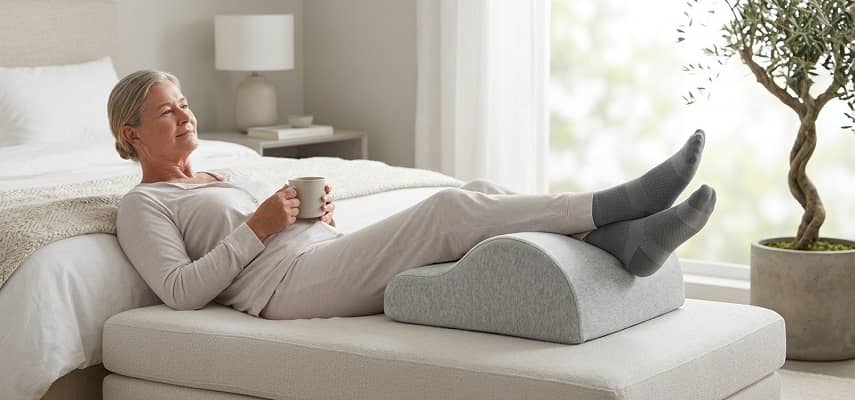
2026 buying guide · elevation, fit & safety
A leg elevation pillow is a wedge or contoured cushion that keeps one or both legs raised without stacking loose pillows. For many people with lower-leg swelling, elevation can help fluid drain, but it does not treat the underlying cause. Our top overall pick is the Ebung Memory Foam Leg Elevation Pillow; adjustable, single-leg and firmer alternatives are included below.
Quick picks
Best adjustable
KingPavonini Adjustable
Removable layers let you change the height instead of committing to one fixed wedge.
Best single-leg
LightEase Leg Support
A long single-leg channel with handles for repositioning during recovery or rest.
How we chose these leg elevation pillows
We treated this as a desk-research buying guide, not a hands-on product test. We checked current U.S. Amazon identifiers and compared product geometry, single- versus double-leg capacity, height adjustability, foam construction, washable covers, handles or anti-slip features, and how clearly the dimensions are documented. We also checked medical guidance on leg elevation so the product claims do not outrun the evidence.
Important: “Best” is an editorial category based on features and fit, not a clinical ranking. No pillow can diagnose the cause of swelling or guarantee faster recovery. After surgery, use the height, position and duration your surgeon or physical therapist recommends.
Best leg elevation pillows at a glance
| Pillow | Our category | Layout | Notable design | Before you buy |
|---|---|---|---|---|
| Ebung Memory Foam | Best overall | Wide two-leg wedge | 24 x 21-inch footprint; memory foam; washable cover | Fixed height; takes more bed space |
| KingPavonini Adjustable | Best adjustable | Double-leg wedge | Removable height layers; flat or U-shaped top; handles | More parts to position and store |
| LightEase Leg Support | Best single-leg | Single-leg channel | About 29 x 13 x 9.5 inches; dual handles | Only elevates one leg at a time |
| Kölbs Double Leg | Best contoured two-leg option | Contoured wedge | Memory-foam top, high-density core, removable cover | Fixed height and footprint |
| DMI Ortho Bed Wedge | Best simple firm wedge | Fixed foam wedge | Firm foam; removable machine-washable cover | Less cushioning and no height adjustment |
The five leg elevation pillows we would shortlist
01 / BEST OVERALL
Ebung Memory Foam Leg Elevation Pillow
The Ebung is the most balanced pick for readers who simply want a broad wedge for both legs. Current product data lists a roughly 24-by-21-inch footprint, memory-foam construction and a machine-washable cover. Its main advantage is simplicity: there are no removable height layers or narrow channels to line up.
Ebung Memory Foam Leg Elevation Pillow — view on Amazon
Key features
- Wide wedge intended to support both lower legs
- Memory-foam construction
- Breathable, removable and machine-washable cover listed for the current model
- Simple fixed shape with no assembly or layer changes
Pros
- Roomy width for two-leg elevation
- Easy to understand and use
- Washable cover simplifies cleanup
Cons
- Height is not adjustable
- Wide footprint can crowd a smaller bed or couch
- No dedicated channel to keep a single injured leg centered
Best for: Everyday two-leg elevation when you want a wide, uncomplicated memory-foam wedge.
Who it is not for: Anyone who needs a clinician-specified height, a narrow single-leg trough, or a smaller travel-friendly pillow.
02 / BEST ADJUSTABLE
KingPavonini Adjustable Leg Elevation Pillow
KingPavonini’s double-leg adjustable model is the better choice when a fixed wedge feels too limiting. The design uses removable layers so you can change the elevation, and the top can be configured as a flatter surface or a U-shaped channel. The cover also adds carrying handles and a non-slip underside.
KingPavonini Adjustable Leg Elevation Pillow — view on Amazon
Key features
- Adjustable-height design using removable layers
- Gel memory-foam top layer over denser support foam
- Wide U-shaped area designed for both legs
- Multiple handles and a silicone-pattern non-slip bottom
Pros
- More control over height than a fixed wedge
- Two-leg capacity
- Handles make repositioning easier
Cons
- More parts to assemble, remove or store
- Bulkier than a simple foam wedge
- Adjustability does not replace a prescribed post-surgery position
Best for: People who want to experiment with a few height settings for comfort or who have been given a target position that a fixed wedge cannot match.
Who it is not for: Anyone who wants the lightest, simplest pillow or who does not want to manage removable sections.
03 / BEST SINGLE-LEG
LightEase Memory Foam Leg Support and Elevation Pillow
The LightEase single-leg model is built around a long central channel rather than a broad shared surface. Current listing data puts it at about 29 inches long, 13 inches wide and 9.5 inches high, with dual handles and a removable cover. That shape can be easier to manage when only one leg needs support.
LightEase Memory Foam Leg Support and Elevation Pillow — view on Amazon
Key features
- Single-leg contoured channel
- About 29 x 13 x 9.5 inches for the current ASIN
- Memory-foam construction
- Two handles for carrying and repositioning
Pros
- Dedicated space for one leg
- Long surface supports more of the lower limb
- Handles help with repositioning
Cons
- Only one leg fits in the intended channel
- Height is fixed
- Channel width may not suit every cast, boot or body size; measure first
Best for: Single-leg elevation after an injury or procedure when your care team has said a contoured support is appropriate.
Who it is not for: People who want to elevate both legs together or need adjustable height.
04 / CONTOURED TWO-LEG OPTION
Kölbs Double Leg Elevation Pillow
Kölbs combines a contoured top with a softer memory-foam layer over a denser support core. The removable jacquard cover is designed to be washable, and the current retailer listing also notes carrying and positioning handles. It is a good middle ground between a plain rectangular wedge and a multi-layer adjustable system.
Kölbs Double Leg Elevation Pillow — view on Amazon
Key features
- Contoured top intended to help keep the legs positioned
- Memory-foam comfort layer over a high-density foam core
- Removable jacquard cover
- Carrying and positioning handles
Pros
- More leg-positioning structure than a flat wedge
- Two-layer foam design
- Cover is removable for cleaning
Cons
- Fixed height
- Contoured shape may feel restrictive to people who move their legs often
- Measure the usable width before buying for both legs
Best for: People who want both legs supported in a more defined channel without the removable sections of an adjustable pillow.
Who it is not for: Anyone who needs variable height or prefers a broad, completely flat top.
05 / SIMPLE FIRM WEDGE
DMI Ortho Bed Wedge Elevated Leg Pillow
The DMI Ortho is the straightforward choice for people who prefer firm polyurethane-style support over a plush memory-foam feel. The current ASIN is commonly listed as an approximately 8-inch-high wedge with a roughly 20-by-23-inch footprint and a removable, machine-washable poly-cotton cover.
DMI Ortho Bed Wedge Elevated Leg Pillow — view on Amazon
Key features
- Firm supportive foam wedge
- Approximately 8 inches high for the current ASIN
- Removable, machine-washable poly-cotton cover
- Simple fixed shape with no memory-foam top layer or removable height sections
Pros
- Firm support resists deep sinking
- Simple design with few failure points
- Washable cover
Cons
- Firmer feel may be uncomfortable for some sleepers
- No contour to center the legs
- Height is not adjustable
Best for: People who want a basic firm wedge and do not need a contoured channel or adjustable layers.
Who it is not for: Anyone who strongly prefers soft memory foam or needs precise height changes.
What should you look for in a leg elevation pillow?
The most useful leg elevation pillow is the one that creates the position you actually need without causing pressure, sliding or awkward bed posture. Height matters, but so do length, usable width, firmness and whether one or both legs need to be supported. For post-surgery use, your care team’s positioning instructions matter more than any marketing claim.
1. Fixed height or adjustable height?
A fixed wedge is simpler and usually lighter. An adjustable model gives you more options if the first height feels too low or too aggressive. Do not assume a taller pillow is medically better: the correct elevation depends on why you are using it and, after surgery, on the instructions for that procedure.
2. Single-leg or double-leg support?
A single-leg channel can keep an injured or operated leg more centered, while a broad two-leg wedge is easier for general swelling or end-of-day elevation. If you need both legs raised, measure the usable top width rather than relying only on the product’s outer dimensions.
3. Foam firmness
Soft foam feels comfortable but may compress more under the calves. Firm foam keeps its shape better but can create pressure points if the geometry does not suit you. Memory foam can improve surface comfort, while a dense support core helps keep the intended elevation.
4. Length and edge placement
A pillow should support the area your clinician or comfort goal calls for without a hard edge digging into the back of the knee, calf, ankle or heel. Taller people should pay special attention to length. If you are wearing a cast or walking boot, compare its width and shape with the pillow channel before ordering.
5. Washable cover and stability
A removable cover is useful for a pillow that may be used daily or after surgery. Handles also matter more than they seem when you are repositioning a bulky wedge from bed to sofa. A non-slip base can help on smooth bedding, but it still needs to sit securely on a stable surface.
If you are comparing elevation with compression for swelling, see our compression socks for swelling guide and our broader compression socks guide. Compression is not appropriate for everyone, so ask a clinician when circulation or vascular disease is part of the picture.
For a different sleep-positioning goal, our under-knee pillow guide explains how a knee-support pillow differs from a wedge intended to elevate the lower legs.
How do you use a leg elevation pillow safely?
Start with the reason you are elevating your legs. For everyday lower-leg swelling, medical sources commonly advise raising the legs while sitting or lying down; some guidance specifically places the feet above heart level. After an operation, however, positioning can be procedure-specific, so follow your surgeon or physical therapist rather than a generic angle printed on a product page.
- Use the correct position for your goal. If your clinician gave you a height, angle or knee-position instruction, match that first.
- Keep the setup stable. Place the wedge on a firm mattress, couch or recliner surface where it cannot easily tip or slide.
- Check pressure points. Reposition or stop if the edge causes pain, numbness, tingling, skin discoloration or persistent heel/calf pressure.
- Do not force an overnight schedule. How long to elevate varies by the cause. Johns Hopkins notes about 15 minutes three or four times daily for some people with mild-to-moderate varicose veins, while Cleveland Clinic describes 30 minutes or longer at least three times daily for chronic venous insufficiency. Those are condition-specific examples, not universal pillow instructions.
- Reassess swelling. If swelling is new, one-sided, painful, hot, red, severe or worsening, do not rely on the pillow as the treatment.
A pillow is a positioning aid, not a diagnosis. Leg swelling can come from prolonged sitting or standing, pregnancy, medications, venous disease, injury, infection, heart or kidney problems, or a blood clot. The correct treatment depends on the cause.
Does leg elevation actually help swelling?
It can help in some situations. Cleveland Clinic advises elevating swollen areas, especially the legs and feet, to help fluid drain. Its chronic venous insufficiency guidance says raising the legs above heart level can reduce pressure in the leg veins. NHS guidance for swollen ankles, feet and legs also recommends raising the legs or swollen area on a chair or pillows when possible.
What elevation cannot do
Leg elevation may reduce a symptom, but it does not tell you why the swelling happened. It also does not replace anticoagulant treatment for a blood clot, medication changes for drug-related edema, treatment for heart or kidney disease, or a post-operative rehabilitation plan.
For some people, movement and compression are also part of a treatment plan. Cleveland Clinic recommends avoiding long periods of sitting or standing and notes that compression garments may help some types of edema, but it advises checking with a healthcare provider first. Our leg compression sleeves guide covers the product category, but it should not replace individual vascular advice.
When should leg swelling be checked by a professional?
Do not self-treat sudden or unexplained swelling with a pillow alone
Seek urgent medical advice for swelling in one leg with no clear cause, severe or suddenly worsening swelling, or swelling that is red, hot or painful. NHS guidance also flags high fever or swelling that follows a significant injury as reasons for prompt assessment.
Call emergency services for swelling with sudden shortness of breath, chest pain or tightness, coughing up blood, fainting or severe breathing difficulty. A deep vein thrombosis can travel to the lungs and cause a pulmonary embolism.
If you have heart, kidney or liver disease, persistent edema, recurrent one-sided swelling, or a recent operation, ask your healthcare professional how elevation fits into your treatment plan.
Frequently asked questions
What does a leg elevation pillow do?
A leg elevation pillow holds one or both legs in a raised position more consistently than a loose stack of pillows. Elevation can help fluid drain from swollen lower legs in some conditions, but the pillow is only a positioning aid. It does not treat the underlying cause of edema, pain or post-surgery symptoms.
How high should I elevate my legs?
There is no single height that is correct for everyone. Medical guidance for edema and venous problems often describes raising the feet above heart level, but post-surgery instructions may be more specific. Choose a pillow that can match the position your clinician recommends rather than buying the tallest wedge available.
Can I sleep with my legs elevated all night?
Some people use elevation while resting or sleeping, but overnight use is not automatically right for every condition or operation. Make sure the pillow does not cause numbness, tingling, skin pressure or pain. If you are recovering from surgery or have significant heart, kidney or vascular disease, ask your clinician about duration and sleep position.
Is a leg elevation pillow useful after knee, ankle or foot surgery?
It can be useful when your post-operative plan calls for elevation, but the correct height and knee position depend on the procedure. A product description should never override your surgeon or physical therapist. Measure casts, braces or boots against the pillow’s channel and check that the edge does not create pressure behind the knee or at the heel.
Is a single-leg or double-leg pillow better?
A single-leg pillow is easier to center around one injured or operated limb, while a double-leg wedge is more convenient for general bilateral swelling or end-of-day elevation. Neither style is inherently better. Choose based on which leg or legs need support, the width of your bed and any clinician instructions.
When is leg swelling an emergency?
Get urgent medical help for sudden unexplained one-sided swelling, especially with pain, warmth or skin-color change. Call emergency services if leg swelling occurs with sudden shortness of breath, chest pain, coughing up blood, severe breathing difficulty or fainting. Those symptoms can be associated with a blood clot or pulmonary embolism.