Best Tennis Elbow Brace (2026): 7 Top Picks, Compared Honestly
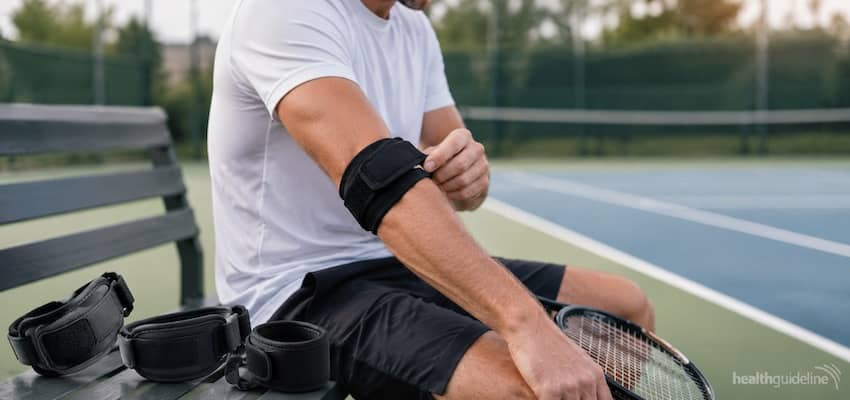
For most people with activity-related tennis elbow, a counterforce strap is the right tool. Our best overall pick is the Mueller Hg80 Premium Tennis Elbow Support for its comfortable, breathable fit from a trusted sports-medicine brand.
Best budget
Bodyprox Elbow Brace (2-Pack)
Best for all-day/desk wear
POWERLIX Elbow Compression Sleeve
Best premium/medical-grade
Bauerfeind EpiTrain
Reality check: a brace is a comfort aid that offloads the tendon during activity — it is not a cure. Pair it with progressive strengthening exercises for lasting results.
If your outer elbow flares up every time you grip a racquet, a screwdriver, or a coffee cup, a tennis elbow brace can take the edge off enough to keep you moving. But braces are widely misunderstood — many pages promise they “heal” the injury, which is not what the evidence shows. This guide keeps it honest: what a brace can and can’t do, the two brace types and who each one suits, and seven real, currently-available options across every budget.
Do tennis elbow braces actually work?
A counterforce strap can reduce pain during activity by spreading load away from the injured tendon, and studies show short-term symptom relief. But braces don’t repair the tendon or fix the problem long-term. According to the American Academy of Orthopaedic Surgeons, a brace centered over the back of the forearm may help relieve symptoms — but the strongest evidence for actually recovering is progressive strengthening exercise.
The nuance is worth knowing before you spend money. A placebo-controlled trial found that a counterforce brace reduced pain frequency and severity in the short term (roughly 2–12 weeks) and improved elbow function at 26 weeks compared with a fake brace — yet both the real and placebo braces improved symptoms, suggesting part of the benefit comes simply from supportive wrapping. A long-standing Cochrane review reached a cautious conclusion: possible short-term relief, but not enough evidence for lasting benefit. The takeaway from clinicians is consistent — use a brace as a comfort aid that makes activity more tolerable while your tendon heals, not as a stand-alone treatment.
The two brace types (and which one you need)
Almost every “tennis elbow brace” is one of two designs. Picking the right type matters more than picking the right brand.
Counterforce strap (band)
A single padded strap worn 2–3 finger-widths below the elbow, on the forearm. The pad presses on the muscle belly and redirects force away from the sore tendon attachment.
Best for gripping and sport — tennis, pickleball, golf, DIY, lifting. Great targeted relief, but it doesn’t support the elbow joint itself.
Compression sleeve
A full-elbow knit or neoprene sleeve. It provides warmth, mild all-over compression, and a sense of joint position (proprioception).
Best for all-day and desk wear, arthritis, or people who dislike a tight band. Less targeted than a strap for sport.
Many people end up owning both: a strap for their gym or match days and a sleeve for the office. If you only buy one and your pain is tied to gripping or swinging, start with a counterforce strap.
How we chose
This is a research-based buying guide, not a hands-on lab test. We started by mapping each brace design to what orthopedic and physiotherapy sources actually recommend (see Sources), then built a shortlist of products that are real and currently sold on Amazon US. We prioritized: correct brace type for the job, a genuine adjustable or well-graded fit, breathable materials, a repositionable or well-placed pressure pad for straps, and a spread of price points from budget two-packs to a premium medical option. We deliberately skipped “copper” and “magnetic” marketing claims, which lack good supporting evidence. We don’t state fixed prices or star ratings because both change constantly — always check the live listing.
Top tennis elbow braces at a glance
| Brace | Type | Best for | Standout feature | Approx. price* |
|---|---|---|---|---|
| Mueller Hg80 Premium | Counterforce strap | Best overall | Breathable HydraCinn fabric + gel pad, 60-yr brand | ~$20–25 |
| Bauerfeind EpiTrain | Knit compression sleeve w/ pad | Premium / persistent pain | Medical-grade German knit, viscoelastic pads | ~$90–110 |
| Simien Tennis Elbow Brace | Counterforce strap (2-pack) | Best value bundle | Two straps + sweatband + exercise e-book | ~$15–20 |
| Bodyprox Elbow Brace | Counterforce strap (2-pack) | Best budget | "Amazon's Choice," EVA pad, two included | ~$12–16 |
| Sleeve Stars | Counterforce strap | Best adjustable fit | Fits 9″–23″; repositionable pad for either side | ~$15–20 |
| POWERLIX Elbow Sleeve | Compression sleeve | All-day / desk wear | 4-way-stretch pull-on knit, no straps | ~$12–18 |
| CAMBIVO Elbow Sleeve | Compression sleeve (2-pack) | No-strap comfort, a pair | 3D knit, moisture-wicking, two included | ~$15–20 |
01 / Best overall
1. Mueller Hg80 Premium Tennis Elbow Support — Best overall
The Mueller Hg80 Premium is the counterforce strap we’d point most people to first. It does the core job — targeted pressure over the forearm extensor muscles — while being genuinely comfortable to wear for hours, which is where cheaper straps often fall down. Mueller has been a sports-medicine mainstay for decades, and it shows in the fit and finish.
Key features
- Mueller-exclusive HydraCinn moisture-wicking fabric with an anti-microbial treatment to fight odor on sweaty days
- Gel pad concentrates pressure on the extensor tendon for effective offloading
- Slides on and cinches with one adjustable strap; works on either the left or right arm
- Two sizes to match your forearm: S/M fits ~7–11″, L/XL fits ~11–15″
Pros:
Comfortable enough for all-day wear; breathable; trusted brand; simple to fit.
Cons:
A single strap gives targeted relief but no whole-joint support; measure your forearm, as sizing is specific.
Best for: Everyday tennis-elbow pain from gripping, racquet sports, DIY, or repetitive work.
02 / Best premium / medical-grade
2. Bauerfeind EpiTrain — Best premium / medical-grade
If your elbow pain is persistent and you want the most refined option, the Bauerfeind EpiTrain is in a different class — and priced like it. Rather than a strap, it’s a form-fitting knit sleeve made in Germany with built-in viscoelastic pads that sit around the epicondyle and deliver a gentle “massage” effect as you move. The soft knit is far more pleasant against the skin than neoprene and won’t slip or dig in.
Key features
- Medical-grade breathable knit with integrated Epicon pressure pads that offload the tendon and stimulate circulation
- Compression massage effect intended to ease pain, activate muscles, and reduce swelling during movement
- Numbered sizes (0–6) based on your forearm circumference in centimeters — measure carefully
Pros:
Excellent comfort and build quality; good for chronic pain and all-day support; kinder to sensitive skin than neoprene.
Cons:
Expensive — several times the price of a strap; numbered sizing is finicky; it’s a sleeve, so it’s less targeted than a counterforce band for pure sport use.
Best for: Ongoing or arthritis-related elbow pain, and anyone who wants a premium daily brace.
Bauerfeind EpiTrain Elbow Support — view on Amazon
Prefer Bauerfeind’s targeted band instead of a sleeve? The brand also makes an adjustable Sports Elbow Strap with a BOA dial — a premium counterforce alternative worth a look if the EpiTrain sleeve isn’t your style.
03 / Best value bundle
3. Simien Tennis Elbow Brace (2-Count) — Best value bundle
Simien is a small brand started, fittingly, by a tennis player sidelined by tennis elbow — and its two-count strap is one of the better value buys in the category. You get two counterforce straps (handy for a spare, or to keep one at work and one in your bag), plus a wrist sweatband and a downloadable exercise e-book, which nudges you toward the strengthening work that actually drives recovery.
Key features
- Two counterforce straps with a compression pad, adjustable hook-and-loop closure
- One-size-fits-most design for either arm
- Includes a wrist sweatband and an exercise/recovery e-book
Pros:
Two braces for a low price; the bundled exercise guide is a genuinely useful extra; simple and effective.
Cons:
Generic one-size fit won’t suit every forearm as precisely as sized options; basic materials versus premium brands.
Best for: Value seekers who want a spare, and anyone new to bracing who’d benefit from the exercise guide.
Simien Tennis Elbow Brace (2-Count) — view on Amazon
Want a deeper look at this one? See our full Simien Tennis Elbow Brace review.
04 / Best budget
4. Bodyprox Elbow Brace (2-Pack) — Best budget
If you want reliable counterforce support for as little as possible, the Bodyprox two-pack is the easy pick — it’s frequently badged “Amazon’s Choice” in this category. It’s not fancy, but the fundamentals are right: an adjustable strap with a firm EVA compression pad that sits over the sore tendon, and two in the box so you’re covered if one is in the wash.
Key features
- Adjustable compression strap with an EVA pressure pad for targeted relief
- Two braces included; fits either arm
- Lightweight and low-profile enough to wear under a sleeve
Pros:
Very affordable; two-pack value; does the core counterforce job well.
Cons:
Basic build; one-size-adjustable fit may not be ideal for very large or very slim forearms.
Best for: Budget buyers, first-time users testing whether a strap helps, or anyone wanting a cheap spare.
05 / Best adjustable fit
5. Sleeve Stars Tennis Elbow Brace — Best adjustable fit
Fit is the single biggest reason a strap “doesn’t work” — a band that’s the wrong size either slips or cuts off circulation. The Sleeve Stars strap tackles that head-on with a very wide adjustment range (it fits arms from about 9″ to 23″) and a repositionable gel pad you can shift to press on the outer elbow (tennis elbow) or the inner elbow (golfer’s elbow). It’s a frequent best-seller for good reason.
Key features
- Wide fit range (~9″–23″) suits slim and larger forearms alike
- Repositionable pad works for both lateral (tennis) and medial (golfer’s) elbow
- Adjustable compression so you can dial in support for sport vs. light daily wear
Pros:
Excellent for hard-to-fit arms; flexible pad placement; adjustable tension.
Cons:
Single-strap design (no joint support); exact inclusions and color options vary by listing.
Best for: Anyone between sizes, or dealing with both tennis and golfer’s elbow.
06 / Best for all-day / desk wear
6. POWERLIX Elbow Compression Sleeve — Best for all-day / desk wear
When your elbow aches through a workday of typing rather than during sport, a strap can feel like overkill. This is where a compression sleeve shines, and the POWERLIX is a comfortable, well-priced option. Its 4-way-stretch knit gives gentle all-over compression and warmth, pulls on in seconds, and stays put without a band. Think of it as steady background support rather than targeted offloading.
Key features
- 4-way-stretch knit for full range of motion and even, mild compression
- Breathable, moisture-wicking, with an anti-slip design so it doesn’t roll down
- Pull-on fit sized by elbow circumference; the knit stretches generously
Pros:
Comfortable for hours; warmth helps stiff, achy elbows; no straps to fuss with; low cost.
Cons:
Provides compression and warmth, not targeted counterforce; no adjustment once it’s on.
Best for: Desk workers, arthritis, weightlifting warmth, and anyone who dislikes bands.
POWERLIX Elbow Compression Sleeve — view on Amazon
Comparing sleeves specifically? See our guide to the best elbow compression sleeves.
07 / Best no-strap comfort, as a pair
7. CAMBIVO Elbow Compression Sleeve (2-Pack) — Best no-strap comfort, as a pair
CAMBIVO’s two-pack sleeve is a great pick if you want the comfort of a sleeve for both arms, or a spare to rotate while one is drying. These are strap-free 3D-knit sleeves — no Velcro, nothing to dig in — with support lines to help them stay in place and keep the joint warm. Like all sleeves, they trade targeted pad pressure for even, all-day comfort.
Key features
- Breathable 3D-knit, moisture-wicking, strap- and Velcro-free
- Two sleeves included; multiple sizes (measure and size down if between sizes for a snugger fit)
- Support lines help hold position and add warmth around the joint
Pros:
Comfortable all-day wear; two included; nothing to irritate the skin; tidy under sleeves.
Cons:
Sleeve-style compression, not counterforce; you must measure for the right size; less targeted for sport.
Best for: All-day comfort, arthritis, and people who want a pair of no-fuss sleeves.
What to look for in a tennis elbow brace
Brace type (match it to your pain)
Decide this first. Pain triggered by gripping or swinging? A counterforce strap is the targeted tool. Constant, low-grade ache or stiffness through the day, or arthritis? A compression sleeve is usually more comfortable. If in doubt, a strap is the more evidence-supported choice for activity-related tennis elbow.
Fit and size
Fit makes or breaks a brace. For straps, look for a wide adjustment range or the correct size band for your forearm; it should feel snug but never pins-and-needles tight. For sleeves, measure your elbow/forearm circumference and follow the size chart — when between sizes, most brands suggest sizing down for firmer compression.
The pressure pad
On a counterforce strap, the pad is what does the work. A firmer gel or EVA pad concentrates pressure on the tendon. A repositionable pad is a bonus, since it lets you target the outer elbow for tennis elbow or the inner elbow for golfer’s elbow with the same brace.
Materials and breathability
You’ll wear this for hours, so breathability matters. Moisture-wicking knits (like Mueller’s HydraCinn or Bauerfeind’s medical knit) stay cooler and fight odor. If neoprene irritates your skin, choose a soft knit sleeve instead.
Skip the gimmicks
“Copper-infused” and “magnetic” braces are heavily marketed for pain relief, but the evidence for those specific claims is weak. Buy for fit, pad quality, and comfort — not for magnets.
How to wear a tennis elbow brace
Placement is simple but important. For a counterforce strap, position it on the fleshy part of your forearm about 2–3 finger-widths below the bony bump on the outside of your elbow, with the pad sitting over the muscle (not on the bone). Tighten until it’s firm and stays put during movement, but loosen it if you feel tingling, coolness, or numbness in the hand — that means it’s too tight. A compression sleeve simply pulls on and centers over the joint. Take a strap off during rest and sleep; it’s meant for use during activity.
About tennis elbow (lateral epicondylitis)
Tennis elbow, or lateral epicondylitis, is an overuse injury of the tendons that attach your forearm muscles to the bony bump on the outside of the elbow — most often the extensor carpi radialis brevis (ECRB). According to the Mayo Clinic, repeated wrist and arm motion is the usual cause, and despite the name, most people who get it don’t play tennis — it’s common in painters, plumbers, carpenters, butchers, cooks, and anyone doing repetitive gripping, typing, or tool work. The Cleveland Clinic notes it most often improves with a few months of nonsurgical care and rest.
Typical symptoms include pain or burning on the outer elbow, a weakened grip, and pain that worsens when you grip, lift, twist, or straighten the wrist — sometimes radiating down the forearm. It usually builds gradually rather than starting with a single injury.
What helps most. Bracing is one piece of the puzzle, but clinical guidelines put the strongest weight on progressive strengthening exercise for the wrist extensors (starting gentle and building up), alongside relative rest, activity modification, and ice for flare-ups. Corticosteroid injections can give short-term relief but often underperform exercise-based care over the medium term, so they’re used selectively. A brace makes the loading and daily activity more tolerable while the tendon remodels — it’s a helpful support, not a substitute for the rehab work.
When to see a doctor
A brace and self-care are reasonable for mild, activity-related elbow pain, but see a healthcare professional if any of these apply: the pain is severe, follows a fall or direct blow, or came with a “pop”; the joint looks deformed or you can’t use your arm; there’s fever, warmth, redness, or swelling (possible infection); you have numbness, tingling, or weakness in the hand or fingers; or the pain isn’t improving after a few weeks of rest and self-care. As the Mayo Clinic advises, persistent elbow pain that limits daily activities is worth getting checked. A clinician can confirm the diagnosis and rule out other causes.
Frequently asked questions
Do tennis elbow braces actually work?
They can reduce pain during activity by offloading the injured tendon, and studies show short-term symptom relief. But braces don’t heal the tendon or fix the problem long-term. Treat a brace as a comfort aid that makes gripping and daily tasks more tolerable while you do the strengthening exercises that drive real recovery.
Where should I place a tennis elbow brace?
For a counterforce strap, sit it on the forearm about two to three finger-widths below the bony bump on the outside of your elbow, with the pad over the muscle rather than the bone. It should be snug and stay put during movement. A compression sleeve simply centers over the elbow joint.
How tight should a tennis elbow brace be?
Firm enough that it doesn’t slide and the pad stays over the tendon, but not so tight that you feel tingling, numbness, or coldness in your hand. If your fingers change color or go numb, loosen it. Re-check the tension after a few minutes of activity and adjust as the brace settles.
Counterforce strap or compression sleeve — which is better?
A counterforce strap gives targeted relief for gripping and sport, so it’s usually the better choice for activity-related tennis elbow and returning to play. A compression sleeve offers warmth and gentle all-over support, which suits all-day or desk wear and arthritis. Many people own both and switch depending on the task.
Should I wear a tennis elbow brace all day or at night?
A counterforce strap is designed for use during activity, not around the clock — take it off during rest and sleep. Wearing it constantly can irritate the skin and isn’t necessary. A soft compression sleeve is more comfortable for longer stretches, but there’s no need to sleep in a tight brace.
How long does tennis elbow take to heal?
It varies with severity. Mild cases can settle within a few weeks of rest, activity changes, and exercises, while stubborn tendon cases can take several months — sometimes 6–12 months — to fully recover. Consistency with strengthening work matters more than any single product. If there’s no progress after weeks of self-care, see a professional.
Can I still play tennis or golf with a brace?
Often yes — many players use a counterforce strap during matches to reduce tendon load and stay on the court. Position it correctly and stop if pain climbs above a mild level, since pushing through significant pain can set recovery back. A brace buys comfort, but easing your training load while you heal is just as important.
Do copper or magnetic elbow braces work?
There’s little solid evidence that copper-infused fabric or magnets relieve tennis elbow beyond the support and warmth any brace provides. If you like how one feels, there’s no harm — but choose your brace based on fit, pad quality, and comfort rather than paying extra for copper or magnetic marketing claims.
Medical disclaimer: This article is for general information only and is not medical advice. It does not diagnose or treat any condition. Talk to a qualified healthcare professional about your specific situation before starting or stopping any treatment.