CPAP Cleaner Machine Guide 2026: 2 FDA-Cleared Add-Ons
2026 CPAP care guide · FDA status, cleaning & safety
Quick answer: Most people do not need a CPAP cleaner machine. The FDA says masks, hoses and humidifier tubs can usually be cleaned with mild soap and water according to the manufacturer’s instructions. In 2026, two FDA-cleared devices can reduce bacteria on specific compatible CPAP accessories after cleaning, but neither replaces normal washing.
What should you use?
Best for most users
Manufacturer-approved washing
Mild soap or detergent, water and thorough air-drying remain the standard starting point for CPAP masks, tubing and humidifier parts.
Cleared hose + mask add-on
SoClean 3+
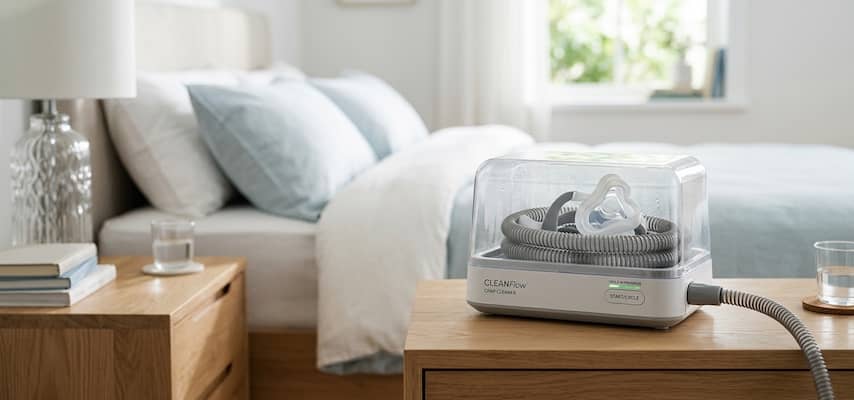
An FDA-cleared ozone-based bacterial-reduction device for certain compatible masks and hoses after they have already been cleaned.
Cleared ozone-free add-on
Paptizer 360
A 2026 FDA-cleared UV-C device for bacterial reduction on a compatible CPAP mask cushion after washing; its cleared use is narrow.
Do you really need a CPAP cleaner machine?
For most CPAP users, no separate cleaning machine is necessary. The FDA says most CPAP accessories, including masks, hoses and humidifier tanks, can be cleaned with mild soap and water as directed by the CPAP manufacturer. Filters should be cleaned or replaced according to the exact machine’s instructions. Read the FDA consumer guidance.
That distinction matters because “CPAP cleaner machine” is a marketing term, not one regulatory category. The FDA’s current consumer page says there are no cleared or approved devices for cleaning, disinfecting or sanitizing CPAP machines. A newer regulatory category instead covers devices used as an adjunct for microbial reduction on compatible respiratory accessories after cleaning.
Important 2026 update: The FDA consumer explainer still describes one authorized bacterial-reduction add-on, but the FDA’s current device database now lists a second cleared device, Paptizer 360, with a decision date of April 29, 2026. That is why this update covers two cleared add-ons while still following the FDA’s core message: wash first, and do not treat an add-on as a replacement for cleaning.
How we updated this guide
The older version of this article ranked a long list of ozone and UV products. For this update, we removed the “more products must be better” approach. We checked the FDA’s CPAP-cleaning guidance, the FDA 510(k)/De Novo databases, current manufacturer instructions and product labeling. Only devices with a current FDA marketing authorization in the respiratory-accessory microbial-reduction category are profiled as CPAP bacterial-reduction machines here.
CPAP cleaner machine options at a glance
| Option | What it does | Cleared/validated scope | Key limitation |
|---|---|---|---|
| Soap + water | Removes oils, dirt and debris during normal cleaning | Follow the exact mask, hose, humidifier and machine instructions | Requires hands-on washing and drying |
| SoClean 3+ | Ozone-based bacterial reduction after cleaning | Certain compatible home-use CPAP masks and ventilation hoses; cleared accessories are limited | Does not replace washing; ozone compatibility and warranty issues need checking |
| Paptizer 360 | UV-C LED bacterial reduction after cleaning | Tested/cleared for certain compatible mask cushions; current FDA indication cites ResMed AirFit F20 cushion | Does not treat a complete CPAP setup, hose or machine |
Do not compare these by the biggest percentage alone. SoClean 3+ reports an in-vitro 3-log (99.9%) reduction for listed bacteria on cleared accessories; Paptizer 360 reports an in-vitro 2-log (99%) reduction on its tested mask cushion. Neither manufacturer establishes that those laboratory results translate into better clinical outcomes for a CPAP user.
The two FDA-cleared CPAP bacterial-reduction add-ons in 2026
01 / BROADER CLEARED ACCESSORY SCOPE
SoClean 3+ Bacterial Reduction Device
SoClean 3+ is an FDA-cleared Class II respiratory-accessory microbial-reduction device that uses ozone to reduce bacterial populations on certain compatible CPAP masks and hoses after normal cleaning. It is the better fit of these two devices if your cleared accessories include both a mask and ventilation hose, but compatibility must be checked carefully before purchase.
Key features and verified limits
- FDA De Novo authorization in 2024, followed by a 510(k) clearance for SoClean 3+ in 2025
- Ozone-based bacterial-reduction cycle; manufacturer FAQ lists a 90-minute cycle
- In-vitro 3-log (99.9%) bacterial reduction demonstrated for listed organisms after a complete cycle
- Manufacturer-established accessories currently include ResMed Mirage FX, AirFit P10, ClimateLineAir tubing and SlimLine tubing for AirSense 10
Pros
- FDA-cleared specifically as an adjunct for bacterial reduction on compatible CPAP accessories
- Can treat certain compatible hoses as well as masks
- Hands-free cycle after the required manual cleaning is complete
Cons
- Uses ozone, which requires extra attention to device instructions, user sensitivities and equipment compatibility
- Cleared performance does not apply to every CPAP mask, hose or machine
- Still requires hand-washing first, so it does not remove the basic cleaning task
Ozone caution: SoClean states that people with underlying lung diseases such as asthma or COPD, people with cardiovascular disease, pregnant or breastfeeding people, and users under age 22 should consult a healthcare professional about SoClean 3+ use because safety or sensitivity considerations apply. Also check your CPAP maker’s warranty and compatibility rules before using any ozone device.
Best for: A user who specifically wants a cleared bacterial-reduction add-on for compatible mask-and-hose accessories, understands that washing still comes first, and has confirmed both health and equipment compatibility.
02 / OZONE-FREE CLEARED OPTION
Paptizer 360
Paptizer 360 received FDA 510(k) clearance on April 29, 2026. It uses UV-C LEDs to reduce bacterial populations on certain compatible CPAP mask cushions after cleaning. Its main advantage is an ozone-free process; its main limitation is that the cleared use is much narrower than many shoppers expect from a product called a CPAP cleaner.
Key features and verified limits
- FDA-cleared Class II respiratory-accessory microbial-reduction device
- UV-C LED system with a 30-minute automatic cycle
- In-vitro 2-log (99%) bacterial reduction demonstrated for listed organisms after a complete cycle
- FDA-cleared labeling states testing with the ResMed AirFit F20 mask cushion; safe use with other respiratory accessories has not been established
Pros
- FDA-cleared for the stated bacterial-reduction use
- Ozone-free design
- No hose connection or ozone aeration step; manufacturer lists a 30-minute cycle
Cons
- Current cleared use is for a compatible mask cushion, not a complete mask, hose or CPAP machine
- Manual cleaning and drying are still required first
- Do not assume an unlisted mask material or accessory is validated just because it fits inside the chamber
Compatibility matters more than chamber size. The FDA indication states that Paptizer 360 was tested with the ResMed AirFit F20 mask cushion and that safe use with other respiratory devices or accessories, including headgear, frame and elbow, has not been established. Check current labeling before treating any other part.
Best for: A user with a compatible cleared mask cushion who wants an ozone-free bacterial-reduction add-on after normal washing and does not need hose treatment.
How should you clean CPAP equipment without a machine?
The safest default is to follow the instructions for the exact CPAP machine, mask, tubing and humidifier you own. In general, the FDA says most accessories can be cleaned with mild soap and water. ResMed’s current U.S. guidance gives a useful example: clean the mask cushion and humidifier water tub daily, and clean the mask frame/headgear and air tubing weekly, while always checking the product-specific manual.
- Disconnect and disassemble. Unplug the CPAP if the manufacturer instructs you to, disconnect the hose and take the mask apart according to its user guide.
- Wash the washable parts. Use the temperature and soap/detergent type specified by the manufacturer. Avoid stronger cleaners, scented oils or chemicals that are not approved for your equipment.
- Rinse thoroughly. Residue left on a mask or hose can be inhaled or can irritate skin, so rinse until the manufacturer’s instructions are satisfied.
- Air-dry completely. Let washed parts dry away from direct sunlight or excessive heat unless your product guide says otherwise. Reassemble only when dry.
- Handle the humidifier and filter separately. Empty/refill the water chamber and clean it on the schedule for your model. Clean or replace filters exactly as directed; some filters are not washable.
Your manual beats a generic schedule. Some mask materials have special rules. For example, certain memory-foam cushions should not be soaked. Use the cleaning instructions for the exact model rather than copying a routine from a different mask.
ResMed’s U.S. cleaning guide is a practical reference for common AirFit, Swift, Mirage and Quattro components: ResMed CPAP cleaning instructions. If your main problem is mask comfort rather than cleanliness, our CPAP mask for side sleepers guide may be more useful than buying another cleaning device.
What should you know about ozone and UV CPAP cleaners?
Ozone and UV are not automatically safe or appropriate just because they can reduce microorganisms under controlled conditions. The FDA has warned about unauthorized CPAP-cleaning devices and reports of asthma attacks, headaches and breathlessness after use of ozone products. The FDA also notes that ozone or UV light can damage CPAP accessories such as masks and hoses. That is why the exact device authorization and exact compatible accessory matter.
Do not generalize a clearance. SoClean 3+ clearance does not make every ozone cleaner FDA-cleared, and Paptizer 360 clearance does not make every UV box safe for CPAP gear. Each authorization is tied to a defined intended use, device design and compatible accessories.
What about ResMed equipment?
ResMed’s current U.S. cleaning guidance says prolonged and repeated ozone-device use may eventually cause internal damage and increase motor noise. Its limited warranty specifically excludes damage caused by ozone, activated oxygen or other gases. ResMed also says SoClean 3+ has not been tested or approved by ResMed for use with its products, even though SoClean’s FDA-cleared labeling includes specific ResMed accessories. Check both sets of instructions before deciding.
What about Philips DreamStation equipment?
Philips states that ozone and UV light cleaning products are not approved cleaning methods for its sleep-apnea devices or masks and should not be used. FDA guidance for recalled Philips devices likewise tells users to follow Philips cleaning instructions and not use ozone or UV light cleaners. If you have a Philips device, follow the current Philips and FDA instructions for that exact model.
If you own an older SoClean 2 or SoClean 3
Do not assume the newer SoClean 3+ clearance applies to an older model. The FDA published a 2024 safety communication about a voluntary recall/correction involving SoClean 2 and SoClean 3 equipment, including updated instructions and a hose-and-mask adapter intended to reduce ozone entering the CPAP. Owners of those older products should follow the recall instructions for their exact device.
What should you check before buying a CPAP cleaner machine?
If you still want an electronic bacterial-reduction add-on after reading your CPAP manual, use a much stricter checklist than “UV vs ozone” or “highest germ-kill percentage.” The most important question is whether the exact device has a legitimate regulatory indication for the exact accessory you plan to treat.
1. FDA authorization for the exact intended use
Look up the device in the FDA database. “FDA registered,” “FDA compliant” and “medical-grade” are not substitutes for a De Novo grant or 510(k) clearance. Also read the indications for use; a device cleared for bacterial reduction on one mask cushion is not cleared to sanitize a CPAP machine, hose and humidifier just because they physically fit nearby.
2. Exact mask and hose compatibility
Compatibility can be narrower than advertising language. Confirm the exact mask model, cushion material, hose diameter and heated/non-heated tubing. For an ozone device, also confirm whether your CPAP manufacturer permits exposure and whether it affects warranty coverage.
3. Whether it actually saves you work
Both cleared devices in this guide are adjuncts after cleaning. If your main reason for buying a cleaner is to avoid hand-washing completely, neither matches that expectation. The convenience is in adding a controlled bacterial-reduction cycle after normal cleaning, not replacing the sink.
4. Health sensitivities and household exposure
Ozone can irritate the respiratory system, so manufacturer contraindications and FDA safety information deserve attention—especially if you have asthma, COPD, cardiovascular disease or other conditions that may increase sensitivity. Ask your clinician if you are uncertain whether an add-on is suitable for you.
5. Warranty, replacement cost and cleaning instructions
Read the CPAP manufacturer’s warranty before exposing masks, tubing or the machine to ozone or UV. A cleaner that damages an expensive mask or blower is not a bargain. Also factor in required replacement parts, cycle time and whether the device’s permitted accessories match what you actually use every night.
If dryness is the problem, a cleaner is not the fix. Humidification and CPAP hygiene are separate issues. If you are researching room humidity for nasal or sinus comfort, see our humidifier for sinus problems guide, and discuss persistent CPAP dryness or congestion with your sleep-care provider.
When should you contact a healthcare or equipment professional?
Contact your sleep-care clinician or durable medical equipment provider if your CPAP smells unusual after cleaning, a mask or hose has visible damage, you are unsure whether a cleaning method is permitted, or you develop breathing symptoms after using an ozone/UV product. Do not stop prescribed CPAP therapy solely because cleaning feels complicated; ask for a simpler, model-specific routine.
Seek prompt medical advice for new or worsening shortness of breath, wheezing, chest tightness or other significant respiratory symptoms after exposure to a cleaning product or gas. For device problems or suspected adverse events, the FDA also accepts reports through MedWatch.
Frequently asked questions
Are CPAP cleaner machines FDA approved?
No device is FDA-approved or cleared to replace normal cleaning of a CPAP machine. The FDA has created a Class II category for respiratory accessory microbial reduction devices used after cleaning. As of September 2026, the FDA database lists SoClean 3+ and Paptizer 360 in that category, each with specific compatible accessory limitations.
Is SoClean 3+ FDA cleared?
Yes. SoClean 3+ has FDA marketing authorization as a Class II respiratory-accessory microbial-reduction device. Its intended use is bacterial reduction on certain compatible CPAP masks and ventilation hoses after cleaning. That clearance does not mean it replaces washing, applies to every mask or hose, or represents FDA endorsement of older SoClean models.
Is Paptizer 360 FDA cleared?
Yes. The FDA cleared Paptizer 360 under 510(k) K252471 on April 29, 2026. Its indication is adjunct bacterial reduction on certain compatible CPAP mask cushions after cleaning. FDA labeling states testing with the ResMed AirFit F20 cushion; safe use with other accessories such as headgear, frame and elbow has not been established.
Can an ozone cleaner replace washing my CPAP hose and mask?
No. Even the FDA-cleared SoClean 3+ is labeled as an adjunct after cleaning. Hand-washing removes oils, dirt and organic material that a bacterial-reduction cycle is not designed to replace. Follow your mask and hose manufacturer’s cleaning instructions first, then use only a compatible add-on exactly as labeled.
Is UV light safe for CPAP equipment?
Not universally. The FDA has warned about unauthorized UV CPAP cleaners and possible equipment damage. Paptizer 360 is different because it has a specific FDA-cleared use for compatible mask cushions after washing. That clearance should not be generalized to other UV boxes, other mask materials, hoses or the CPAP machine itself.
How often should I clean my CPAP mask and hose?
Use the schedule in your exact product manuals. As one current example, ResMed advises daily cleaning for the mask cushion and humidifier water tub, and weekly cleaning for the mask frame/headgear and air tubing. Other brands or materials can differ, so a generic schedule should never override the instructions for your equipment.
Why did this guide remove most of the old “top 10” cleaner picks?
Because the updated standard is verification, not list length. Many generic ozone and UV products are marketed with broad “sanitize” or “kill germs” claims, but the FDA has specifically warned about unauthorized CPAP-cleaning devices. We would rather show two devices with current FDA marketing authorization and their limitations than pad the article with unverified alternatives.
Medical disclaimer: This article is for general information only and is not medical advice. Talk to a qualified healthcare professional about your specific situation.