CPAP Mask for Side Sleepers: 6 Best Picks (2026)
2026 buying guide · side-sleeping fit, hose routing & seal stability
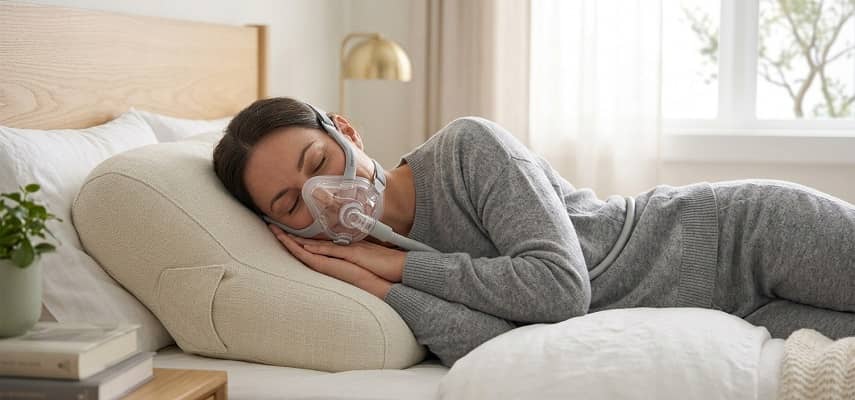
The best CPAP mask for side sleepers is usually one that keeps bulky hardware away from the pillow, seals without excessive strap tension and lets the hose move without pulling the mask sideways. For many people, that points to a low-profile nasal pillow or under-the-nose design; mouth breathers may need a compact full-face mask instead.
Quick picks
Best overall
ResMed AirFit P30i
Top-of-head tubing plus a small nasal-pillow cushion make it a strong starting point for side sleepers who change positions.
Best full-face tube-up
ResMed AirFit F30i
An under-the-nose full-face cushion with the hose connection at the top of the head for people who breathe through their mouth.
Simplest fitting
F&P Solo Nasal Pillows
AutoFit headgear and one-touch adjustment reduce the number of fitting steps, and Fisher & Paykel says its masks contain no magnets.
How we chose these CPAP masks for side sleepers
We treated side sleeping as a fit-and-movement problem rather than assuming one mask style works for everyone. We prioritized low-profile cushions, hose routing that reduces tugging, room to rest the cheek near a pillow, current manufacturer support, multiple fit options and clear safety information. Category labels such as “best overall” are editorial judgments, not findings from a head-to-head clinical trial.
We also checked current 2026 side-sleeper recommendations from Sleep Foundation and SleepApnea.org as a second opinion, then verified product construction against ResMed, Philips Respironics and Fisher & Paykel Healthcare. Medical guidance comes from the National Heart, Lung, and Blood Institute (NHLBI), Mayo Clinic and the FDA.
Fit beats rankings. A mask that seals comfortably on your face is a better choice than a “best” mask that leaks when your cheek touches the pillow. NHLBI recommends adjusting the mask while lying down with the PAP machine running, which better recreates the position in which you actually sleep.
Best CPAP masks for side sleepers at a glance
| Mask | Our category | Mask style | Hose connection | Watch for |
|---|---|---|---|---|
| ResMed AirFit P30i | Best overall | Nasal pillows | Top of head | Nasal breathing required |
| Philips DreamWear Silicone Pillows | Top-of-head alternative | Nasal pillows | Top of head | Frame size and pillow size both matter |
| ResMed AirFit P10 | Minimalist pick | Nasal pillows | Front/tube-down | Hose can tug if unmanaged |
| ResMed AirFit F30i | Full-face tube-up | Under-the-nose full face | Top of head | Contains magnets |
| ResMed AirFit F40 | Compact full-face | Under-the-nose full face | Front/tube-down | Contains magnets |
| F&P Solo Nasal Pillows | Easy fitting / magnet-free | Nasal pillows | Front/tube-down | Not ideal if top-of-head routing is essential |
Magnet safety: ResMed AirFit F30i and AirFit F40 use magnetic clips. ResMed says masks with magnets are contraindicated for people with certain active medical implants or ferromagnetic metallic implants/objects, including if someone in close physical contact has an affected device. Keep mask magnets at least 6 inches (150 mm) from devices that may be affected and review the current labeling with your clinician or equipment provider.
The six CPAP mask profiles
01 / BEST OVERALL
ResMed AirFit P30i Nasal Pillows Mask
The ResMed AirFit P30i is our best overall starting point for side sleepers because its hose connects at the top of the head and the nasal-pillow cushion leaves most of the cheeks free. ResMed specifically designs it for people who switch sleep positions.
Key features
- Top-of-head hose connection with swivel elbow
- Nasal-pillows cushion with minimal facial contact
- Quick-release elbow for getting up at night
- P30i cushion can be interchanged with the compatible N30i nasal-cradle cushion on the appropriate frame
Pros
- Keeps the hose away from the front of the face and pillow
- Small cushion footprint gives the cheek more room on the pillow
- Good option for active sleepers who roll from side to side
Cons
- Nasal pillows can irritate sensitive nostrils if the size or tension is wrong
- Not the best match for people who cannot reliably breathe through the nose during sleep
- Air travels through the side frame, which some users notice when one side is compressed
Best for: Side sleepers and combination sleepers who breathe through the nose and want the hose routed away from the pillow.
Who should keep looking: Persistent mouth breathers, people with very sensitive nostrils, or anyone who does better with an under-the-nose cradle rather than pillows.
02 / TOP-OF-HEAD ALTERNATIVE
Philips Respironics DreamWear Silicone Pillows Mask
The DreamWear Silicone Pillows uses a top-of-head tube connection and in-frame airflow, giving side sleepers a second strong tube-up option. Philips says the pillows are designed for stability and seal during sleep, and the platform is intended to allow freedom of movement between positions.
Key features
- Top-of-head air delivery
- Silicone nasal pillows
- Airflow travels through the hollow frame
- DreamWear platform offers interchangeable nasal-style cushions when compatible components are used
Pros
- Hose stays away from the front of the body
- Minimal contact across the nose bridge and cheeks
- Good alternative if P30i pillows do not suit your nose shape
Cons
- You need the correct frame and pillow sizes, not just a headgear adjustment
- Side-frame airflow can feel different when one side presses into the pillow
- Not appropriate if you need mouth coverage
Best for: Nasal-breathing side sleepers who want top-of-head tubing but prefer the fit and geometry of the DreamWear platform.
Who should keep looking: People who need a full-face interface or anyone who dislikes air moving through a hollow side frame.
03 / MINIMALIST PICK
ResMed AirFit P10 Nasal Pillows Mask
The ResMed AirFit P10 is a small, lightweight nasal-pillow mask with very little material on the face. It does not route the hose over the head, so side sleepers need to manage the front tube, but its minimal cushion and headgear can reduce the amount of hardware pressed into the pillow.
Key features
- Minimalist nasal-pillows design
- Lightweight headgear
- Small facial footprint
- Front hose connection
Pros
- Very little mask surface touches the pillow
- Open field of vision for reading or wearing glasses before sleep
- Simple option for people who dislike bulky frames
Cons
- Front hose can drag the cushion sideways if it catches on bedding
- Nasal pillows may irritate nostrils if over-tightened
- Does not cover the mouth
Best for: Side sleepers who prioritize the smallest possible mask footprint and can route a front hose without tugging.
Who should keep looking: Restless sleepers whose tubing frequently catches on bedding, or anyone who needs mouth coverage.
04 / BEST FULL-FACE TUBE-UP
ResMed AirFit F30i Full Face Mask
The ResMed AirFit F30i is the most side-sleeping-friendly full-face design in this list when hose routing is the priority. Its cushion seals under the nose and around the mouth, while the tubing attaches at the top of the head so it can rotate as you change positions.
Key features
- Top-of-head tube connection
- Under-the-nose full-face cushion
- Quick-release elbow
- Magnetic lower headgear clips
Pros
- Full mouth coverage without a cushion over the nasal bridge
- Top-of-head hose reduces front-of-mask tugging
- Designed for people who move between sleeping positions
Cons
- More facial contact than a nasal-pillow mask
- Correct cushion positioning is important when the cheek contacts a pillow
- Magnetic clips are contraindicated for certain implants and medical devices
Magnet warning: Check ResMed’s current contraindications before using the F30i. This matters for you and for anyone who may be in close physical contact with the mask while it is being worn.
Best for: Side sleepers who breathe through their mouth and want a full-face mask with the hose routed above the head.
Who should keep looking: Anyone covered by ResMed’s magnet contraindications, or people who can use a smaller nasal interface successfully.
05 / COMPACT FULL-FACE
ResMed AirFit F40 Full Face Mask
The ResMed AirFit F40 is a low-profile full-face alternative for side sleepers who do not need a top-of-head hose. ResMed describes the F40 as an UltraCompact, under-the-nose design intended for movement and sleeping in any position, with a flexible silicone cushion and a smaller tube-down frame than its traditional full-face masks.
Key features
- Under-the-nose full-face cushion
- Flexible frame designed to adapt with movement
- Front/tube-down connection
- Magnetic headgear clips
Pros
- Less bulky than many traditional mouth-and-nose masks
- No cushion over the nasal bridge
- Useful option when nasal-only masks are not appropriate
Cons
- Front hose is easier to press or tug against bedding than a tube-up design
- Still has more sealing surface than nasal pillows
- Magnetic clips are not suitable for everyone
Magnet warning: The F40 contains magnets. Read ResMed’s current contraindications and warnings before use, especially if you or a close-contact bed partner has an implanted medical device or ferromagnetic metallic implant.
Best for: Side sleepers who need mouth coverage but want less facial bulk than a conventional full-face mask.
Who should keep looking: Anyone covered by the magnet contraindications, or active sleepers who strongly prefer the hose connection above the head.
06 / EASY FITTING · MAGNET-FREE
Fisher & Paykel Solo Nasal Pillows Mask
The F&P Solo Nasal Pillows stands out for its AutoFit headgear and one-touch adjustment rather than top-of-head tubing. Fisher & Paykel says AutoLock technology holds the fit in place during sleep, and the same headgear works with Solo nasal or nasal-pillow cushions. The company also states that its masks do not contain magnets.
Key features
- AutoFit headgear with one-touch adjustment
- AutoLock system designed to maintain fit
- Nasal-pillow cushion in multiple sizes
- No magnets, according to Fisher & Paykel Healthcare
Pros
- Fewer strap-adjustment steps than many traditional masks
- Minimal nasal-pillow footprint for side sleeping
- Useful alternative for people avoiding magnetic clips
Cons
- Front hose may need more deliberate routing for active side sleepers
- Nasal-only design is not suitable for everyone
- Availability can vary by provider and region
Best for: Nasal-breathing side sleepers who want a simple fitting routine or need a magnet-free option.
Who should keep looking: People who specifically need top-of-head hose routing or mouth coverage.
What type of CPAP mask is best for side sleepers?
For many side sleepers, nasal pillows and under-the-nose nasal masks are easier to accommodate because they have less material for the pillow to push against. But they are not automatically better: nasal obstruction, mouth breathing, prescribed pressure, facial anatomy and comfort can make a full-face mask the more practical choice.
Nasal pillows
Nasal-pillow masks have the smallest facial footprint in this guide. That leaves more cheek area free and reduces the amount of frame that can be displaced by a pillow. Mayo Clinic notes that nasal-pillow and nasal-cradle masks can improve comfort and fit for many people, although nasal-only masks are less suitable when nasal breathing is difficult.
Under-the-nose nasal masks
A nasal cradle rests under the nose rather than inserting pillows into the nostrils. For side sleepers who like a minimal mask but find nasal pillows irritating, this can be a useful middle ground. Some platforms, including ResMed N30i/P30i and Philips DreamWear, use top-of-head tubing that helps keep the main hose away from the face.
Full-face masks
Full-face masks cover the mouth as well as the nose area, so they have more sealing surface to disturb when you press your face into a pillow. Compact under-the-nose designs such as the AirFit F30i and F40 reduce that bulk. Mayo Clinic also notes that full-face masks can be useful for people who breathe through their mouth while sleeping.
Do not switch mask type only because of sleep position. If you have persistent nasal blockage, mouth leak, high pressure needs or another therapy issue, your sleep clinician or equipment provider can help match the interface to your prescription and your breathing pattern.
What should side sleepers look for in a CPAP mask?
1. Hose routing that does not pull the mask sideways
A top-of-head connection is helpful when you roll over frequently because the tube can rotate above you rather than dragging across the pillow. A front hose can still work well if it has slack and a clear path. The goal is not a particular hose location; it is to prevent the tubing from transmitting force into the cushion seal.
2. A cushion that stays clear of pillow pressure
Look at where the cushion seals, not only the overall mask size. A low-profile mask can still leak if the pillow presses directly on the cushion edge. Nasal pillows have very little cheek contact, while compact full-face cushions sit lower on the face than traditional masks that cover the nasal bridge.
3. Enough size options to fit your face
A side-sleeping seal depends heavily on size. Cushion size, frame size and headgear size may be separate choices. Use the manufacturer’s fitting template or fit pack when offered, and do not assume your size in one brand matches another. Mayo Clinic specifically recommends paying attention to sizing because mask sizes are not standardized across brands and styles.
4. Safety features that match your medical devices
Some full-face masks use magnets for quick headgear attachment. Check the current contraindications before buying. If magnets are not appropriate for you or a close-contact partner, choose a nonmagnetic mask rather than trying to modify magnetic clips or ignore the manufacturer’s warning.
How can side sleepers reduce CPAP mask leaks?
The most effective leak fixes are usually fit and positioning changes, not maximum strap tension. Recreate your real sleep posture, run the PAP machine, let the cushion inflate, then make small adjustments. If the mask still moves when your cheek touches the pillow, try a different cushion size or mask geometry rather than simply tightening harder.
- Fit the mask lying down. Put the machine on at your prescribed settings and settle into your normal side-sleeping position before judging the seal.
- Keep the cushion near the pillow edge. Position your head so the mask is not being pushed sideways. A CPAP pillow with side cutouts can help some people, but it is optional if your regular pillow allows the mask to hang over the edge comfortably.
- Give the hose slack. Route tubing above the headboard, across the mattress or through a hose-management system so turning over does not pull on the mask.
- Do not overtighten. Over-tightening can distort a silicone cushion, create pressure points and sometimes worsen leaks. Follow the manufacturer’s fitting order.
- Clean skin and the cushion as directed. Oils and residue can interfere with the seal. NHLBI recommends cleaning the mask and washing your face before putting it on.
- Review leak data. If your PAP machine or app reports persistent large leaks, or you wake with air blowing into your eyes or mouth, contact your equipment provider or sleep clinician for fitting help.
A different pillow can help, but it should not be used to compensate for a badly sized mask. First get the mask, cushion and headgear fit correct; then adjust pillow height or edge position to reduce direct pressure on the mask.
How does CPAP work for sleep apnea?
Continuous positive airway pressure (CPAP) provides a constant level of air pressure through a mask to help keep the airway open during sleep. NHLBI describes PAP as a common treatment for sleep apnea and advises using the device whenever you sleep. The mask does not cure sleep apnea by itself; it is the interface that delivers the prescribed pressure.
Side sleeping may also help some people with obstructive sleep apnea because it can reduce airway collapse compared with sleeping on the back, but position does not replace prescribed PAP therapy. Do not change or stop therapy based only on sleeping position without discussing it with your healthcare provider.
How should you clean a CPAP mask?
Follow the cleaning instructions for your exact mask and PAP device. In general, manufacturers recommend regular hand cleaning of mask components with mild soap and water, followed by thorough rinsing and air drying. The FDA says most ozone- or UV-based devices marketed to clean CPAP equipment have not been cleared or approved for cleaning, disinfecting or sanitizing CPAP machines and accessories.
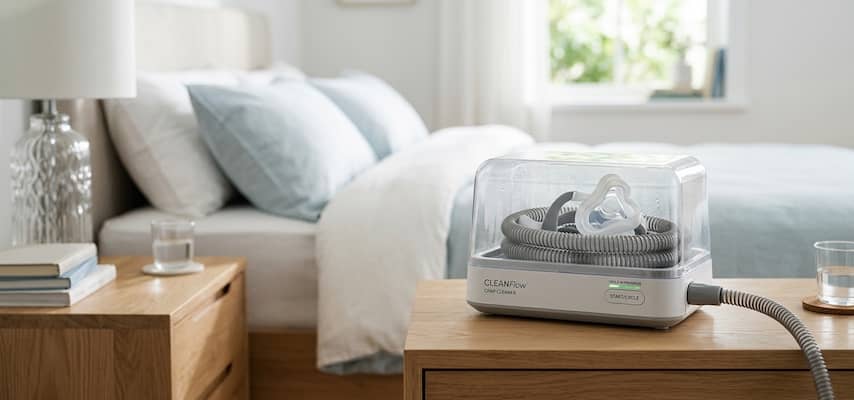
For background on add-on devices, see our CPAP cleaner machine guide, but use your mask and PAP manufacturer’s current cleaning instructions as the primary source.
FDA cleaning caution: Ozone and UV can damage some CPAP accessories, and the FDA has received reports of respiratory symptoms after use of ozone cleaning products. An add-on cleaner does not replace manufacturer-recommended cleaning.
When should you ask a sleep professional for help?
Contact your sleep clinician, respiratory therapist or equipment provider when a mask repeatedly leaks, will not stay on, causes persistent skin injury, blows air into your eyes, or makes it difficult to use PAP for the full night. They can check fit, mask style and therapy data and may recommend a different interface rather than simply tighter headgear.
- Your mask still leaks after careful fitting in your normal sleep position.
- You have persistent dry mouth, nasal blockage, pressure sores or eye irritation.
- You cannot keep the mask on through the night or are avoiding PAP because of discomfort.
- Your PAP data suggests persistent large leaks or your symptoms are not improving.
- You are considering changing prescribed PAP pressure settings on your own.
Frequently asked questions
Which CPAP mask style is usually best for side sleepers?
Nasal pillows and under-the-nose nasal masks are often the easiest styles to accommodate because they leave more of the cheek free and create fewer contact points for a pillow to push against. A compact full-face mask may be more appropriate if you breathe through your mouth, have nasal obstruction or need mouth coverage.
Can a side sleeper use a full-face CPAP mask?
Yes. Side sleepers can use full-face masks, but the larger sealing area makes pillow pressure more important. Under-the-nose models such as the AirFit F30i and F40 reduce bulk compared with traditional masks that cover the nasal bridge. Fit the mask while lying on your side and check for leaks before deciding.
Why does my CPAP mask leak when I sleep on my side?
Your pillow can push the mask frame or cushion sideways, changing the seal. Tubing can also pull the mask when you roll over. Try fitting the mask while lying down with the machine on, give the hose more slack and move the mask closer to the pillow edge. Persistent leaks may require a different size or mask style.
Is a top-of-head CPAP hose better for side sleepers?
A top-of-head hose is often convenient for people who change sides because the tube can swivel above the head instead of pulling across the chest or pillow. It is not automatically better for everyone. A well-routed front hose can work just as well if it stays free of bedding and does not tug the cushion.
Should I tighten my CPAP mask more to stop leaks?
Not necessarily. Excessive tension can distort the cushion and create pressure points. Follow the manufacturer’s fitting order and make small adjustments with the PAP running in your normal sleeping position. If the mask has to be painfully tight to seal, the cushion size, headgear size or mask design may be wrong for you.
Do I need a special CPAP pillow for side sleeping?
No. A CPAP pillow with edge cutouts can create space for the mask, but many side sleepers do well with a regular pillow by positioning the face near the edge. The priority is a properly fitted mask. A special pillow is an accessory to reduce contact pressure, not a fix for incorrect mask sizing.
Can I buy a complete CPAP mask on Amazon?
Availability changes, and Amazon often carries replacement cushions, frames and headgear separately rather than a complete mask system. Before ordering, verify exactly what the listing includes and make sure it matches the mask model and size you use. If a complete system requires a prescription through your supplier, follow that process rather than piecing together incompatible parts.
This article provides general information and product research, not medical advice. A qualified healthcare professional can help you choose and fit a mask for your diagnosis, prescription and medical history.