Best Fitness Tracker for Ankle: Top 6 for 2026
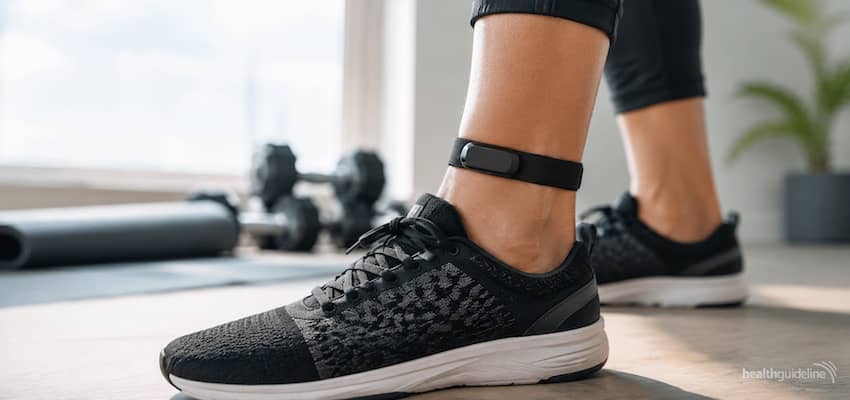
The Fitbit Inspire 3 is the best fitness tracker for ankle wear for most people — it’s slim, reliable, lasts about 10 days, and fits the widest range of dedicated ankle bands. Want no screen at all? The Fitbit Air is the most comfortable low-profile choice. Run or cycle outdoors? The Fitbit Charge 6 adds built-in GPS. On a tight budget, a screenless FITVII band covers the basics for well under $50.
Most fitness trackers are built for your wrist — but plenty of people need or want to wear one lower down. Maybe your job has a “bare below the elbows” hygiene rule, maybe a wrist band gets in the way at work or the gym, maybe you have a wrist tattoo or sensitive skin, or maybe you just want a more accurate step count when your hands are busy pushing a cart or a stroller. This guide covers the trackers that work best on the ankle, the honest trade-offs of ankle wear, and — the part most guides skip — the ankle band that actually keeps the device in place.
One thing to know up front: there is no mainstream tracker sold only for the ankle. Almost every “ankle fitness tracker” is a normal wrist tracker paired with an ankle-length band. A few slim, screenless devices happen to suit the ankle especially well, and we’ve flagged those below.
How we chose
We looked only at products currently sold on Amazon US and verified each one exists and is available. We prioritized slim, lightweight designs (weight and bulk are far more noticeable on the ankle than the wrist), a secure ankle fit, water resistance, battery life, and reliable data from established brands. We cross-checked manufacturer specs against independent expert reviews and verified owner feedback, and we’ve called out the real limitations of ankle wear rather than glossing over them — including where step counting is more accurate at the ankle and where heart rate is less accurate.
Best fitness trackers for ankle at a glance
| Tracker | Best for | Screen | Battery | Water resistance | Approx. price | Link |
|---|---|---|---|---|---|---|
| Fitbit Inspire 3 | Best overall | Yes (AMOLED) | Up to 10 days | 50 m (5 ATM) | ~$80–100 | View |
| Fitbit Air | Best screenless | No | Up to 7 days | Water-resistant* | ~$100 | View |
| Fitbit Charge 6 | Best with GPS | Yes (AMOLED) | Up to 7 days | 50 m (5 ATM) | ~$135–160 | View |
| FITVII Screenless | Best budget | No | Up to ~10 days | IP68 | Under ~$50 | View |
01 / BEST OVERALL FOR ANKLE WEAR
Fitbit Inspire 3 For ankle wear
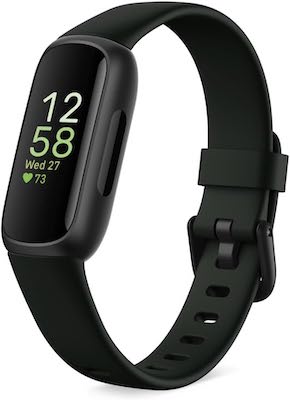
The Fitbit Inspire 3 is the best all-round fitness tracker for the ankle. It’s slim and light with a roughly 10-day battery and 50 m water resistance, it tracks steps, heart rate, and sleep dependably, and — crucially — it fits the widest range of dedicated ankle bands, so getting a secure fit below the wrist is easy.
Key features:
- Slim resin case
- bright AMOLED touchscreen
- 24/7 heart rate
- SpO2 and skin-temperature tracking
- sleep stages and Sleep Score
- 40+ exercise modes
- Daily Readiness Score
- smartphone-GPS distance
- ~10-day battery.
Pros:
- Lightweight and low-profile for all-day and overnight ankle wear
- genuinely long battery life
- mature, well-supported Fitbit/Google app
- by far the best selection of aftermarket ankle bands.
Cons:
- No built-in GPS (uses your phone’s)
- some deeper insights sit behind Google Health Premium
- screen can catch glare in direct sun.
Best for: Anyone who wants one reliable tracker that also happens to work great on the ankle.
Pair it with a dedicated ankle band (see the ankle band section below) — the Inspire 3 works with both pouch-style and quick-release strap bands.
02 / BEST SCREENLESS TRACKER FOR ANKLE WEAR
Fitbit Air for ankle wear
The Fitbit Air is the best screenless option for ankle wear. Its tiny pebble-shaped sensor (about 5 grams) sits flat with no screen to catch on socks or glare in the sun, the battery lasts about a week, and you get reliable Fitbit data with no mandatory subscription — ideal for distraction-free step tracking below the knee.
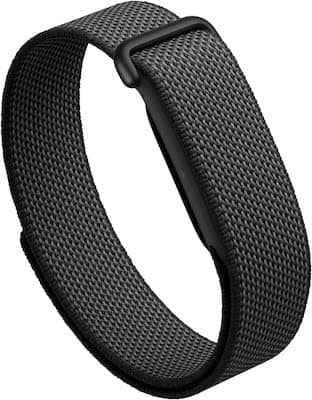
Key features:
- Screenless “pebble” that clicks into a swappable band
- 24/7 heart rate
- SpO2
- HRV
- sleep stages
- irregular-rhythm (AFib) alerts
- up to 7-day battery with a 5-minute fast charge
- works with the Google Health app on Android and iOS.
Pros:
- Extremely light and low-profile — arguably the most comfortable device here for the ankle
- no screen means nothing to scratch or glare
- most core features work without a subscription
- strong sleep and recovery data.
Cons:
- Launched in mid-2026, so dedicated ankle bands are still limited
- its bands are proprietary (the stock Large silicone band fits up to about 8.3″, which suits slimmer ankles — larger ankles may need the micro-adjustable loop band or an emerging third-party strap)
- you must open your phone to see any stat
- some coaching needs Google Health Premium.
Best for: Minimalists who want passive, screen-free tracking from a brand they can trust.
03 / BEST FOR RUNNERS AND CYCLISTS
3. Fitbit Charge 6 for runners and cyclists (built-in GPS)
Choose the Fitbit Charge 6 if you run or cycle and want accurate outdoor distance and pace without carrying your phone. It’s the only pick here with built-in GPS, plus an ECG app, contactless payments, and a bright color screen. It’s a little bulkier and pricier than the Inspire 3, but it’s the most capable tracker on this list.
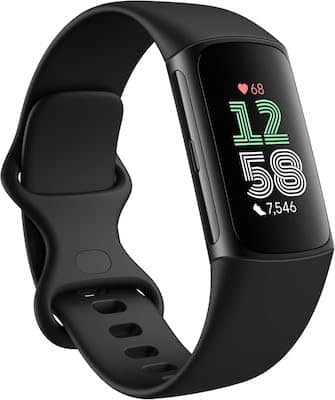
Key features:
- Built-in GPS
- 24/7 heart rate with on-machine heart-rate broadcasting
- ECG and irregular-rhythm alerts
- 40+ exercise modes
- Google Maps and Google Wallet
- ~7-day battery
- 50 m water resistance.
Pros:
- Phone-free GPS for precise runs and rides
- the most features of any pick
- bright, responsive display
- strong heart-rate hardware.
Cons:
- Larger and heavier on the ankle than the Inspire 3 or Air
- most expensive pick
- some features need Premium.
Best for: Active users who want GPS-tracked workouts and don’t mind a slightly larger device.
For the ankle, there’s a B-Great ankle band that fits the Charge 6 (and the Charge 5/4/3, Inspire 3/2, Luxe, and more). Because the Charge 6 also has an ECG, it may interest anyone comparing an FDA-cleared ECG smartwatch.
04 / BEST BUDGET SCREENLESS PICK
FITVII Screenless Fitness Tracker
The FITVII screenless tracker is the budget pick: an ultra-thin, screen-free band with IP68 water resistance, up to a 10-day battery, and no subscription, usually for well under $50. Just set expectations honestly — its step counts can read optimistically versus established brands, and its health readings are wellness estimates, not clinical measurements.
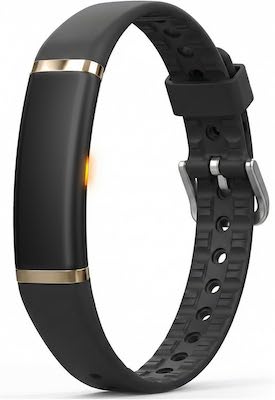
Key features:
- Screenless slim band
- 24/7 heart rate
- SpO2
- HRV and sleep tracking
- steps/calories/distance
- IP68 rating
- guest mode (use the app without registering)
- small and large straps included
- no subscription.
Pros:
- Very affordable
- genuinely slim and light for the ankle
- no glowing screen
- long claimed battery life
- no locked features or fees.
Cons:
- Step counts can overcount compared with a Fitbit
- blood-pressure and other health figures should be read as trends, not medical data
- the app and long-term software support are less polished than a major brand’s
- niche-brand quality can vary between units.
Best for: Budget-focused buyers who want basic, screen-free step and sleep tracking and understand the accuracy trade-offs.
The part most guides skip: a good ankle band
A tracker only works on your ankle if the band actually fits and holds it in place. Most wrist bands are too short, so you’ll want a purpose-made ankle band. Look for three things: it’s long enough for your ankle (measure first — most adults are between 8 and 11 inches around), it closes securely with hook-and-loop so it can’t slip during activity, and — if you care about heart rate — it keeps the sensor against your skin rather than facing outward. Here are two proven options.
BEST FOR MOST FITBITS
B-Great Ankle Band with Mesh Pouch
This adjustable strap holds your tracker inside a secure mesh pouch, so it works with a wide range of devices — Fitbit Flex 2, One, Alta, Charge 2/3/4, Inspire HR/2, and more. It’s comfortable for all-day and overnight wear and closes with a touch fastener so nothing slips out. Because the tracker sits in a pouch, the heart-rate sensor won’t press flat against your skin — perfect if you mainly want an accurate step count.
Best for: Most Fitbit owners who want a secure, one-size-fits-most ankle option.
BEST STRAP-STYLE BAND
Seltureone Ankle Band for Fitbit Inspire
If you own a Fitbit Inspire, Inspire HR, or Inspire 2, this replaces the wrist strap directly using the tracker’s quick-release pins — no pouch needed. It adjusts from 8″ to 12.6″ with a double hook-and-loop closure, keeps the sensor against your skin (so heart rate reads better than with a pouch), and looks cleaner than a bulky holder. It’s a soft fabric band designed for comfortable day-and-night wear.
Best for: Fitbit Inspire owners who want the tightest, lowest-profile ankle fit.

What to look for in an ankle fitness tracker
A slim, lightweight design
Weight and bulk you’d never notice on your wrist become obvious on your ankle, especially overnight or under trousers and socks. The lighter and thinner the device, the better — which is exactly why screenless trackers like the Fitbit Air are so comfortable down there.
Screen or screenless?
A screen lets you glance at your stats mid-walk, but it also adds bulk and can catch glare or snag on clothing near your foot. Screenless trackers are lower-profile and distraction-free; the trade-off is that you’ll always check your data in the app.
A secure, ankle-length band
This is the make-or-break detail. Measure your ankle (most adults land between 8 and 11 inches) and choose a band that adjusts to your size, closes firmly with hook-and-loop, and won’t migrate as you move. A device that spins or slides will miscount and annoy you.
Water resistance
If you’ll wear it in the shower, rain, or pool, check the rating. Fitbit’s Inspire 3 and Charge 6 are rated to 50 m (5 ATM); many budget bands carry an IP68 rating that’s fine for sweat and splashes. If swimming is your main sport, see our guide to the best fitness trackers for swimming.
Battery life
Longer battery means fewer interruptions — and one less thing to remember for a device that’s out of sight on your ankle. The Fitbit Inspire 3’s ~10-day life is a real convenience; the Air and Charge 6 land around a week.
What it actually tracks
Be clear about your priority. If it’s steps and daily activity, almost any pick here works well on the ankle. If it’s precise heart rate, keep reading — placement matters more than you might think. If you want heart-rate-first tracking, compare options in our best fitness tracker with a heart-rate monitor guide.
Is the ankle actually better than the wrist?
For step counting, often yes. In one treadmill-walking validation study, ankle-worn devices miscounted steps by only about 1%, compared with roughly 15% at the wrist. The gap gets dramatic when your arms aren’t swinging: the U.S. Centers for Disease Control and Prevention notes that wrist trackers can undercount steps by anywhere from 35% to 95% during activities where the arm stays still — pushing a shopping cart, a wheelchair, or a stroller. That’s exactly why nurses, retail and warehouse workers, new parents, and caregivers so often move their tracker to the ankle.
For heart rate, the wrist (or upper arm) is usually the better spot. Optical heart-rate sensors rely on light through the skin and are sensitive to motion and to where they sit on the body; validation studies show even wrist devices are best treated as trend indicators and lose accuracy during rapid changes in effort. There’s far less testing of heart rate specifically at the ankle, so treat any ankle heart-rate reading as a rough guide. If you need precise heart rate — for interval training or heart-rate zones — a chest strap remains the gold standard.
The practical takeaway: the ankle is a great home for step, distance, and all-day activity tracking, and a compromise for heart rate. Match the position to what you care about most.
Frequently asked questions
Can you wear a Fitbit on your ankle?
Yes. Fitbits track steps from the ankle just fine, and many people find the count more accurate for activities like cycling or pushing a stroller, where the arm barely moves. You’ll need an ankle-length band or a pouch band to hold it securely. Just know that heart-rate readings are less reliable at the ankle than on the wrist.
Is an ankle fitness tracker more accurate than a wrist one?
It depends on the metric. For step counting during arm-still activities — cycling, treadmill walking, pushing a cart — the ankle often reads more accurately than the wrist. For heart rate, the wrist is usually more accurate, because optical sensors struggle with motion and tissue at the ankle. For precise heart rate, use a chest strap.
What’s the best fitness tracker for ankle wear?
For most people, the Fitbit Inspire 3 — it’s slim and reliable, lasts about 10 days, and fits the most ankle bands. If you’d rather have no screen at all, the screenless Fitbit Air is the most comfortable low-profile choice. On a tight budget, a screenless FITVII band handles the basics for well under $50.
Why do nurses and others wear a tracker on the ankle?
Common reasons include hospital “bare below the elbows” hygiene rules, wrist tattoos or skin sensitivity, jobs or workouts where a wrist device gets in the way, and simply wanting a more accurate step count when your hands are busy pushing carts, strollers, or wheelchairs. The ankle keeps counting without getting in the way. If you’re after a wrist option instead, see our best watches for nurses.
Do I need a special band to wear a tracker on my ankle?
Usually yes. Most wrist bands are too short for an ankle, so you’ll want a dedicated ankle band or a pouch-style strap. Measure your ankle first — most adults fall between 8 and 11 inches — and pick a band that adjusts to your size and closes securely with hook-and-loop so the tracker can’t slip off.
Are there trackers made specifically for the ankle?
A few screenless trackers, like the Fitbit Air and FITVII bands, suit the ankle especially well because they’re tiny and have no screen to catch or glare. But there’s no mainstream tracker sold only for the ankle — most “ankle fitness trackers” are standard wrist trackers paired with an ankle-length band. If you’d rather clip a tracker to your waistband or shoe, see our guide to the best clip-on fitness trackers.
Related reading
- Best clip-on fitness trackers
- Best fitness tracker with a heart-rate monitor
- Best fitness tracker for swimming
- Best watches for nurses
- FDA-approved ECG smartwatches
- Best sneakers with ankle support
Health note: This article is for general information only and is not medical advice. Consumer trackers are wellness tools, not medical devices; talk to a qualified healthcare professional about your specific situation.