Best Inversion Tables of 2026: 5 Top Picks for Back Pain Relief
Quick Verdict
Best overall:
Teeter FitSpine LX9
The only inversion tables registered with the FDA as a Class I medical device, with the best-in-class ankle lock and decompression backrest.
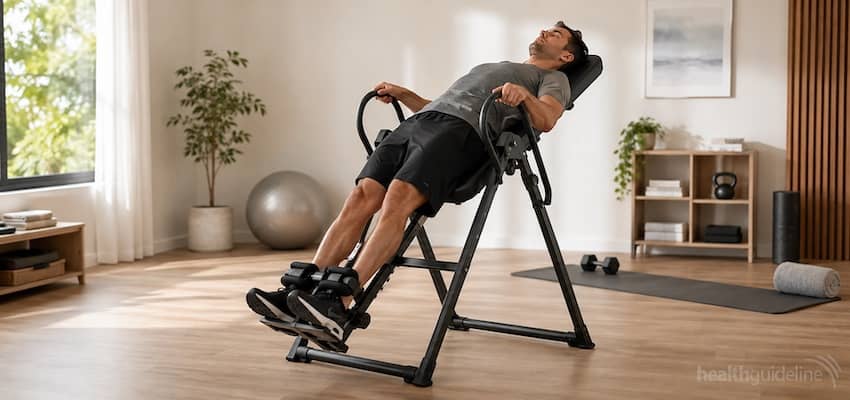
An inversion table tilts you partly or fully upside down so gravity can gently stretch your spine — a technique clinicians call spinal traction. Used carefully, it can offer short-term relief from back and disc-related pain for some people. It is not a cure, and it is not safe for everyone. This guide covers five inversion tables worth your money in 2026, what the science actually says, and — just as important — who should stay off one entirely.
Read this first: Hanging upside down raises your blood pressure and the pressure inside your eyes, and slows your heart rate. Health authorities advise against inversion therapy if you have high blood pressure, heart disease, glaucoma or other eye conditions, or if you are pregnant, among other conditions. Talk to a doctor before you start — see who should avoid an inversion table below.
How we chose these inversion tables
We prioritized the things that actually matter on an inversion table: a stable, heavy-gauge steel frame, an ankle-locking system that’s easy to reach and comfortable (the number-one complaint on cheap tables), predictable angle control, and a realistic weight and height range. We favored models with independent safety testing (UL) or FDA registration, weighed comfort features like lumbar support and heat against price, and cross-checked specifications against manufacturer manuals and buyer feedback. We did not rank any table on marketing claims alone, and we flag below where the evidence for inversion therapy is thin.
Top inversion tables at a glance
| Table | Best for | Capacity & height | Standout feature | Approx. price* |
|---|---|---|---|---|
| Teeter FitSpine LX9 | Best overall | 300 lb · 4'8"–6'6" | FDA-registered; deluxe easy-reach ankle lock | around $450–$600 |
| Teeter FitSpine X3 | Best value premium | 300 lb · 4'8"–6'6" | Same FlexTech backrest as the LX9 for less | around $350–$430 |
| Innova ITX9600 | Best budget | 300 lb · 4'10"–6'6" | Adjustable headrest + 6-angle pin system | around $120–$160 |
| Innova ITM5900 | Best with heat & massage | 300 lb · 4'10"–6'6" | Removable heat + vibration lumbar pad | around $180–$230 |
| Ironman Gravity 4000 | Best heavy-duty | 350 lb · 4'9"–6'6" | Highest weight capacity + memory-foam bed | around $150–$230 |
01 / Best overall
1. Teeter FitSpine LX9 — Best overall
The Teeter FitSpine LX9 is the most complete inversion table for most people with back pain. Teeter is the only brand whose tables are registered with the FDA as a Class I medical device, and the LX9 pairs that pedigree with the easiest ankle lock to reach, a firm decompression backrest, and an arched boarding platform that makes getting on and off far less awkward than rivals.
Key features
- FlexTech backrest with an 8-point floating suspension for a deeper, firmer stretch
- Deluxe EZ-Reach ankle lock with a long stainless handle plus a secondary gravity lock
- Removable Lumbar Bridge and acupressure nodes for targeted lower-back traction
- UL safety-certified, heat-treated steel frame; 5-year warranty; folds for storage
Pros
- The most credible safety/quality credentials in the category
- Ankle lock you can reach without straining your back
- Firm bed genuinely aids decompression (no “sinking in”)
Cons
- Premium price
- Large and heavy — plan a permanent spot for it
Best for: Anyone who wants the safest, most refined option and will use it regularly. Approx. price: around $450–$600 — check current price on Amazon.
02 / Best value premium
2. Teeter FitSpine X3 — Best value premium
The FitSpine X3 is the smart-money Teeter. It shares the same FlexTech backrest, 8-point suspension, deluxe ankle lock, and FDA registration as the LX9, but sits a notch lower on price. The main thing you give up is the LX9’s arched boarding platform and a little frame refinement — a fair trade if you want Teeter’s engineering without the top-tier cost.
Key features
- FlexTech decompression backrest with 8-point floating suspension
- Deluxe EZ-Reach ankle lock with secondary gravity lock
- Lumbar Bridge, acupressure nodes, and grip-and-stretch handholds included
- FDA-registered, UL safety-certified, 300 lb capacity, 5-year warranty
Pros
- Nearly LX9 performance for meaningfully less money
- Same safety credentials as the flagship
- Consistently well-reviewed by long-term owners
Cons
- Boarding is slightly less easy than the LX9
- Still a large, heavy unit
Best for: Buyers who want a Teeter and care more about value than the flagship’s extras. Approx. price: around $350–$430 — check current price on Amazon.
03 / Best budget
3. Innova ITX9600 — Best budget
If you want to try inversion without a big outlay, the Innova ITX9600 is the sensible starting point. It’s a long-running, heavily reviewed table with an adjustable headrest, a padded backrest, and a 6-position pin system that lets you set a firm maximum angle — safer and more predictable than the loose tether straps on some cheap tables. You won’t get Teeter’s firm decompression bed or FDA registration, but for occasional home use it covers the basics well.
Key features
- Six-angle pin system with a protective cover for repeatable angles
- Adjustable headrest and “True Balance” three-point adjustment
- Reversible ankle holders; folds flat for storage
- 300 lb capacity; fits users 4’10″–6’6″
Pros
- Excellent price-to-feature ratio
- Pin-based angle control is easy and consistent
- One of the most-reviewed budget tables available
Cons
- Padded bed lets you sink slightly, reducing decompression
- No independent UL/FDA credentials; shorter warranty
Best for: First-timers and occasional users on a budget. Approx. price: around $120–$160 — check current price on Amazon.
04 / Best with heat & massage
4. Innova ITM5900 — Best with heat & massage
The ITM5900 is essentially Innova’s value table with a removable heat-and-vibration pad added along the spine and lower back. The warmth and gentle massage can help tight muscles relax before or after a stretch, and the pad detaches so you can use it on a couch or bed. The comfort extras are a nice-to-have rather than a clinical feature — but at this price, they’re a reasonable bonus.
Key features
- Removable vertical heat + vibration massage pad with multi-mode settings
- Six-angle pin system with protective cover; adjustable headrest
- Padded backrest and foam handlebars; folds for storage
- 300 lb capacity; fits users 4’10″–6’6″
Pros
- Heat and vibration help loosen tight muscles
- Massage pad is portable and removable
- Good value for a heat/massage model
Cons
- Heat/massage is a comfort feature, not therapy — and it must be limited to short sessions (the pad auto-shuts off around 15 minutes)
- Same soft-bed and no-UL/FDA caveats as the ITX9600
Best for: Buyers who want built-in warmth and massage for tight lower-back muscles. Approx. price: around $180–$230 — check current price on Amazon.
05 / Best heavy-duty
5. Ironman Gravity 4000 — Best heavy-duty
For bigger and taller users, the Ironman Gravity 4000 is the long-standing favorite. Its heavy tubular-steel frame is rated to 350 lb — higher than most tables here — and it uses a thick memory-foam bed, a removable lumbar pillow, and long side handles that make inverting and returning upright easy. The honest trade-off: unlike Teeter, the Gravity 4000 isn’t UL certified or FDA registered, so start conservatively and follow the manual closely.
Key features
- 350 lb weight capacity; fits users up to 6’6″
- Thick memory-foam backrest with removable lumbar pillow
- Ratchet ankle lock with an easy-reach adjustment lever
- Long safety handles; non-skid stabilizers; folds for storage
Pros
- Highest weight capacity in this lineup
- Comfortable, well-padded bed for larger users
- Sturdy, stable feel
Cons
- No UL certification or FDA registration
- Heavy (around 75 lb) and bulky to move
Best for: Big-and-tall users who need extra capacity and padding. Approx. price: around $150–$230 — check current price on Amazon.
What to look for when buying an inversion table
Ankle-locking system
This is where cheap tables fail. Clamps that dig in after two minutes will keep you from ever using the table. Look for padded, wrap-around ankle supports and a lock you can reach without bending forward — bending is exactly what you’re trying to avoid if your back hurts. Teeter’s long-handled locks are the benchmark here.
Frame stability and weight capacity
Choose a heavy-gauge steel frame with non-skid floor stabilizers, and stay well within the stated weight limit — most tables here top out at 300 lb, with the Ironman Gravity 4000 rated to 350 lb. A frame that flexes or shifts under load is a safety risk, not a bargain.
Angle control
Pin systems and marked tethers let you set and repeat a specific maximum angle, which is safer than an open strap that can loosen. You rarely need a full 180° inversion; most benefit comes from modest angles you can control.
Backrest and decompression
A thickly padded bed feels plush but lets your body sink in, which can blunt the stretch. Firmer decompression surfaces (like Teeter’s FlexTech) provide a more effective spinal stretch. Heat or massage pads are pleasant extras, not medical features.
Certifications
UL certification means the table passed independent safety testing; FDA registration (Teeter only) means the device is listed as a Class I medical device. Neither guarantees results, but both are meaningful signals of build quality and accountability.
Do inversion tables actually work?
Inversion tables use gravity to gently stretch the spine, which can ease pressure on discs and nerves and give short-term back-pain relief for some people. High-quality evidence is limited, and most clinicians treat inversion as a complementary tool — helpful alongside exercise and physical therapy, not a stand-alone cure.
The theory is straightforward: hanging head-down briefly takes gravity’s compressive load off your lower spine and gives the discs between your vertebrae a little room to relax. According to the Cleveland Clinic, this may relieve muscle tension and spasm and improve flexibility when used for short periods, but most supporting studies are small and the evidence for lasting benefit is limited.
The most-cited research is a 2012 pilot randomized trial from Newcastle upon Tyne in the UK (Prasad and colleagues, published in Disability & Rehabilitation). Among a small group of patients with single-level disc-related sciatica who were already scheduled for surgery, adding inversion traction to physiotherapy was associated with far fewer going on to have an operation than physiotherapy alone. It’s an encouraging result — but it was a small pilot study, and it was funded in part by an inversion-table manufacturer (Teeter), so it needs to be read cautiously and confirmed by larger, independent trials that don’t yet exist.
Just as important is what inversion tables don’t do. There’s no good evidence that hanging upside down “detoxifies” your lymphatic system, makes you permanently taller, cures insomnia or depression, dissolves kidney stones, or measurably boosts memory or brain function. Treat those claims — common in older articles and marketing — with skepticism. Realistic expectations are: temporary relief, gentle stretching, and muscle relaxation, best combined with core-strengthening exercise and guidance from a physical therapist or doctor.
Who should not use an inversion table?
Quick answer: Being inverted raises your blood pressure and the pressure inside your eyes and slows your heart, so authorities advise against inversion therapy for several groups. When in doubt, get medical clearance first.
Avoid an inversion table, or use one only with explicit medical approval, if you have:
- High blood pressure, heart disease, or a history of stroke
- Glaucoma, retinal detachment, or other eye conditions
- Pregnancy
- Osteoporosis, recent fractures, or spinal injuries
- A hiatal hernia or acid reflux
- Ear infections or inner-ear problems (affecting balance)
- Use of blood-thinning medication
Even if none of these apply, inversion isn’t risk-free: injuries do happen, most often from operator error — leaning back too far too soon, skipping the ankle lock, or losing balance. That makes technique and a cautious start essential.
How to use an inversion table safely
General guidance from clinicians and manufacturers, not a substitute for personalized medical advice:
- Get cleared first, especially if you have any condition listed above.
- Start shallow. Tip back only about 10–30° at first — closer to 10° if you’re older — rather than going fully upside down.
- Keep sessions short. Begin with 1–2 minutes once a day and see how you feel before doing more. Some clinicians cite roughly 60° for 2–3 minutes for fuller decompression, but build up to that gradually.
- Have a spotter nearby the first several times in case you can’t right yourself.
- Secure the ankle locks and straps every time, and confirm the frame is stable before you lean back.
- Come back up slowly and pause upright for a moment before dismounting to avoid dizziness.
- Stop immediately if you feel head pressure, dizziness, blurred vision, or pain, and check with a doctor.
Frequently asked questions
Do inversion tables really work for back pain?
For some people, yes — but usually only short-term. Gently stretching the spine can relieve muscle tension and take temporary pressure off compressed discs. The quality evidence is limited and mostly points to brief relief, so inversion works best as one part of a plan that includes exercise and physical therapy, not as a cure on its own.
How long should you stay on an inversion table?
Start small: about 1–2 minutes once a day when you’re new to it, then build up slowly as you get comfortable. Many clinicians suggest keeping sessions to just a few minutes. If you ever feel dizzy, notice pressure in your head or eyes, or feel pain, come upright and stop.
What is the best angle for an inversion table?
There’s no single “best” angle. Beginners should start shallow — around 10–30° — and only progress further if it feels comfortable. Some practitioners cite roughly 60° for fuller spinal decompression, but you rarely need to go fully upside down, and a controlled, moderate angle is safer and often just as useful.
Are inversion tables safe?
They’re reasonably safe for healthy adults who follow the instructions, but they’re not safe for everyone. Inversion raises blood pressure and eye pressure and slows the heart, so people with heart conditions, high blood pressure, glaucoma, or who are pregnant should avoid them. Most injuries come from operator error, so a cautious start and a spotter matter.
Who should not use an inversion table?
Avoid inversion therapy — or use it only with medical approval — if you have high blood pressure, heart disease, a history of stroke, glaucoma or eye conditions, osteoporosis, recent fractures or spinal injury, a hiatal hernia, ear infections, or if you’re pregnant or taking blood thinners. When in doubt, check with your doctor before your first session.
Do inversion tables help sciatica?
They might, for disc-related sciatica. A small 2012 pilot trial found that adding inversion to physiotherapy was linked to fewer patients needing surgery, though the study was small and industry-funded. It’s promising but not conclusive, so treat inversion as a possible complement to proper treatment rather than a guaranteed fix, and get a diagnosis first.
How often should you use an inversion table?
There’s no universal rule. Many people invert for a few minutes once or twice a day, but the right frequency depends on your body and any medical guidance you’ve received. Start with less than you think you need, pay attention to how you feel afterward, and increase gradually rather than overdoing it early.
Are Teeter tables worth the extra money?
If you’ll use it regularly, often yes. Teeter is the only brand registered with the FDA as a Class I medical device, uses independently safety-tested (UL) frames, and has the easiest-to-reach ankle lock plus a firmer decompression bed. Budget tables like the Innova ITX9600 work fine for occasional use, but Teeter’s build quality and safety credentials justify the premium for frequent users.
Related back-pain tools
An inversion table is one option among many. If you’re building a home setup for back comfort, these related guides may help:
- Best recliners for back pain
- Back braces for support
- Back massagers for your chair
- TENS units for pain relief
- Coccyx (tailbone) support cushions
Medical disclaimer: This article is for general information only and is not medical advice. Inversion therapy carries real risks and is not suitable for everyone. Talk to a qualified healthcare professional about your specific situation before using an inversion table.