Best Pillow for Pregnancy: 5 Supportive Picks (2026)
2026 pregnancy sleep guide · comfort, support & fit
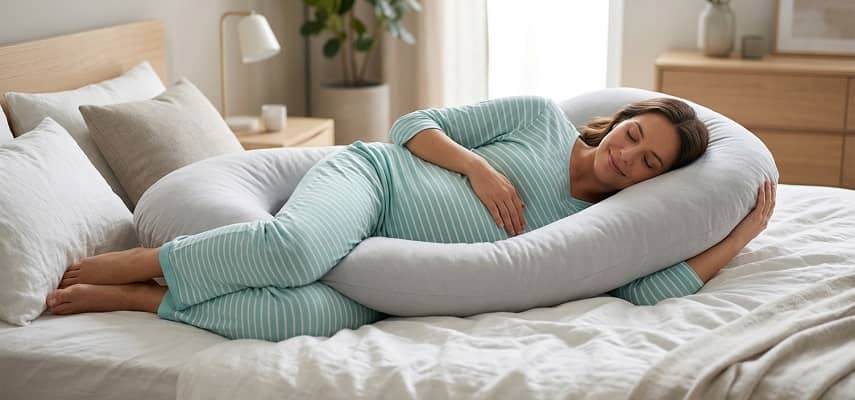
The best pillow for pregnancy depends on how much support and bed space you need. A full-body U-shape surrounds both sides, a compact connected-wedge design supports the bump and back with less bulk, and a simple wedge targets one area. For most buyers wanting head-to-toe support, the Momcozy 57-inch U-shaped pillow is our starting pick.
Quick picks: best pregnancy pillows in 2026
Best overall
Momcozy U-Shaped
Full-body U-shaped support for side sleepers who want cushioning on both sides without rebuilding a pile of pillows each night.
Small-bed pick
Momcozy Portable W
Connected cushions support both sides of the torso while leaving much more mattress space open than a full-body pillow.
Simple wedge
Boppy Pregnancy Wedge
A compact foam wedge for targeted bump, back or knee support without committing to a large wraparound pillow.
How we chose the best pillows for pregnancy
This is a desk-research buying guide, not an independent laboratory or hands-on test. We checked current Amazon US product pages and recent pregnancy-pillow market/roundup data, then prioritized designs that solve meaningfully different problems: full-body support, adjustability, compact two-sided support and a simple wedge. We also favored removable or washable covers where the listing clearly documented them.
Our category labels are editorial judgments, not clinical rankings. We excluded legacy products when the Amazon listing we checked showed the featured variant as currently unavailable. We also avoided fixed star ratings, review counts and exact prices because those can change quickly.
Before you order: recheck the exact shape, cover, seller, price and stock on Amazon. Pregnancy pillows often share a product page with multiple colors or covers, so the selected variant can differ from the one described in a roundup.
Best pregnancy pillows at a glance
| Pillow | Best for | Shape | Research-time price band | Main trade-off |
|---|---|---|---|---|
| Momcozy 57-inch U | Overall full-body support | U-shaped | About $35–$45 | Large mattress footprint |
| ALLOPERA 57-inch U | Adjustable-fill shoppers | U-shaped | About $30–$40 | Still bulky in smaller beds |
| QUEEN ROSE 55-inch U | Classic wraparound feel | U-shaped | About $50–$60 | More pillow than targeted support requires |
| Momcozy Portable W | Small beds and travel | Connected W / wedges | About $25–$35 | No head-to-toe support |
| Boppy Pregnancy Wedge | Targeted bump, back or knee support | Wedge | About $20 | Supports one area at a time |
The five pregnancy pillow picks
01 / BEST OVERALL FULL-BODY PICK
Momcozy U-Shaped Pregnancy Pillow, 57 Inch — view on Amazon
Why it stands out: This 57-inch U-shaped pillow is the best starting point for buyers who want one cushion around the head, torso and legs. Its current Amazon listing describes a removable cover and full-body U shape. The trade-off is straightforward: wraparound coverage takes substantially more mattress space than a wedge or compact two-sided pillow.
Key features
- 57-inch U-shaped full-body design
- Removable cover
- Support on both sides for easier side-to-side repositioning
- Current Amazon US listing verified during research
Pros
- Full-body coverage in one piece
- Cushioning available on either side when you turn
- Removable cover simplifies routine cleaning
Cons
- Takes up significant mattress space
- More cumbersome to move or travel with than a wedge
Best for: Side sleepers who want full-body support and have enough bed space for a wraparound pillow.
Who it is not for: People sharing a smaller bed, frequent travelers, or anyone who only needs a small amount of targeted bump support.
Research-time price band: about $35–$45 — check current price on Amazon.
02 / BEST ADJUSTABLE-FILL U-SHAPE
ALLOPERA 57-Inch U-Shaped Pregnancy Pillow — view on Amazon
Why it stands out: The ALLOPERA is another 57-inch U-shaped option, but its Amazon listing identifies adjustable fill and a removable washable cover. That makes it more appealing if you want to tune the loft instead of accepting one fixed feel. It remains a large pillow, so adjustability does not solve the bed-space issue common to U-shaped designs.
Key features
- 57-inch U-shaped design
- Adjustable fill
- Removable, washable cover
- Current Amazon US listing verified during research
Pros
- Loft can be adjusted
- Wraparound U-shape supports either side
- Washable removable cover
Cons
- Adjusting fill adds setup and maintenance
- Large footprint compared with compact pillows
Best for: Buyers who like U-shaped coverage but care about changing the amount of fill.
Who it is not for: Anyone looking for a small, grab-and-go support pillow or minimal bedding.
Research-time price band: about $30–$40 — check current price on Amazon.
03 / CLASSIC U-SHAPE ALTERNATIVE
QUEEN ROSE 55-Inch U-Shaped Pregnancy Pillow — view on Amazon
Why it stands out: QUEEN ROSE is a long-running name in the U-shaped pregnancy-pillow category, and this current 55-inch Amazon listing offers the familiar wraparound format in a slightly shorter length than the two 57-inch picks above. Choose it for the classic U-shape, not because a brand name or “cooling” label can guarantee a cooler or better night’s sleep.
Key features
- 55-inch U-shaped full-body format
- Wraparound support on both sides
- Multiple cover/color variants may share the Amazon page
- Current Amazon US listing verified during research
Pros
- Classic full-body U-shaped layout
- Support remains available when changing sides
Cons
- Bulky for smaller beds
- Exact cover feel varies by selected variant
Best for: Shoppers who specifically want a conventional U-shaped pillow and prefer a 55-inch format.
Who it is not for: Minimalists, frequent travelers or couples already short on mattress space.
Research-time price band: about $50–$60 — check current price on Amazon.
04 / BEST COMPACT TWO-SIDED SUPPORT
Momcozy Portable W-Shaped Pregnancy Pillow — view on Amazon
Why it stands out: This connected W-shaped design is the strongest fit for buyers who want support at the torso without surrendering half the bed to a full-body pillow. The listing uses polyester fill and a breathable removable cover. Its limitation is equally important: it does not replace a separate head pillow or provide continuous support down the legs.
Key features
- Compact connected W-shaped / wedge-style layout
- Polyester fill
- Removable cover
- Designed to use far less bed space than a U-shaped pillow
Pros
- Compact and easier to pack than full-body pillows
- Provides cushions on both sides of the torso
- Leaves room for your preferred head pillow
Cons
- Less coverage for knees and ankles
- Compact connected designs can require repositioning as your body changes
Best for: Small beds, travel, and side sleepers who mainly want bump-and-back support.
Who it is not for: Anyone specifically seeking one continuous pillow from head to ankles.
Research-time price band: about $25–$35 — check current price on Amazon.
05 / BEST SIMPLE WEDGE
Boppy Pregnancy Support Wedge — view on Amazon
Why it stands out: Boppy’s Pregnancy Support Wedge is the simplest pick here: a compact foam wedge with a removable cover that can be placed under the bump, behind the back or around the knees as needed. It is easy to store and travel with, but it provides targeted support rather than the all-around cushioning of a body pillow.
Key features
- Compact wedge format
- Firm foam construction
- Removable, machine-washable cover
- Small enough for travel or a crowded bed
Pros
- Smallest footprint in this guide
- Simple to move between support positions
- Washable cover
Cons
- Only supports one targeted area at a time
- You may still want separate pillows for knees or head
Best for: Buyers who want compact, targeted support rather than a large maternity pillow.
Who it is not for: People who want one pillow to cradle the head, back, belly and legs at the same time.
Research-time price band: around $20 — check current price on Amazon.
Which pregnancy pillow shape is best?
Choose the smallest shape that comfortably supports the areas you actually need. A U-shaped pillow is easiest to understand if you change sides because padding stays on both sides. A wedge is compact and targeted. Connected wedges support the bump and back together without surrounding the legs. No shape is medically required, and bigger is not automatically better.
U-shaped pregnancy pillows
U-shaped pillows wrap around both sides of the body. That can be convenient for side sleepers who turn over because you do not have to drag one long pillow from one side to the other. Their downside is footprint: a 55- to 57-inch wraparound pillow can crowd a smaller mattress and is awkward to pack.
C- and J-shaped body pillows
C- and J-shaped designs use less material on one side and can feel less enclosing than a U. They make sense when you prefer a long pillow along one side of the body. The compromise is that changing sides may mean moving the pillow or accepting less support behind you.
Wedges and connected-wedge pillows
A wedge is best when the need is specific: a little support under the bump, behind the back or between/under the knees. A connected two-sided pillow can support the torso from front and back while staying compact. These designs leave more of the bed free but do not give continuous head-to-toe cushioning.
What is the safest sleep position during pregnancy?
After 28 weeks, NHS guidance advises going to sleep on your side, either left or right. If you wake on your back, there is no need to panic; turn onto a side and go back to sleep. The NHS also suggests supporting the bump with pillows and placing a pillow between the knees. A maternity pillow can make that setup easier, but it does not replace medical advice.
Do not use a pillow to justify intentional back sleeping later in pregnancy
A product cannot make a sleep position automatically safe. Follow current maternity guidance and any individualized advice from your obstetrician or midwife. See the NHS pregnancy sleep guidance.
For pregnancy-related back discomfort, Mayo Clinic notes that side sleeping with one or both knees bent may help and suggests placing a pillow between the bent knees, under the abdomen or behind the back. If you are comparing external support during the day as well, see our back support in pregnancy guide.
What should you look for when buying a pregnancy pillow?
Start with support location and mattress space, then compare firmness, cover care and heat. The most expensive or largest pillow is not necessarily the most comfortable. A good choice should fit your bed, let you turn without a struggle, and place cushioning where you personally want it without forcing your neck, hips or knees into an awkward position.
1. Bed footprint
Measure your available mattress space before ordering a full-body U-shape. If you share a full- or queen-size bed, a wedge or connected compact design may be easier to live with. A pillow that feels luxurious on a product page can be frustrating if it forces your partner to the edge of the bed or makes getting up difficult.
2. Where you need support
If the bump is the only area that feels unsupported, start with a wedge. If you routinely place separate pillows behind the back and between the knees, a connected or full-body design may reduce clutter. If your main issue is significant or persistent pain rather than positioning comfort, ask a healthcare professional about the cause instead of relying on a pillow as treatment.
3. Firmness and adjustable fill
Very soft fill can compress more than expected, while firmer foam gives more defined support but may feel less cuddly. Adjustable-fill pillows let you change loft, which can help if you are sensitive to height. Any pillow placed under the head should still keep your neck comfortable rather than pushing it sharply upward.
4. Cover care and heat
Pregnancy can make some sleepers feel warmer, so pay attention to the cover material and whether it removes easily for washing. Treat “cooling” as a comfort feature, not a medical promise. A removable machine-washable cover is especially useful on a large pillow that cannot simply be dropped into a home washing machine.
5. Getting in and out of bed
A wraparound pillow can make turning and bathroom trips more cumbersome. If mobility, pelvic discomfort or limited bed space already makes transfers difficult, a smaller wedge may be more practical. The best pillow is one you can position consistently without wrestling with it several times a night.
When should you start using a pregnancy pillow?
There is no universal week when a pregnancy pillow becomes necessary. Use one when ordinary pillows no longer provide the comfort or positioning support you want. Some people start in the first or second trimester; others never need a dedicated maternity pillow. Later in pregnancy, side-sleeping guidance may make strategically placed pillows more useful.
If swelling or leg heaviness is part of the issue, a pillow is not a substitute for medical assessment. You can also read our separate guides to compression socks for pregnancy and maternity compression leggings for product-specific considerations.
How to set up a pregnancy pillow comfortably
- Start with your normal sleep side. Place the pillow so it supports rather than pushes your body out of a neutral, comfortable position.
- Support the bump gently. A wedge or section of a body pillow should fill the gap under the abdomen without forcing it upward.
- Use knee support if it feels comfortable. The NHS suggests a pillow between the knees; Mayo Clinic also discusses pillows between bent knees, under the abdomen or behind the back.
- Check your neck. If the maternity pillow doubles as your head pillow, make sure the height is comfortable rather than excessively flexing the neck.
- Reassess as pregnancy progresses. Your preferred setup can change. Adjust fill, pillow position or shape rather than assuming the first configuration must remain ideal.
A pregnancy pillow is a comfort aid, not a treatment. It should not be used to self-treat severe back, pelvic, abdominal or leg pain, or to override personalized advice from your maternity care team.
When should you talk to a healthcare professional?
Talk to your midwife, obstetrician or other maternity clinician if pain or sleep problems are persistent, severe, suddenly worse or interfering with normal activity. Mayo Clinic advises contacting a healthcare professional for severe back pain during pregnancy or pain that lasts more than two weeks, and notes that back pain can sometimes signal other pregnancy complications.
Also ask for individualized sleep-position advice if you have a high-risk pregnancy or a medical condition that affects breathing, circulation, mobility or pain. A pillow can change comfort and positioning, but it cannot diagnose the reason you are uncomfortable.
Frequently asked questions
What type of pregnancy pillow is best?
There is no single best shape for everyone. A U-shaped pillow gives support on both sides and can suit people who switch sides at night, while a wedge uses far less bed space and targets one area. A compact connected-wedge design sits between those two options. Choose by support needs, bed size, heat preference and how easily you turn.
When should you start using a pregnancy pillow?
You can start whenever ordinary pillows stop keeping you comfortable; there is no required week when everyone needs a pregnancy pillow. Some people use one early, while others only want extra support as the bump grows. If discomfort, pain or poor sleep is persistent or severe, discuss it with your midwife, obstetrician or other maternity clinician.
Can I use normal pillows instead of a pregnancy pillow?
Yes. A dedicated maternity pillow is a convenience, not a medical requirement. Standard pillows can support the bump, sit between the knees or rest behind the back. The NHS specifically suggests supporting the bump with pillows and placing one between the knees. A pregnancy pillow mainly combines several support points into one product.
Should I sleep on my left side or right side during pregnancy?
Either side can be appropriate. NHS guidance says the safest position to go to sleep after 28 weeks is on your side, either left or right. If you wake on your back, do not panic; turn back onto a side. Ask your maternity care team if a medical condition or pregnancy complication changes the advice for you.
Can a pregnancy pillow make back sleeping safe later in pregnancy?
A pillow should not be treated as a way to make intentional back sleeping safe later in pregnancy. NHS guidance advises going to sleep on your side after 28 weeks. Pillows can make side sleeping more comfortable by supporting the bump, knees or back. If you wake on your back, simply turn onto a side again.
Are pregnancy pillows worth it?
They can be worthwhile if one product replaces several loose pillows or makes side sleeping more comfortable, but they are not essential. Full-body pillows cost more and take more space; wedges are cheaper and compact but less comprehensive. The best value is the smallest design that comfortably supports the areas you actually need.
This article is for general information only and is not medical advice. Talk to a qualified healthcare professional about your specific situation.