Best Sandals for Plantar Fasciitis (2026): 7 Top Picks
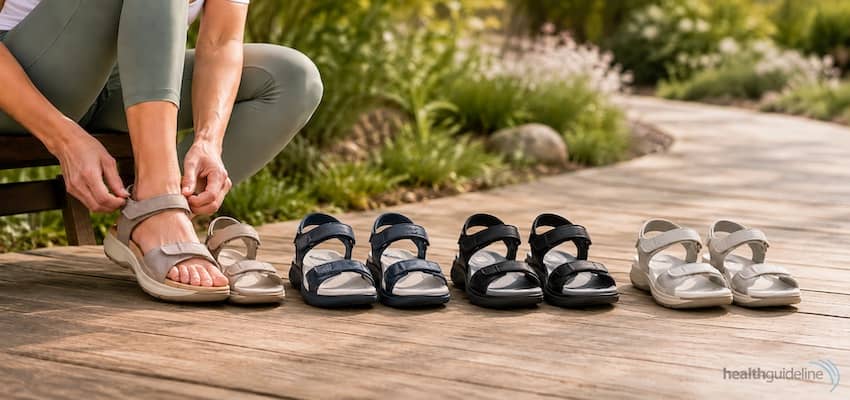
Warm weather shouldn’t mean choosing between comfortable feet and a summer wardrobe. If your first steps out of bed feel like a bruise or a tack in the heel, the flat, flimsy flip-flops most of us reach for in July can make plantar fasciitis worse. The good news: a well-chosen sandal with real arch support and a firm heel cup can take genuine pressure off the plantar fascia — and there are now excellent options for every foot and budget. Below are seven we’d recommend, with honest pros, cons, and who each one isn’t for.
Quick Picks
Best overall
Vionic Tide II
Best for recovery & all-day softness
OOFOS OOriginal
Best moldable cork footbed
Birkenstock Arizona
Best supportive flip-flop
Archies Arch Support
JUMP TO A SECTION
Do sandals actually help plantar fasciitis?
Yes — but only the right kind. A supportive sandal with a contoured arch and a deep heel cup can reduce strain on the plantar fascia, while flat, unsupportive flip-flops tend to make heel pain worse. Sandals are one helpful piece of care, not a cure; most plantar fasciitis improves gradually with a mix of supportive footwear, stretching, and rest.
The plantar fascia is a thick band of tissue running along the bottom of your foot, connecting your heel bone to your toes and supporting your arch like a bowstring. When it’s overloaded, tiny tears and irritation cause that classic stabbing heel pain — usually worst with your first steps in the morning or after sitting a while. The Mayo Clinic notes that people who wear shoes with inadequate support are at higher risk, and that footwear giving the foot extra support is a mainstay of treatment, sometimes needed long term to keep symptoms from returning. The American Academy of Orthopaedic Surgeons (through its OrthoInfo patient resource) similarly recommends supportive shoes with cushioning and advises avoiding shoes with little padding or thin, hard soles. In other words, what you put on your feet in summer matters — and a good sandal can help you stay on the supportive side of that line.
Two features do most of the work: arch support that matches your arch height, and a deep heel cup that keeps your heel stable. Cushioning helps with impact, and a secure strap keeps your toes from clenching to hold the sandal on. Keep those in mind as you read the picks below.
How we chose these sandals
We focused on sandals that pair a firm, contoured footbed and a supportive heel with everyday wearability — the qualities podiatrists consistently point to for plantar fasciitis. We prioritized structured arch support and heel cups over flat cushioning alone, gave weight to the APMA Seal of Acceptance where a style carries it, and cross-referenced current podiatrist and expert roundups (including Forbes, CNN Underscored, and practicing DPMs) alongside each product’s own specifications. Every product here is a real model currently listed on Amazon (US) at the time of writing; we’ve included honest trade-offs and a “who it isn’t for” so you can match a sandal to your own feet rather than just the highest star rating.
The best sandals for plantar fasciitis at a glance
| Sandal | Best for | Standout feature | Approx. price* | APMA Seal | Link |
|---|---|---|---|---|---|
| Vionic Tide II | Best overall | Podiatrist-designed orthotic footbed + deep heel cup | ~$70–$90 | Yes | Amazon |
| OOFOS OOriginal | Recovery & all-day softness | OOfoam that (per OOFOS) absorbs ~37% more impact | ~$60–$70 | Yes | Amazon |
| Birkenstock Arizona | Moldable cork footbed | Cork-latex footbed that molds to your foot | ~$100–$145 | No | Amazon |
| HOKA Ora Recovery Slide 3 | Post-workout recovery slide | Thick dual-density cushioning; slip-on ease | ~$55–$65 | Yes | Amazon |
| Chaco Z/Cloud | Walking, travel & water | Firm LUVSEAT arch support + fully adjustable straps | ~$95–$110 | Yes | Amazon |
| Orthofeet (adjustable) | Wide/swollen feet & custom orthotics | Removable orthotic insole + wide toe box | ~$85–$110 | — | Amazon |
| Archies Arch Support | Supportive flip-flop | Orthotic-height arch support in a true thong | ~$35–$45 | No | Amazon |
01 / BEST OVERALL
Vionic Tide II
The Vionic Tide II is the sandal podiatrists mention most often, because it’s built around a genuine podiatrist-designed orthotic footbed rather than a flat foam insert with marketing attached. A deep heel cup cradles your heel and a contoured arch redistributes pressure off the inflamed fascia, and it’s one of the few sandals carrying the APMA Seal of Acceptance — so it’s a dependable first choice for most people.
Key features
- concealed orthotic EVA footbed with contoured arch support and a deep heel cup
- soft woven toe post and foam-lined strap
- flexible EVA midsole for shock absorption
- durable treaded TPR outsole. Comes in women’s and men’s versions and fits medium/wide widths.
Pros
- true orthotic-level arch support in a sandal
- APMA-accepted
- wipe-clean
- supportive without feeling bulky
- widely available in many colors.
Cons
- if you’ve never worn arch support, the firmer footbed takes a few days to get used to
- it’s a toe-post thong, which not everyone likes
- less pillowy underfoot than a soft recovery foam.
Best for: most people who want one everyday, do-it-all supportive sandal — and anyone who wants orthotic-style arch support without switching to a full shoe.
02 / BEST FOR RECOVERY & ALL-DAY SOFTNESS
OOFOS OOriginal
If your feet ache after a shift or a workout, OOFOS OOriginal is the recovery sandal to beat. Its springy OOfoam midsole is forgiving underfoot, and OOFOS says the material absorbs about 37% more impact than standard footwear foam. Every OOFOS style carries the APMA Seal, and the whole sandal is machine washable — a genuinely easy sandal to live in.
Key features
- OOfoam recovery midsole with a softly contoured arch cradle
- closed-cell foam that’s machine washable and odor-resistant
- unisex thong design
- very lightweight.
Pros
- outstanding cushioning and impact absorption
- APMA-accepted
- washable
- ideal after running or a long day
- reasonably priced.
Cons
- the support is soft and cushioned rather than a firm, structured orthotic — some people with plantar fasciitis want firmer arch control
- the toe post can feel snug (OOFOS suggests women who wear a half size go up, men go down)
- the look is casual/sporty.
Best for: recovery, around-the-house wear, poolside, and anyone who finds firm footbeds harsh.
03 / BEST MOLDABLE CORK FOOTBED
Birkenstock Arizona
The Birkenstock Arizona is the classic contoured sandal for good reason: its cork-latex footbed gradually molds to the shape of your foot, and a deep heel cup, firm arch, and raised toe bar work together to unload the plantar fascia. For the most support, choose the firmer original cork footbed rather than the extra-soft version, and give it a week or two of short wears to break in.
Key features
- anatomically contoured cork-latex footbed with deep heel cup and longitudinal/transverse arch support
- two adjustable pin-buckle straps
- lightweight EVA sole
- available in narrow, regular, and wide widths, and in Birko-Flor, suede, or leather.
Pros
- firm, durable, personalized support once it molds
- adjustable straps for a dialed-in fit
- enormous size, width, and color range
- legendary longevity.
Cons
- firm underfoot (not plush) and there’s a real break-in period
- the ultra-soft-footbed version is comfier out of the box but less supportive
- cork needs occasional care.
Best for: people who want firm, molding arch support and don’t mind breaking a sandal in. (Note: Birkenstock’s Amazon availability comes and goes; if this listing is out of stock, the Arizona is also sold through other verified sellers.)
04 / BEST RECOVERY SLIDE
HOKA Ora Recovery Slide 3
HOKA’s Ora Recovery Slide 3 is a plush, easy on-and-off slide made for downtime and post-workout recovery. Thick dual-density EVA softens every step, HOKA’s J-Frame geometry is designed to gently limit inward roll, and the slide carries the APMA Seal. Just remember it’s a slide — expect generous cushioning but less structured arch support than a true footbed sandal.
Key features
- dual-density EVA (softer foam up top, firmer beneath)
- J-Frame stability geometry to help curb overpronation
- part-sugarcane footbed
- air-flow channels for breathability
- unisex sizing.
Pros
- very cushioned and forgiving
- slip-on convenience
- lightweight
- APMA Seal
- good value.
Cons
- as a slide, there’s no toe post or adjustable strap and a shallower heel cradle, so your foot is less locked-in and less arch-structured than in the Vionic or Birkenstock
- best for short distances and recovery, not long walks.
Best for: post-exercise recovery, quick errands, and around the house.
05 / BEST FOR WALKING, TRAVEL & WATER
Chaco Z/Cloud
For long walks, travel days, and time near water, the Chaco Z/Cloud pairs a firm, podiatrist-accepted LUVSEAT arch-support footbed with a soft cushion top layer. Fully adjustable straps lock your foot in place, the grippy outsole handles wet surfaces, and every Chaco style is APMA-accepted. It’s a rugged, do-everything sandal that holds up mile after mile.
Key features
- contoured LUVSEAT polyurethane arch-support footbed with a 5 mm cushion top layer
- 360° adjustable jacquard straps plus an optional toe loop
- non-marking ChacoGrip outsole
- repairable, and comfortable in and out of water.
Pros
- firm, reliable arch support with a customizable fit
- APMA-accepted
- excellent traction
- extremely durable
- the adjustable straps suit a wide range of foot shapes.
Cons
- bulkier and heavier than a simple flip-flop
- the strap system takes a moment to dial in the first time
- the firm footbed has a short break-in.
Best for: walkers, travelers, hikers, water lovers, and anyone who wants an adjustable, secure fit.
06 / BEST FOR WIDE/SWOLLEN FEET & CUSTOM ORTHOTICS
Orthofeet adjustable orthopedic sandal
Orthofeet’s adjustable orthopedic sandals are built for feet that need both room and structure: a wide toe box, multiple adjustable straps, and a removable orthotic insole with anatomical arch support. Because that insole lifts out, you can also drop in your own custom orthotics — a real plus if a podiatrist has prescribed them for your plantar fasciitis.
Key features
- built-in removable orthotic insole with anatomical arch support
- cushioned, shock-absorbing sole
- adjustable multi-strap closure
- roomy wide toe box
- available in wide and extra-wide widths
- soft, seamless interior that’s friendly to sensitive and diabetic feet.
Pros
- excellent for wide, swollen, sensitive, or diabetic feet
- accommodates custom orthotics
- highly adjustable
- supportive and roomy at once.
Cons
- the styling is more “comfort/orthopedic” than fashion-forward
- it can feel substantial
- sizing tends to run generous, so check the chart.
Best for: wide or swollen feet, custom-orthotic users, and anyone prioritizing support and adjustability over looks.
07 / BEST SUPPORTIVE FLIP-FLOP
Archies Arch Support Flip Flops
If you love the barely-there feel of a flip-flop, Archies is the supportive upgrade. Designed by physiotherapists, it builds arch support into a lightweight thong — roughly the height of a supportive orthotic — so you get alignment help that flat flip-flops simply don’t offer. Support is moderate, so it’s ideal for casual wear rather than a replacement for a structured sandal in severe cases.
Key features
- built-in arch support (around orthotic height) inside a true flip-flop
- closed-cell foam footbed that molds to your foot over time
- durable single-mold construction
- slightly elevated heel
- unisex
- 60-day trial.
Pros
- real arch support in an actual flip-flop
- light and packable
- affordable
- single-mold build resists the usual blowouts
- casual, beachy look.
Cons
- support is moderate compared with a footbed sandal — not enough for severe plantar fasciitis or long days on hard floors
- it’s a thong toe post
- less heel containment than a strapped sandal.
Best for: the beach, casual summer wear, and flip-flop devotees who want more than a flat sole.
What to look for in a sandal for plantar fasciitis
The “best” sandal is really the one that fits your foot and your day. Here’s what actually matters.
Contoured arch support that matches your arch
Arch support is the single most important feature. It helps spread pressure across the foot instead of letting the arch collapse and repeatedly stretch the fascia. Firmer, structured footbeds (Vionic, Birkenstock, Chaco, Orthofeet) tend to help more than soft cushioning alone — though the right firmness depends on your arch height and what feels good to you.
A deep heel cup
A deep heel cup keeps the heel bone stable and helps control the motion that aggravates plantar fasciitis. It’s a big reason footbed sandals often outperform flat slides for heel pain.
The bend test (sole firmness)
A quick shop-floor check podiatrists suggest: try to fold the sandal in half. A supportive sole should resist and flex mainly at the ball of the foot — not fold flat in the middle. If it bends easily everywhere, it won’t give your arch much help.
Cushioning and shock absorption
Some give underfoot reduces impact, especially on hard summer surfaces. Recovery foams (OOFOS, HOKA) shine here; the trade-off is less rigid arch structure.
A secure, adjustable fit
If a sandal is loose, your toes end up gripping to keep it on — which tightens the very tissues you’re trying to relax. Adjustable straps (Chaco, Orthofeet, Birkenstock) let you lock the foot in and fine-tune the fit, and help with wide or swollen feet.
What to avoid
Flat, flimsy flip-flops and shoes with thin, hard soles offer little support and can make heel pain worse — a point both the Mayo Clinic and AAOS make about footwear and plantar fasciitis. If you’re going to wear a thong style, choose one with genuine built-in arch support.
When to see a professional
Supportive sandals are one helpful piece of care — not a substitute for medical advice. Consider seeing a doctor, podiatrist, or physical therapist if:
- Your heel pain lasts more than a few weeks despite supportive footwear, rest, and gentle stretching.
- The pain is severe, keeps you from walking normally, or wakes you at night.
- You notice swelling, numbness or tingling, redness or warmth, or the pain followed an injury.
- You have diabetes, neuropathy, or circulation problems — get professional guidance before self-treating foot pain.
Frequently asked questions
Can I wear sandals all day with plantar fasciitis?
You can, if they’re genuinely supportive — a structured footbed with a deep heel cup, like the Vionic Tide II, Chaco Z/Cloud, or a molded Birkenstock, is far better for all-day wear than a flat flip-flop. If you’re on hard floors for long stretches, a supportive closed shoe may still be easier on your feet, and it’s smart to build up wear time gradually.
Are flip-flops bad for plantar fasciitis?
Most flat, flimsy flip-flops are, because they offer no arch support and let your heel move freely, which increases strain on the plantar fascia. The fix isn’t to avoid thongs entirely but to choose one with built-in arch support, such as Archies — you keep the airy flip-flop feel while adding the alignment your foot needs.
Do I need arch support or cushioning — or both?
Ideally both, but arch support does the heavier lifting for plantar fasciitis. Firm, contoured support (Vionic, Birkenstock, Chaco, Orthofeet) helps unload the fascia, while cushioning (OOFOS, HOKA) softens impact. If you have to prioritize, start with structured arch support and a deep heel cup, then add cushioning to taste.
Are Birkenstocks good for plantar fasciitis?
Many people find them excellent once broken in. The cork-latex footbed molds to your foot and provides firm arch support and a deep heel cup. For plantar fasciitis, the firmer original cork footbed generally supports better than the extra-soft version — just expect a one-to-two-week break-in of short wears before all-day use.
What’s the difference between a recovery slide and an orthotic sandal?
Recovery slides like OOFOS and HOKA use soft, springy foam to cushion impact and are great after activity, but they’re less structured. Orthotic sandals like Vionic and Chaco use a firmer, contoured footbed and heel cup to actively support the arch. For daily plantar fasciitis support, a structured footbed usually helps more; for recovery, a slide feels wonderful.
How long until supportive sandals help?
Some people feel relief within days of switching to supportive footwear, but plantar fasciitis often takes weeks to months to settle, and healing rewards patience. Supportive sandals work best alongside stretching, activity changes, and rest. If there’s no improvement after several weeks, check in with a professional.
Medical disclaimer: This article is for general information only and is not medical advice. Talk to a qualified healthcare professional about your specific situation.