Best Shoes for Plantar Fasciitis in 2026: 11 Podiatrist-Informed Picks
The short version
Best overall
Hoka Bondi 9
Maximum cushioning and a rockered sole that eases pressure off the heel.
Best on a budget
Skechers Go Walk Arch Fit
A removable, contoured arch-support insole for roughly a third of the price of premium trainers.
Best for overpronation
Brooks Adrenaline GTS 25
GuideRails stability without a harsh medial post.
Best for standing all day at work
Dansko Professional
Clog on hard floors.
Best sneaker for standing all day at work
Asics Gel-Nimbus 28
if you prefer a sneaker.
The right shoe is part of treatment, not a cure — pair it with stretching, load management and, if pain lingers, a clinician’s advice.
Plantar fasciitis is the single most common cause of heel pain, and footwear is one of the few things you can change today that genuinely affects how your feet feel tomorrow. This guide focuses on real, currently available shoes that share the design features clinicians look for — firm arch support, a deep heel cup, a stiff midfoot and shock-absorbing cushioning — organised by how you’ll actually use them, from running and all-day walking to work shifts and summer sandals.
According to StatPearls (National Library of Medicine), plantar fasciitis affects roughly 10% of people over a lifetime, and about 83% of those affected are working adults aged 25 to 65. The encouraging part: peer-reviewed reviews report that conservative care — supportive footwear, stretching and time — resolves symptoms in around 90% of cases, typically within 6 to 12 months. Good shoes are a cornerstone of that conservative approach.
How we chose these shoes
We started from the design features that podiatrists and footwear researchers consistently recommend for plantar fasciitis, then matched specific current models to real-world use cases. We prioritised structured (not soft) arch support, a deep, firm heel cup, a rigid midfoot that resists twisting, meaningful heel cushioning and shock absorption, and a removable insole so you can drop in a custom orthotic if you wear one. We cross-referenced current podiatrist round-ups from CNN Underscored, Forbes, and practising foot-and-ankle specialists, and we only included shoes that are genuinely sold in the US right now. Where a shoe wins for a specific foot type or job, we say so — and we’re honest about who each pick isn’t for.
What do the best shoes for plantar fasciitis have in common?
The best shoes for plantar fasciitis share five features: firm arch support that meets the arch along its full span, a deep and stable heel cup, a stiff midfoot that won’t twist in half, cushioning under the heel to absorb impact, and a removable insole that fits a custom orthotic. A moderate heel-to-toe drop (roughly 8–12 mm) suits most people better than a flat, minimalist sole.
A quick in-store test: hold the shoe by the heel and toe and try to twist it. A good plantar fasciitis shoe resists that twist through the midfoot. Then try to fold it — it should bend at the toes (where your foot bends), not in the middle of the arch. Flat, bendy shoes and unsupportive flip-flops are the footwear most often linked to flare-ups, which is why replacing them is step one.
Top picks at a glance
| Shoe | Best for | Standout feature | Approx. price* |
|---|---|---|---|
| Hoka Bondi 9 | Best overall / max cushion | Plush stack + rockered sole offloads the heel | ~$170 |
| Hoka Clifton 10 | Everyday walking & light running | Lighter, softer daily trainer | ~$150 |
| Brooks Adrenaline GTS 25 | Overpronation / stability | GuideRails support, 10 mm drop | ~$155 |
| Asics Gel-Nimbus 28 | Standing all day (sneaker) | Deep, plush neutral cushioning | ~$165 |
| New Balance 990v6 | Everyday support & style | ENCAP + FuelCell, made in USA | ~$200 |
| New Balance 928v3 | Dedicated walking / motion control | Roll-bar stability, multiple widths | ~$135 |
| Dansko Professional | Long shifts on hard floors | Rocker sole + firm arch for standing | ~$140 |
| Skechers Go Walk Arch Fit | Best budget | Removable podiatrist-designed arch insole | ~$65 |
The best shoes for plantar fasciitis in 2026
01 / BEST OVERALL
Hoka Bondi 9
The Hoka Bondi 9 is the shoe most podiatrists reach for first, and it’s our top overall pick. Its very thick, soft midsole absorbs impact, while the rockered “meta-rocker” geometry rolls you smoothly through each step so the heel isn’t loaded as sharply — which is exactly what an irritated plantar fascia needs.
Key features
- maximum EVA cushioning
- early-stage meta-rocker
- padded heel collar
- roomy fit
- available in wide widths.
Pros
- outstanding shock absorption
- smooth heel-to-toe roll
- works for both walking and neutral running.
Cons
- tall and a little heavy/bulky
- the soft foam feels less “connected” to the ground than firmer trainers.
Best for: heavier impact, long days on your feet, and anyone who wants the most cushioning available.
May not suit: people who overpronate significantly and need active stability (see the Adrenaline GTS 25 below).
02 / BEST FOR EVERYDAY WALKING AND LIGHT RUNNING
Hoka Clifton 10
If the Bondi feels like too much shoe, the Clifton 10 is its lighter, nimbler sibling. It keeps Hoka’s signature cushioning and smooth rocker but weighs less, which many people prefer for daily walking, errands and shorter runs. It’s a frequent recommendation for a supportive shoe you can wear all day without feeling weighed down.
Key features
- balanced cushioning
- meta-rocker geometry
- breathable upper
- secure midfoot.
Pros
- lighter and more versatile than the Bondi
- comfortable straight out of the box
- great daily walker.
Cons
- slightly less plush than the Bondi
- neutral shoe, so no built-in pronation control.
Best for: everyday walking, standing and light running when you want cushioning without bulk.
May not suit: those who want the absolute maximum stack, or who need motion control.
03 / BEST FOR OVERPRONATION AND STABILITY
Brooks Adrenaline GTS 25
Flat feet and overpronation (the foot rolling inward) add strain to the plantar fascia, and the Adrenaline GTS 25 is built for exactly that. Instead of a hard, old-style medial post, it uses Brooks’ GuideRails — raised foam strips that gently limit excess inward roll only when you need it, with a firm-but-cushioned DNA midsole and a 10 mm drop underneath.
Key features
- GuideRails holistic support
- DNA v3 cushioning
- 10 mm heel-to-toe drop
- structured heel.
Pros
- excellent everyday stability for walkers and runners
- supportive without feeling stiff
- comes in wide widths.
Cons
- the fit is a touch narrow and tapered through the toe
- neutral, high-arched feet may not need the guidance.
Best for: overpronators and flat-footed walkers/runners who want stability plus cushioning. (New to this? See our explainer on neutral vs stability running shoes.)
May not suit: supinators or very high arches, who often do better in a neutral shoe like the Nimbus.
04 / BEST SNEAKER FOR STANDING ALL DAY
Asics Gel-Nimbus 28
The Gel-Nimbus 28 is a plush, neutral cushioning shoe that’s a favourite for people who are on their feet all day and want a sneaker rather than a clog. Deep, soft foam takes a lot of the ground impact out of every step, protecting the heel over long hours of walking or standing.
Key features
- high-stack neutral cushioning
- softly padded heel and collar
- breathable engineered upper.
Pros
- superb all-day comfort
- smooth ride
- roomy, forgiving fit.
Cons
- bulky and on the heavier side
- premium price
- not a stability shoe.
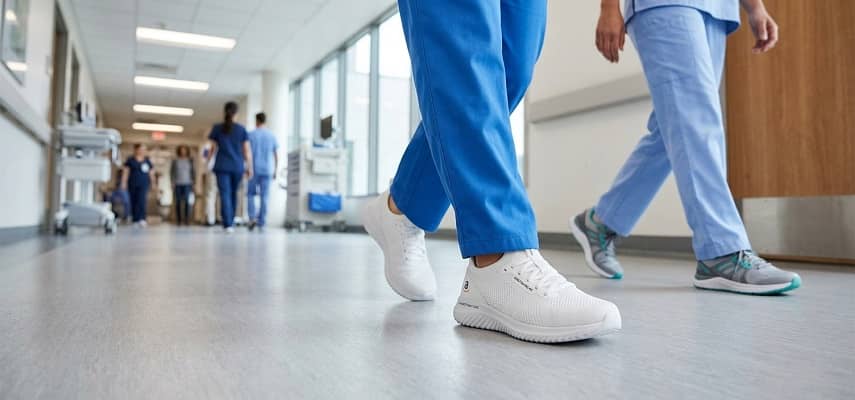
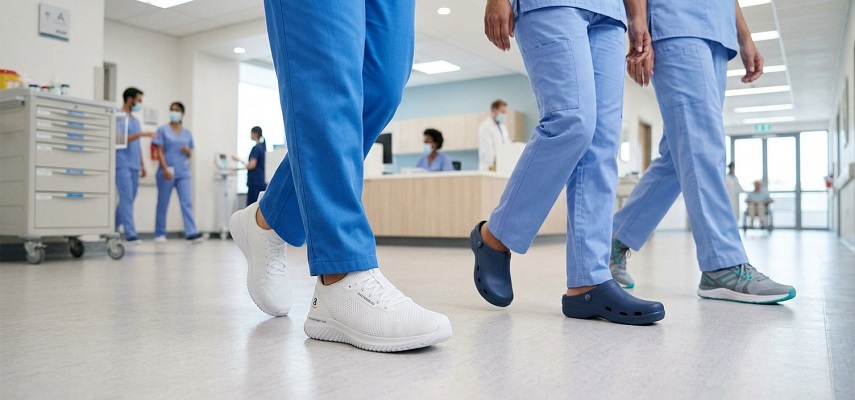
Best for: nurses, retail and hospitality workers, and anyone who prefers a cushioned sneaker for long shifts. See also our guide to shoes for nurses with plantar fasciitis.
May not suit: those needing pronation control, or anyone who dislikes a tall, soft platform.
05 / BEST FOR EVERYDAY SUPPORT AND STYLE
New Balance 990v6
The 990v6 is the shoe to reach for when you want real support in something that looks like a normal sneaker, not a medical device. It pairs a supportive ENCAP midsole with FuelCell cushioning and a structured heel, and it comes in multiple widths — a genuine everyday workhorse for people with heel pain.
Key features
- ENCAP support + FuelCell foam
- firm heel counter
- suede/mesh upper
- made in the USA
- multiple widths.
Pros
- supportive and stable without looking clinical
- durable
- wide sizing options.
Cons
- expensive
- heavier than a dedicated running shoe.
Best for: all-day everyday wear where you want support and a classic look.
May not suit: shoppers on a tight budget (see the Skechers pick) or runners chasing a light race shoe.
06 / BEST DEDICATED WALKING SHOE
New Balance 928v3
The 928v3 is a classic “walking shoe” in the truest sense — a supportive, stable leather shoe with motion-control features and a firm ride designed for people who walk a lot and need their arch and heel controlled. It’s widely available in narrow-to-extra-wide widths and easily accepts a custom orthotic.
Key features
- ROLLBAR rear-foot stability
- firm midsole
- leather upper
- removable insole
- extensive width range.
Pros
- strong motion control and heel support
- roomy for orthotics and wider feet
- very stable.
Cons
- heavier and less stylish
- firm rather than plush
- utilitarian look.
Best for: dedicated walkers, flat/wide feet, and orthotic users who prioritise support over fashion.
May not suit: anyone wanting a soft, springy feel or a sneaker look.
07 / BEST FOR LONG SHIFTS ON HARD FLOORS
Dansko Professional
For people who stand in one place on concrete or tile for hours — healthcare, kitchens, labs, retail — the Dansko Professional clog is a long-standing favourite. Its firm, contoured footbed supports the arch and its rocker sole encourages a natural roll, taking strain off the heel during long stationary shifts.
Key features
- firm arch-supportive footbed
- wide rocker outsole
- roomy toe box
- reinforced heel counter.
Pros
- excellent standing support on hard floors
- durable
- easy on/off
- slip-resistant options.
Cons
- heavy and clunky
- open-back design isn’t ideal for fast walking or running
- takes a short break-in.
Best for: nurses and workers who stand for long periods. Related: best shoes for nurses.
May not suit: runners, or anyone who does a lot of brisk walking during their day.
08 / BEST BUDGET PICK
Skechers Go Walk Arch Fit
You don’t have to spend $150+ to get real arch support. The Go Walk Arch Fit line pairs Skechers’ lightweight cushioning with a removable, podiatrist-designed contoured insole, and it’s frequently praised by owners with plantar fasciitis — often for well under $70. Many versions are machine washable, too.
Key features
- removable Arch Fit contoured insole
- lightweight responsive midsole
- 10 mm drop
- breathable knit upper
- regular and wide widths.
Pros
- genuinely supportive for the price
- very light
- easy to slip on
- washable.
Cons
- some owners report the foam packs out over time
- less durable than premium trainers.
Best for: budget-conscious buyers who still want a contoured arch and a removable insole.
May not suit: heavy runners or anyone needing firm motion control.
Best sandals for plantar fasciitis
Most flip-flops are among the worst footwear for plantar fasciitis because they’re flat and unsupportive. The exception is a sandal with genuine, built-in arch support — a contoured footbed that meets the arch, a deep heel cup, and a sole that won’t twist. The picks below deliver that. A useful habit for morning heel pain: keep a supportive sandal by the bed and put it on before your first steps. For a deeper dive, see our full guide to the best sandals for plantar fasciitis.
09 / BEST THERAPEUTIC SANDAL
Vionic Tide II
The Tide II builds Vionic’s podiatrist-designed Orthaheel footbed — a contoured arch, deep heel cup and cushioned support zone — into a normal-looking toe-post sandal. It carries the American Podiatric Medical Association (APMA) Seal of Acceptance, and it’s the sandal most often recommended for everyday warm-weather wear.
Pros
- true orthotic-grade arch support in a stylish sandal
- APMA accepted
- durable.
Cons
- firm footbed needs a few wears to get used to
- standard widths only.
Best for: everyday summer wear when you still want arch support. Approx. price: around $70 — check current price on Amazon.
10 / BEST RECOVERY SLIDE
OOFOS OOriginal
OOFOS recovery sandals use a proprietary closed-cell foam (OOfoam) that the brand says absorbs about 37% more impact than standard EVA. The contoured footbed and deep heel cup cradle the foot, which makes these a go-to for slipping on after a long day or a workout when the heel is sore.
Pros
- exceptionally soft impact absorption
- very light
- APMA accepted
- great post-activity.
Cons
- squishy feel isn’t for everyone
- better for recovery than for long-distance walking.
Best for: post-workout recovery and around-the-house wear. Approx. price: around $70 — check current price on Amazon.
11 / BEST CONTOURED CORK OPTION
Birkenstock Arizona (Soft Footbed)
The Arizona’s cork-latex footbed is deeply contoured with a pronounced arch, a deep heel cup and a toe bar, and it moulds to your foot over a couple of weeks of wear to create semi-custom support. Choose the Soft Footbed version for an added cushioning layer; it carries APMA acceptance.
Pros
- excellent, durable contoured arch support
- adjustable straps
- lasts for years.
Cons
- requires a 2–3 week break-in
- firm underfoot
- open design offers no cushioning “give.”
Best for: people who want lasting, structured arch support and don’t mind a break-in. Approx. price: around $110 — check current price on Amazon.
What to look for when buying shoes for plantar fasciitis
Structured arch support
Support should meet your arch across its full span, not just poke up as a single bump under the middle of the foot. Firm, structured support reduces the tension the fascia takes with each step. If your arches are unusually high or flat, over-the-counter or custom plantar fasciitis insoles can add support a stock shoe can’t — and matching support to your foot type matters (see also arch pain on the foot).
A deep, firm heel cup
A deep heel cup cradles the heel bone and limits the side-to-side motion that tugs on the fascia. It also holds cushioning under the heel where you strike the ground.
A stiff midfoot (the twist test)
The shoe should resist twisting through the arch and bend only at the toes. A shoe that folds in half at the middle offers little support where you need it most.
Cushioning and heel-to-toe drop
Cushioning absorbs impact; a moderate heel-to-toe drop (about 8–12 mm) takes some load off the fascia and Achilles for most people. Flat, zero-drop and minimalist shoes tend to increase strain and are generally not recommended during a flare — though very cushioned rocker shoes (like Hoka) work differently and can be comfortable despite a lower drop.
A removable insole
If you wear custom orthotics, you need a shoe whose factory insole lifts out so yours can go in. This is one of the most practical features to check before buying.
The right fit and purpose
Match the shoe to what you do most — running, walking, standing, or dress — and get the width right. Shoes should be snug but not tight, with room in the toe box. If you’re between widths or have wide feet, brands like New Balance and Hoka offer wide and extra-wide options; for at-home comfort, slippers with arch support beat walking barefoot on hard floors.
Shoes are part of the plan — what else helps
Supportive shoes reduce strain, but they work best alongside a few simple, well-established habits. None of this is a substitute for professional care, but many people find it helps day to day:
- Stretch the calf and plantar fascia — gentle daily stretching of the calf, Achilles and the sole of the foot is one of the most consistently recommended self-care steps.
- Ease into activity — sudden jumps in walking or running distance are a classic trigger; increase load gradually.
- Address the first-step pain — a plantar fasciitis night splint keeps the fascia gently stretched overnight, which can reduce that sharp pain on your first morning steps.
- Ice and rest during flares — a cloth-wrapped ice pack for about 15 minutes can calm irritation after a long day.
- Soothe tired feet — a foot massager or rolling the arch over a cold bottle can feel relieving, and some people use compression socks for support.
When to see a professional
Footwear can do a lot, but some situations call for a clinician. Consider seeing a doctor or podiatrist if:
- Heel pain persists despite several months of supportive shoes and self-care;
- The pain is severe, came on suddenly after an injury, or you heard a “pop”;
- You have numbness, tingling, burning, or pain that spreads or wakes you at night;
- You have diabetes, poor circulation, or reduced sensation in your feet;
- Swelling, redness or warmth suggests something other than plantar fasciitis.
A professional can confirm the diagnosis, check your gait, and tailor treatment — including custom orthotics, physical therapy, or other options if conservative care isn’t enough.
Frequently asked questions
What are the best shoes for plantar fasciitis?
For most people, a maximum-cushion neutral shoe like the Hoka Bondi 9 is the best all-round choice, because its thick, rockered sole absorbs impact and offloads the heel. If you overpronate, a stability shoe such as the Brooks Adrenaline GTS 25 is often better. The right pick depends on your foot type and daily activity.
What features should a plantar fasciitis shoe have?
Look for firm, structured arch support that meets your arch fully; a deep, stable heel cup; a stiff midfoot that resists twisting; cushioning under the heel; and a removable insole so you can fit a custom orthotic. A moderate heel-to-toe drop of roughly 8–12 mm suits most people better than a flat sole.
What heel-to-toe drop is best for plantar fasciitis?
Most people do well with a moderate drop of about 8–12 mm, which slightly reduces load on the plantar fascia and Achilles. Flat, zero-drop and minimalist shoes generally increase strain during a flare and aren’t recommended. Highly cushioned rocker shoes are an exception — they can feel comfortable even with a lower drop.
Are Hoka or Brooks better for plantar fasciitis?
Both are excellent; the difference is your foot type. Hoka (Bondi, Clifton) are neutral, maximum-cushion shoes with a rocker sole — ideal if you want impact protection. Brooks Adrenaline GTS is a stability shoe better suited to overpronators and flat feet. If your foot rolls inward, choose Brooks; if you want cushioning, choose Hoka.
Can I wear sandals or flip-flops with plantar fasciitis?
Flat, unsupportive flip-flops can make heel pain worse and are best avoided. But supportive sandals with genuine built-in arch support — like the Vionic Tide II, OOFOS OOriginal or Birkenstock Arizona — can be part of your routine. Keeping a supportive pair by the bed to wear before your first steps often eases morning pain.
Are barefoot or zero-drop shoes bad for plantar fasciitis?
During an active flare, minimalist and zero-drop shoes usually aren’t ideal, because they offer little arch support or cushioning and place more stretch on the fascia. Most people get more relief from a supportive, cushioned shoe with a moderate drop. Some transition toward less drop later, gradually, once pain has settled — ideally with professional guidance.
Do shoe inserts and orthotics help plantar fasciitis?
Often, yes. Cushioned inserts with a supportive arch and a heel cup can reduce strain and absorb shock, and they let you upgrade the support of a shoe you already like. Over-the-counter plantar fasciitis insoles help many people; a clinician can prescribe custom orthotics for stubborn cases.
How long until the right shoes make a difference?
Many people notice less first-step and end-of-day pain within a couple of weeks of switching to supportive shoes and adding stretching. Full recovery is slower: peer-reviewed reviews find conservative care resolves about 90% of cases, but often over 6 to 12 months. Consistency matters more than any single product.
How often should I replace my shoes?
Cushioning and support break down with use. As a rough guide, replace walking and running shoes roughly every 300–500 miles, or when the midsole feels flat and the support noticeably softens. Worn-out shoes are a common trigger for flare-ups, so don’t wait until they fall apart.
Medical disclaimer: This article is for general information only and is not medical advice. Plantar fasciitis and heel pain can have several causes — talk to a qualified healthcare professional about your specific situation before starting or changing treatment.