Best Tennis Shoes for Nurses: 6 Picks for 2026
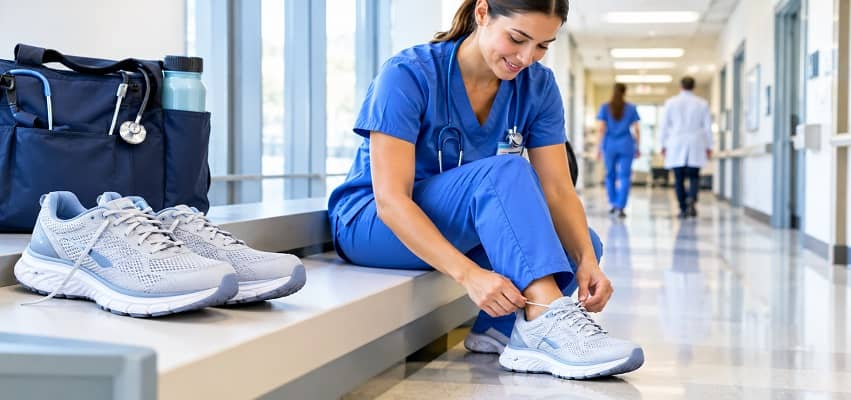
2026 nurse shoe guide · cushioning, fit & traction
The best tennis shoes for nurses are not all the same kind of shoe. For dry, walking-heavy units, a comfortable road-running sneaker such as the HOKA Bondi 9 or Brooks Ghost 17 can make sense. If your facility requires work-rated slip resistance, choose a model designed for that job instead, such as the Skechers Work Arch Fit Arcade. Fit, traction requirements, cleanability and your own support preference matter more than a brand name.
Quick picks
Best overall cushioning
HOKA Bondi 9
Maximum-cushion road shoe for nurses who spend a lot of the shift walking on dry indoor floors.
Best balanced feel
Brooks Ghost 17
A neutral, flexible walking-and-running shoe with broad width availability and a less bulky feel.
Work-floor traction
Skechers Arch Fit Arcade
A work shoe with a manufacturer-stated slip-resistant outsole and a wipe-friendlier leather/synthetic upper.
JUMP TO A SECTION
How we chose the best tennis shoes for nurses
This is a desk-research buying guide, not a hands-on clinical trial or a claim that one shoe prevents pain. We checked current manufacturer specifications, current Amazon US product pages where available, workplace-safety guidance and published research on slip-resistant footwear for healthcare workers. We prioritized four practical questions: Does the shoe fit the shift? Does it offer the support style the wearer wants? Is the upper practical for the work area? And does the outsole meet the facility’s traction requirements?
That last question matters because a road-running outsole and a work-rated slip-resistant outsole are not interchangeable. A soft running shoe may be comfortable on dry floors but still fail a unit’s footwear policy. For a broader overview, see our best shoes for nurses and healthcare-worker shoe guide.
Start with policy, not cushioning. If your hospital, clinic, lab or food-service area requires slip-resistant or fluid-resistant footwear, filter by that requirement before comparing foam softness, color or brand.
Best nurse-friendly tennis shoes at a glance
| Shoe | Best for | Support / cushion | Upper / traction note | Approx. price guide |
|---|---|---|---|---|
| HOKA Bondi 9 | Maximum cushioning | Neutral, plush, wide-base road shoe | Engineered mesh; road outsole, not treated here as work-rated slip resistant | About $160–$175 |
| Brooks Ghost 17 | Balanced walking feel | Neutral, soft/balanced cushioning | Air-mesh upper; road shoe, not work-rated here | About $110–$150 while stock lasts |
| ASICS GEL-KAYANO 32 | Stability-shoe preference | High cushion + adaptive stability system | Road-running construction; confirm work-floor requirements | About $125–$165 while stock lasts |
| New Balance 1080v15 | Multiple width choices | Extra-soft neutral cushion | Breathable perforated mesh; road outsole | About $135–$170 |
| ASICS GEL-NIMBUS 28 | Soft neutral cushioning at lower weight | Maximum neutral cushioning | Engineered knit; HYBRID ASICSGRIP road outsole | About $170 |
| Skechers Work Arch Fit Arcade | Slip-resistant work use | Removable Arch Fit insole + cushioned midsole | Leather/synthetic upper; slip-resistant work outsole | About $85 |
Six tennis shoes for nurses to consider in 2026
01 / BEST OVERALL CUSHIONING
HOKA Bondi 9
The Bondi 9 is the strongest fit for nurses who want a highly cushioned athletic sneaker and whose workplace allows breathable mesh road shoes. HOKA positions the Bondi 9 for everyday running, walking and recovery, with a premium foam midsole, a structured knit/engineered mesh upper and a broad, stable-feeling platform. The key limitation is just as important: the standard Bondi 9 is not the Bondi SR work shoe, so do not assume its road outsole satisfies a slip-resistant footwear requirement.
Key features
- Maximum-cushion HOKA road-shoe platform
- Engineered mesh / structured knit upper for breathability
- Durabrasion rubber outsole for road-use durability
- Available in multiple widths on current listings
Pros
- Plush cushioning for people who prefer a soft underfoot feel
- Rockered, walking-friendly geometry
- Broad platform can feel more planted than many soft trainers
Cons
- Standard Bondi 9 is not a certified work shoe in this guide
- Mesh is less wipeable than leather or purpose-built healthcare uppers
- High-stack cushioning can feel bulky to people who prefer ground feel
Best for: Nurses on walking-heavy, relatively dry units who prioritize maximum cushioning and whose dress code permits mesh athletic shoes.
Who should skip it: Anyone whose employer requires a specifically rated slip-resistant work shoe, or anyone who needs a wipe-clean upper for frequent fluid exposure.
02 / BEST BALANCED WALKING FEEL
Brooks Ghost 17
The Ghost 17 is a good counterpoint to the Bondi: still cushioned, but more conventional in shape and easier to recommend to nurses who want an everyday walking shoe rather than the softest possible platform. Brooks lists it for walking and everyday running, with nitrogen-infused cushioning, an air-mesh upper and flex grooves intended to keep heel-to-toe transitions smooth. It is also sold in narrow, medium, wide and extra-wide versions, although exact Amazon availability varies.
Key features
- DNA LOFT v3 nitrogen-infused cushioning
- Air-mesh upper for breathability and structure
- Flex grooves designed for smoother transitions
- Narrow through extra-wide width options from Brooks
Pros
- Balanced option for a lot of walking
- Less bulky than many maximum-cushion shoes
- Broad range of width choices
Cons
- Road-running outsole is not presented here as work-rated slip resistant
- Mesh is not the easiest material to disinfect or wipe clean
- Ghost 18 is now the newer generation, so Ghost 17 stock will eventually narrow
Best for: Nurses who cover a lot of distance during a shift and prefer a familiar, balanced neutral trainer over a very tall max-cushion platform.
Who should skip it: Workers who need a wipeable upper or a formal slip-resistant work-shoe requirement.
03 / STABILITY VALUE PICK
ASICS GEL-KAYANO 32
The GEL-KAYANO 32 is the choice here for nurses who already know they prefer the feel of a stability running shoe. ASICS built it around its 4D GUIDANCE SYSTEM, a high-cushion FF BLAST PLUS midsole and an 8 mm drop. The newer GEL-KAYANO 33 launched in the United States in June 2026, so the 32 is best viewed as a still-available prior-generation value option rather than the newest model.
Key features
- 4D GUIDANCE SYSTEM for adaptive stability
- FF BLAST PLUS cushioned midsole
- 8 mm heel-to-toe drop
- Standard and wide versions sold by ASICS
Pros
- More structured support feel than the neutral shoes above
- High cushioning without relying on a soft neutral platform alone
- Prior-generation pricing may be attractive while stock lasts
Cons
- Not the latest Kayano generation
- A stability shoe is not automatically better for every foot
- Road-shoe construction still needs to be checked against workplace traction rules
Best for: Nurses who already do well in stability footwear and want a cushioned, structured road shoe.
Who should skip it: Anyone choosing “stability” based only on a diagnosis they have made themselves. If you have recurring foot, ankle, knee or leg symptoms, a qualified clinician or footwear professional can help you assess fit and support needs.
04 / BEST FOR MULTIPLE WIDTHS
New Balance 1080v15
The 1080v15 deserves a place on a nurse shortlist because New Balance currently offers the women’s model in narrow, standard, wide and extra-wide widths. That makes it easier to solve a fit problem with actual width options instead of simply sizing up. The shoe uses Infinion foam, a perforated mesh upper, a rubber outsole and a 6 mm drop, with New Balance positioning it as an extra-soft neutral trainer for everyday and long runs.
Key features
- Narrow (2A), standard (B), wide (D) and extra-wide (2E) options
- Infinion cushioning foam
- Lightweight perforated mesh upper
- 6 mm drop and rubber outsole
Pros
- Unusually useful width range
- Soft neutral cushioning with relatively low listed weight
- Current New Balance listing carries the APMA Seal of Acceptance
Cons
- Soft neutral ride will not suit everyone
- Perforated mesh is breathable but not wipe-clean leather
- Road outsole is not treated here as a work-rated slip-resistant outsole
Best for: Nurses who struggle to get a correct width in standard athletic shoes, especially if they want a soft neutral trainer.
Who should skip it: People who need a firm stability shoe or a purpose-built work outsole. For more New Balance work-oriented options, see our New Balance slip-resistant shoe guide.
05 / SOFT NEUTRAL ALTERNATIVE
ASICS GEL-NIMBUS 28
The GEL-NIMBUS 28 is a maximum-cushion neutral option for nurses who like the softness of the Bondi idea but prefer ASICS fit and a lighter listed weight. ASICS uses FF BLAST PLUS cushioning with PureGEL technology and an engineered knit upper. Its HYBRID ASICSGRIP outsole combines ASICSGRIP and AHARPLUS rubber for road-use durability and traction, but that still should not be confused with a workplace slip-resistance certification.
Key features
- FF BLAST PLUS + PureGEL cushioning
- Maximum-cushion neutral platform
- Engineered knit upper
- HYBRID ASICSGRIP / AHARPLUS rubber outsole
Pros
- Soft cushioning without being the heaviest option here
- Comfort-oriented knit upper
- Current 2026 GEL-NIMBUS generation
Cons
- Premium price tier
- Neutral support is not the same feel as the Kayano
- Knitted upper is not ideal for frequent fluid exposure
Best for: Nurses who want a soft, neutral, breathable athletic shoe and prefer ASICS fit over HOKA or Brooks.
Who should skip it: Anyone who needs a wipe-clean, workplace-rated slip-resistant shoe.
06 / BEST WORK-FLOOR TRACTION PICK
Skechers Work Slip-Resistant: Arch Fit Arcade
This Skechers is here for a different reason than the five road shoes: it is built as a work shoe. Skechers specifies a slip-resistant traction outsole, an electrical-hazard design, a removable Arch Fit insole and a leather/synthetic upper. For a nurse working around wet or contaminated floors, those work-focused details can matter more than having the thickest running-shoe foam.
Key features
- Manufacturer-stated slip-resistant traction outsole
- Removable Arch Fit insole system
- Leather and synthetic upper
- Electrical Hazard design; check the exact model specification
Pros
- Purpose-built work traction rather than a road-running outsole
- Upper is easier to wipe than open mesh
- Lower price tier than many premium running shoes
Cons
- Does not have the same plush max-cushion feel as Bondi or Nimbus
- Leather/synthetic work construction can run warmer than mesh
- Work-shoe fit and styling may feel less athletic
Why this matters: A randomized trial involving 4,553 NHS staff found fewer workplace slips among workers offered 5-star GRIP-rated slip-resistant footwear than among controls wearing usual footwear. That result supports taking verified slip resistance seriously, but it does not prove that every shoe marketed as “slip resistant” performs identically.
Best for: Nurses whose facility prioritizes work-rated traction and an easier-to-clean upper over maximum running-shoe cushioning.
Who should skip it: Nurses whose workplace permits road shoes and who strongly prefer a very soft, high-stack athletic ride.
See our broader Skechers nurse-shoe guide and slip-resistant work-shoe guide for more work-focused options.
What should nurses look for in tennis shoes?
A good nursing shoe should match the hazards and movement pattern of your actual unit. Cushioning matters, but it sits behind fit, traction requirements, cleanability and appropriate support. A shoe that feels wonderful in a store can still be the wrong work shoe if it slips on the surfaces you encounter or violates your employer’s dress code.
1. Slip resistance that matches the workplace
OSHA identifies wet floors, spills and other walking-surface hazards as causes of slips, trips and falls in hospitals. If your unit requires slip-resistant footwear, look for a work shoe whose manufacturer clearly states that function rather than assuming any rubber outsole qualifies. Our slip-resistant work-shoe guide is a better starting point when traction is the first priority.
2. The right width at the end of a shift
Fit should be checked with the socks you actually wear to work and, ideally, later in the day when your feet may be less fresh than first thing in the morning. Do not solve a width problem by automatically buying a longer shoe. Models such as the New Balance 1080v15 and Brooks Ghost 17 are useful because they come in several true width options.
3. Cushioning level you can control
More foam is not always better. Maximum-cushion shoes can feel comfortable and reduce the harsh sensation of hard floors for some wearers, while others prefer a firmer or lower platform that feels more stable under quick direction changes. The best comparison is how your feet feel after repeated real-world use, not how soft a shoe feels when you press the midsole with a thumb.
4. Neutral versus stability construction
Neutral shoes such as the Bondi, Ghost, 1080 and Nimbus are designed differently from stability models such as the GEL-KAYANO. Do not choose a stability shoe simply because marketing uses words such as “support.” If you have recurring symptoms, orthotics or a history of foot/ankle problems, consider a fitting with a podiatrist, physical therapist or appropriately trained footwear professional.
5. Upper material and cleanability
Mesh and knit uppers breathe well, but leather, coated synthetic or healthcare-specific uppers are usually easier to wipe. If your role includes frequent exposure to fluids, check your employer’s infection-control and PPE policies rather than relying on a general shoe roundup. If your uniform requires a particular look, our white leather nursing-shoe guide may be more relevant.
How to test a nursing shoe before committing to it
- Check your employer’s rule first. Note any requirements for color, closed heel/toe, slip resistance, leather or wipeable materials.
- Try the shoe with your work socks. The heel should feel secure without pinching, and your toes should not be compressed.
- Compare width, not just length. If the sides bulge or your forefoot feels squeezed, try a true wide or extra-wide version before sizing longer.
- Walk, turn and stop. Pay attention to heel slip, side-to-side movement, pressure points and whether the platform feels predictable during quick direction changes.
- Use the return window. Keep packaging and test indoors first if the seller allows it. A shoe that feels wrong should not need a painful “break-in” period to become acceptable.
Footwear is only one part of shift comfort. For another common workday consideration, see our compression socks for nurses guide.
Do slip-resistant shoes actually reduce slips for healthcare workers?
There is useful real-world evidence for appropriately tested slip-resistant footwear. In a multicenter randomized controlled trial, 4,553 NHS employees were assigned either 5-star GRIP-rated slip-resistant footwear or usual footwear for 14 weeks.
1.16 vs. 1.80 slips per participant
The study recorded 2,633 slips in the intervention group (mean 1.16 per participant) and 4,110 in the control group (mean 1.80). The reported incidence-rate ratio for slips was 0.63, favoring the tested slip-resistant footwear.
The important limitation is scope: the trial evaluated specific 5-star GRIP-rated footwear. It does not establish that every sneaker with a grippy-looking rubber sole — or every product using the phrase “slip resistant” — has equivalent performance.
OSHA also advises hospitals to address wet floors, spills and walking-surface hazards. Footwear is only one layer of prevention; prompt cleanup, signage and safe work practices still matter. See OSHA’s hospital slip, trip and fall guidance.
Can better shoes prevent pain from long nursing shifts?
No shoe can honestly promise that. NIOSH’s review of prolonged standing literature found consistent reports of low-back pain, physical fatigue, muscle pain, leg swelling and discomfort among workers who stand for long periods. NIOSH also notes that dynamic movement appears to be an important strategy; footwear and inserts may be part of a broader comfort plan, not a cure for pain.
Persistent pain deserves assessment. New or worsening foot, ankle, knee, hip or back pain; numbness; marked swelling; weakness; or pain that changes how you walk should not be managed only by buying a new shoe. Talk with a qualified healthcare professional.
Frequently asked questions
What are the best tennis shoes for nurses on 12-hour shifts?
There is no single best shoe for every 12-hour shift. For nurses who can wear mesh road shoes, the HOKA Bondi 9 is a strong maximum-cushion option and the Brooks Ghost 17 is a balanced alternative. If the workplace requires slip-resistant work footwear, prioritize a purpose-built model such as the Skechers Work Arch Fit Arcade over a standard road-running shoe.
Are HOKA Bondi 9 shoes slip resistant enough for nurses?
The standard Bondi 9 is a road-running and walking shoe, not the Bondi SR work model. Do not assume its road outsole satisfies a hospital slip-resistance rule. If your employer requires rated slip-resistant footwear, choose a work model whose specification clearly states that feature and verify that it meets the facility’s policy.
Should nurses choose soft cushioning or firm support?
Choose the feel that fits your gait, work tasks and comfort preferences rather than assuming softer is always better. Some nurses prefer maximum-cushion shoes such as the Bondi or Nimbus; others feel more secure in a firmer or stability-oriented shoe. If you have recurring pain, orthotics or a known foot condition, individualized fitting advice is more useful than a generic category label.
Are running shoes appropriate for hospital work?
They can be appropriate where the employer permits them and the work area is compatible with breathable mesh uppers and road outsoles. They are a poor substitute when the job requires slip-resistant, fluid-resistant or easy-to-disinfect footwear. Always check the unit’s written footwear and infection-control requirements before buying.
What should nurses with wide feet look for?
Look for a shoe sold in a true wide or extra-wide width rather than automatically increasing length. The New Balance 1080v15 currently has narrow, standard, wide and extra-wide women’s widths, while Brooks offers several widths in the Ghost family. Try the exact width with your work socks and verify heel hold as well as forefoot room.
How often should nursing shoes be replaced?
There is no reliable calendar rule that fits every nurse because body weight, walking volume, floor surface, shoe construction and rotation habits differ. Replace a pair when cushioning feels permanently compressed, the outsole loses meaningful tread, the upper or heel counter breaks down, or the shoe no longer fits securely. Do not wait for visible damage if function has clearly deteriorated.
Medical disclaimer: This article is for general information only and is not medical advice. Talk to a qualified healthcare professional about persistent symptoms, orthotics, injuries or footwear needs related to a medical condition.