BSN Medical Leukotape P Sports Tape Review (2026)
2026 product review · rigid sports taping
BSN Medical Leukotape P is a rigid, non-stretch strapping tape—not kinesiology tape. Its strongest use case is firm corrective or supportive taping, especially clinician-taught patellofemoral (McConnell-style) taping. The trade-off is an aggressive adhesive and a natural-rubber-latex warning, so it is not the right tape for every skin type or every injury.
Is Leukotape P worth buying?
Best for
Rigid corrective taping
Leukotape P is purpose-built for strong, low-stretch support and is specifically identified by BSN Medical for patellofemoral taping.
Main caution
Contains latex
The current BSN Medical catalog warns that Leukotape P contains latex rubber, which can cause an allergic reaction.
Latex-free alternative
Hampton Adams
A rigid 100% cotton athletic tape whose current manufacturer page identifies it as latex-free, but it is not a direct McConnell-taping equivalent.
JUMP TO A SECTION
How we reviewed BSN Medical Leukotape P
We compared the current BSN Medical/Essity product documentation with current US retail listings, Amazon listing pages, guidance from the American Physical Therapy Association, and manufacturer information for two rigid athletic-tape alternatives. We prioritized what the tape actually is, its intended use, adhesive and material cautions, how it differs from elastic kinesiology tape, and who should avoid it.
Important correction to older descriptions: Leukotape P should not be described as a Kinesio-style tape. It is a high-strength rigid strapping tape with a strong zinc oxide adhesive. Elastic kinesiology tape is a different product category.
Our verdict on Leukotape P
Leukotape P is a strong choice when the goal is intentionally rigid taping and the technique has been selected for a specific reason. Its biggest advantage is the firm hold: BSN Medical describes it as porous, hand-tearable and high strength, with a very strong zinc oxide adhesive. It is particularly associated with patellofemoral taping and is specified for use with Cover-Roll Stretch.
It is less appealing for casual “support tape” use. The adhesive can be demanding on skin, the product contains natural rubber latex, and correct taping technique matters. If you simply want a general athletic tape—or need a latex-free option—one of the alternatives below may be easier to justify.
Leukotape P vs. two rigid athletic-tape alternatives
| Tape | Type | Best fit | Main caution |
|---|---|---|---|
| BSN Medical Leukotape P | Rigid strapping tape; strong zinc oxide adhesive | Clinician-taught corrective/support taping, especially patellofemoral taping | Contains natural rubber latex; aggressive adhesive |
| Mueller MTape | 100% cotton athletic tape with zinc oxide adhesive | General athletic taping, support and compression | Not specifically positioned as a patellofemoral corrective tape |
| Hampton Adams Athletic Tape | Rigid 100% cotton athletic tape | General rigid taping when a latex-free product is preferred | Not a direct substitute for a clinician-selected corrective taping system |
FOCAL PRODUCT / RIGID CORRECTIVE TAPE
BSN Medical Leukotape P Sports Tape
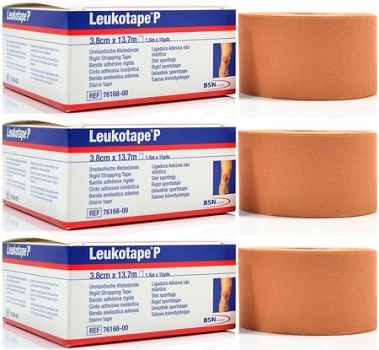
Leukotape P is a high-strength, rigid strapping tape built around a very strong zinc oxide adhesive. The current BSN Medical catalog lists a 1.5-inch by 15-yard roll (reference 76168), describes the tape as porous and hand-tearable, and identifies patellofemoral taping as a primary use. Unlike elastic kinesiology tape, it is meant to resist stretch and mechanically limit selected movement.
Key features
- Rigid, high-strength strapping tape
- Very strong zinc oxide adhesive
- Porous and hand-tearable construction
- 1.5 inches x 15 yards per roll (ref. 76168)
- Specifically identified for patellofemoral taping
- Manufacturer specifies use with Cover-Roll Stretch
Pros
- Very firm hold for low-stretch taping techniques
- Hand-tearable despite its rigid support
- Purpose-specific documentation for patellofemoral taping
- Pairs with Cover-Roll Stretch to create a layered taping system
Cons
- Contains natural rubber latex
- Aggressive adhesive may be difficult for sensitive skin
- Not elastic, so it does not behave like kinesiology tape
- Correct application technique matters; it is not a cure-all for joint pain
Best for: People who have been shown a rigid corrective or supportive taping technique by a physical therapist, athletic trainer or other qualified clinician—especially for patellofemoral taping.
Who it is not for: Anyone with a natural-rubber-latex allergy, people looking for stretchy kinesiology tape, or anyone trying to self-treat a new or unexplained injury without an appropriate assessment.
Latex warning: BSN Medical’s current US orthopedic catalog states that Leukotape P contains latex rubber and may cause an allergic reaction. Do not use it if you have a known latex allergy.
Does Leukotape P help with patellofemoral knee pain?
Taping can be a useful short-term tool for some people with patellofemoral pain, but it should not be treated as the whole treatment plan. The American Physical Therapy Association says a physical therapist may teach knee taping to make painful exercises easier to perform, while emphasizing that taping alone does not resolve patellofemoral pain.
That distinction matters with Leukotape P. Its strong adhesive and rigid construction make it well suited to a deliberate mechanical taping technique, but the tape itself does not diagnose why a knee hurts. For a deeper discussion, see our guide to using Leukotape for knee pain. If a brace is more appropriate than tape, our knee brace guide explains the main support styles.
Is Leukotape P the same as kinesiology tape?
No. Leukotape P is a rigid strapping tape, while kinesiology tape is designed to stretch. That changes how each product is used. Leukotape P is selected when the taping goal calls for firm mechanical restraint or repositioning. Elastic kinesiology tape is chosen for different taping approaches where stretch and movement are part of the design.
Do not substitute by appearance alone. Two rolls can look similar in an online listing while having very different stretch, adhesive and intended-use characteristics. Match the tape to the technique you were actually taught.
Two alternatives to Leukotape P
These are credible rigid athletic tapes, but neither should be presented as an exact clinical replacement for Leukotape P’s patellofemoral-taping role. They make more sense when the goal is general athletic taping or when the material profile better fits the user.
ALTERNATIVE 01 / GENERAL ATHLETIC TAPING
Mueller MTape Athletic Tape
Mueller MTape is a more conventional athletic-training-room tape. Mueller describes it as 100% cotton backcloth with a zinc oxide-based adhesive, high tensile strength, strong tack and easy hand tearing. It is intended to provide firm support and compression to weak, injured or unstable body parts.
Pros
- 100% cotton woven construction
- Hand-tearable and designed for fast athletic taping
- Strong, conformable support for general sports use
Cons
- Not specifically positioned for McConnell/patellofemoral taping
- Amazon had no featured offer on the checked listing
Best for: General rigid athletic taping where a clinician or athletic trainer recommends traditional cotton sports tape rather than Leukotape P’s more specialized corrective-taping role.
ALTERNATIVE 02 / LATEX-FREE RIGID TAPE
Hampton Adams Athletic Sports Tape
Hampton Adams sells a rigid athletic tape made from 100% cotton, with each roll measuring 1.5 inches by 15 yards. The manufacturer currently describes the product as latex-free. That makes it the more relevant alternative in this comparison for people who need to avoid natural-rubber latex, although any adhesive can still irritate sensitive skin.
Pros
- Manufacturer identifies it as latex-free
- Rigid 100% cotton tape
- Hand-tearable and sold in multi-roll packs
Cons
- Not specifically documented for patellofemoral corrective taping
- Latex-free does not mean irritation-free for every user
- Amazon had no featured offer on the checked listing
Best for: General rigid athletic taping when natural-rubber latex is a concern and the user does not specifically need Leukotape P’s documented patellofemoral-taping role.
What should you check before buying rigid sports tape?
1. Do you need rigid tape or elastic tape?
Start with the taping goal, not the brand name. If the technique depends on limiting movement or holding a correction, a rigid tape may be appropriate. If the technique is built around stretch and movement, an elastic kinesiology tape is a different tool. Do not assume the two are interchangeable.
2. Is latex a problem for you?
Leukotape P carries a natural-rubber-latex warning. That alone rules it out for people with a known latex allergy. If latex avoidance is important, verify the exact tape and adhesive formulation on the current manufacturer page rather than relying on an old marketplace description.
3. Does the technique call for an underlayer?
BSN Medical specifies Leukotape P for use with Cover-Roll Stretch. That pairing is relevant because Leukotape P has a very strong adhesive. If a clinician has shown you a particular taping method, follow the same tape sequence and materials rather than improvising.
4. Are you buying the right listing?
Check roll width, length, quantity and whether the listing is tape-only or a combo pack. The Amazon link in this review is currently a Leukotape P plus Cover-Roll Stretch combo, not a single standalone roll. Seller availability and packaging can change.
How to use Leukotape P more safely
- Use a technique you have actually been shown. Rigid taping changes movement, so placement and tension matter. A physical therapist or athletic trainer can teach the technique appropriate to your problem.
- Check the latex warning first. Do not use Leukotape P if you have a known natural-rubber-latex allergy.
- Follow the manufacturer’s layering guidance. For the patellofemoral applications highlighted by BSN Medical, Leukotape P is specified for use with Cover-Roll Stretch.
- Stop if your skin reacts. Remove the tape if you develop significant itching, burning, rash, blistering or other concerning skin symptoms.
- Do not tape over a diagnosis problem. New severe pain, major swelling, deformity, inability to bear weight, repeated giving way or persistent symptoms deserve clinical assessment rather than tighter taping.
When to get professional help: If pain is severe, worsening, associated with major swelling or instability, or does not improve as expected, get assessed by a qualified healthcare professional. Taping can support a treatment plan; it should not be used to hide symptoms and push through a significant injury.
Frequently asked questions
Is Leukotape P stretchy?
No. Leukotape P is a rigid strapping tape. Its purpose is to provide firm mechanical support rather than the elastic stretch associated with kinesiology tape. That difference is central to choosing it: use Leukotape P when the taping technique specifically calls for rigid tape.
Does Leukotape P contain latex?
Yes. BSN Medical’s current US orthopedic catalog warns that Leukotape P contains latex rubber, which may cause an allergic reaction. People with a known natural-rubber-latex allergy should avoid it and choose a verified latex-free alternative instead.
Can Leukotape P be used directly on skin?
Follow the exact technique and manufacturer instructions you were given. BSN Medical specifies Leukotape P for use with Cover-Roll Stretch, particularly in patellofemoral taping. Because the adhesive is very strong, using the recommended underlayer can be an important part of the taping system.
Is Leukotape P good for patellofemoral pain?
It can be useful as part of a clinician-guided taping plan. BSN Medical identifies Leukotape P for patellofemoral taping, while the American Physical Therapy Association notes that knee taping may help some people perform painful exercises more comfortably. Taping alone does not resolve patellofemoral pain.
Is Leukotape P the same as regular athletic tape?
Not exactly. Both are rigid tape categories, but Leukotape P is specifically documented as a high-strength rigid strapping tape for uses including patellofemoral taping. General athletic tapes such as Mueller MTape are positioned more broadly for sports support and compression.
How long should Leukotape P stay on?
The sources reviewed do not provide one universal wear time that is appropriate for every taping technique or skin type. Follow the schedule given by the clinician who taught you the application, and remove the tape promptly if you develop significant skin irritation or other concerning symptoms.
Medical disclaimer: This article is for general information only and is not medical advice. Talk to a qualified healthcare professional about your specific injury, symptoms and taping technique.