Best Coccyx Pillow for Tailbone Pain (2026): 7 Top Picks
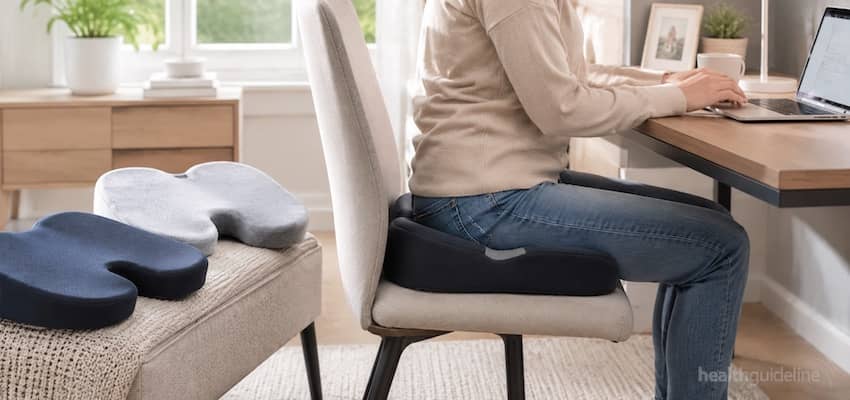
A good coccyx pillow can make sitting bearable again when tailbone pain flares up at your desk, in the car, or during recovery. The best cushions use a cutout or wedge shape to lift your tailbone off the seat and spread your weight more evenly, so you can sit longer with less pressure. Below are seven cushions currently sold on Amazon — spanning memory foam, cooling gel, budget, and recovery options — with honest pros, cons, and who each one is really for.
For most people, the best coccyx pillow for tailbone pain is the ComfiLife Gel Enhanced Seat Cushion — supportive high-density memory foam, a cooling gel top layer, and a U-shaped coccyx cutout that offloads the tailbone. On a budget, the Xtreme Comforts Coccyx Cushion covers the essentials for less; for firm all-day support, the Cushion Lab Pressure Relief Cushion is hard to beat.
Best coccyx pillows for tailbone pain at a glance
| Coccyx cushion | Best for | Fill & shape | Price band* | Link |
|---|---|---|---|---|
| ComfiLife Gel Enhanced | Best overall | Gel-topped memory foam, U-cutout | Mid | View on Amazon |
| Everlasting Comfort | Best value for all-day office use | 100% memory foam, U-cutout | Mid | View on Amazon |
| Cushion Lab Pressure Relief | Best firm support for long hours | Extra-dense contoured foam | Premium | View on Amazon |
| Xtreme Comforts Coccyx | Best budget | Memory foam, mesh cover, U-cutout | Budget | View on Amazon |
| Aylio Coccyx Cushion | Best deep cutout & pelvic tilt | Contoured wedge, large cutout | Budget | View on Amazon |
| Purple Simply Seat Cushion | Best cooling / travel (runs hot) | GelFlex grid (no cutout) | Mid | View on Amazon |
| Kieba Donut Cushion | Best for recovery (hemorrhoid / postpartum / post-surgery) | Ring / donut foam, full cutout | Budget | View on Amazon |
How we chose these coccyx cushions
We focused on cushions that are real, currently listed on Amazon, and genuinely suited to tailbone relief rather than whatever is easiest to link. We deliberately spanned different materials (memory foam, gel-topped foam, and Purple’s gel grid), shapes (U-cutout, wedge, contoured, and donut), price bands, and use cases (office, car, travel, and recovery). Within each, we weighed foam density and durability, how effectively the shape offloads the coccyx, cover breathability and washability, a non-slip base, and honest fit — including who each cushion isn’t for. For the health context, we leaned on guidance from the Mayo Clinic, Cleveland Clinic, and other sources listed at the end.
The 7 best coccyx pillows for tailbone pain
01 / Best overall
1. ComfiLife Gel Enhanced Seat Cushion — Best overall
The ComfiLife Gel Enhanced is our top overall pick because it pairs supportive high-density memory foam with a cooling gel layer on top and a U-shaped coccyx cutout that lifts your tailbone off the seat. A non-slip rubber base, a machine-washable velour cover, and a built-in carry handle make it easy to move between an office chair, car seat, and wheelchair. It hits the best balance of support, cooling, and everyday practicality.
Key features:
- gel top layer over high-density memory foam
- U-shaped rear cutout
- non-slip base
- washable zippered cover
- carry handle.
Pros:
- gel layer runs noticeably cooler than plain foam
- cutout offloads the coccyx
- stays put on slick chairs
- easy to clean and carry.
Cons:
- memory foam softens as it warms and can compress under heavier users
- roughly 2.8″ of height slightly raises your seat (you may need to adjust your desk or monitor)
- firmer than a plush pillow.
Best for: office workers and drivers who sit for hours and want cushioning that doesn’t overheat.
02 / Best value for all-day office use
2. Everlasting Comfort Memory Foam Seat Cushion — Best value for all-day office use
Everlasting Comfort’s cushion is pure high-density memory foam with a U-shaped coccyx cutout, built to hold its shape through long workdays without flattening. It’s a straightforward, popular pick for office chairs and car seats, and the brand backs it with a long replacement guarantee — which makes it easy to recommend if you want durable memory foam without paying a premium.
Key features:
- 100% high-density memory foam
- U-shaped cutout
- breathable washable cover
- non-slip base
- long manufacturer warranty.
Pros:
- dense foam resists going flat
- simple, effective cutout
- removable washable cover
- strong warranty and good value.
Cons:
- no gel/cooling layer, so it can feel warm in hot rooms
- pure memory foam feels firm to some at first
- taller or heavier users may prefer a larger cushion.
Best for: people who sit 8+ hours a day and want dependable memory foam at a fair price.
03 / Best firm support for long hours
3. Cushion Lab Patented Pressure Relief Seat Cushion — Best firm support for long hours
The Cushion Lab takes a different approach: instead of a rear cutout, it uses extra-dense, ergonomist-shaped memory foam that cradles your hips and thighs and redistributes weight across the whole seat. It stays supportive through very long sitting sessions and doesn’t bottom out, which makes it a strong pick for anyone who finds softer cushions collapse under them by mid-afternoon.
Key features:
- extra-dense charcoal-infused memory foam
- contoured cradle shape (no rear cutout)
- non-slip bottom
- washable cover.
Pros:
- firm, dense foam that doesn’t bottom out
- contoured shape encourages an upright posture
- supportive for heavier users and marathon sitting sessions
- odor-controlled foam.
Cons:
- the firm feel isn’t for everyone
- no dedicated tailbone cutout, so people with an acutely bruised coccyx may prefer a U-cutout style
- premium price
- can feel stiff in a cold room until it warms up.
Best for: long-haul sitters and heavier users who want firm, structured support over softness.
04 / Best budget
4. Xtreme Comforts Coccyx Seat Cushion — Best budget
The Xtreme Comforts cushion delivers the core coccyx-cushion formula — memory foam, a U-shaped cutout, a breathable mesh cover, and a non-slip base — at a budget-friendly price. It’s a sensible entry point if you want tailbone relief without spending much, or a low-risk way to find out whether a cushion helps your pain before investing more.
Key features:
- memory foam core
- U-shaped cutout
- breathable machine-washable mesh cover
- non-slip base
- carry handle
- certified foam (CertiPUR-US / OEKO-TEX per listing).
Pros:
- affordable
- mesh cover breathes cooler than velour
- cutout offloads the tailbone
- handle and non-slip base included.
Cons:
- mesh cover feels less plush than velour
- mid-density foam may compress sooner than premium picks
- plain, utilitarian look.
Best for: budget shoppers and first-time buyers testing whether a cushion eases their tailbone pain.
05 / Best deep cutout & pelvic tilt
5. Aylio Coccyx Seat Cushion — Best deep cutout & pelvic tilt
Aylio’s wedge tilts your pelvis slightly forward and uses a generous rear cutout so an inflamed or bruised tailbone doesn’t touch the seat at all. The forward tilt suits people who tend to slouch, and the larger-than-average cutout is genuinely helpful when your coccyx is acutely tender. At around a pound, it’s also easy to carry between chairs.
Key features:
- contoured comfort-foam wedge with forward pelvic tilt
- large rear cutout
- washable velour cover
- roughly 18″ × 14″ × 3″ and very lightweight.
Pros:
- pronounced forward tilt encourages upright posture
- larger cutout keeps pressure fully off the coccyx
- light and portable
- washable cover.
Cons:
- the forward tilt isn’t for everyone — some dislike the angle
- comfort foam is softer and less dense than premium memory foam
- the wedge raises the front edge of the seat.
Best for: people with acute tailbone tenderness, or slouchers who want a deeper cutout plus a gentle pelvic tilt.
06 / Best cooling / travel option
6. Purple Simply Seat Cushion — Best cooling / travel option
Purple’s Simply cushion swaps memory foam for a flexible GelFlex grid that stays cool and doesn’t trap body heat. At just 1.25 inches it’s the slim, travel-friendly option — easy to slip onto a plane or car seat. Note that it relieves pressure by distributing your weight across the springy grid rather than with a cutout, so it suits people who run hot more than those needing a dedicated tailbone notch.
Key features:
- 100% GelFlex polymer grid
- temperature-neutral (won’t trap heat)
- low-profile 1.25″ height
- non-slip bottom
- washable cover
- made in USA.
Pros:
- stays cool through long sittings
- slim, light, and travel-friendly
- springy support that doesn’t go flat
- easy to clean.
Cons:
- no dedicated coccyx cutout, so it may offload the tailbone less than a U-cutout cushion
- the thin profile gives less cushioning on very hard seats
- costs more per inch of thickness.
Best for: hot sitters, frequent travelers, and anyone who dislikes the sink and heat of memory foam.
07 / Best for recovery (hemorrhoid / postpartum / post-surgery)
7. Kieba Donut Tailbone Cushion — Best for recovery (hemorrhoid / postpartum / post-surgery)
A donut (ring) cushion like Kieba’s fully suspends the tailbone and perineal area over an open center. That makes it better suited to recovery situations — hemorrhoids, post-surgery soreness, or the postpartum period — than to everyday ergonomic desk work. The dense comfort foam resists flattening, and the velour cover is removable and washable.
Key features:
- ring/donut comfort foam with a full center cutout
- roughly 18″ diameter
- non-slip base
- removable washable velour cover.
Pros:
- the open center removes pressure from sensitive or healing areas
- well-suited to hemorrhoid, postpartum, and post-surgery recovery
- dense foam holds its shape
- washable cover.
Cons:
- the ring shape is niche and less ideal for all-day posture support than a wedge or U-cushion
- can feel unusual on a standard office chair
- it’s a relief cushion, not a posture cushion.
Best for: short-term recovery from hemorrhoids, childbirth, or tailbone/perineal procedures.
What to look for when buying a coccyx pillow
The right cushion depends on your body, your chair, and why your tailbone hurts. A few features matter more than the marketing:
Shape: U-cutout, wedge, donut, or grid?
A U-shaped cutout (the most common coccyx-cushion design) removes the section of foam directly under your tailbone. A wedge adds a forward tilt that nudges your pelvis upright — good for slouchers. A donut/ring suspends the whole tailbone and perineal area and is aimed at recovery, not daily posture. A flat gel grid like Purple’s has no cutout and relieves pressure by spreading weight instead. Match the shape to your main goal: everyday sitting, posture, or recovery.
Foam type and density
High-density memory foam cushions pressure well and holds up over time, but it molds to heat and can feel warm. A gel top layer or a gel grid stays cooler and springier. Whatever the material, density and durability matter more than the label — a thin, low-density cushion will bottom out quickly no matter what it’s made of.
Cover and breathability
A breathable mesh cover runs cooler; a velour cover feels plusher. Either way, look for a removable, machine-washable cover — a cushion you sit on all day will need cleaning.
Non-slip base, thickness, and portability
A grippy, non-slip base keeps the cushion from sliding on slick office and car seats. Around 2–3 inches of thickness suits most people — enough to offload the tailbone without perching you too high relative to your desk. If you’ll carry it between home, office, and car, a handle and light weight help. Sitting all day? It’s worth pairing a cushion with a genuinely supportive chair — see our guide to office chairs with back support, or try an ergonomic kneeling chair to vary your posture through the day.
About tailbone pain (coccydynia)
Tailbone pain — known medically as coccydynia — is pain in or around the coccyx, the small triangular bone at the base of your spine. It’s a common complaint and, according to the Cleveland Clinic, occurs several times more often in women than in men. Typical triggers include a fall or other trauma, prolonged sitting on hard or narrow surfaces, changes during pregnancy and childbirth, and joint changes from arthritis; sometimes there’s no obvious cause, and in rare cases infection or a tumor is involved.
The encouraging part: most tailbone pain eases on its own within a few weeks to a few months with simple self-care. A shaped cushion with a cutout under the coccyx is often described by clinicians as a sensible first-line measure — the Mayo Clinic notes that many people find a wedge-shaped, pressure-reducing cushion helpful, and specialist sources list seating cushions among standard conservative options. Just keep expectations realistic: a cushion relieves pressure and symptoms while you heal; it isn’t a cure for the underlying cause.
How to relieve tailbone pain while you sit
Alongside a good cushion, these commonly recommended steps may help you sit more comfortably. They’re general self-care ideas, not a treatment plan:
- Lean slightly forward when you sit down, which takes weight off the coccyx.
- Take movement breaks — stand and walk for a minute or two every 20–30 minutes.
- Keep your feet supported on the floor rather than dangling.
- Use a cutout or wedge cushion on hard chairs, in the car, and on hard benches.
- Apply heat or ice to the area as feels comfortable.
- Over-the-counter anti-inflammatories may help — follow the label and your pharmacist’s or doctor’s guidance.
- Gentle stretching and, for persistent pain, physical therapy can address tight pelvic-floor and hip muscles.
If your lower back is involved too, some people find added relief from a supportive back brace, a recliner designed for back pain, or a back massager for the chair to ease muscle tension.
When to see a healthcare professional
A cushion is for comfort, not diagnosis. See a doctor, physical therapist, or other qualified professional if any of the following apply:
- Your pain began after a significant fall or injury.
- The pain doesn’t improve over a few weeks, or it steadily worsens.
- You have a fever or other signs of infection.
- You notice numbness, tingling, or weakness in your legs.
- You have changes in bowel or bladder control.
- You have unexplained weight loss or severe pain that wakes you at night.
Frequently asked questions
Do coccyx cushions actually work for tailbone pain?
Many people find a cutout or wedge cushion eases pressure on the tailbone while sitting, and clinicians commonly suggest one as first-line self-care. The evidence is more practical than from large clinical trials, and a cushion relieves symptoms rather than curing the underlying cause — so persistent or severe pain still warrants a professional assessment.
Which is better, a coccyx (U-cutout) cushion or a donut pillow?
A U-cutout or wedge cushion suits everyday sitting and posture, offloading the tailbone while still supporting your thighs. A donut (ring) cushion fully suspends the tailbone and perineal area, which better fits recovery from hemorrhoids, surgery, or childbirth. Choose based on whether you mainly need daily ergonomics or short-term recovery relief.
Memory foam or gel — which coccyx cushion should I choose?
Memory foam molds to you and cushions pressure well, but it can trap heat and softens as it warms. Gel-topped foam or a gel grid stays cooler and springier, which helps if you run hot or sit for long stretches. In practice, foam density and the cushion’s shape matter more than the material alone.
How long does tailbone pain usually last?
Tailbone pain (coccydynia) often improves on its own within a few weeks to a few months with self-care such as cushioning, movement breaks, and heat or ice. If pain persists beyond that, worsens, or follows a significant fall, it’s worth seeing a healthcare professional to rule out other causes.
Can I use a coccyx cushion in the car?
Yes. Most memory-foam and gel coccyx cushions work on car seats, and many people use one for commuting and road trips. Slim, low-profile cushions travel best and are less likely to change your seating position; just make sure the added height still feels safe and comfortable for driving.
How thick should a coccyx cushion be?
Around 2–3 inches suits most people — thick enough to offload the tailbone without perching you too high. Too thin and it can bottom out on hard chairs; too thick and it may raise you awkwardly relative to your desk. If your desk is low, a slim gel-grid cushion is a good compromise.
Medical disclaimer: This article is for general information only and is not medical advice. Talk to a qualified healthcare professional about your specific situation.