Hinged Elbow Brace: The 7 Best Post-Op & Sports Support Braces (2026)
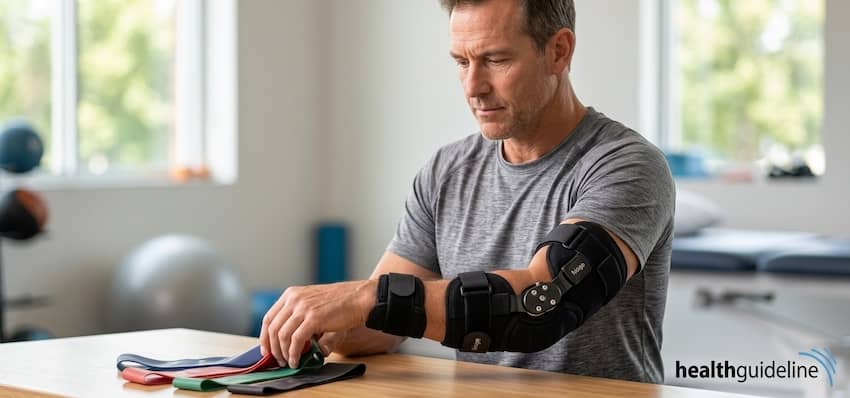
Quick take: “Hinged elbow brace” covers two different products, so match the tool to your situation.
Best overall (recovery)
Vive Hinged ROM Elbow Brace
pairs a trusted brand and a one-year guarantee with easy dial-set range-of-motion control.
Best for athletes
DonJoy Performance Bionic Elbow Brace II
guards against hyperextension and ligament stress during sport.
Important: if you are recovering from surgery, a dislocation, or a ligament repair, set the brace’s flexion and extension limits only as your surgeon or physical therapist directs — not on your own.
Search for a “hinged elbow brace” and you’ll get two very different products mixed together — and buying the wrong one wastes money. Most people who search this term need a post-operative range-of-motion (ROM) brace that locks the elbow at set angles while an injury or surgical repair heals. A smaller group wants an athletic hinged support that limits hyperextension during contact sport. This guide separates the two, recommends seven real braces you can buy today, and shows how to match one to your needs.
Which type of hinged elbow brace do you actually need?
Choose a ROM post-op brace if you are recovering from elbow surgery, a dislocation, or a ligament or tendon repair and a clinician wants to limit how far the joint bends and straightens. Choose an athletic hinged brace if you want to protect an already-stable elbow from hyperextension or side-to-side ligament stress during sport.
If your real problem is tendon overuse or nerve irritation rather than joint instability, a hinged brace is usually the wrong tool. For lateral elbow pain, see our guide to the best tennis elbow brace; for inner-elbow pain, the golfer’s elbow brace; for mild support or arthritis, an elbow compression sleeve; and for tingling or numbness in the ring and little fingers, a cubital tunnel (ulnar nerve) brace. Early on, a post-op brace is often paired with an arm sling to offload the joint.
How we chose
We focused on hinged elbow braces that are real and currently sold on Amazon in the US, prioritizing genuine ROM adjustability, secure fit and correct-side options, build quality, and — where it matters — brand support and insurance eligibility. Worth knowing: the post-op ROM category is crowded with near-identical braces sold under many seller names, so we chose representatives based on reliability, price, and specific features rather than marketing language. None of the links below carry an affiliate tag, and no brand paid for placement.
Top picks at a glance
| Brace | Best for | Hinge / ROM | Price tier* | Link |
|---|---|---|---|---|
| Vive Hinged ROM | Best overall recovery brace | Dial-set; ~120° flexion, 90°–0° extension | Budget–Mid | Amazon |
| Orthomen Hinged ROM | Specialist orthopedic brand | Locking hinges, 15° increments | Mid | Amazon |
| Brace Align ROM | Insurance / FSA-HSA + fitting help | ROM dial; PDAC L3760/L3761 | Mid–Premium | Amazon |
| Komzer Hinged | Best budget ROM brace | 0°–120° flexion, 0°–105° extension | Budget | Amazon |
| X-shuan ROM + Hand Grip | When wrist/hand needs support too | 0°–120°, 15° increments | Budget–Mid | Amazon |
| DonJoy Bionic Elbow II | Athletes: hyperextension / UCL | Bilateral polycentric hinges + stops | Mid | Amazon |
| Breg X2K | High-contact sports, max control | Rigid aluminum frame, polycentric hinge | Premium | Amazon |
01 / Best overall
1. Vive Hinged ROM Elbow Brace — Best overall
The Vive Hinged ROM Elbow Brace is a strong default for post-op and injury recovery. A locking dial and sliders set flexion from open down to about 120°, with extension limited between 90° and 0°, and the frame length adjusts from roughly 14.75″ to 18.75″. A one-year guarantee and y-straps that shorten for slimmer arms add practical reassurance.
Key features:
- locking ROM dial with flexion/extension sliders
- push-button length adjustment
- removable padded shoulder strap
- quick-release fastener straps
- latex-free.
Pros:
- reputable brand with responsive support and a one-year guarantee
- genuinely adjustable ROM
- lightweight
- fits a wide range of arm sizes.
Cons:
- side-specific, so order the correct left or right
- the maker notes it is not intended for sleeping
- the hinge dial can sit prominently at the joint.
Best for: most people needing controlled motion after elbow surgery, a dislocation, or a ligament/tendon repair.
02 / Best from a specialist brand
2. Orthomen Hinged ROM Elbow Brace — Best from a specialist brand
Orthomen has specialized in ROM elbow bracing longer than most Amazon sellers, and its brace reflects that focus: telescoping arm cuffs, locking hinges adjustable in 15° increments, a padded shoulder sling, and a rigid-but-light frame built for post-surgical immobilization and staged rehabilitation as your clinician loosens the range over time.
Key features:
- telescoping length adjustment
- locking hinges in 15° steps
- padded shoulder strap
- breathable pads.
Pros:
- established specialist brand
- solid, predictable build
- clearly marked increments.
Cons:
- bulkier than soft supports
- costs more than unbranded generics
- side-specific.
Best for: buyers who prefer a specialist orthopedic brand over an unbranded generic.
03 / Best for insurance / FSA-HSA
3. Brace Align ROM Hinged Elbow Brace — Best for insurance / FSA-HSA
The Brace Align ROM Hinged Elbow Brace carries PDAC codes L3760/L3761, meaning it meets the standard for Medicare and insurance billing, and it is typically FSA/HSA eligible. The company also offers free video fitting sessions — helpful if you are unsure how to position the hinge or apply your prescribed motion limits.
Key features:
- ROM dial
- PDAC L3760/L3761 coding
- moisture-wicking foam
- included shoulder sling
- free fitting support.
Pros:
- potentially insurance/HSA/FSA reimbursable
- professional fitting help
- medical-grade positioning.
Cons:
- higher sticker price
- you’ll need documentation to claim reimbursement
- verify eligibility with your own plan first.
Best for: anyone planning to seek reimbursement or who wants fitting guidance.
04 / Best budget
4. Komzer Hinged Elbow Brace — Best budget
If you want the core post-op function for less, the Komzer Hinged Elbow Brace delivers it: bilateral ROM settings from 0°–120° flexion and 0°–105° extension in 15° increments, one-push length adjustment from about 15″ to 18.8″, four fastener straps, and a removable shoulder strap. It covers the essentials without the specialist-brand premium.
Key features:
- 0°–120° flexion / 0°–105° extension
- 15° increments
- one-push length 15″–18.8″
- aluminum bar with padded pads
- removable sling.
Pros:
- budget-friendly
- full ROM range
- sling included.
Cons:
- unbranded-tier quality control can vary unit to unit
- side-specific
- basic padding.
Best for: cost-conscious buyers who still need genuine ROM control.
05 / Best when the hand needs support too
5. X-shuan Hinged ROM Elbow Brace with Hand Grip — Best when the hand needs support too
Some recoveries need the wrist and hand steadied as well. The X-shuan Hinged ROM Elbow Brace adds a removable hand grip to the familiar 0°–120° hinge (15° increments) and adjustable, trimmable cuffs, giving the forearm and wrist extra stability early on when gripping is uncomfortable. It represents a class of near-identical hand-grip ROM braces, so compare current listings.
Key features:
- removable hand grip
- 0°–120° in 15° increments
- cushioned pads
- cuttable straps
- optional shoulder strap.
Pros:
- hand grip adds wrist/forearm support
- adjustable
- sling included.
Cons:
- the hand grip isn’t needed by everyone
- generic-tier build
- side-specific.
Best for: recoveries where the hand and wrist also need positioning support.
X-shuan Hinged ROM Elbow Brace with Hand Grip — view on Amazon
06 / Best for athletes
6. DonJoy Performance Bionic Elbow Brace II — Best for athletes
For a stable elbow that needs protection during sport rather than post-op immobilization, the DonJoy Performance Bionic Elbow Brace II uses bilateral polycentric hinges with hyperextension stops and adjustable cross-straps to guard the medial (UCL) and lateral ligaments. Perforated neoprene and hex silicone anti-migration banding keep it in place under a jersey, and it fits either arm.
Key features:
- dual polycentric hinges with hyperextension stops
- cross-straps to set maximum extension
- perforated neoprene
- silicone anti-migration banding
- removable hinges
- universal left/right fit.
Pros:
- trusted sports-medicine brand
- low profile under clothing
- wears on either arm
- targets hyperextension and ligament stress.
Cons:
- it’s protective support, not a substitute for a prescribed rehab brace
- neoprene can run warm
- check sizing.
Best for: athletes with a history of hyperextension or ligament sprain returning to play (football, lacrosse, basketball).
07 / Best for high-contact sports
7. Breg X2K Elbow Brace — Best for high-contact sports
When the priority is maximum control in heavy-contact sport, the Breg X2K uses a rigid, tempered aircraft-aluminum frame and a polycentric hinge to resist medial/lateral instability and hyperextension. It’s the type of brace favored by football linemen and wrestlers who need a hard mechanical stop, the frame is malleable for a custom fit, and it comes in sizes XS–L.
Key features:
- tempered aluminum frame
- polycentric hinge with flexion/extension control
- malleable for a custom fit
- sizes XS–L
- left/right options.
Pros:
- maximum rigid protection
- durable
- trusted orthopedic brand.
Cons:
- bulky and among the priciest here
- overkill for everyday support
- some users note it may not lock deeply into flexion.
Best for: high-contact athletes needing the strongest available stabilization.
What to look for when buying a hinged elbow brace
Correct side and size
Many hinged braces are built for a specific arm and are sized by arm circumference. Measure your mid-bicep and forearm as the listing directs, and order the right side and size — a brace that fits poorly won’t hold the hinge over the joint where it belongs.
ROM adjustment and increments
For recovery, look for a dial or pin that locks both flexion and extension, typically in 10–15° steps. That’s what lets a clinician block the joint at a safe angle and open it up gradually as you heal. Athletic braces instead use fixed hyperextension stops rather than fine ROM steps.
Build and hinge quality
Aluminum uprights and a smooth polycentric hinge track the joint’s natural motion far better than thin plastic. A rigid frame matters most for post-surgical stabilization and heavy-contact protection; a soft neoprene sleeve with hinges is enough for lighter athletic support.
Comfort, breathability, and the sling
You may wear a recovery brace for weeks, so padded, moisture-wicking, washable liners matter. A removable, padded shoulder strap helps offload the arm in the early days. If you’ll need the elbow supported at night, ask your provider — many ROM braces are not designed for sleeping.
Insurance, HSA, and FSA
Braces with PDAC/HCPCS codes such as L3760/L3761 (for example, the Brace Align option above) may qualify for insurance billing and are often FSA/HSA eligible. Coverage depends on your plan and paperwork, so confirm before you buy.
The right tool for the actual problem
A hinged ROM brace is built for joint instability, not tendon overuse or nerve irritation. If your issue is tennis elbow, golfer’s elbow, general soreness better suited to an elbow compression sleeve, or cubital tunnel syndrome, one of those is likely the better buy.
How hinged elbow braces work — and why the settings come from your clinician
The elbow is essentially a hinge joint that bends and straightens (flexion and extension) while a separate rotation lets the forearm turn palm-up and palm-down. A hinged brace keeps those uprights aligned along the arm so the joint stays stable while still allowing controlled bending within set limits.
According to the American Academy of Orthopaedic Surgeons’ OrthoInfo, after certain elbow surgeries or dislocations the joint may be protected with an external hinge, and moving the elbow early — within safe limits — appears to help recovery by reducing stiffness and scar tissue. In typical supervised rehabilitation, a clinician first rests the joint, then transitions to a hinged brace locked at a protective angle and gradually opens up the allowed range over several weeks. The exact angles and timeline are specific to your injury and repair, which is why they must be set by your own surgeon or physical therapist rather than chosen from a web article.
Frequently asked questions
What is a hinged elbow brace used for?
It stabilizes the elbow while allowing controlled bending and straightening, protecting healing tissue after surgery, a dislocation, or a ligament or tendon repair. A separate group of hinged braces is instead designed to prevent hyperextension and side-to-side ligament stress during sport, adding protection to an already-stable joint.
How is a hinged ROM brace different from an elbow sleeve or strap?
A hinged ROM brace has rigid uprights and a mechanical hinge that limits how far the joint moves. A compression sleeve or a tennis/golfer’s-elbow strap adds warmth or targeted pressure but doesn’t restrict motion, so it suits tendon overuse pain rather than post-surgical stabilization or instability.
Can I set the range of motion myself?
No. If you’re recovering from surgery or injury, your surgeon or physical therapist sets the flexion and extension limits and decides when to progress them. Adjusting the hinge on your own can stress healing tissue or slow recovery. Wear the brace only within the range you were prescribed.
Left or right — does it matter?
Often, yes. Many hinged elbow braces are built for a specific arm and sized by arm circumference, so check the listing and order the correct side and size. Universal-fit athletic braces, such as the DonJoy Bionic Elbow II, can be worn on either arm.
Can I sleep in a hinged elbow brace?
Many ROM braces aren’t designed for sleeping, and some makers say so directly. If your provider wants the elbow protected overnight, ask which device to use — a dedicated night splint or immobilizer is sometimes more appropriate than a bulky ROM brace.
Are hinged elbow braces covered by insurance?
Sometimes. Braces with PDAC/HCPCS codes such as L3760/L3761 may qualify for Medicare or insurance billing and are often FSA/HSA eligible. Coverage depends on your plan and documentation, so confirm with your insurer or supplier before purchasing.
Medical disclaimer: This article is for general information only and is not medical advice. A hinged elbow brace does not replace professional care, and range-of-motion settings after surgery or injury should be determined by your surgeon or physical therapist. Talk to a qualified healthcare professional about your specific situation.