Best Knee Sleeve for Running: 5 Picks for 2026
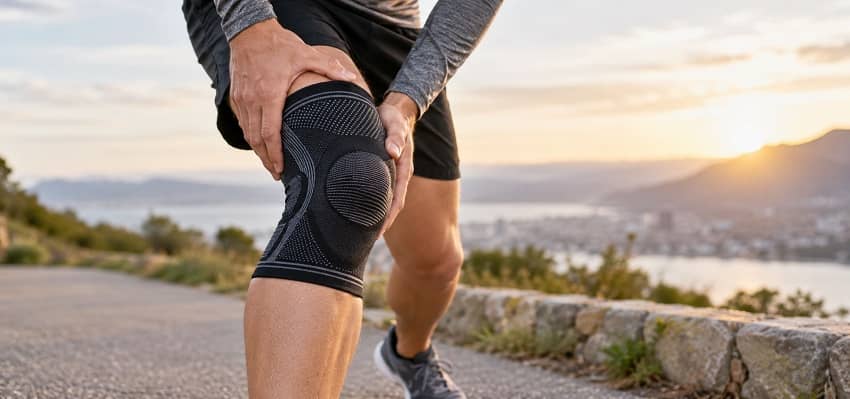
2026 running guide · fit, grip & support
If you want the best knee sleeve for running in 2026, the UFlex Athletics sleeve is our strongest all-round starting point because it combines a low-profile four-way-stretch knit with a double silicone grip designed to stay put. Bauerfeind is the premium pick, while Bodyprox is the value choice when you want two sleeves.
A knee sleeve can add compression, warmth and a sense of support, but it is not a diagnosis or a cure for “runner’s knee.” If pain is new, worsening, changing your stride or stopping you from normal activity, get the cause assessed rather than using a sleeve to push through it.
Quick picks for runners
Best overall
UFlex Athletics
Light, flexible and built with an anti-slip grip — a sensible starting point for everyday road, treadmill and gym running.
Premium pick
Bauerfeind Sports Knee Support
Breathable AirKnit, targeted compression and an integrated pad for runners who want a more engineered fit.
Best value pair
Bodyprox 2-Pack
A straightforward two-sleeve option for runners who want compression on both knees or a spare for wash days.
JUMP TO A SECTION
How did we choose the best knee sleeves for running?
We prioritized products with a current U.S. Amazon listing and runner-relevant features: a secure stay-put fit, enough stretch for repeated knee flexion, manageable bulk, breathable or moisture-managing construction, and clear sizing information. We checked manufacturer specifications where available and deliberately included different constructions rather than five nearly identical knit sleeves.
Our category labels are editorial judgments based on construction and intended use. We did not conduct a laboratory test, measure compression ourselves, or treat Amazon star ratings as clinical evidence. Prices, stock, colors and size availability can change, so confirm the exact listing before buying.
Runner-first rule: the “best” sleeve is the one that stays in place without pinching, bunching or changing your stride. More structure is not automatically better. For a diagnosed injury or recurring instability, brace choice should follow professional advice rather than a product ranking.
Which knee sleeves made the 2026 shortlist?
For most recreational runners, start with a flexible sleeve that stays put and fits comfortably under running clothes. Move toward a padded or stabilized design only when you specifically want that construction. The five choices below span lightweight knit, premium anatomical support, a value two-pack, simple neoprene and a more structured sleeve/brace hybrid.
| Product | Our category | Runner-relevant design | Main tradeoff |
|---|---|---|---|
| UFlex Athletics | Best overall | Four-way stretch + double silicone grip | Correct sizing matters for grip and comfort |
| Bauerfeind Sports Knee Support | Premium pick | AirKnit + Omega pad + 20–30 mmHg manufacturer-rated compression | Costs more than basic sleeves |
| Bodyprox 2-Pack | Best value pair | Pull-on compression sleeves sold as a pair | Less structured than padded/stabilized options |
| McDavid Knee Compression Sleeve | Simple neoprene option | Lightweight pull-on neoprene construction | Neoprene can feel warmer on long or hot runs |
| NEENCA Professional | Most structured | Patella gel pad + side stabilizers + non-slip gel | Bulkier than a basic running sleeve |
The 5 best knee sleeves for running
01 / BEST OVERALL
UFlex Athletics Knee Compression Sleeve
Why it stands out: UFlex is the most balanced running-focused option in this group. Its four-way-stretch construction is designed to move with the knee, while a double silicone anti-slip grip addresses one of the most annoying problems runners have with sleeves: migration during repeated flexion. It is also sold as a single pull-on sleeve rather than a bulky brace.
Key features
- Four-way-stretch fabric
- Double silicone anti-slip grip
- Pull-on compression-sleeve design
- Marketed for running and other sports
Pros
- Low-profile construction suits running better than rigid designs
- Anti-slip grip is useful for repetitive movement
- Flexible enough for running, gym work and hiking
Cons
- A too-small size can feel restrictive; a too-large size may slide
- It does not provide rigid or hinged support
- Sold as one sleeve, so bilateral use requires two
Best for: Recreational runners who want a flexible, stay-put compression sleeve without the bulk of a brace.
Who should skip it: Anyone who has been told they need a hinged, immobilizing or injury-specific brace rather than a general compression sleeve.
For a closer look at this model, read our UFlex Athletics knee compression sleeve review.
02 / PREMIUM PICK
Bauerfeind Sports Knee Support
Why it stands out: Bauerfeind’s Sports Knee Support is the premium option for runners who want more engineering than a plain knit tube. The manufacturer specifies breathable moisture-wicking AirKnit, an integrated Omega pad around the kneecap, GripTech silicone zones and 20–30 mmHg compression. It is still a pull-on support, but the pad and mapped knit make sizing especially important.
Key features
- Breathable, moisture-wicking AirKnit
- Integrated viscoelastic Omega pad
- Silicone GripTech gripping zones
- Manufacturer-rated 20–30 mmHg compression
Pros
- Breathable knit is well suited to active use
- Integrated pad adds a different support feel from plain sleeves
- Clear manufacturer sizing and care information
Cons
- Significantly more expensive than basic compression sleeves
- Precise measurement matters for the anatomical fit
- The pad may feel like more structure than some runners want
Best for: Runners willing to pay more for a breathable anatomical support with an integrated kneecap pad and mapped compression.
Who should skip it: Budget-focused runners who only want light compression or anyone who dislikes a padded feel around the kneecap.
03 / BEST VALUE PAIR
Bodyprox Knee Compression Sleeve 2-Pack
Why it stands out: Bodyprox is the practical value pick because the selected Amazon listing is a two-pack. That is useful if you prefer compression on both knees or want a clean spare between runs. The tradeoff is simplicity: this is a pull-on compression option rather than a padded or hinged brace, so it is best judged on fit, comfort and whether it stays in place for your stride.
Key features
- Two sleeves in the selected listing
- Pull-on compression design
- Designed for running and workouts
- Multiple sizes; use the current listing’s chart
Pros
- Two-pack can be better value for bilateral use
- Simple pull-on design is easy to understand
- Less bulky than stabilizer-heavy designs
Cons
- Offers less structure than padded or stabilized supports
- Two sleeves are unnecessary if you only ever use one
- Material and fit should be checked on the exact size/version before purchase
Best for: Value-conscious runners who want a pair of basic compression sleeves rather than one feature-heavy support.
Who should skip it: Runners specifically looking for a kneecap pad, side stabilizers, hinges or clinician-prescribed support.
04 / SIMPLE NEOPRENE OPTION
McDavid Knee Compression Sleeve
Why it stands out: McDavid’s classic compression sleeve takes a different route from thin knitted supports: it uses lightweight neoprene in a simple pull-on, closed-patella design. Some runners like neoprene for its close, warm feel. The same feature can be a drawback in hot weather, so this is more of a preference pick than a universal winner.
Key features
- Lightweight neoprene construction
- Closed-patella pull-on design
- Fits left or right knee
- Selected listing includes one sleeve
Pros
- Simple design with no complicated straps
- Either-knee fit
- Neoprene provides a warmer feel than thin knit sleeves
Cons
- Can feel hotter and sweatier on long summer runs
- No kneecap pad or side stabilizers
- Single sleeve, not a pair
Best for: Runners who specifically prefer the snug, warm feel of a basic neoprene sleeve.
Who should skip it: Hot-weather runners who prioritize maximum airflow or anyone who needs a more structured brace.
05 / MOST STRUCTURED
NEENCA Professional Knee Brace / Compression Sleeve
Why it stands out: NEENCA’s selected model is the most structured option here. It combines a pull-on compression body with a patella gel pad, side spring stabilizers and non-slip gel. That construction may appeal to runners who want noticeably more support around the knee, but it is also bulkier than a plain sleeve and should not be treated as automatically better for pain.
Key features
- Patella gel pad
- Side spring stabilizers
- Non-slip gel
- Pull-on sleeve/brace hybrid construction
Pros
- More structured than a basic compression tube
- Integrated patella pad and side stabilizers
- Non-slip gel addresses sleeve migration
Cons
- Bulkier than the other running sleeves in this guide
- More structure may be unnecessary for uncomplicated runs
- A stabilizer design should not substitute for assessment of an unstable or injured knee
Best for: Runners comparing a more supportive sleeve/brace hybrid and who can tolerate extra bulk.
Who should skip it: Minimalist runners seeking the lightest possible sleeve, or anyone with a new injury who has not yet been assessed.
NEENCA Professional Knee Brace / Compression Sleeve — view on Amazon
What should runners look for in a knee sleeve?
The best running sleeve should stay in place, allow a normal stride and feel supportive without causing numbness, pinching or bunching. Prioritize accurate sizing, a grip system that works for your skin and leg shape, enough breathability for your climate, and the least amount of structure that meets your actual need.
1. Stay-put fit matters more than maximum compression
A sleeve that slides down every mile is distracting; one that is excessively tight can be uncomfortable and may alter how you move. Silicone grip zones can help, but sizing is still the foundation. Measure exactly where the brand instructs rather than assuming your usual clothing size will translate.
2. Breathability matters on longer and warmer runs
Thin knitted supports generally release heat better than neoprene. Neoprene can still be comfortable if you like warmth or run in cooler conditions, but it can feel hotter during long sessions. A breathable sleeve is not automatically more supportive; it is simply easier to tolerate for some runners.
3. Decide whether you want a plain sleeve or added structure
Basic sleeves mainly provide circumferential compression and warmth. Other designs add patellar pads, side stays or stabilizers. If you are shopping because a knee feels unstable, locks, repeatedly gives way or has been injured, a product comparison is not enough to determine the right support. See our broader knee brace guide for the main brace categories.
4. Match the product to the problem you are actually trying to solve
If your goal is simply light compression during training, a low-profile sleeve is usually the cleaner starting point. If the discomfort is focused around the patellar tendon, a strap is a different type of product; compare our patellar tendon strap guide. For more general options, see our knee compression sleeve guide.
Do knee sleeves help with running knee pain?
Knee sleeves can provide compression, warmth and sensory feedback, and some people find that supportive during activity. Evidence does not justify treating a sleeve as a fix for the cause of running-related knee pain. For patellofemoral pain, current best-practice guidance puts exercise therapy and education first, with other supports tailored to the individual.
What current evidence can — and cannot — tell us
A 2024 systematic review and meta-analysis of compression garments included 27 studies with 671 participants. It found improvement in one joint-position-sense measure, while several other proprioception measures did not show a significant effect. That supports a cautious conclusion: compression may influence sensory feedback, but it is not a blanket performance or pain-treatment guarantee.
A 2024 British Journal of Sports Medicine best-practice guide for patellofemoral pain synthesized 65 high-quality randomized trials and concluded that knee- and/or hip-targeted exercise therapy underpinned by education should be the primary intervention. Additional measures should be selected for the individual after assessment.
In practical terms, use a sleeve as an optional support — not permission to ignore pain. Cleveland Clinic advises against “playing through” knee pain during or after physical activity and recommends evaluation when pain persists, affects routine activities or makes movement difficult.
How should a knee sleeve fit for running?
A running knee sleeve should feel snug and stable without cutting into the leg or changing your gait. It should remain centered through several deep knee bends and a short walk or jog. If it rolls, slips, causes numbness or creates painful pressure, recheck the size or try a different shape rather than tightening indefinitely.
- Use the exact brand’s measurement points. Some charts use thigh circumference, some measure above and below the knee, and some combine measurements. Do not mix charts between brands.
- Test it before a long run. Wear the sleeve for a short walk, easy jog or treadmill session first. Check whether it migrates, bunches behind the knee or creates hot spots.
- Recheck after sweating. A sleeve that is fine when dry may move differently once the fabric and skin are damp.
- Stop if symptoms worsen. A sleeve should not cause numbness, tingling, unusual color change, worsening pain or a forced change in stride. Remove it and seek professional advice if concerning symptoms continue.
One useful test: a sleeve that feels supportive while standing but repeatedly slides, pinches or changes your mechanics once you run is the wrong running fit, even if the size label looks correct.
When should a runner stop and get medical advice?
Stop using a sleeve as a workaround and get assessed if knee pain lasts more than a few days, is bad enough to change your normal routine, or makes it hard to move. After major trauma, or if you cannot move the knee or leg, urgent evaluation is appropriate. The goal is to identify the cause, not simply cover the symptom.
Do not run through significant pain
Cleveland Clinic specifically advises not to “play through the pain” when a knee hurts during or after physical activity. A provider can help determine whether the issue is a temporary training irritation, patellofemoral pain, a tendon problem, a ligament or meniscus injury, or something else that needs a different plan.
Frequently asked questions
What is the best knee sleeve for running in 2026?
UFlex Athletics is our best overall pick because its flexible four-way-stretch construction and double silicone anti-slip grip address the two features most runners need: freedom of movement and staying power. Bauerfeind is the premium alternative, while Bodyprox is the better-value choice if you want two sleeves. Fit should decide the final choice.
Can a knee sleeve prevent runner’s knee?
No knee sleeve can guarantee prevention of runner’s knee or patellofemoral pain. A sleeve may provide compression, warmth and sensory feedback, but current best-practice guidance for patellofemoral pain emphasizes exercise therapy and education as primary care. Training load, strength, running mechanics and the cause of symptoms matter more than simply wearing a sleeve.
Is a compression sleeve the same as a knee brace?
No. A basic compression sleeve is usually a flexible pull-on tube that provides circumferential compression and warmth. Knee braces can add straps, hinges, stays, rigid frames or specialized unloading systems. Some products, such as the NEENCA model in this guide, sit between categories by combining a sleeve body with stabilizers and a patellar pad.
How tight should a knee sleeve be for running?
It should be snug enough to stay centered but not so tight that it causes numbness, tingling, painful pressure or a change in your stride. Use the manufacturer’s measurement guide, then test the sleeve during a short easy session. If it rolls or slides, try another size or shape instead of simply pulling it tighter.
Should I wear a knee sleeve for the whole run?
If a sleeve is comfortable and you are using it as general support, you can test it for the duration of a run, but start with a short session first. Remove it if it causes rubbing, numbness, worsening pain or altered mechanics. If you need the sleeve to tolerate pain that otherwise stops you running, get the knee assessed.
Is a knee sleeve useful for patellofemoral pain?
It can be an optional comfort or support tool, but it should not replace the core treatment plan. A 2024 best-practice guide for patellofemoral pain recommends knee- and/or hip-targeted exercise therapy with education as the primary intervention, with additional supports selected to match the person after assessment rather than applied automatically.
This article provides general information and product-comparison guidance. It is not medical advice and does not diagnose knee pain. Talk to a qualified healthcare professional about persistent symptoms, injury, brace choice or return to running.