Best Knee Massagers: 5 Heat & Vibration Picks (2026)
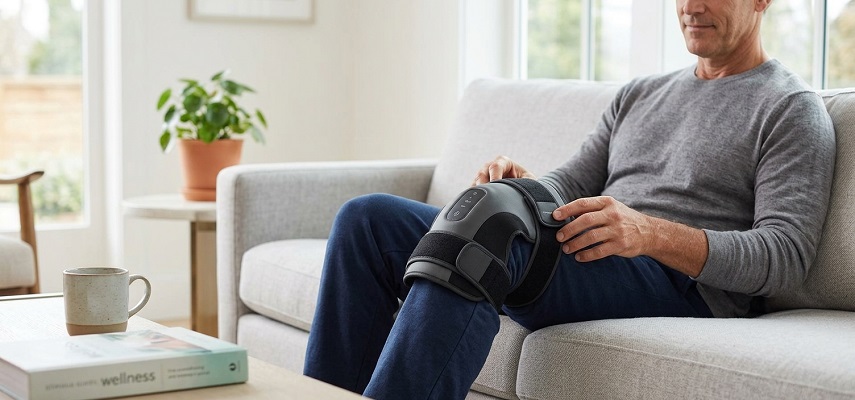
2026 buying guide · heat, vibration, fit & safety
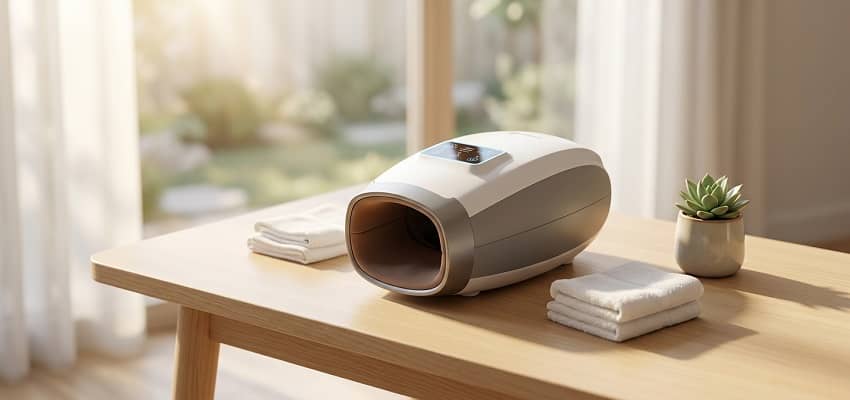
Knee massagers are best viewed as comfort devices, not arthritis treatments. For most shoppers who want a traditional heat-and-vibration model, the Medcursor is a balanced starting point; people treating both knees may prefer the Nekteck two-pack. Heat can temporarily ease stiffness for some people, but persistent or worsening knee pain still needs proper assessment.
Quick picks
Balanced heat + vibration
Medcursor
Three heat levels, three vibration modes, cordless operation and adjustable straps without extra light-therapy features.
For both knees
Nekteck 2-Pack
Two cordless wraps, each with five heat levels, three vibration modes and a 20-minute auto-off.
Soft red-light wrap
Comfytemp K4008
A flexible 660/850 nm light-and-vibration wrap for buyers who do not specifically need a heated massager.
JUMP TO A SECTION
How we chose these knee massagers
We treated this as a current buying guide rather than preserving the older product list. We checked U.S. Amazon product pages and, where available, manufacturer specifications. We prioritized adjustable heat or vibration, secure fit, cordless usability, automatic shutoff, clear controls and meaningful differences between models. We did not use star ratings, review counts or fixed prices as ranking criteria because they change.
Category labels below are editorial judgments about design and usability, not findings from a clinical head-to-head trial. We also do not assume that a red-light feature makes a device more effective for knee osteoarthritis; it is listed as a product feature only.
Knee massagers at a glance
| Model | Best fit in this guide | Main functions | Before you buy |
|---|---|---|---|
| Medcursor | Balanced heat + vibration | 3 heat levels + 3 vibration modes | Shell-style unit; check current Amazon seller |
| Nekteck 2-Pack | Two-knee use | 5 heat levels + 3 vibration modes | Pair format is unnecessary if only one knee needs comfort |
| IKEEPFIT MAXwarm 4.0 | More heat settings | 5 heat levels + 3 vibration modes | Top heat setting is relatively high; start conservatively |
| FORTHiQ Smart | Shell-style all-in-one | Heat + vibration + red light | Red-light feature is not treated here as proven arthritis therapy |
| Comfytemp K4008 | Soft light-and-vibration wrap | 660/850 nm light + vibration | Not a conventional heated knee massager |
Most important distinction: “Massage” in these products generally means vibration. They do not reproduce therapist-delivered kneading, joint mobilization or exercise-based rehabilitation.
Five knee massagers worth comparing in 2026
01 / BALANCED HEAT + VIBRATION
Medcursor Knee Massager with Heat
The Medcursor is the most straightforward all-rounder in this group. It combines three heat levels with Auto, Low and High vibration modes in a cordless knee-shaped unit, and its extension strap gives more fitting flexibility than short built-in straps alone. It is the place we would start if you want heat and vibration without paying for extra light features.
Medcursor Knee Massager with Heat — view on Amazon
Key features
- Three heat levels
- Auto, Low and High vibration modes
- Cordless rechargeable design
- LED controls and adjustable/extension strap
Pros
- Simple feature set that is easy to compare
- Heat and vibration can be adjusted rather than fixed at one intensity
- Extension strap helps accommodate a wider range of knees
Cons
- Rigid shell is bulkier than a soft wrap
- Amazon offer/seller can change even while the listing remains live
- Vibration is not the same as hands-on massage
Best for: Buyers who mainly want adjustable warmth and vibration in one cordless device.
Who it is not for: Someone who wants a soft, packable sleeve or a device specifically recommended by a clinician for rehabilitation.
02 / BEST FOR BOTH KNEES
Nekteck Cordless Knee Massager with Heat, 2-Pack
Nekteck’s current two-pack makes the most sense when you actually want a device for each knee. Each wrap provides five heat settings from 104–140°F, three vibration modes and a 20-minute automatic shutoff. The soft wrap format is less rigid than a hard-shell massager, and the manufacturer also supplies an extension strap for fit.
Nekteck Cordless Knee Massager with Heat, 2-Pack — view on Amazon
Key features
- Five heat settings: 104–140°F (40–60°C)
- Three vibration modes
- 20-minute auto-off
- Rechargeable cordless wraps with extension straps
Pros
- Two units for bilateral knee comfort
- More heat steps than most three-level models
- Current Amazon offer was sold by Nekteck Direct and fulfilled by Amazon when checked
Cons
- Buying two is wasteful if only one knee bothers you
- Higher heat settings may be too intense for heat-sensitive users
- Still provides vibration, not kneading or rolling massage
Best for: People who prefer matching cordless wraps for both knees.
Who it is not for: A one-knee buyer looking for the smallest or least expensive setup.
03 / MORE HEAT SETTINGS
IKEEPFIT MAXwarm Knee 4.0, Single
The 2026 MAXwarm Knee 4.0 is a heat-forward option. Its Amazon listing describes five temperature settings from 113–149°F, three vibration modes and a rechargeable 5000mAh battery. That broad heat range is useful if you want fine control, but it also makes conservative temperature selection especially important.
IKEEPFIT MAXwarm Knee 4.0 — view on Amazon
Key features
- Five heat settings: 113–149°F
- Three vibration modes
- 5000mAh rechargeable battery
- Single-knee wrap with extension straps
Pros
- Five-step heat control
- Single-unit format suits one-knee use
- Heat and vibration are the main functions, without an app requirement
Cons
- 149°F is hotter than many users will need
- Amazon’s featured offer may vary by seller and time
- No reason to choose it solely for “more heat” if lower settings already feel comfortable
Heat caution: More heat is not automatically better. Use the lowest comfortable setting, follow the product instructions, and stop if you feel burning, numbness or worsening pain.
Best for: Buyers who specifically want several temperature steps and a single-knee cordless wrap.
Who it is not for: Anyone with reduced heat sensation or a condition for which a clinician has advised against local heat.
04 / SHELL-STYLE ALL-IN-ONE
FORTHiQ Knee Massager Smart
FORTHiQ combines three heat settings, three vibration settings and red-light output in a rechargeable shell-style device. Its controls are easy to reach while seated, and the functions can be adjusted rather than locked into one program. We like the clear feature set, but we would buy it for the heat/vibration format—not because the red light guarantees an arthritis benefit.
FORTHiQ Knee Massager Smart — view on Amazon
Key features
- Three heat settings around 104–140°F (40–60°C)
- Three vibration settings
- Red-light function
- Rechargeable shell with touch controls
Pros
- Heat and vibration controls are straightforward
- Rechargeable and portable
- Long-running product line with a current manufacturer support page
Cons
- Hard shell is less packable than a fabric wrap
- Red-light marketing is stronger than the evidence we can apply to this exact consumer device
- Amazon seller/featured offer can change
Best for: Buyers who like an integrated shell and want heat, vibration and a red-light feature in one unit.
Who it is not for: Someone choosing a device specifically because they believe red light is proven to treat their arthritis.
05 / SOFT RED-LIGHT + VIBRATION WRAP
Comfytemp Cordless Red Light Therapy Knee Wrap K4008
Comfytemp is the outlier here: it is a flexible knee wrap with 660 nm red and 850 nm near-infrared LEDs plus vibration, rather than a conventional heated massager. It uses a 5000mAh rechargeable power source, offers three vibration modes with three intensity levels, and supports physical controls plus app-based timing. Choose it for the soft wrap format—not as a substitute for proven arthritis care.
Comfytemp Cordless Red Light Therapy Knee Wrap — view on Amazon
Key features
- 660 nm red + 850 nm near-infrared LEDs
- Three vibration modes and three intensity levels
- 5000mAh wireless power
- 3D wrap design with button and app controls
Pros
- Soft wrap i/ref=nosim?tag=hguideline-20s more flexible than a hard shell
- Vibration has both mode and intensity adjustments
- Current Amazon listing was in stock from Comfytemp US when checked
Cons
- Does not provide the local heat function many “knee massager” shoppers expect
- App control adds complexity if you prefer physical-only controls
- Do not assume its red/NIR wavelengths prove benefit for your individual knee condition
Best for: Buyers who specifically want a soft light-and-vibration wrap and do not require a heating pad.
Who it is not for: Anyone whose main priority is adjustable warmth.
What should you look for in a knee massager?
The useful features are the ones you can control safely: comfortable fit, several heat or vibration levels, a timer or automatic shutoff, and controls you can reach without twisting the knee. A longer feature list is not automatically better, and light-therapy claims should not outweigh basic fit and usability.
Heat range and independent controls
Heat can feel soothing for a stiff, non-acutely-injured knee, and major osteoarthritis guidance considers thermal interventions a reasonable symptom-management option. Look for more than one temperature setting and the ability to turn vibration off if you only want warmth. Do not equate the highest temperature with the best result.
Vibration intensity
Most consumer knee massagers use small vibration motors rather than kneading heads. Multiple vibration modes are useful only if the difference is noticeable and comfortable. If vibration increases pain, stop. A device should never be used to push through a painful activity or mask a new injury.
Soft wrap or rigid shell?
Soft wraps pack more easily and can contour around different leg shapes. Shell-style models keep their control panel and motors in a fixed position but take up more space. Neither format is inherently more therapeutic; fit and comfort matter more.
Strap length and knee circumference
Measure around the knee where the manufacturer tells you to measure, then compare that number with the exact model’s fit range. An extension strap can help, but it does not fix a shell that presses on the kneecap or sits in the wrong place.
Battery, timer and controls
Cordless operation is useful only if charging is simple and the controls are readable. Automatic shutoff is especially valuable with heat. Prefer a device you can operate without repeatedly bending, reaching or removing the wrap.
Knee massager, brace, TENS or ice — which makes sense?
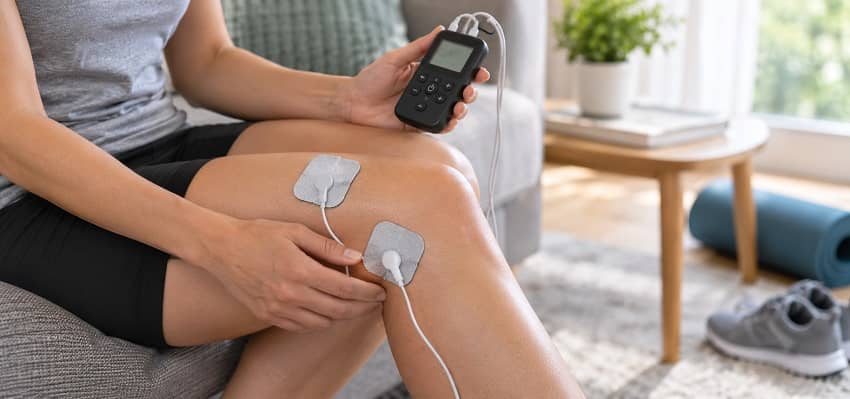
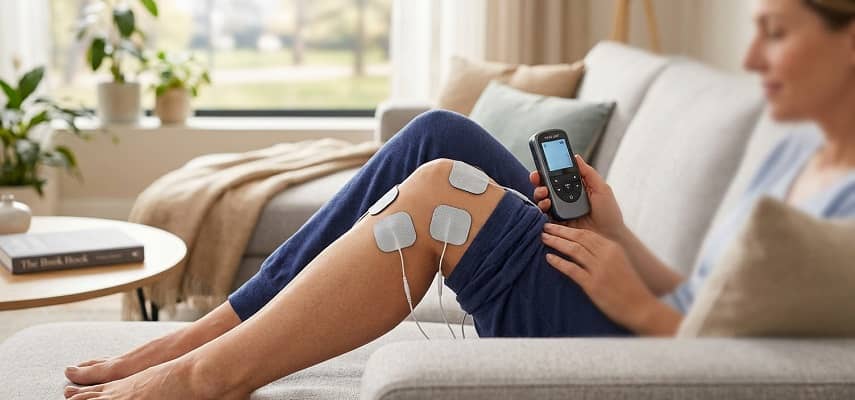
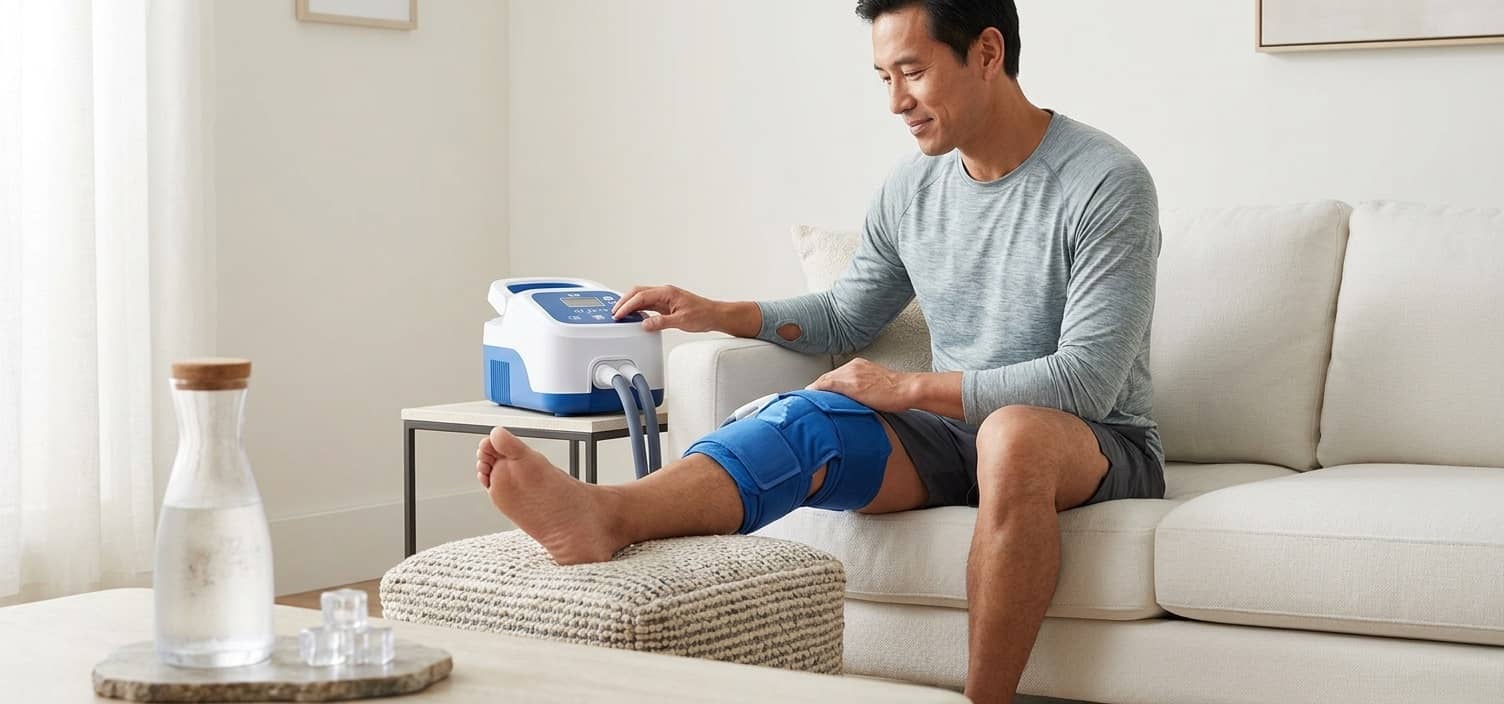
These tools do different jobs. A knee massager mainly offers warmth and/or vibration for short-term comfort. A knee brace is designed for support or movement control, while a TENS unit for knee pain uses electrical stimulation. For a newly irritated or swollen knee, an ice pack for the knee may be more appropriate than adding heat.
If osteoarthritis is the main issue, our knee osteoarthritis brace guide covers support devices separately. None of these products should replace the exercise, weight-management, medication or other treatment plan you have discussed with a healthcare professional.
Can a knee massager help arthritis pain?
Possibly for short-term comfort, but the evidence does not prove that consumer knee massagers treat osteoarthritis. A 2021 systematic review of 12 massage studies involving 737 people with knee osteoarthritis found short-term improvements in pain, stiffness and function, but no clear long-term advantage. The evidence quality ranged from low to very low for several outcomes.
What the research can — and cannot — tell us
The massage review studied massage therapy, not these exact cordless vibration products. It therefore supports the idea that massage may provide some short-term symptom relief, but it does not validate a particular consumer device, vibration pattern, red-light setting or temperature.
The 2019 American College of Rheumatology/Arthritis Foundation guideline conditionally recommends thermal interventions such as heat or cold for knee osteoarthritis, while it conditionally recommends against massage therapy because available studies were small, heterogeneous and at risk of bias. NICE likewise emphasizes therapeutic exercise as a core treatment and does not recommend manual therapy as a stand-alone treatment.
Bottom line: Buy a knee massager for comfort and convenience, not because it promises to “heal” arthritis, rebuild cartilage, improve circulation enough to cure pain, or replace rehabilitation. Those stronger claims are not supported by the evidence used for this update.
How should you use a heated knee massager safely?
- Read the exact manual. Session length, heat limits, charging requirements and contraindications vary by model.
- Start low. Begin with the lowest comfortable heat and vibration setting rather than jumping to maximum intensity.
- Fit it securely, not tightly. The unit should stay in place without causing numbness, tingling, skin color change or pressure on the kneecap.
- Stay awake and check your skin. Stop if you notice burning, unusual redness, numbness, increasing pain or any other concerning reaction.
- Do not use comfort as a return-to-activity test. Feeling temporarily better after heat or vibration does not prove that an injury is healed or ready for exercise.
When should knee pain be checked by a professional?
Do not simply massage through these warning signs
Seek prompt medical assessment if you cannot bear weight, the knee is markedly swollen, it looks deformed, it locks or repeatedly gives way, or the pain followed a significant injury. Fever with a red, hot or swollen knee also needs urgent evaluation because infection is one possible cause.
If you recently had knee surgery or a joint replacement, have reduced skin sensation, or have a condition that affects circulation, ask your clinician before using powered heat or vibration around the joint.
For broader knee-pain warning signs, see Mayo Clinic’s knee pain guidance and the NHS knee pain page.
Frequently asked questions
Can a knee massager cure arthritis?
No. Knee osteoarthritis is a joint condition, and a heated or vibrating massager does not rebuild cartilage or reverse the disease. Heat, vibration or massage may provide temporary comfort for some people, but treatment should focus on evidence-based strategies such as therapeutic exercise and individualized medical care.
Is heat good for an arthritic knee?
Heat can temporarily ease stiffness and feel soothing for some people with osteoarthritis, and ACR/Arthritis Foundation guidance conditionally recommends thermal interventions. If the knee is newly injured, very swollen, hot or red, heat may not be the right choice. Use your clinician’s advice for your situation.
How long should I use a knee massager?
Use the session length in the manufacturer’s manual rather than a universal timetable. Current models in this guide commonly include automatic shutoff periods around 10–20 minutes. Do not repeatedly restart a heated device just to extend exposure, and stop sooner if the skin feels too hot or uncomfortable.
Is a knee massager better than a TENS unit?
They use different sensations and should not be treated as interchangeable. A knee massager usually provides heat and vibration; a TENS unit uses electrical stimulation through skin electrodes. The better choice depends on your diagnosis, preferences and clinician’s advice. See our TENS unit for knee pain guide.
Can I use a knee massager after knee replacement surgery?
Only after your surgeon or rehabilitation professional says it is appropriate. Incisions, swelling, altered sensation and rehabilitation restrictions change over time after surgery. Do not place a heated or vibrating device over a healing surgical area or use it as a substitute for prescribed rehabilitation.
Can I sleep with a heated knee massager on?
Do not assume a powered heat-and-vibration device is designed for sleep. Use it only as the manufacturer instructs, stay awake enough to notice excessive heat or skin irritation, and allow the automatic shutoff to end the session rather than repeatedly restarting it overnight.
This article is for general information only and is not medical advice. Talk to a qualified healthcare professional about your specific knee symptoms, diagnosis and treatment options.