Best Tennis Knee Brace: 5 Picks for 2026
2026 tennis knee brace guide · support, fit & court movement
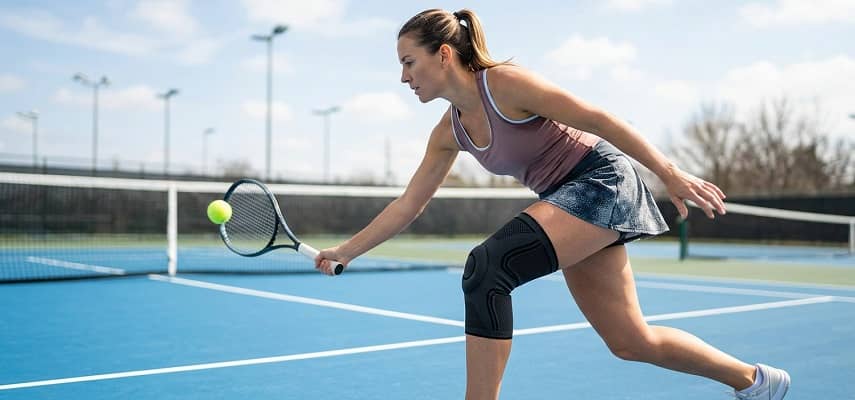
The best tennis knee brace depends on why you want support. For flexible compression, the Bauerfeind GenuTrain is our best overall pick; POWERLIX is a lighter alternative. A patellar strap targets the tendon below the kneecap, while hinged braces add movement control but are bulkier and better suited to clinician-guided use after injury.
Quick picks
Best overall
Bauerfeind GenuTrain
Premium knitted compression with a patella-surrounding pad and a lower-profile feel than a hinged brace.
Lightweight compression
POWERLIX Knee Sleeve
A simple pull-on knit sleeve for players who want compression without rigid hardware.
Patellar tendon support
BODYPROX Patella Strap
A minimal band worn below the kneecap when patellar-tendon support is the specific goal.
How we chose these tennis knee braces
We treated “tennis knee brace” as several different needs rather than one product category. The shortlist covers light compression, targeted patellar-tendon support and more structured hinged support. We prioritized freedom to bend and change direction, secure fit, heat and bulk, clear sizing information, current manufacturer documentation and a verifiable Amazon US product identifier.
The categories below are editorial judgments based on specifications and intended construction; they are not results from a head-to-head clinical trial or our own court testing. We did not use Amazon star ratings or review totals to rank products because those figures change. Stock, sellers, prices and available sizes can also change, so confirm the exact variant before ordering.
Start with the reason for bracing, not the brand. A soft sleeve, a patellar strap and a dual-hinge brace do different jobs. If you have a new injury, repeated giving-way, significant swelling or persistent pain, get the knee assessed instead of choosing a stronger brace by guesswork.
Best tennis knee braces at a glance
| Brace | Our category | Support design | Main trade-off |
|---|---|---|---|
| Bauerfeind GenuTrain | Best overall | Medical-grade knit compression + Omega+ pad | Premium-priced; precise sizing matters |
| POWERLIX Compression Knee Sleeve | Lightweight compression | Pull-on knitted compression sleeve | No hinges or rigid side control |
| BODYPROX Patella Tendon Strap | Patellar tendon support | Adjustable band below the kneecap | Targeted support, not whole-knee stability |
| Mueller Hg80 Hinged Knee Brace | Structured stability | Triaxial hinges + upper/lower straps | Heavier and bulkier for court movement |
| Shock Doctor 872 | Most substantial support | Medial/lateral dual hinges + wrap straps | Most restrictive option in this list |
Top five tennis knee braces
01 / BEST OVERALL
Bauerfeind GenuTrain Knee Brace
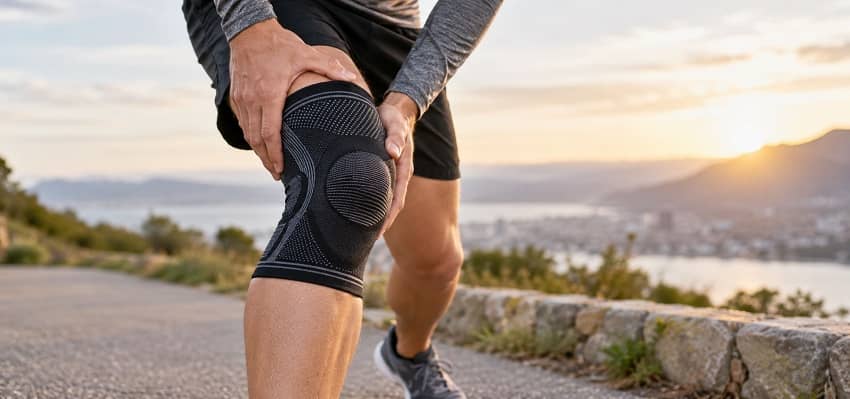
The Bauerfeind GenuTrain — view on Amazon is our best all-round tennis pick because it sits between a basic sleeve and a rigid brace. Bauerfeind pairs breathable medical-grade compression with an Omega+ pad around the kneecap, giving players a structured but flexible option when mild support is appropriate.
Key features
- Medical-grade knitted compression
- Omega+ pad around the patella
- Breathable, lightweight and machine-washable construction
- Bilateral design; one brace can be worn on either knee
Pros
- More contouring and patella support than a plain compression sleeve
- No external metal hinges to catch or feel bulky during court movement
- Wide size range from a specialist brace manufacturer
Cons
- Costs substantially more than a basic knitted sleeve
- Correct measurement is important; do not choose by usual clothing size
- Not the right substitute when a clinician has prescribed rigid stabilization or immobilization
Best for: Players who want flexible compression and patella-area support without moving to a hinged brace.
Who it is not for: Anyone who needs a prescribed post-operative brace, locked range of motion or substantial ligament stabilization.
For simpler sleeve options, compare our knee compression sleeve guide.
02 / LIGHTWEIGHT COMPRESSION
POWERLIX Compression Knee Sleeve
The POWERLIX Compression Knee Sleeve — view on Amazon is the simpler choice for players who mainly want a snug knitted sleeve. The design uses four-way stretch and silicone anti-slip bands, and POWERLIX specifically lists tennis among the activities for which the sleeve is intended.
Key features
- Pull-on four-way compression knit
- Double silicone anti-slip bands
- Breathable, sweat-absorbing fabric
- Multiple sizes; measurement is taken above the kneecap per the brand chart
Pros
- Low-bulk design for bending, split steps and lateral movement
- No hinges, laces or wrap straps to adjust between points
- Usually a lower-cost category than premium or hinged braces
Cons
- Compression is not the same as mechanical side-to-side stabilization
- A too-small sleeve can feel restrictive; a too-large one may slide
- Not appropriate as a stand-in for a prescribed injury brace
Best for: Players who prefer light, flexible compression and do not need rigid stabilization.
Who it is not for: Players trying to self-treat instability, a significant acute injury or a knee that repeatedly gives way.
See our POWERLIX knee sleeve review for more brand-specific background.
03 / PATELLAR TENDON SUPPORT
BODYPROX Patella Tendon Knee Strap (2 Pack)
The BODYPROX Patella Tendon Knee Strap — view on Amazon is different from a sleeve: it is a narrow adjustable band worn below the kneecap. That makes it the lowest-bulk pick here when the specific goal is patellar-tendon support rather than compression around the whole knee.
Key features
- Adjustable hook-and-loop fastening
- Silicone padding that flexes with the knee
- Vented interior
- Sold as a two-pack
Pros
- Minimal material around the back and sides of the knee
- Easy to fine-tune strap pressure
- Current Amazon listing explicitly includes tennis among its sports/use cases
Cons
- Does not provide whole-knee compression or hinge-based stability
- Incorrect placement or overtightening can be uncomfortable
- Persistent tendon pain still needs assessment and rehabilitation
What the evidence says: Mayo Clinic notes that strapping or taping can take pressure off the patellar tendon and may help relieve pain. Cleveland Clinic explains that a patella band can reduce tendon strain during movement, but it is a support tool rather than a cure. Mayo Clinic · Cleveland Clinic.
Best for: Players already dealing with or being treated for patellar-tendon or patellofemoral symptoms who have been advised that a strap is appropriate.
Who it is not for: Someone who needs side-to-side stabilization, post-operative control, or an explanation for undiagnosed knee pain.
Compare more options in our patellar tendon strap guide.
04 / STRUCTURED STABILITY
Mueller Hg80 Hinged Knee Brace
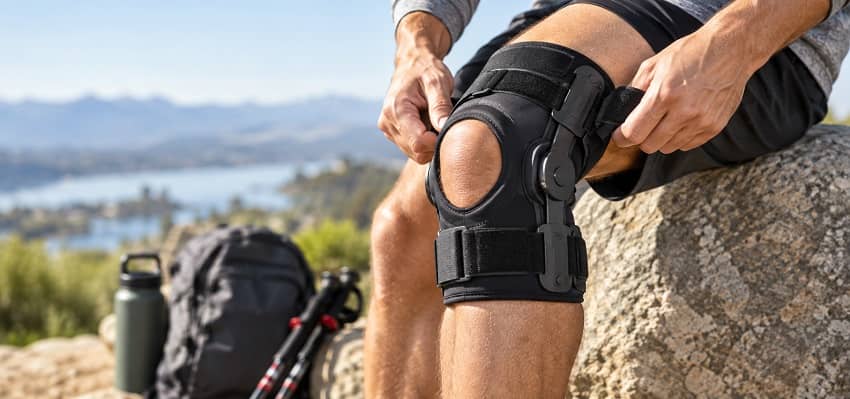
The Mueller Hg80 Hinged Knee Brace — view on Amazon moves into a more structured category. Mueller uses Triaxial hinges on both sides, upper and lower straps and a patella buttress. For tennis, that added control is a trade-off: you gain more medial-lateral structure but also more weight and bulk.
Key features
- Triaxial hinged construction
- Upper and lower positioning straps
- Tibial containment system with patella buttress and rear support strap
- Fits the left or right knee; size by knee circumference
Pros
- More medial-lateral structure than a compression sleeve
- Multiple straps help hold the brace in position
- Current Mueller documentation provides model-specific sizing
Cons
- Bulkier and warmer than a knit sleeve
- May feel like too much brace for a symptom-free knee
- Hinged support should not be used to self-clear an unstable or recently injured knee for tennis
Best for: Players who have been advised to use a hinged brace and want a bilateral, size-specific option for return-to-activity.
Who it is not for: Players seeking only light compression, or anyone who has not yet had a significant new injury or instability assessed.
For more structured designs, see our hinged knee brace guide.
05 / MOST SUBSTANTIAL SUPPORT
Shock Doctor 872 Knee Support with Dual Hinges
The Shock Doctor 872 Knee Support with Dual Hinges — view on Amazon is the most substantial brace in this list. Its medial and lateral hinges, X-Fit lower strap and upper wrap are designed for greater stability. That structure can be useful when specifically indicated, but it is also the least minimalist option for fast tennis footwork.
Key features
- Medial and lateral dual hinges with hyperextension stops
- X-Fit lower strap and wrap-style upper strap
- Four-way stretch mesh behind the knee
- Manufacturer states it is not made with natural rubber latex
Pros
- Highest degree of external structure among these five picks
- Multiple fit adjustments around the hinges
- Rear stretch panel helps the knee flex despite the heavier construction
Cons
- More heat, bulk and hardware than most players need for routine tennis
- Can change how the knee feels during deep flexion and quick direction changes
- A strong brace is not permission to return to play before the knee is ready
Do not choose this simply because it is “maximum support.” For a ligament injury, meniscus injury, post-operative knee or recurrent instability, the diagnosis and return-to-play plan should determine whether a hinged brace is appropriate and how it should be fitted.
Best for: Players returning to activity when a qualified clinician has recommended substantial medial-lateral support.
Who it is not for: Healthy players looking for the lightest preventive brace, or anyone using a brace to avoid evaluation of pain, swelling or instability.
Our Shock Doctor hinged-support review covers the brand’s related bilateral-hinge approach.
What kind of knee brace is best for tennis?
For tennis, the least restrictive brace that appropriately matches your diagnosed need is usually the more practical starting point. A compression sleeve adds a snug flexible layer, a patellar strap targets the tendon below the kneecap, and a hinged brace adds mechanical side support. Those categories are not interchangeable, and more support is not automatically better.
Compression sleeve: for low-bulk support
A knitted sleeve is easiest to pair with quick starts, split steps and lateral cuts because it has no rigid side hardware. The trade-off is equally clear: compression cannot provide the same movement control as a hinged brace. If you mainly want a sleeve, our knee sleeve guide for running also explains fit and compression considerations that carry over to court sports.
Patellar strap: for a specific front-of-knee use case
A patellar strap sits directly below the kneecap and applies pressure to the patellar tendon. Mayo Clinic says strapping or taping may take pressure off the tendon and help relieve pain in patellar tendinitis. Cleveland Clinic emphasizes that the strap is not a cure; pain that keeps returning during activity should be assessed rather than covered up indefinitely.
Hinged brace: when more movement control is prescribed
Hinges and external stays add medial-lateral structure, but they also add weight, warmth and contact points. For a tennis player with a significant injury history, that may be a worthwhile trade-off when recommended by a clinician. For a symptom-free player, a heavy hinged brace can be unnecessary equipment rather than an upgrade.
Fit and staying power matter on court
A brace that slides during a serve, pinches behind the knee in a ready position or becomes painfully tight after warm-up is a poor match regardless of its feature list. Measure exactly where the manufacturer tells you, test normal tennis movements before competition, and make sure the brace does not cause numbness, tingling or color/temperature changes below the knee.
Do tennis players need knee braces?
Most healthy tennis players do not need to wear a knee brace simply because they play tennis. Bracing is more useful when it has a defined purpose — for example, symptom management or stability as part of a clinician-guided plan. It should complement appropriate strength, load management and rehabilitation rather than replace them.
12.5% of reported injuries involved the knee
In one U.S. high-school tennis surveillance study covering 2014–2018, 22 of 176 reported injuries (12.5%) involved the knee. The ankle was more common at 25.6%. This describes that specific adolescent dataset; it does not mean a knee brace prevents 12.5% of tennis injuries.
For patellar tendinitis specifically, treatment usually involves more than a strap. Mayo Clinic describes activity modification plus stretching and progressive strengthening as core conservative approaches, with strapping or taping as an option that may reduce tendon pressure and pain. That makes a brace or strap an accessory to the plan, not the plan itself.
How should a tennis knee brace fit?
- Measure for the exact product. Different brands measure at the knee, above the kneecap or at another specified point. Do not transfer a size from one brand to another.
- Put it on before you are fully warmed up. Follow the manufacturer’s sequence for sleeves, straps or hinges, then re-check it after several minutes of movement.
- Rehearse tennis positions. Try a ready stance, controlled split step, side shuffle, lunge and service motion. Stop if the brace creates pain, catches, significantly restricts motion or repeatedly slips.
- Check circulation and skin. Numbness, tingling, unusual color or temperature changes, marked swelling below the brace or persistent skin irritation are signs to loosen/remove it and get advice if symptoms do not resolve.
- Do not use the brace as a pain mask. If you need progressively tighter support just to finish a match, the safer next step is to stop and assess the knee rather than keep cinching the brace.
When should knee pain be checked by a professional?
Do not play through these warning signs
Seek medical assessment for a knee that cannot bear weight, has marked swelling, cannot fully bend or straighten, looks deformed, or becomes red and swollen with fever. Severe pain after an injury also deserves prompt evaluation. Repeated giving-way, locking, or pain that persists despite reducing activity should be checked even if a brace seems to help temporarily.
For broader brace types and their intended roles, see our knee brace guide.
Frequently asked questions
What is the best knee brace for tennis?
For most players who only need flexible support, our top overall pick is the Bauerfeind GenuTrain because it combines knitted compression with a patella-surrounding pad without external metal hinges. But the best choice depends on the problem: a patellar strap and a hinged brace serve different purposes. Match the brace to a diagnosed need, not just a support label.
Can I play tennis with patellar tendinitis?
Patellar tendinitis is an overuse injury, so whether you should play depends on your symptoms and rehabilitation plan. Mayo Clinic advises reducing or avoiding activities that worsen pain and using progressive strengthening as part of treatment. A patellar strap may reduce tendon pressure and help symptoms, but it should not be used to push through worsening pain.
Is a compression sleeve or hinged brace better for tennis?
Neither is universally better. A compression sleeve is lighter and usually less restrictive, which suits players who only need flexible compression. A hinged brace provides more mechanical side-to-side support but adds bulk and warmth. If instability or a significant injury is the reason you are considering hinges, get professional guidance on the correct brace and return-to-play plan.
Should I wear a knee brace to prevent tennis injuries?
Do not assume that every healthy player benefits from routine knee bracing. The products in this guide provide different kinds of support, but none is a guarantee against injury. A brace makes the most sense when it addresses a defined need. Strength, appropriate training load, footwear, technique and recovery still matter, and new symptoms deserve assessment.
How tight should a tennis knee brace be?
It should feel secure enough to stay in place during court movement without causing pain, numbness, tingling, unusual swelling, or color and temperature changes below the brace. Follow the exact manufacturer’s sizing and fitting instructions. More compression is not automatically more support, and overtightening a sleeve or patellar strap can make it uncomfortable.
Can I wear a knee brace over tennis tights or under clothing?
Follow the manufacturer’s instructions first. Many sleeves are designed for direct contact with the skin so their knit or anti-slip bands can hold position; some wrap-style braces may tolerate a thin layer differently. Whatever you wear, test the complete setup during practice and watch for slipping, bunching, chafing or pressure behind the knee.
Medical disclaimer: This article is for general information only and is not medical advice. Talk to a qualified healthcare professional about your specific symptoms, diagnosis, brace choice and return to tennis.