5 Best Knee Walkers for Recovery (2026)
2026 knee scooter guide · fit, terrain & safer use
A knee scooter, also called a knee walker, can help some people stay mobile while keeping weight off a recovering foot or ankle. For most buyers, the right choice depends less on brand hype and more on fit, wheel size, braking, weight capacity, transport needs and the surfaces you actually use. This guide compares five current knee walkers and explains the safety points that matter before you ride.
Quick picks: which knee scooter fits which need?
Best overall standard
Drive Medical 796
A 21 lb steerable frame with a 350 lb capacity, split knee pad and compact 7.5-inch casters.
Best value shortlist
KneeRover Economy
Lightweight, foldable and widely adjustable, with four 7.5-inch wheels and dual rear braking.
Mixed outdoor terrain
KneeRover HYBRID
Air-filled 9-inch front tires add cushioning for rougher outdoor surfaces while keeping a four-wheel layout.
How did we choose these knee scooters?
We compared current manufacturer specifications, product manuals, current U.S. Amazon listing URLs and published research on knee-scooter mobility and falls. We prioritized adjustable fit, braking, wheel setup, weight capacity, folded transport and distinct use cases. The “best” labels below are editorial judgments from those features; they are not results of a clinical head-to-head product trial.
Important: A knee scooter is not automatically better or safer than crutches for every person. Your surgeon, clinician or physical therapist should tell you what weight-bearing restriction applies and whether a knee walker is suitable for your injury, balance, home layout and recovery plan.
Best knee scooters at a glance
| Knee scooter | Our category | Product weight / capacity | Wheel setup | Key fit note |
|---|---|---|---|---|
| Drive Medical 796 | Best overall standard | 21 lb / 350 lb | Four 7.5-in casters | Knee pad 16.75–20.5 in; handle 31.5–40.25 in |
| KneeRover Economy | Best value shortlist | 21 lb / 300 lb | Four 7.5-in rubber wheels | Manufacturer range: 4 ft 9 in–6 ft 4 in |
| KneeRover HYBRID | Mixed indoor/outdoor terrain | 25.6 lb / 300 lb | 9-in air front + 7.5-in rear | Manufacturer range: 4 ft 9 in–6 ft 6 in |
| Vive All Terrain | Large pneumatic wheels | About 25 lb / 350 lb | Four 12-in pneumatic tires | Knee platform 20–26 in; check fit carefully if shorter |
| Roscoe Medical | Broad height range | 22.8 lb / 350 lb | Four 8-in wheels | Manufacturer range: 4 ft 11 in–6 ft 6 in |
Five knee scooters worth comparing in 2026
01 / BEST OVERALL STANDARD
Drive Medical 796 Steerable Knee Walker
The Drive Medical 796 is the strongest all-round standard-format choice in this list because it combines a relatively light 21 lb frame with a 350 lb capacity, tool-free height adjustment, a removable basket and a split knee pad. Its 7.5-inch casters suit smooth indoor flooring and ordinary paved outdoor use better than genuinely rough terrain.
Drive Medical 796 — view on Amazon
Key features
- 21 lb product weight
- 350 lb maximum weight capacity
- 7.5-inch casters
- Split 7 x 15-inch knee pad
- Handle height: 31.5–40.25 inches
- Removable front basket and deluxe braking system
Pros
- High capacity without an especially heavy frame
- Compact standard wheels suit homes and clinics
- Tool-free fit adjustment
Cons
- Small hard casters transmit more vibration on broken pavement
- Knee-pad height range is narrower than some competitors
Best for: Adults who mainly need a straightforward steerable knee walker for indoor spaces, sidewalks and routine errands.
Not ideal for: People whose normal route includes gravel, grass, large pavement gaps or repeated rough surfaces where larger pneumatic tires are more forgiving.
02 / BEST VALUE SHORTLIST
KneeRover Economy Knee Scooter
The KneeRover Economy is the value-focused pick for buyers who do not need large pneumatic tires. It weighs 21 lb, supports up to 300 lb and uses four 7.5-inch rubber wheels with dual rear on-wheel brakes. The manufacturer lists a broad 4 ft 9 in to 6 ft 4 in user-height range, which makes it easier to shortlist by fit.
KneeRover Economy Knee Scooter — view on Amazon
Key features
- 21 lb product weight
- 300 lb maximum weight capacity
- Four 7.5-inch rubber wheels
- Dual rear on-wheel brakes
- Knee support height: 16–22 inches
- Quick-release folding handlebar
Pros
- Lightweight and easy to fold
- Useful adjustment range for a standard scooter
- Simple solid-wheel setup avoids tire inflation
Cons
- Small wheels are less comfortable on rough outdoor routes
- 300 lb capacity is lower than the Drive and Roscoe models here
Best for: Cost-conscious buyers who mainly use smooth floors and pavement and want a light, foldable standard knee walker.
Not ideal for: Frequent gravel, grass, cracked paths or other terrain where a larger front tire can reduce jolting.
03 / MIXED INDOOR & OUTDOOR TERRAIN
KneeRover HYBRID All Terrain Knee Scooter
The KneeRover HYBRID is the practical middle ground between a compact indoor scooter and a full four-pneumatic-wheel design. It uses two 9-inch air-filled front tires to absorb more surface irregularity while retaining 7.5-inch rear wheels, a rear drum brake and a foldable four-wheel frame. That makes it better suited to mixed routes than the basic 7.5-inch-wheel models.
KneeRover HYBRID All Terrain Knee Scooter — view on Amazon
Key features
- 25.6 lb product weight
- 300 lb maximum weight capacity
- Two 9-inch air-filled front tires
- Two 7.5-inch rear wheels
- Knee support height: 16–22.5 inches
- Manufacturer user-height range: 4 ft 9 in–6 ft 6 in
Pros
- Front pneumatic tires soften rougher surfaces
- Still folds for vehicle transport
- Wide fit range
Cons
- Heavier than the standard 21 lb models
- Air-filled front tires require pressure checks and can puncture
Terrain does not remove fall risk. Bigger tires can improve rolling over irregular ground, but the manufacturer still recommends slow, controlled use. Uneven surfaces, downhill travel and sharp turns require extra caution.
Best for: People who move between indoor spaces and outdoor pavement, grass or mildly rough routes and want more front-wheel cushioning.
Not ideal for: Buyers who need the lightest possible scooter to lift into a car or who do not want to maintain pneumatic tire pressure.
04 / LARGE PNEUMATIC WHEELS
Vive Mobility All Terrain Knee Walker
The Vive Mobility All Terrain Knee Walker goes further toward an outdoor-oriented design with four 12-inch pneumatic tires. The larger wheels can roll over grass, gravel and uneven paths more readily than small solid casters, and the frame supports up to 350 lb. The trade-off is more bulk, tire maintenance and a relatively high 20-inch minimum knee-platform setting.
Vive Mobility All Terrain Knee Walker — view on Amazon
Key features
- Four 12-inch pneumatic tires
- 350 lb maximum weight capacity
- Approximately 25 lb product weight
- Knee platform height: 20–26 inches
- Handlebar height: 38–46 inches
- Dual rear braking system and storage bag
Pros
- Largest tires in this comparison
- High 350 lb capacity
- Four pneumatic tires provide more cushioning
Cons
- Bulkier to turn and transport indoors
- Minimum knee and handle heights may not fit shorter users
- Pneumatic tires need inflation and can puncture
Best for: Taller users who expect frequent outdoor travel on grass, gravel or uneven pavement and have room for a larger frame.
Not ideal for: Tight apartments, small bathrooms, frequent car lifting, or anyone whose leg length does not work with the 20-inch minimum knee-platform height.
05 / BROAD HEIGHT RANGE
Roscoe Medical Knee Scooter
The Roscoe Medical Knee Scooter is a conventional four-wheel option with a useful combination of 350 lb capacity, 22.8 lb product weight and an explicit manufacturer height range of 4 ft 11 in to 6 ft 6 in. It uses 8-inch wheels, a padded 7 x 14-inch knee platform, an adjustable hand brake and a folding steering column.
Roscoe Medical Knee Scooter — view on Amazon
Key features
- 22.8 lb product weight
- 350 lb maximum weight capacity
- Four 8-inch wheels
- Knee pad height: 17.5–22 inches
- Handle height: 31–41 inches
- Manufacturer height range: 4 ft 11 in–6 ft 6 in
Pros
- High capacity and broad stated height range
- Folds for transport
- 8-inch wheels split the difference between compact and oversized designs
Cons
- Still a solid-wheel design rather than a cushioned pneumatic setup
- Older design has fewer terrain-focused features than newer all-terrain models
Best for: Buyers who want a traditional medical knee scooter with a 350 lb capacity and a clearly stated broad height range.
Not ideal for: Rough-surface users who specifically need pneumatic tires or a lighter compact travel frame.
Is a knee scooter better than crutches?
A knee scooter can be easier and less tiring than axillary crutches on level ground for some users, but it is not universally better. Research has found lower perceived exertion and strong user preference for knee walkers in some controlled studies, while knee scooters cannot handle stairs and still carry a meaningful fall risk. The right aid depends on your injury, environment and ability.
In a 2016 randomized crossover study of 24 healthy adults, the wheeled knee walker produced greater assisted walking distance and lower perceived exertion than axillary crutches on level surfaces, and 88% of participants preferred the knee walker. A 2024 trial in healthy college students also found the knee scooter had the lowest energy expenditure of the tested assistive devices during a six-minute walk. These studies are useful, but neither proves that a knee scooter is best for every injured or postoperative patient.
Crutches still have advantages: they can be used on stairs with proper training, are easier to transport, and may work in very tight spaces. If you want a different hands-free alternative, see our iWALK 2.0 hands-free crutch guide.
Who is a knee scooter actually for?
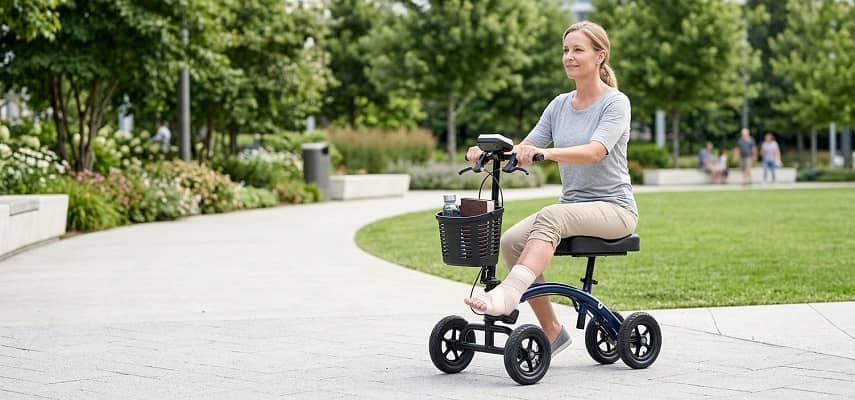
Knee scooters are mainly designed for people who need to reduce or avoid weight through one foot or ankle while they can safely rest the affected-side knee or upper shin on a padded platform. They are commonly used after foot or ankle surgery and for some lower-leg injuries. They are not a general treatment for knee injuries simply because the device is called a “knee” scooter.
If your knee itself is injured, painful, recently operated on or unable to tolerate pressure, do not assume a knee scooter is appropriate. The device requires kneeling on the recovery-side platform. Ask your clinician or physical therapist which mobility aid fits your specific restriction.
A knee scooter may also be a poor fit if you cannot safely steer and brake with both hands, have significant balance problems, need to use stairs frequently, have injuries to both lower limbs, or cannot fit the device correctly. Those are reasons to discuss alternatives rather than force the scooter to work.
What should you look for when buying a knee scooter?
Start with fit and environment, then compare wheel design, braking, weight capacity and portability. A knee scooter that looks “premium” can still be the wrong choice if the knee pad will not reach the correct height, the frame will not turn inside your home, or the tires do not match your route. Measure before ordering and prioritize controllability over extra features.
1. Knee-pad and handlebar height
Your recovering leg should rest on the platform without forcing you to hike one hip or bend awkwardly. KneeRover’s manual instructs users to adjust the platform so the injured leg is supported at roughly a right angle while standing and to set the handlebar around waist height for a comfortable arm position. Use the instructions for your exact model rather than copying another scooter’s setting.
2. Wheel size and tire type
Small solid wheels are compact, easy to maintain and usually better indoors. Larger pneumatic tires can absorb cracks, gravel and grass more effectively, but they add bulk and need inflation. “All terrain” is not permission to ride aggressively: larger tires improve rolling ability, not balance, braking distance or judgment.
3. Brakes and parking lock
Check how the hand brake and parking brake work before relying on the scooter. Engage the parking brake before mounting or transferring whenever the manual instructs you to do so. Brake cables and fasteners also need periodic inspection; a scooter that no longer stops predictably should not be used until it is adjusted or repaired.
4. Weight capacity
Stay below the manufacturer’s stated maximum capacity and remember that the rating is only one part of fit. Height, knee-platform position, balance, upper-body control and space to turn matter too. Do not choose a model solely because the capacity number is higher.
5. Folded size and lifting weight
If you will load the scooter into a car every day, compare product weight as seriously as wheel size. A 21 lb standard scooter is meaningfully easier to lift than a 25–30 lb all-terrain frame, especially while you are already protecting one leg. Check whether the knee platform must be removed to achieve the smallest folded size.
6. Your home layout
Measure your narrowest doorway, bathroom approach and turning space. Also check floor transitions, rugs, thresholds and clutter. A basket is useful because it keeps your hands available for steering and braking, but it does not make the scooter hands-free while moving.
How do you use a knee scooter more safely?
Use a knee scooter slowly, fit it correctly, keep both hands ready to steer and brake, and practice before taking it into crowded or uneven areas. Published studies report that falls are not rare. Common mechanisms include sharp turns, obstacles, excessive speed and downhill travel, so technique and environment matter as much as the scooter itself.
- Get approval for the mobility aid. Confirm your weight-bearing status and whether resting on the knee platform is appropriate for your injury or surgery.
- Fit the scooter before riding. Set the knee platform and handlebar to the manufacturer’s instructions. Do not ride with the hip tilted or shoulders hunched because the scooter is too high or low.
- Lock the brake before mounting or transferring. Keep the scooter stable as you place the recovering leg on the pad.
- Start on a level, open surface. Practice straight travel, gentle turns, braking and stopping before using tight rooms, crowds or outdoor routes.
- Slow down before every turn. Sharp turns were a frequently reported mechanism in knee-scooter injury research. Do not turn quickly just because the scooter feels stable in a straight line.
- Avoid stairs, curbs and abrupt drops. Dismount and use the mobility method your clinician taught you instead of attempting to roll a knee scooter over steps.
- Treat slopes and wet surfaces cautiously. Downhill speed can build quickly, and wet or loose surfaces reduce traction. Follow the exact model’s manual and choose another route when conditions are unsafe.
- Inspect the scooter regularly. Check tires, brake response, cables, folding locks, steering fasteners and knee-pad hardware. Stop using the device if anything is loose, damaged or unpredictable.
Do not use the scooter to push through new pain or ignore a changed recovery plan. If your clinician advances you into a walking boot or different weight-bearing stage, the mobility aid may need to change too. For background on boot use, see our walking boot guide.
What does research say about knee scooters?
The evidence suggests knee scooters can improve mobility and reduce effort compared with crutches for some users, but falls remain a real safety concern. Small controlled studies often favor knee scooters for level-ground efficiency or satisfaction, while a 2023 prospective clinical cohort found 37% of users reported at least one fall and 15% reported a scooter-related injury.
37% reported a fall; 15% reported an injury
In a prospective cohort of 118 analyzed knee-scooter users after foot and ankle care, 44 people (37%) reported a fall and 18 (15%) reported an injury. The study also found sedentary lifestyle was associated with higher injury odds. This was a single-clinic cohort, so the percentages should not be treated as a universal risk estimate.
A multicenter randomized controlled trial published in 2024 compared orthopedic knee scooters with forearm crutches in 88 people who needed partial or total lower-limb weight-bearing avoidance. The scooter group reported better general health on one SF-36 dimension and higher scores on several practical mobility and autonomy questions, although the overall EQ-5D self-rated health difference was not considered clinically relevant.
Laboratory and crossover studies also suggest a knee scooter may require less effort than axillary crutches on level ground. In one 24-person healthy-volunteer study, 88% preferred the wheeled knee walker. In a 2024 study of 20 healthy college students, the knee scooter produced the lowest energy expenditure, heart rate and perceived exertion among the tested assistive devices during the six-minute walk. These results should not be generalized to every postoperative patient, older adult or home environment.
When should you ask a professional before using a knee scooter?
Ask your surgeon, clinician or physical therapist before using a knee scooter if your weight-bearing status is unclear, your knee cannot comfortably bear pressure, you have balance or coordination concerns, or you are unsure how to manage stairs and transfers. Seek medical advice if using the scooter causes new pain, numbness, skin injury, a fall or a change in your recovery symptoms.
After a fall: Stop and assess yourself before continuing. Get prompt medical care for significant new pain, swelling, inability to move or use a limb normally, head injury symptoms, bleeding that will not stop, or any concern that you may have damaged the original injury or surgical site.
Frequently asked questions
Can I use a knee scooter for a broken ankle?
Often, a knee scooter is considered for people who must keep weight off a foot or ankle, but the decision depends on your fracture, treatment and weight-bearing instructions. You also need to be able to rest the recovering-side knee or shin on the platform safely. Follow your clinician’s plan rather than choosing the device based only on the injury name.
Can I use a knee scooter for a knee injury?
Usually, a knee scooter is intended for foot, ankle or lower-leg recovery rather than an injured knee, because you kneel on the padded platform. If the knee itself is painful, injured or postoperative, putting pressure through it may be inappropriate. Ask your clinician or physical therapist which mobility aid is suitable.
Can you sit on a knee scooter?
Do not assume a standard knee scooter is designed as a seat. The padded platform is intended to support the recovering leg, not your body as a chair. Sitting or transferring in an unintended way can destabilize the frame. Use the device only as its manual describes, and choose a purpose-built seated mobility aid if that is what you need.
Can a knee scooter go on grass or gravel?
Some models with larger pneumatic tires are designed to handle grass, gravel and uneven outdoor surfaces better than small solid-wheel scooters. That does not make rough terrain risk-free. Move slowly, avoid sharp turns and steep slopes, and follow the manufacturer’s surface guidance. If your daily route is rough, prioritize tire size and control over compactness.
Can you use a knee scooter on stairs?
No standard knee scooter should be ridden up or down stairs. Stairs are one of the situations where another mobility method and proper training are usually needed. Ask your clinician or physical therapist to teach you a safe stair plan for your weight-bearing restriction rather than improvising with the scooter.
How high should the knee pad be?
Use the exact manufacturer’s fitting instructions. As a general example, KneeRover directs users to set the platform so the recovering leg is supported at roughly a 90-degree angle while standing, with the handlebar around waist height. Your hips should not be forced noticeably uneven. If you cannot achieve a comfortable stable fit, choose a different size or device.
Should I rent or buy a knee scooter?
Renting can make sense for a short, predictable recovery when a local supplier provides a correctly fitted, well-maintained scooter. Buying can be more convenient when you need a specific all-terrain design, longer use or repeated transport. Compare the total rental period, maintenance, return terms and exact model rather than assuming one option is always cheaper.