Golfer’s Elbow Brace: The 6 Best Picks for Pain Relief in 2026
Best overall
Simien Tennis Elbow Brace (2-Count)
Best budget
Bodyprox Elbow Brace (2-Pack).
Best for all-day comfort
Kunto Fitness compression sleeve.
Best for stubborn, long-running pain
Medical-grade Bauerfeind EpiTrain.
If you have a sharp or nagging ache on the inner side of your elbow when you grip a club, lift a bag, or make a fist, that’s the signature of golfer’s elbow (medial epicondylitis). A good brace won’t heal the tendon on its own — rest and the right exercises do that — but it can take load off the painful area so you can keep moving while it settles. Below are six braces we’d actually recommend, spanning simple counterforce straps, comfortable compression sleeves, and one premium knit support, with honest pros, cons, and who each one isn’t for.
What is the best brace for golfer’s elbow?
For most people, a counterforce strap worn on the upper forearm — a couple of finger-widths below the elbow crease — is the most effective choice, because it applies focused pressure to the flexor tendon and reduces the pull on the sore attachment point. Compression sleeves are more comfortable for all-day wear and mild cases but give less targeted relief. Match the brace to how bad your pain is and what you’re doing.
How we chose
We prioritized the design features that matter for medial epicondylitis specifically: a firm, well-placed compression pad that sits over the flexor tendon, secure adjustability that stays put during activity, breathable materials for long wear, and a size range that fits real forearms. We cross-referenced current, in-stock listings on Amazon.com with how each product is built and what the general clinical guidance says about bracing for tendon overuse. Every pick below is a real, currently-sold product; none of the links carry an affiliate tag.
Top picks at a glance
| Brace | Type | Best for | Standout feature | Approx. price* |
|---|---|---|---|---|
| Simien Tennis Elbow Brace (2-Count) | Counterforce strap | Best overall | Gel-style pad; two braces per pack | ~$15–$20 (2-pack) |
| Bodyprox Elbow Brace (2-Pack) | Counterforce strap | Best budget | Thick EVA pad; low price | ~$12–$16 (2-pack) |
| Mueller Adjustable Neoprene Elbow Support | Single adjustable strap | Best from a trusted brand | Neoprene warmth; easy slide-on fit | ~$10–$15 |
| Kunto Fitness Elbow Compression Sleeve | Compression sleeve | All-day comfort | 4-way-stretch knit; no dangling strap | ~$15–$20 |
| Bauerfeind EpiTrain | Knit brace + pads | Stubborn / chronic pain | Medical-grade knit; sized to fit | ~$90–$110 |
| POWERLIX Elbow Compression Sleeve (Pair) | Compression sleeve | The gym / lifting | Comes as a pair; sweat-wicking | ~$15–$22 (pair) |
01 / Best overall
1. Simien Tennis Elbow Brace (2-Count) — Best overall
A no-fuss counterforce strap that does the one thing that matters most: it presses a firm pad onto the flexor tendon just below the elbow. It’s adjustable, one-size, works on either arm, and comes as a pair so you can keep one in your bag. That combination of targeted relief, value, and simplicity makes it our default recommendation for golfer’s elbow.
Key features:
- hook-and-loop counterforce strap with a raised compression pad
- one size fits most forearms
- usable left or right
- two braces plus a sweatband per pack
- 65% neoprene / 35% nylon.
Pros:
- targeted pressure where golfer’s elbow actually hurts
- genuinely adjustable
- two-per-pack value
- long track record of positive owner feedback.
Cons:
- a single strap can creep during vigorous swings if you don’t cinch it
- the pad placement takes a try or two to nail
- not latex-free (the logo uses natural rubber).
Best for: most people who want the most effective, no-frills option. Not for: anyone who finds straps fiddly and would rather pull on a sleeve.
Want a deeper look at this one? See our full Simien elbow brace review.
02 / Best budget
2. Bodyprox Elbow Brace (2-Pack) — Best budget
If you want the counterforce-strap approach for as little money as possible, Bodyprox delivers. Each strap has a thick EVA foam pad that hugs the forearm, and you get two in a pack. The listing even explains the small placement difference for golfer’s elbow (pad facing inward) versus tennis elbow (pad facing outward) — a nice touch for first-time users.
Key features:
- adjustable hook-and-loop strap
- thick EVA compression pad
- nylon/spandex/SBR build
- two braces per pack
- works for both golfer’s and tennis elbow.
Pros:
- among the cheapest effective options
- comfortable pad
- two-per-pack
- clear guidance on pad direction.
Cons:
- basic materials feel less premium
- one-size strap won’t suit very large or very small arms as well
- no rigid support for severe cases.
Best for: trying a brace without overspending, or keeping spares at home, work, and in your bag. Not for: people who want plush knit comfort or medical-grade support.
03 / Best from a trusted brand
3. Mueller Adjustable Neoprene Elbow Support — Best from a trusted brand
Mueller has made sports-medicine supports for decades, and its adjustable elbow strap is a reliable, widely stocked pick. The neoprene retains a little warmth, which some people find soothing, and the slide-on-then-tighten design is about as easy as bracing gets. It’s a single strap (not a pair), so it’s best if you only need one.
Key features:
- adjustable neoprene strap
- slide-on design that tightens to your comfort level
- fits roughly 7″–14″ forearms
- wears on either arm
- from a long-established brand.
Pros:
- trusted maker and easy to find in stores
- warm, comfortable neoprene
- quick to put on and adjust.
Cons:
- neoprene can get sweaty in heat
- only one strap per box
- some users want a firmer, more focused pad.
Best for: anyone who prefers a recognized brand and a single, fuss-free strap. Not for: those who dislike neoprene against the skin.
04 / Best for all-day comfort
4. Kunto Fitness Elbow Compression Sleeve — Best for all-day comfort
Not everyone gets along with a strap. If you’d rather pull on a sleeve and forget about it, the Kunto Fitness elbow compression sleeve is a comfortable choice. Its four-way-stretch knit gives even, gentle compression around the whole joint without the itch of neoprene — good for milder golfer’s elbow, warmth, and prevention. Just know that a sleeve spreads pressure broadly rather than concentrating it on the tendon.
Key features:
- form-fitting 4-way-stretch fabric
- breathable and no-slip
- multiple sizes (measure your elbow)
- covers the full joint.
Pros:
- very comfortable for long wear
- breathable and light
- no dangling strap
- several sizes for a true fit.
Cons:
- less targeted than a counterforce strap
- sized (so measure carefully)
- may feel too light for sharp, activity-driven pain.
Best for: mild cases, all-day comfort, warmth, and prevention. Not for: acute, well-localized tendon pain that needs focal pressure.
05 / Best for stubborn or chronic pain
5. Bauerfeind EpiTrain — Best for stubborn or chronic pain
When golfer’s elbow has hung around for months, it can be worth stepping up to a medical-grade support. The German-made Bauerfeind EpiTrain is a breathable knit brace with built-in visco-elastic pads that massage the soft tissue as you move. It’s noticeably more expensive than a strap and it’s sized (0–6), so measuring correctly matters — but the fit, comfort, and build quality are a clear step above.
Key features:
- anatomically knit compression support
- two built-in stabilizing/massage pads around the joint
- soft, breathable, non-neoprene fabric
- sized 0–6 for a precise fit.
Pros:
- premium comfort and durability
- pads add a gentle massage effect during movement
- won’t dig in or slip like a strap.
Cons:
- costs several times more than a strap
- you must measure to order the right size
- it’s a supportive brace, not a focal counterforce strap.
Best for: persistent or recurring pain where comfort and quality justify the price. Not for: shoppers on a tight budget or anyone who wants the simplest possible option.
06 / Best for the gym
6. POWERLIX Elbow Compression Sleeve (Pair) — Best for the gym
For weightlifting, CrossFit, or racket sports where you want light joint support on both arms, POWERLIX sleeves come as a pair and use a sweat-wicking, four-way-stretch knit. Like any sleeve, they give broad compression and warmth rather than pinpoint tendon pressure, but they’re comfortable under a workout and easy to keep on between sets.
Key features:
- pair of compression sleeves
- 4-way-stretch, moisture-wicking fabric
- multiple sizes (measure your elbow)
- designed for active use.
Pros:
- two sleeves in the box
- breathable and sweat-friendly
- good all-round support for training
- supports both arms.
Cons:
- not targeted to the flexor tendon
- sizing runs firm, so check the chart
- heavy pain may need a strap instead.
Best for: gym-goers and lifters wanting comfortable, everyday joint support. Not for: sharp, localized golfer’s-elbow pain that needs a focal pad.
Strap or sleeve: which do you actually need?
The two main styles solve slightly different problems. A counterforce strap wraps the upper forearm and concentrates pressure on the tendon, which is why it tends to help most with active, well-localized golfer’s-elbow pain. A compression sleeve covers the whole joint with gentler, even pressure and warmth — more comfortable for all-day wear, mild aches, and prevention, but less focused. Many people own one of each. If your pain is on the outside of the elbow instead, that’s tennis elbow, and our tennis elbow brace guide is the better starting point.
Fit and size
Adjustable straps suit most forearms, but check the size range if your arms are very slim or large. Sleeves are sized — measure your elbow circumference and follow the chart rather than guessing, since a sleeve that’s too big won’t compress and one that’s too small will pinch.
Pad type
The pad is the working part of a strap. Firmer EVA or gel-style pads deliver more concentrated pressure; softer pads are gentler but less focused. Look for a pad broad enough to cover the tendon comfortably.
Material and breathability
Neoprene adds warmth and a snug feel but can get sweaty; knit fabrics breathe better and tend to be kinder to sensitive skin. If you’ll wear the brace for hours or in the heat, favor a breathable knit.
Adjustability
Hook-and-loop straps let you dial the tension and reposition the pad, which is useful while you learn where relief is greatest. Pull-on sleeves trade that adjustability for simplicity.
How to wear a golfer’s elbow strap
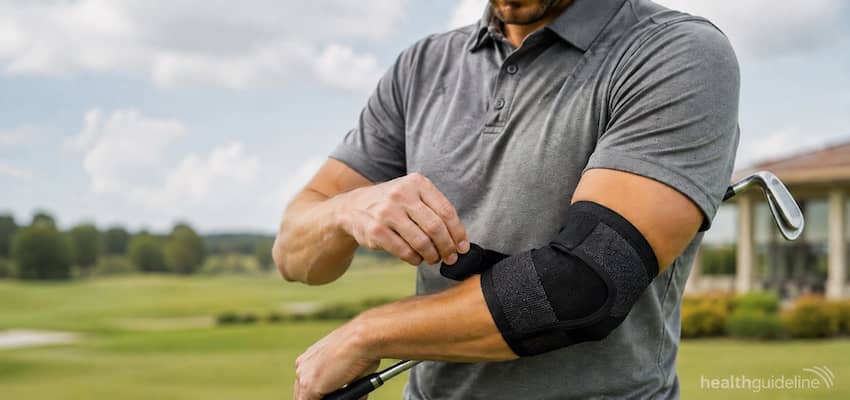
Place the top edge of the strap about two finger-widths below the crease of your elbow, on the upper forearm. Position the pad against the inner side of the forearm, over the sore tendon, then tighten until it feels firm and supportive — snug enough that it stays put, but never so tight that it tingles, throbs, or restricts circulation. You should still be able to make a fist and grip normally. Loosen it if your hand feels cold or numb.
An honest note on what a brace can and can’t do: a brace reduces load and can ease pain so you stay active, but it doesn’t cure the tendon. The mainstays of recovery are relative rest, avoiding the movements that flare it up, and progressive strengthening — often guided by a physical therapist. Think of a brace as a helpful support alongside those, not a replacement for them.
About golfer’s elbow (medial epicondylitis)
Golfer’s elbow is pain where the tendons of your forearm muscles attach to the bony bump on the inside of the elbow (the medial epicondyle), and it can spread down the inner forearm and into the wrist. According to the Mayo Clinic, it’s caused by damage to the muscles and tendons that control the wrist and fingers, usually from excess or repeated stress — forceful gripping and wrist motions, or poor technique and conditioning. Despite the name, you don’t have to play golf to get it; it’s common in racket sports, lifting, and jobs involving repetitive gripping.
Typical symptoms include pain and tenderness on the inner elbow, stiffness (making a fist may hurt), weakness in the hand and grip, and sometimes numbness or tingling that radiates into the ring and little fingers. The Cleveland Clinic notes that leaving it untreated and continuing to overuse the arm can lead to longer-term problems such as reduced range of motion, chronic pain, and a weaker grip — which is why it’s worth addressing early. If tingling into the fingers is a big part of your symptoms, a nerve issue like carpal tunnel can overlap; our carpal tunnel brace guide covers that.
When to see a doctor
Golfer’s elbow usually isn’t urgent, and self-care over a few weeks often helps. But see a healthcare professional if rest, ice, and over-the-counter pain relievers don’t ease the pain and tenderness, or if symptoms interfere with daily activities or sleep. The Mayo Clinic advises seeking immediate care if your elbow is hot and inflamed and you have a fever, or if you can’t bend the elbow or notice sudden numbness or weakness. A brace is a support, not a diagnosis — if you’re unsure what’s causing your pain, get it checked.
Frequently asked questions
Do braces actually help golfer’s elbow?
A brace can genuinely help by offloading the strained tendon and easing pain so you can keep moving, and many people find a counterforce strap makes gripping activities more comfortable. It works best as one part of a plan that also includes rest and strengthening — it supports recovery rather than replacing it, and it won’t fix the underlying tendon on its own.
Where exactly should a golfer’s elbow strap sit?
On the upper forearm, about two finger-widths below the inside crease of your elbow, with the pad pressed over the sore tendon on the inner side. That placement is what lets the strap reduce the pull on the painful attachment point. It usually takes a couple of small adjustments to find the spot where relief is greatest.
How tight should it be?
Firm and secure, but never painful. It should stay in place while you move and feel supportive without cutting off circulation. If your hand tingles, throbs, feels cold, or goes numb, it’s too tight — loosen it. You should still be able to make a fist and grip normally with the brace on.
Should I wear it all day or only during activity?
There’s no fixed rule, but most people get the most benefit wearing a brace during activities that trigger pain — gripping, lifting, racket sports, repetitive work. Some wear a comfortable sleeve for longer stretches. Give your arm breaks, and don’t rely on a brace to push through pain that a rest would settle.
Is golfer’s elbow the same as tennis elbow?
They’re closely related overuse tendon injuries, but on opposite sides. Golfer’s elbow (medial epicondylitis) affects the inner elbow, while tennis elbow (lateral epicondylitis) affects the outer elbow. The braces are similar, but you position the pad toward the sore side. If your pain is mainly on the outside, start with a tennis elbow brace instead.
Strap or sleeve — which is better?
A counterforce strap gives targeted pressure and tends to help more with active, localized pain. A compression sleeve is more comfortable for all-day wear, warmth, and mild aches, but spreads pressure out. If you’re not sure, a strap is the better first buy for classic golfer’s elbow; many people end up using both for different situations.
Can I keep golfing or lifting while I wear one?
Often yes, in moderation — a brace can make activity more comfortable. But pain is a signal. If a movement clearly aggravates your elbow, ease off it for a while rather than bracing over the top of it. Continuing to overload a painful tendon can prolong the problem, so build back gradually.
How long does golfer’s elbow take to heal?
It varies. Mild cases can settle in a few weeks with rest, ice, and activity changes, while more stubborn cases can take several months and benefit from physical therapy and strengthening. If there’s little improvement after a few weeks of self-care, it’s worth seeing a professional for a tailored plan.
Medical disclaimer: This article is for general information only and is not medical advice. Talk to a qualified healthcare professional about your specific situation.