Elastic Adhesive Bandage Comparisons: 4 Picks (2026)
2026 comparison guide · EAB tape, support & skin safety
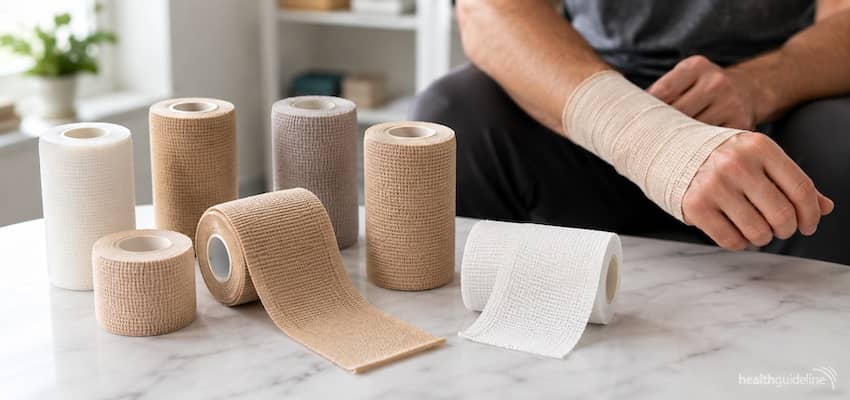
Elastic adhesive bandage (EAB) is stretchable fabric tape with an adhesive backing. It can provide flexible compression and support while conforming around joints and muscles. This guide compares four distinct EAB options for 2026, including heavyweight, easy-tear and latex-free choices, and explains how EAB differs from cohesive wrap, rigid athletic tape and kinesiology tape.
Quick picks
Best overall
Tensoplast EAB
A classic heavyweight elastic adhesive bandage with controlled stretch, firm adhesion and a center guideline for overlap.
Easiest to tear
Mueller Tear-Light
A lightweight, hand-tearable elastic adhesive tape for fast wrapping, brace fixation and flexible support.
Latex-free option
Tensoplast LF
The best fit in this shortlist when avoiding natural-rubber latex is a priority; confirm the exact LF variant before ordering.
JUMP TO A SECTION
How we chose these elastic adhesive bandages
We compared manufacturer specifications, current U.S. product listings and medically reputable guidance on compression and ankle support. We prioritized genuinely different constructions rather than listing multiple widths of the same tape. Category labels such as “best overall” and “best easy-tear” are editorial judgments based on product design and intended use, not results from a head-to-head clinical test.
What is an elastic adhesive bandage?
An elastic adhesive bandage is a stretchable cloth tape with adhesive on one side. Compared with rigid sports tape, EAB allows more give while still adding compression and support. It is also different from cohesive wrap, which sticks mainly to itself rather than directly to the skin, and from kinesiology tape, which is usually thinner and used with different taping techniques.
Manufacturers position EAB for uses such as support of sprains and strains, compression, securing dressings or pads, and taping around irregular body contours. For an acute ankle injury, the right support depends on severity; Mayo Clinic notes that an elastic bandage, sports tape, ankle brace, cast or walking boot may be used in different situations.
Do not confuse adhesive with cohesive. EAB adheres to skin or an underwrap depending on the product and technique. Cohesive wrap is designed primarily to stick to itself. If you want a removable self-clinging wrap, EAB may be the wrong category.
Elastic adhesive bandage comparisons at a glance
| Product | Our category | Construction | Before you buy |
|---|---|---|---|
| Tensoplast Elastic Adhesive Bandage | Best overall heavyweight EAB | Extensible cloth + strong adhesive | Confirm exact latex/material warning and width |
| ELASTIKON by Actimove | Best for conforming around joints | Soft cotton elastic tape | Contains natural rubber latex and colophony (rosin) |
| Mueller Tear-Light | Best easy-tear option | Cotton/Lycra stretch tape | Not water-resistant; verify skin sensitivity |
| Tensoplast LF | Best latex-free option | Permeable elastic adhesive bandage | Confirm the listing specifically says LF / latex-free |
The four elastic adhesive bandage picks
01 / BEST OVERALL HEAVYWEIGHT EAB
Tensoplast Elastic Adhesive Bandage
Tensoplast is the most traditional EAB in this comparison. The manufacturer describes a porous, extensible cloth that provides firm, controlled compression and strong support, with reliable adhesion and a center line that helps users judge overlap. It is a good reference point for buyers who specifically want a robust elastic adhesive bandage rather than a thin kinesiology tape or self-clinging wrap.
Key features
- Porous, extensible cloth construction
- Firm adhesive for longer-wear support
- Central guideline for overlap
- Multiple widths are sold for different body areas
Pros
- Classic heavyweight EAB feel
- Strong adhesion and controlled stretch
- Center line makes overlap easier to judge
Cons
- Heavy EAB is bulkier than lightweight tearable tape
- Material/latex status varies by exact Tensoplast version
- Removal can be uncomfortable on hair or sensitive skin
Best for: Buyers who want a robust, traditional elastic adhesive bandage for sports taping, joint support or clinician-directed compression.
Who it is not for: Anyone who needs a guaranteed latex-free product should choose a clearly labeled latex-free variant instead of assuming every Tensoplast roll has the same formulation.
02 / BEST FOR CONFORMING AROUND JOINTS
ELASTIKON by Actimove Cotton Elastic Tape
ELASTIKON by Actimove is a soft cotton elastic adhesive tape designed to conform around areas such as knees, elbows and shoulders while providing flexible compression. Actimove says the current product continues the familiar ELASTIKON line previously associated with Johnson & Johnson. For joint contours, it is a particularly practical alternative to stiff non-elastic athletic tape.
Key features
- Soft cotton elastic backing
- Conforms around joints and curved body areas
- Allows air and moisture to pass through
- Available in several widths
Pros
- Conforms well around knees, elbows and shoulders
- Flexible compression without rigid-tape stiffness
- Current Actimove version is easy to identify on Amazon
Cons
- Contains natural rubber latex
- Contains colophony (rosin), another potential allergen
- Strong adhesive can be uncomfortable to remove
Allergy warning: Actimove states that ELASTIKON contains natural rubber latex and colophony (rosin), which may cause allergic reactions. Avoid this product if those ingredients are a known problem for you.
Best for: Athletic taping or support around joints where a soft, conformable elastic tape is preferred.
Who it is not for: People with natural-rubber-latex or rosin sensitivity.
03 / BEST EASY-TEAR OPTION
Mueller Tear-Light Tape
Mueller Tear-Light is the quickest product here to work with because the elastic adhesive fabric is designed to tear by hand. Mueller describes it as conformable and suitable for securing lateral knee braces, holding cold packs or using as a compression wrap. The lighter construction makes it more convenient than heavyweight EAB when fast application matters.
Key features
- Hand-tearable elastic adhesive tape
- Cotton and Lycra Stretch composition
- Designed for flexible support and compression
- Available in multiple widths and colors
Pros
- No scissors needed for normal tearing
- Less bulky than heavyweight EAB
- Useful for brace or cold-pack fixation as well as wrapping
Cons
- Lighter construction may not suit buyers seeking a heavyweight EAB feel
- Mueller lists the tape as not water-resistant
- Amazon pack sizes can differ sharply from team-case packaging
Best for: Trainers, athletes or home users who value quick hand tearing and lighter flexible support.
Who it is not for: Buyers who specifically need a water-resistant wrap or a heavy-duty, maximum-adhesion EAB.
04 / BEST LATEX-FREE OPTION
Tensoplast LF Elastic Adhesive Bandage
Tensoplast LF is the clearest choice in this comparison for people who specifically need a latex-free elastic adhesive bandage. U.S. medical-supply listings identify the LF line as latex-free, permeable and designed for controlled support and compression. It keeps the familiar Tensoplast-style center line while avoiding the natural-rubber-latex issue found in some traditional adhesive tapes.
Key features
- Latex-free construction
- Permeable elastic material
- Yellow center line for overlap
- Common medical-supply widths include 2, 3 and 4 inches
Pros
- Clearly positioned as latex-free
- Firm support without switching to cohesive wrap
- Center line helps with consistent overlap
Cons
- Less common in consumer retail than standard Tensoplast
- Listings may use similar Tensoplast names, so variant checking matters
- Latex-free does not guarantee freedom from every possible skin irritant
Variant check: Make sure the product title or packaging specifically says Tensoplast LF or latex-free. Do not assume a standard Tensoplast listing has the same material formulation.
Best for: Buyers who need adhesive elastic support but want to avoid natural-rubber latex.
Who it is not for: People who need a self-clinging cohesive bandage that does not adhere to skin.
What should you look for when buying elastic adhesive bandage?
Heavyweight vs. lightweight EAB
Heavyweight EAB such as traditional Tensoplast provides a more substantial wrap and firm feel. Lightweight elastic adhesive tape such as Mueller Tear-Light is easier to tear and quicker to apply. Neither is automatically “better”; the useful choice depends on whether you prioritize robust compression/support, speed, conformability or low bulk.
Width and body area
Narrower rolls are easier to work around fingers, hands and smaller contours. Wider rolls cover ankles, knees, thighs and larger areas faster. Do not choose width from product photos alone; verify the actual inches or centimeters in the listing, because Amazon frequently combines several sizes on one product page.
Adhesive ingredients and skin sensitivity
Read the exact material warning before taping directly on skin. ELASTIKON by Actimove contains natural rubber latex and colophony (rosin). Tensoplast LF is specifically marketed as latex-free, but “latex-free” does not mean no one can react to any adhesive ingredient. Stop use if significant redness, blistering or irritation develops.
Elastic adhesive bandage vs. rigid athletic tape
EAB stretches and conforms; rigid athletic tape is designed to restrict movement more firmly. They are often used for different purposes or together in a taping system. If you specifically need a rigid zinc-oxide strapping tape, read our BSN Medical Leukotape P sports tape guide instead.
Elastic adhesive bandage vs. cohesive wrap
Cohesive wrap is made to cling to itself, which can make removal easier and reduce direct adhesive contact with skin. EAB uses an adhesive backing and usually offers a different level of hold. Product listings sometimes use “self-adhesive” loosely, so check whether the material actually sticks to skin or only to itself.
Elastic adhesive bandage vs. kinesiology tape
Kinesiology tape is typically a thinner elastic tape applied in strips with brand-specific taping methods. Heavyweight EAB is more like a supportive wrap. If your goal is joint restriction or sports strapping, do not assume a roll labeled “elastic athletic tape” behaves like heavyweight EAB; compare backing, adhesive strength, stretch and intended use.
How can you use elastic adhesive bandage more safely?
Follow the directions for the exact bandage and the taping method recommended for your injury or activity. Adhesive compression should feel supportive, not painfully tight. Mayo Clinic advises loosening an elastic bandage if compression interferes with circulation, and medical guidance commonly treats numbness, tingling or color/temperature changes beyond the wrap as warning signs.
- Check the label first. Confirm whether the product is intended for direct skin contact, whether it contains latex or rosin, and whether an underwrap is recommended.
- Use clean, dry skin. Avoid taping over broken, infected or severely irritated skin unless a healthcare professional has specifically directed the dressing technique.
- Do not improvise maximum tension. More stretch is not automatically more support. Follow the manufacturer or a trained clinician’s technique for the body area being taped.
- Monitor circulation and skin. Remove or loosen the wrap if it causes worsening pain, numbness, tingling, marked swelling below the tape, or abnormal color or temperature.
- Remove adhesive carefully. Support the skin and work slowly. An adhesive remover or underwrap may help with repeated sports taping when appropriate for the product.
Do not tape your way past a serious injury. Seek medical assessment for severe pain or swelling, inability to bear weight, a visible deformity, numbness after injury, or a foot/hand that becomes unusually cold or discolored. A severe sprain or fracture may need a brace, cast or boot rather than an adhesive bandage.
For ankle injuries that require more immobilization, see our walking boots for sprained ankles guide, then confirm the appropriate device with a qualified healthcare professional.
Frequently asked questions
Is elastic adhesive bandage the same as self-adhesive cohesive wrap?
No. Elastic adhesive bandage normally has an adhesive backing that can stick to skin or underwrap. Cohesive wrap is designed mainly to stick to itself. The two products can look similar online, so check the manufacturer description rather than relying on words such as “self-adhesive” in a marketplace title.
Can elastic adhesive bandage be used for an ankle sprain?
Sometimes. Mayo Clinic notes that an elastic bandage, sports tape or ankle brace may be recommended depending on sprain severity, while more severe injuries can require a cast or walking boot. EAB should not be used as a substitute for assessment when pain, swelling or difficulty bearing weight is substantial.
How tight should an elastic adhesive bandage be?
It should feel supportive without causing worsening pain, numbness, tingling or abnormal color or temperature below the taped area. Because EAB can create meaningful compression, follow the product instructions or a clinician-taught taping method rather than stretching the tape as hard as possible.
Is elastic adhesive bandage latex-free?
Not always. ELASTIKON by Actimove explicitly contains natural rubber latex, while Tensoplast LF is sold as a latex-free elastic adhesive bandage. Material formulations differ by brand and variant, so read the exact packaging and current product listing if you have a latex allergy or adhesive sensitivity.
Can you put EAB directly on skin?
Many EAB products are designed to adhere to skin, but direct application is not right for every person or every taping system. Check the manufacturer instructions, avoid damaged or highly irritated skin, and consider underwrap when the taping method calls for it or repeated removal is likely to irritate the skin.
What is the difference between EAB and rigid sports tape?
EAB stretches, so it can provide compression and flexible support while accommodating some movement. Rigid athletic tape has little or no stretch and is used when firmer mechanical restriction is the goal. The correct choice depends on the joint, activity, injury and taping method rather than one category being universally better.
This article is for general information only and is not medical advice. Talk to a qualified healthcare professional about your injury, compression level, taping method and return to sport.