iWALK 2.0 & 3.0 Hands-Free Crutch: Review, Who It’s For & Best Alternatives (2026)

If you’ve broken a foot or ankle, ruptured an Achilles tendon, or had foot surgery, your doctor has probably told you to stay non-weight-bearing — and handed you a pair of crutches that hurt your hands and take over your life. A hands-free crutch like the iWALK promises something different: the ability to walk, cook, climb stairs, and carry things with both hands free while your lower leg heals. This guide explains how the iWALK works, honestly covers who it’s right for (and who it isn’t), clears up the iWALK 2.0 vs 3.0 confusion, and compares the best real alternatives you can buy today.
Best overall (if you qualify)
iWALK3.0
The current hands-free crutch that replaced the now-discontinued iWALK2.0. It frees both hands during recovery from a below-the-knee injury.
Best alternative for most people
Steerable knee scooter
No balance or strength test to pass, and it lets you rest the leg completely.
Best for outdoors / uneven ground
All-Terrain Knee Scooter
All-terrain knee scooter with large pneumatic tires.
Important caveat: a hands-free crutch is not for everyone. You need good balance, one uninjured leg, an injury below the knee, and the ability to bend that knee to 90°. When in doubt, ask your surgeon or physical therapist first.
What is the iWALK hands-free crutch?
The iWALK is a hands-free “peg-leg” style crutch for non-weight-bearing lower-leg injuries. You kneel your injured leg on a padded platform and strap it to your thigh, so the device acts as a temporary lower leg. Your hands and arms stay completely free, and you walk using your own upper-leg muscles instead of your wrists and underarms.
Is the iWALK 2.0 still available in 2026?
No — the iWALK2.0 is discontinued and is no longer manufactured. The current model is the iWALK3.0, which keeps the same basic design but adds a wider, more stable foot, thicker high-resilience padding, easier height adjustment on both sides, color-coded straps, and a knee platform shaped to relieve pressure on the shin bone. If you already own an iWALK2.0 it still works fine; if you’re buying new, you’ll be buying the 3.0. (Differences are detailed further down.)
How we chose
We focused on real devices currently sold in the US for non-weight-bearing recovery below the knee, and prioritized safety, ease of learning, comfort over long recovery periods, and honest fit with each reader’s situation rather than whatever is easiest to link to. We cross-referenced manufacturer specifications and qualification requirements with independent, peer-reviewed research on energy use, patient preference, and injury risk (see Sources). Because a hands-free crutch genuinely doesn’t suit everyone, we’ve included knee-scooter alternatives that pass no balance or strength test, so there’s a safe option here for most people.
Top picks at a glance
| Device | Best for | Key strength | Hands free? | Approx. price (check current) |
|---|---|---|---|---|
| iWALK3.0 | Healthy, mobile adults who want to stay independent | Both hands free; natural walking; great on stairs | ✅ Yes | ~$150 |
| KneeRover Economy Steerable Knee Scooter | Most people — especially anyone who can’t pass the iWALK fit test | No balance/strength requirement; rest the leg fully | ❌ No (steer with hands) | ~$110–$140 |
| KneeRover Original All-Terrain Knee Scooter | Outdoor use, grass, gravel, uneven sidewalks | 12″ pneumatic tires; up to 350 lb capacity | ❌ No (steer with hands) | ~$190–$230 |
01 / BEST OVERALL
iWALK3.0 Hands Free Crutch
The iWALK3.0 is the best choice for healthy, motivated adults recovering from a below-knee injury who want to keep living normally. Because it’s truly hands-free, you can carry a cup of coffee, hold a handrail, cook, or work while you heal — things a knee scooter or crutches make difficult. Most people adapt within one to three days.
Key features
- Acts as a temporary lower leg; you kneel the injured shin on a cushioned platform and strap it to your thigh.
- Wider foot and thicker, high-resilience padding than the old 2.0 for more stability and comfort.
- Height adjusts on both sides; knee platform is contoured to relieve pressure on the tibial tuberosity (shin bump).
- Lightweight (about 4–5 lb) and disassembles for transport.
- An Arctic Grip winter-tread version is available if you’ll be walking on ice or snow (Arctic Grip on Amazon).
Pros
- Both hands free
- walks using natural leg muscles, reducing arm/wrist strain
- excellent on stairs (you keep a free hand for the rail)
- helps you stay active and independent
- research links hands-free crutch use to lower energy expenditure than standard crutches.
Cons
- Real learning curve with early wobble and some thigh/knee soreness
- you must remove it to sit down
- not suitable for injuries at or above the knee, for both-leg injuries, or for anyone who can’t safely balance on one leg. Not recommended for elderly users or those with balance or strength limitations.
Best for: Below-knee, single-leg injuries (broken foot/ankle, Achilles rupture, foot or bunion surgery, some below-knee amputations) in people with average-or-better balance who are within the manufacturer’s height and weight limits.
02 / BEST ALTERNATIVE FOR MOST PEOPLE
KneeRover Economy Steerable Knee Scooter
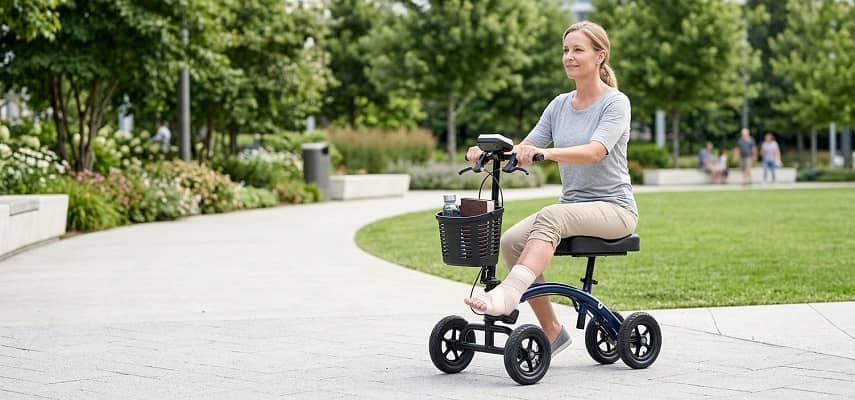
If you can’t pass the iWALK fit test — or you simply want to keep all weight off the leg and rest — a steerable knee scooter is the safer, easier choice, and the KneeRover Economy is a well-established value pick. You rest your shin on a padded platform and roll along, steering with the handlebars. There’s no balance or strength test to pass, which makes it appropriate for far more people.
Key features
- Four smooth 7.5″ wheels for indoor and outdoor use; dual rear brakes plus a locking handbrake.
- Adjustable knee platform (fits left or right leg) and handlebar height.
- Lightweight steel frame (~20 lb) that folds for transport; roughly 300 lb weight capacity.
- Includes a basket for carrying items.
Pros
- No balance/strength requirement
- lets the leg rest completely
- quick to learn
- more stable than crutches
- comfortable for longer distances.
Cons
- Not hands-free (both hands steer)
- bulky and awkward in tight kitchens and bathrooms
- not designed for stairs
- surveys of foot-and-ankle surgeons note that knee-scooter tips and falls do happen, so move slowly and brake on slopes.
Best for: Anyone who doesn’t qualify for a hands-free crutch, needs to fully offload the leg, or prefers a gentler learning curve.
03 / BEST FOR OUTDOORS
KneeRover Original Steerable All-Terrain Knee Scooter
If your recovery involves grass, gravel, dirt paths, or cracked sidewalks, a standard small-wheeled scooter will fight you. The KneeRover All-Terrain solves that with large 12″ pneumatic (air-filled) tires and a heavy-duty double-bar frame, so you can get around outdoors with far more confidence.
Key features
- 12″ pneumatic tires for grass, gravel, and uneven ground.
- Advanced tie-rod steering and an optional stabilizer wheel for control.
- Heavy-duty frame with up to ~350 lb capacity; folds for transport.
- Recommended for taller users (roughly 5’6″–6’5″).
Pros
- Handles outdoor terrain that stops other scooters
- very stable
- high weight capacity
- still no balance test to pass.
Cons
- Heavier and bulkier than an economy scooter
- larger turning radius indoors
- still not hands-free and not for stairs
- higher price.
Best for: Active people who need to be outdoors on uneven surfaces, taller or heavier users, and anyone who found a small-wheeled scooter unstable.
Which should you choose? iWALK vs. knee scooter vs. crutches
There’s no single “best” device — the right one depends on your injury, your balance, and where you need to go. Here’s the honest breakdown:
Hands-free crutch (iWALK): best if you’re healthy and mobile, your injury is below the knee, and you want to keep both hands. In a randomized crossover trial, walking with a hands-free crutch tended to require less energy and lower perceived exertion than standard axillary crutches (Canter et al., 2024). Earlier research also reported that a large majority of foot-and-ankle patients preferred a hands-free crutch over conventional crutches — and preference matters, because people who like their device are more likely to actually stay non-weight-bearing as instructed.
Knee scooter: best if you can’t pass the iWALK fit test, want to fully rest the leg, or prefer an easy learning curve. The trade-off is that it isn’t hands-free and struggles with stairs and tight spaces.
Traditional crutches (underarm or forearm): the cheapest and most universal option, and usually supplied by the hospital. They work for nearly any lower-leg injury and short distances, but they occupy both hands, can cause hand, wrist, and underarm discomfort, and carry a higher energy cost over long recoveries. Many people keep their crutches as a backup even after switching to an iWALK or scooter.
A reasonable approach: if you clearly qualify and want maximum independence, try the iWALK; if you have any doubt about balance or strength, start with a knee scooter and keep your crutches for stairs and short trips.
Who should (and shouldn’t) use a hands-free crutch?
The manufacturer publishes a simple self-check. A hands-free crutch may be appropriate if you can answer “yes” to all of these:
- Could you walk normally before your injury?
- Is the injury to one leg only, and below the knee?
- Can you bend the injured knee to 90 degrees?
- Are you within the height and weight range (most people roughly 4’10″–6’6″ and under 275 lb — confirm with the manufacturer’s fit test, as some listings specify a narrower range)?
- Do you have average-or-better balance and the motivation to spend a few days learning?
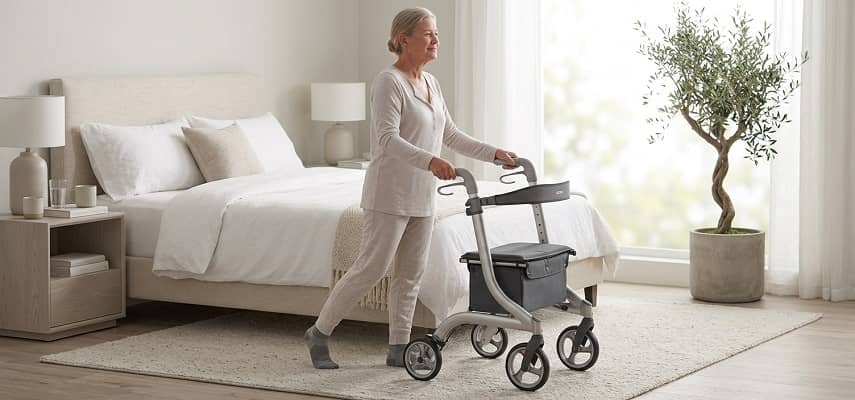
It is generally not recommended for elderly users or anyone with balance problems, vertigo, significant weakness, poor circulation, or an injury at or above the knee. If that’s you, a walker or a rollator with a seat is often safer and more comfortable. Whatever you choose, talk to your surgeon or physical therapist first — they can confirm the device is safe for your specific injury and recovery stage.
What to look for when buying a hands-free crutch or knee scooter
Fit and adjustability
Check the height and weight limits against your own measurements before buying, and look for adjustable padding and platform height. A poor fit is the most common reason people give up on a device.
Stability and terrain
Small hard wheels are fine indoors on smooth floors; if you’ll go outside, prioritize larger or pneumatic tires. For a hands-free crutch, a wider foot means more stability on uneven ground.
Comfort over long recoveries
Non-weight-bearing periods often last several weeks, so padding quality matters. Look for thick, high-resilience foam at every contact point (shin, thigh, or knee platform).
Portability
If you’ll travel or move between floors, a device that folds or disassembles quickly is far easier to live with.
Staying safe and comfortable while non-weight-bearing
A mobility device is only part of recovery. A few general, non-prescriptive habits can make the weeks easier — but follow your own care team’s instructions first:
- Elevate when resting. Keeping the injured leg raised can help manage swelling; a dedicated leg elevation pillow makes this easier than stacking cushions.
- Watch circulation. Reduced movement can affect blood flow in the legs. Ask your provider whether compression socks are appropriate for you, and seek care promptly for new calf pain, warmth, or swelling.
- Protect the healing area. If you’re transitioning back toward walking, your clinician may recommend a supportive boot — see our guide to walking boots for sprained ankles.
- Go slow at first. With any new device, practice in a safe, uncluttered space before tackling stairs, slopes, or crowds.
iWALK 2.0 vs. iWALK 3.0: what actually changed
If you own a 2.0 or are considering a used one, here’s what the 3.0 improved:
- Bigger, more stable foot — noticeably wider for better grip and easier balance.
- More thigh support and better padding — larger contact area with thicker, longer-lasting foam, plus numbered settings to dial in your fit.
- Easier height adjustment — now on both sides of the upper crutch, with external clips on the lower crutch (no more springs lost inside the tubes).
- Redesigned knee platform — airflow channels for cooling and a recess that accommodates a prominent shin bone (tibial tuberosity or Osgood-Schlatter).
- Color-coded, quick-release straps — more intuitive to put on and take off.
A 2.0 in good condition is still usable, but replacement parts and support increasingly center on the 3.0.
Frequently asked questions
Is the iWALK 2.0 still being made?
No. The iWALK2.0 has been discontinued and is no longer in production. The current model is the iWALK3.0, which shares the same core design but adds a wider foot, thicker padding, two-sided height adjustment, a redesigned knee platform, and color-coded straps. An existing 2.0 still works, but new purchases and most replacement parts are now the 3.0.
Can you use the iWALK on stairs?
Yes, and stairs are actually a strength of the hands-free design. Because both hands are free, you can hold the handrail while your legs provide balance and support — something you can’t do safely on a knee scooter. Still, take stairs slowly, especially while you’re learning, and use the rail every time.
Who should not use a hands-free crutch?
It’s generally not recommended for elderly users or anyone with balance problems, vertigo, significant leg weakness, poor circulation, or an injury at or above the knee or in both legs. If you can’t comfortably balance on your uninjured leg, a knee scooter or walker is safer. Always confirm suitability with your doctor or physical therapist.
iWALK or knee scooter — which is better?
Neither is universally better. The iWALK keeps both hands free and handles stairs and tight spaces well, but requires good balance and a below-knee injury. A knee scooter passes no fitness test and lets you rest the leg fully, but it isn’t hands-free and struggles on stairs. Your injury, balance, and environment decide which fits.
How long does it take to learn to use the iWALK?
Most people adapt within one to three days, and some feel steady within an hour or two. Expect early wobbliness and a little thigh or knee soreness as your muscles adjust — this is normal with any new device. Practice in a safe, open space before using it on stairs or outdoors.
Does insurance cover the iWALK?
Hands-free crutches are often purchased out of pocket rather than covered by insurance, though this varies by plan and country. They may be eligible for HSA or FSA spending — check with your provider and plan administrator. If cost is a concern, a basic knee scooter or standard crutches are usually cheaper options.
Medical disclaimer: This article is for general information only and is not medical advice. Mobility devices aren’t right for every injury or person. Talk to a qualified healthcare professional about your specific situation before choosing or using one.