Best Leg Massagers 2026: 5 Picks for Home Recovery
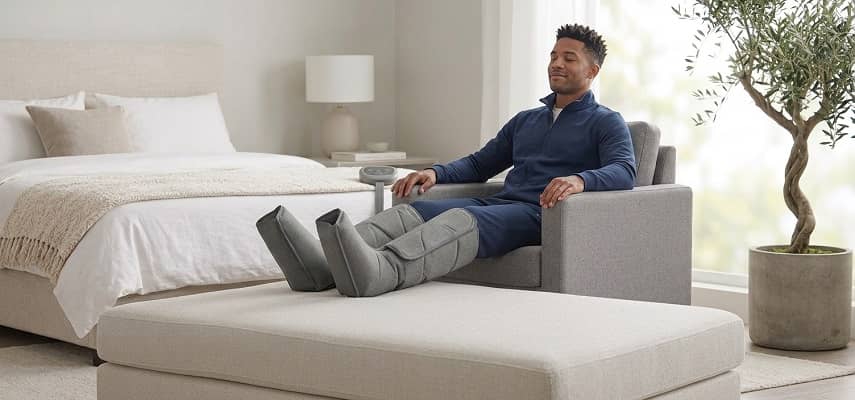
2026 buying guide · compression, kneading & recovery
The best leg massager depends on the feeling you want. Air-compression boots rhythmically squeeze the feet, calves and thighs, while kneading machines use rollers and mechanical pressure around the feet and calves. For a premium full-leg compression system, our feature-based pick is the Hyperice Normatec 3 Legs; for kneading rather than compression, the Human Touch Reflex5s is the better fit.
Best leg massagers: quick picks
Best overall compression
Hyperice Normatec 3
Five compression zones, seven pressure levels and established sizing options in a polished recovery system.
Best cordless value
FIT KING Cordless
A hose-free full-leg design with three modes and 11 intensity settings at a lower tier than premium systems.
Best for kneading
Human Touch Reflex5s
A stationary foot-and-calf machine with underfoot rollers for buyers who do not want compression boots.
How we chose these leg massagers
We compared current manufacturer specifications, U.S. Amazon listings and recent independent coverage, then selected five products that represent genuinely different use cases. We prioritized massage type, coverage, pressure or program control, sizing, portability, cleaning and safety information. “Best” labels are editorial judgments based on those features, not results from a clinical head-to-head test.
Leg massagers at a glance
| Leg massager | Our category | Massage type | Coverage | Before you buy |
|---|---|---|---|---|
| Hyperice Normatec 3 Legs | Best overall compression | Dynamic air compression | Feet to thighs | Premium price; separate controller and hose |
| Therabody JetBoots Prime | Best travel-friendly premium pick | Wireless pneumatic compression | Feet to thighs | Measure carefully for Short, Regular or Long |
| FIT KING Cordless | Best cordless value | Sequential air compression | Feet to thighs | Newer listing; confirm exact size and seller |
| CINCOM CM-020A | Best lower-cost wrap style | Air-compression wraps | Feet, calves and thighs | Corded and more setup than one-piece boots |
| Human Touch Reflex5s | Best kneading alternative | Rollers + kneading | Feet and lower calves | 20 lb stationary machine; no full-thigh coverage |
Do not compare pressure numbers across unrelated devices as if “more” is automatically better. Fit, chamber design, massage pattern and your comfort matter. If a device causes pain, numbness, tingling or unusual skin-color changes, stop using it.
The five best leg massagers in this guide
01 / BEST OVERALL COMPRESSION
Hyperice Normatec 3 Legs
The Hyperice Normatec 3 Legs — view on Amazon is our feature-based overall pick for buyers who specifically want full-leg pneumatic compression. Hyperice lists five overlapping compression zones, seven pressure levels from 40 to 110 mmHg, ZoneBoost control and up to three hours of battery life in the control unit.
Key features
- Five overlapping compression zones
- Seven compression levels, 40–110 mmHg
- ZoneBoost for extra pressure in a selected zone
- Up to three hours of control-unit battery life
- Bluetooth connectivity
- Short, Standard and Tall sizing from Hyperice
Pros
- Broad full-leg coverage
- Fine pressure adjustment
- Zone-specific control
- Established product ecosystem and sizing guidance
Cons
- Premium purchase
- Not fully hose-free like integrated wireless boots
- Amazon may have changing seller availability by size
Best for: Athletes and frequent users who value full-leg compression, adjustable zones and a mature premium system.
Who it is not for: Buyers who mainly want kneading rollers, heat, or the lowest-cost option.
02 / TRAVEL-FRIENDLY PREMIUM PICK
Therabody JetBoots Prime
The Therabody JetBoots Prime — view on Amazon puts the pumps inside the boots, so there is no external control box or air hose to pack. Therabody lists four overlapping pressure chambers, four pressure levels from 25 to 100 mmHg, selectable treatment times and about three hours of battery life.
Key features
- Fully wireless boot design
- Four overlapping air chambers
- 25–100 mmHg in four pressure levels
- 20-, 40- and 60-minute settings plus continuous mode
- About three hours of battery life
- Short, Regular and Long sizing
Pros
- No external hose or pump unit
- Foldable and easier to travel with than many systems
- Simple built-in controls
Cons
- Still a premium-priced system
- Correct leg-length sizing is important
- Four pressure levels offer less fine adjustment than some rivals
Best for: Runners, cyclists and travelers who value a self-contained wireless system.
Who it is not for: Buyers who want a budget wrap, heat, kneading rollers or a compact device for only the calves.
03 / BEST CORDLESS VALUE
FIT KING Cordless Air Compression Recovery System
The FIT KING Cordless Air Compression Recovery System — view on Amazon is the value-oriented wireless pick in this group. Its current Amazon listing describes a two-leg auto-sync design with three compression modes and 11 intensity settings, removing both the wall cord and external air-tube setup during a session.
Key features
- All-in-one cordless boot construction
- Two-leg automatic synchronization
- Three compression modes
- 11 intensity settings
- Full-leg boot format
- Multiple sizes on the current listing
Pros
- Hose-free and cordless during use
- More intensity steps than JetBoots Prime
- Full-leg coverage without a separate console
Cons
- Newer model with a shorter public track record
- Less independent third-party testing than premium brands
- Amazon variants can change; model matching matters
Best for: Buyers who want the convenience of wireless full-leg boots without moving straight to the highest premium tier.
Who it is not for: People who prefer a long-established premium platform, app-centered controls or mechanical kneading.
04 / LOWER-COST WRAP STYLE
CINCOM Air Compression Therapy Device (CM-020A)
The CINCOM Air Compression Therapy Device — view on Amazon is a wrap-style alternative to rigid-looking recovery boots. The current U.S. listing identifies model CM-020A and specifies three massage modes and three intensities for foot, calf and thigh wraps, making it a simpler choice for occasional home use.
Key features
- Separate wraps for feet, calves and thighs
- Three massage modes
- Three intensity settings
- Corded controller
- Adjustable wrap fit
- Long-running CM-020A model
Pros
- Usually positioned below premium boot systems
- Adjustable wraps can accommodate different leg shapes
- Simple mode and intensity controls
Cons
- More straps and pieces to position
- Corded rather than travel-friendly wireless
- Only three intensity steps
Best for: Occasional home users who want adjustable air-compression wraps without paying for a premium recovery system.
Who it is not for: Buyers who want hose-free boots, app controls, mechanical kneading or the fastest setup.
05 / BEST KNEADING ALTERNATIVE
Human Touch Reflex5s Foot & Calf Massager
The Human Touch Reflex5s — view on Amazon is the outlier in this list: it is a stationary kneading-and-roller machine, not a set of compression boots. Human Touch lists underfoot rollers, removable washable inserts, adjustable tilt, two Auto-Wellness programs and two additional Shiatsu programs.
Key features
- Underfoot massage rollers
- Kneading around feet and calves
- Two Auto-Wellness programs
- Two additional Shiatsu programs
- Removable, washable inserts
- Adjustable tilt; approximately 20 lb
Pros
- Actual roller-and-kneading sensation
- Easy-to-clean inserts
- No leg sleeves or sizing chart
Cons
- Does not massage the thighs
- Bulky compared with fabric wraps
- No heat feature listed by Human Touch
- Less portable at about 20 lb
Best for: People who want rollers and kneading around the feet and lower calves rather than rhythmic air compression.
Who it is not for: Buyers seeking thigh coverage, travel portability or a compression-boot recovery routine.
What type of leg massager should you buy?
Choose by massage mechanism, not by marketing language. Pneumatic boots create repeated squeezing with air chambers; wrap-style units do the same with more straps and a separate controller; kneading machines use moving rollers around the feet and calves. These sensations are different, so the “best” device is the one that matches your goal, fit and tolerance.
Air-compression boots
Full-leg boots are the easiest category to compare for athletic recovery. Look at the number of chambers, pressure adjustment, whether zones can be switched off, battery life, hose setup and sizing. Wireless boots are easier to travel with, while console-and-hose systems may offer more granular controls.
Wrap-style compression massagers
Wraps can be less expensive and more adjustable around different leg shapes, but they take longer to position and usually have more cables or hoses. If your main goal is gentle compression after a long day rather than athlete-oriented recovery, they can be a practical category to start with.
Kneading and roller machines
Kneading devices feel closer to a mechanical massage because rollers physically press and move against the foot or calf. They do not provide the same full-leg sequential compression as recovery boots. Check calf-well dimensions, intensity controls, cleaning method and machine weight before buying.
Heat
Heat can feel soothing, but it should be treated as a comfort feature rather than proof that a massager is more effective. If you have reduced sensation, neuropathy or a condition that affects circulation, ask a clinician before using a heated device because you may not feel excessive heat normally.
What should you look for in a leg massager?
- Decide the sensation first. Choose air compression for rhythmic squeezing or rollers/kneading for a more direct mechanical massage.
- Measure before buying boots. Use the exact brand’s inseam, outseam and thigh-circumference chart. Do not assume your clothing size maps to a recovery-boot size.
- Check control range. More pressure levels are useful only if the lowest setting is comfortable and the device fits properly.
- Consider setup and storage. A hose-free system is convenient, but a corded wrap can cost less. A 20-pound kneading machine needs a permanent storage spot.
- Read the contraindications. Manufacturer warnings differ. If you have vascular disease, a history of blood clots, unexplained swelling, major neuropathy, a recent operation or are pregnant, get individualized medical guidance first.
For non-massage approaches to tired or swollen legs, compare our guides to leg compression sleeves, leg elevation pillows and leg exercisers. If your discomfort is mainly around the knee or feet, see our knee massager guide and foot spa massager guide.
Do leg massagers actually help recovery?
The evidence is mixed and depends on the kind of massage. A 2024 systematic review of 17 studies with 319 participants found lower-limb intermittent pneumatic compression produced trivial-to-small benefits for muscular function and trivial-to-moderate effects on pain or soreness. A 2025 meta-analysis found moderate-certainty evidence that IPC did not reduce soreness at 24 hours versus control. In other words, compression boots may feel good, but they are not a guaranteed recovery shortcut.
17 studies · 319 participants
The 2024 review concluded that lower-limb intermittent pneumatic compression may have potential for sports recovery, especially for perceived soreness, but the overall effects were generally small and the evidence was not strong enough to promise better performance or faster tissue recovery.
Research on manual sports massage is somewhat more supportive for soreness: a 2020 systematic review of 29 studies and 1,012 participants found no performance benefit for strength, sprint, endurance or fatigue, but did find small improvements in flexibility and delayed-onset muscle soreness. That evidence should not be automatically transferred to an electric leg massager, because the technique and dose are different.
Bottom line: Buy a home leg massager for comfort, relaxation or a recovery routine—not because a seller promises to “detox,” cure poor circulation, treat edema or replace rehabilitation. Medical compression therapy is a separate clinical intervention that should be matched to the condition and patient.
When should you not use a leg massager without medical advice?
Do not use a home leg massager to self-treat unexplained one-sided swelling, new calf or thigh pain, warmth or skin discoloration. Those can be symptoms of deep vein thrombosis (DVT), which needs prompt medical assessment. Compression may be used clinically for some vascular conditions, but the type, pressure and timing should be chosen by a healthcare professional.
Possible DVT or pulmonary embolism: get medical help
The NHS lists throbbing pain and swelling in one leg as common DVT symptoms, sometimes with skin color changes or swollen veins. If leg pain or swelling occurs with shortness of breath or chest pain, seek emergency care because a clot can travel to the lungs.
Ask a clinician before using compression or vigorous massage if you have known vascular disease, a previous blood clot, recent surgery or fracture, significant neuropathy, active skin infection, unexplained swelling, heart or kidney problems, or if you are pregnant. Also follow the contraindications for the exact model; manufacturer lists are not identical.
Frequently asked questions
What is the best leg massager for most people?
There is no single best mechanism for everyone. If you specifically want premium full-leg air compression, Hyperice Normatec 3 is our feature-based overall pick. If portability matters more, Therabody JetBoots Prime is fully wireless. If you want actual rollers and kneading instead of compression, Human Touch Reflex5s is the more appropriate category.
Can a leg massager improve circulation?
Compression and massage can temporarily change local blood flow and may feel helpful after sitting, standing or exercise, but a consumer massager should not be treated as a cure for “poor circulation.” Cleveland Clinic notes that medical compression therapy is used for specific vascular conditions and should be fitted and used appropriately. Persistent swelling or circulation symptoms need assessment.
Are compression boots proven to speed workout recovery?
Not reliably. A 2024 review found mostly small effects, with the clearest potential benefit in perceived soreness. A 2025 meta-analysis found that intermittent pneumatic compression did not reduce 24-hour soreness versus control. Compression boots can still be a comfortable recovery ritual, but the current evidence does not justify promises of dramatically faster recovery.
Can I use a leg massager if one leg is swollen?
Do not assume new one-sided swelling is ordinary fatigue. DVT commonly affects one leg and can cause swelling, pain, warmth or color changes. Seek prompt medical advice if DVT is possible, and do not use a home massager as a substitute for diagnosis. If swelling is from a known condition, follow the treatment plan your clinician gave you.
How long should I use a leg massager?
Follow the manual for your exact device because session times and pressure ranges differ widely. Start with a comfortable setting, stop if you develop pain, numbness, tingling or unusual skin-color changes, and do not use more pressure simply because a device offers it. Medical conditions may require a different schedule or avoiding the device entirely.
Compression boots or a kneading calf massager: which is better?
Choose compression boots if you like rhythmic squeezing across most of the leg and want a post-exercise recovery routine. Choose a kneading machine if you prefer rollers pressing into the feet and lower calves. Neither mechanism is automatically “stronger” or medically better; fit, comfort and your intended use matter more than the category name.
This article is for general information only and is not medical advice. Talk to a qualified healthcare professional about unexplained leg symptoms, circulation problems or whether a massager is appropriate for you.