Trigger Finger Splint: 5 Best Options for 2026
2026 guide · splint types, fit & evidence
A trigger finger splint limits selected finger movement so the irritated flexor tendon can rest. The American Academy of Orthopaedic Surgeons (AAOS) lists nighttime splinting among first-line nonsurgical options. The best design is one that controls the intended joint without causing pressure, numbness or skin problems. Below are five current options with different support styles.
Quick picks
Best adjustable
Vive Trigger Finger Splint
An adjustable aluminum-backed brace that the manufacturer lists for any finger, including the thumb and pinky.
Best low-profile
3-Point Oval-8
A strap-free molded splint for people who want a small device that can limit motion at a selected finger joint.
Best padded
Dr. Frederick’s Original
A padded adjustable two-pack for index, middle and ring fingers when comfort matters more than minimal bulk.
How we chose these trigger finger splints
We checked current Amazon US listings against manufacturer specifications, then compared the designs with guidance from AAOS, Mayo Clinic and the NHS and with published studies of finger orthoses. We prioritized which joint a splint can restrict, sizing, thumb compatibility, fastening, bulk, skin comfort and ease of daily use. Category labels such as “best adjustable” are editorial judgments about those features, not results from a clinical head-to-head test.
Important evidence distinction: Clinical trials have studied specific MCP-, PIP- and relative-motion orthoses. A retail splint may use a similar movement-control idea, but that does not prove that a particular commercial brand was the device tested or that it will work for every case.
Trigger finger splints at a glance
| Splint | Best for | Support style | Fits | Before you buy |
|---|---|---|---|---|
| Vive Trigger Finger Splint | Adjustable support | Strap + integrated aluminum support | Thumb, index, middle, ring, pinky | Check strap pressure and placement |
| 3-Point Oval-8 | Low-profile wear | Molded 3-point ring-style splint | Finger joints and thumb IP, size-dependent | Exact sizing is critical; linked pack covers sizes 8–12 |
| Dr. Frederick’s Original | Padded two-pack | Padded adjustable brace | Index, middle, ring | Not intended for thumb or pinky in the linked listing |
| Vive Universal Finger Splint | Full-length straightening | Aluminum full-finger support | Index, middle, ring, pinky | More restrictive than a joint-specific splint |
| Neo G Easy-Fit Finger Splint | Molded full-finger support | Cushioned flexible shell | Finger, size-dependent | Linked Amazon variant is Large; choose the correct length |
The Five Trigger Finger Splint
01 / BEST ADJUSTABLE
Vive Trigger Finger Splint & Brace
The Vive Trigger Finger Splint is the most versatile adjustable option in this group because the manufacturer states that it can support the thumb, index, middle, ring or pinky on either hand. An integrated aluminum support sits along the finger while an adjustable wrap secures the brace at the base.
Key features
- Integrated aluminum support
- Adjustable wrap-style fastening
- Manufacturer lists compatibility with all five digits
- Can be used on either hand
Pros
- Broad digit compatibility, including thumb and pinky
- Fast to loosen or retighten without changing splint size
- Less enclosing than a full-length finger shell
Cons
- Wrap pressure can be uncomfortable if overtightened
- More visible and bulkier than a molded ring splint
- Not a substitute for a custom orthosis when one is prescribed
Best for: Someone who wants one adjustable design that can be moved between different fingers or used for trigger thumb, provided the fit and movement restriction are appropriate.
Who it is not for: People who have been told to use a precisely fitted MCP- or PIP-blocking orthosis, or anyone whose symptoms worsen when the strap is applied.
02 / BEST LOW-PROFILE
3-Point Products Oval-8 Finger Splints
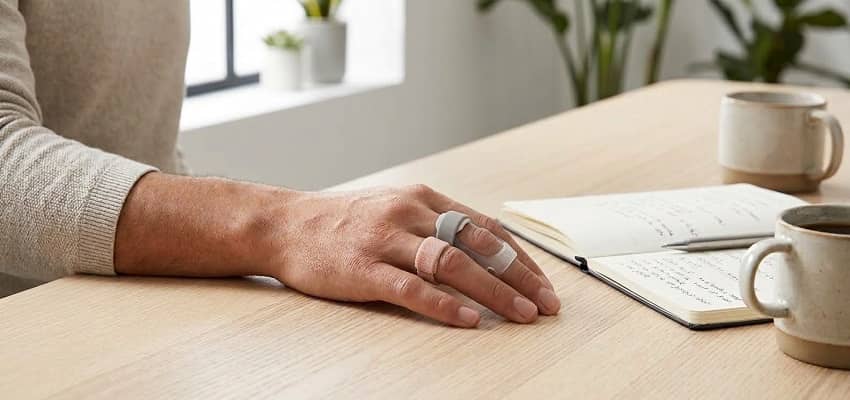
Oval-8 splints use a small molded 3-point design rather than fabric straps. The manufacturer describes trigger-finger use by positioning the splint to limit flexion at the PIP joint, and also lists trigger-thumb applications at the thumb IP joint. This makes Oval-8 the least bulky option here, but correct sizing matters much more than with an adjustable wrap.
Key features
- Molded 3-point pressure design
- No straps or hook-and-loop fasteners
- Waterproof and latex-free according to the manufacturer
- Available across multiple finger sizes
Pros
- Very low profile under normal daily activities
- No fabric to absorb water during hand washing
- Can target a joint without enclosing the whole finger
Cons
- A wrong size can slip, pinch or fail to limit the intended movement
- No strap adjustment to compensate for changing swelling
- The linked Amazon pack covers only one size range
Evidence connection, not product proof: PIP-blocking orthoses have performed well in small trigger-finger trials. Oval-8 can be configured to limit PIP flexion, but the research does not establish this retail product as the exact orthosis tested.
Best for: People who prioritize a small, strap-free splint and can determine the correct size and orientation.
Who it is not for: Anyone who needs easy size adjustment during the day, has rapidly changing finger swelling, or has been prescribed full-finger immobilization.
03 / BEST PADDED
Dr. Frederick’s Original Trigger Finger Splints, 2 ct
Dr. Frederick’s Original is the padded choice in this comparison. The current Amazon listing describes an adjustable two-pack for the index, middle and ring fingers, while the manufacturer’s product information emphasizes cushioning and adjustable fit. It is more forgiving than a rigid ring size, but also occupies more space around the finger.
Key features
- Two splints in the linked pack
- Padded construction
- Adjustable fastening
- Linked listing specifies index, middle and ring fingers
Pros
- Padding can reduce the hard-edge feel of a rigid splint
- Adjustable rather than fixed ring sizing
- Two-pack is useful when more than one finger needs separate support plans
Cons
- Bulkier than Oval-8
- Linked listing does not cover thumb or pinky
- Fabric-style padding needs regular skin and moisture checks
Best for: Index, middle or ring-finger users who prefer padding and an adjustable strap over a hard molded ring.
Who it is not for: Trigger thumb or pinky use, or anyone seeking the smallest possible splint.
04 / FULL-LENGTH ALUMINUM SUPPORT
Vive Universal Finger Splint, 2 Pack
The Vive Universal Finger Splint is different from the brand’s trigger-specific wrap above: it is a longer aluminum-backed straightener intended to stabilize more of the finger. The manufacturer lists trigger finger among its uses and says the two-pack can fit index, middle, ring and pinky fingers. That extra coverage can be useful when fuller immobilization is appropriate, but it reduces dexterity.
Key features
- Aluminum full-finger support
- Two splints in the pack
- Manufacturer lists a latex-free neoprene blend
- Designed for index, middle, ring and pinky fingers
Pros
- Stabilizes more of the finger than a small joint ring
- Two-piece pack
- Simple straightening design
Cons
- Restricts more normal finger movement during daytime tasks
- Not listed for thumb use
- Full-finger immobilization is not the same strategy as an MCP- or PIP-blocking orthosis
Best for: People who have been advised that a straighter, more immobilizing finger splint is suitable, including those who mainly plan to use support at rest.
Who it is not for: Trigger thumb, or anyone who needs substantial finger movement for work and has not been advised to use a full-length splint.
05 / MOLDED FULL-FINGER OPTION
Neo G Easy-Fit Finger Splint
Neo G’s Easy-Fit Finger Splint is a molded, cushioned alternative to aluminum-and-strap designs. Neo G describes a lightweight firm shell with a soft inner cushion, ventilation and four length options. The current Amazon listing includes trigger finger among the indicated support uses. The linked ASIN is the Large version, so size selection is a key part of buying this model.
Key features
- Molded supportive shell
- Soft inner cushion
- Ventilation openings
- Four manufacturer length sizes
Pros
- No wraparound fabric strap at the base of the finger
- Cushioned interior
- Multiple lengths rather than one universal shell
Cons
- Correct finger length is essential
- Full-finger shell is more restrictive than a small joint blocker
- The linked Amazon page is one size, not a universal multi-size pack
Best for: People who want a molded full-finger shell with cushioning and can match the splint length carefully.
Who it is not for: People looking for trigger-thumb support, a very discreet splint, or a joint-specific orthosis recommended by a hand therapist.
Do trigger finger splints really work?
Splinting can help some people with trigger finger, but results vary and orthosis design matters. Small randomized studies have found improvement with MCP- or PIP-blocking orthoses over several weeks. The evidence supports splinting as a conservative treatment option; it does not prove that every retail splint works equally well or that a splint will prevent the need for other treatment.
What two randomized studies found
A 2024 randomized clinical trial of 30 people compared an MCP-joint blocking orthosis with a relative-motion extension orthosis for six weeks. Both groups had pain relief; the authors reported a higher treatment success rate with the MCP-blocking orthosis (60% vs. 27%). The sample was small, so the result should not be treated as a universal success rate.
A 2019 randomized study involving 35 people and 43 trigger digits found that both PIP-joint and MCP-joint blocking orthoses reduced pain. The PIP-blocking group had greater pain reduction and functional improvement in that study; roughly 48% vs. 40% improved by at least one Green classification grade.
AAOS also includes nighttime splinting among first-line nonsurgical measures for trigger finger. Mayo Clinic similarly describes a splint as a way to rest the tendon. These recommendations support splinting as a reasonable conservative option, while leaving the exact device and wear plan to the clinical situation. AAOS trigger finger guidance · Mayo Clinic treatment guidance.
What type of trigger finger splint should you choose?
The useful distinction is not simply “soft versus hard.” Trigger-finger splints can restrict different joints and different amounts of motion. If a clinician or hand therapist has specified an MCP-, PIP- or other joint-blocking design, match that instruction rather than buying by product name alone. For self-selected support, prioritize a secure fit that reduces the movement provoking the trigger without creating new pressure symptoms.
MCP-blocking splints
An MCP-blocking orthosis limits bending where the finger meets the palm while allowing more movement farther along the finger. This strategy has been studied in trigger finger trials. Retail finger-base braces may resemble it, but their exact angle, stiffness and placement differ, so do not assume every base-of-finger splint is equivalent to a custom MCP orthosis.
PIP-blocking splints
A PIP-blocking splint limits movement at the middle finger joint. It can be much smaller than a full-finger splint and has also been studied clinically. Oval-8 is one retail design that its manufacturer says can be positioned to limit PIP flexion, but the fit must be precise enough to control motion without pinching.
Full-finger splints
Full-length aluminum or molded splints hold more of the finger straight. They are simple to understand but reduce more normal motion than a small joint blocker. That can be useful when fuller immobilization is specifically wanted, yet it is not automatically better for trigger finger. Match the amount of restriction to the advice you have received and the activities you need to perform.
Trigger thumb needs a thumb-compatible design
Trigger thumb is the same stenosing-tendon problem occurring in the thumb, but the anatomy and fit are different from the fingers. In this comparison, Vive’s trigger-specific splint and Oval-8 both have manufacturer-described thumb applications. A broader thumb spica splint immobilizes more of the thumb and sometimes the wrist, so it should not be assumed to be a better trigger-thumb device simply because it is larger.
Choose sizing before features
Fixed molded splints need the closest size match. Adjustable wraps tolerate more variation but can be overtightened. If your finger is swollen, changes size through the day, or you cannot tell which joint should be restricted, a hand therapist can often fit an orthosis more precisely than trial-and-error shopping.
How should a trigger finger splint fit and be worn?
A trigger finger splint should feel secure enough to limit the intended movement without causing numbness, tingling, skin discoloration, coldness or increasing pain. Follow the exact product instructions and any clinician-provided wear schedule. AAOS specifically describes nighttime splinting as a first-line option; some clinical studies used longer daily wear, but those research protocols should not be treated as a universal prescription.
- Confirm the finger and joint. Triggering usually involves catching or locking during bending and straightening, often with tenderness near the base of the finger. If you are unsure of the diagnosis, get it checked rather than selecting a splint by symptoms alone.
- Use the model’s size and positioning guide. A fixed ring can fail if it is one size off; an adjustable brace can fail if the support sits over the wrong joint.
- Secure it, but do not crank it down. The goal is movement control, not maximum compression. Loosen or remove the device if you develop numbness, tingling, worsening throbbing, or a change in finger color or temperature.
- Check the skin regularly. Look for persistent redness, rubbing, moisture or pressure points, especially with padded or fabric braces.
- Use the wear schedule appropriate to your case. Night use is commonly recommended, while some orthosis studies used more prolonged wear. Your clinician can tell you whether daytime use is useful or unnecessarily restrictive.
Do not force a locked finger straight into a splint. AAOS notes that a finger that is stuck in a bent position and cannot be straightened may need more urgent evaluation and, in severe cases, surgery to prevent continued locking.
What is trigger finger?
Trigger finger, also called stenosing tenosynovitis, occurs when the flexor tendon and its surrounding pulley system do not glide smoothly. AAOS explains that the A1 pulley at the base of the finger can become thickened or narrowed, making the tendon catch as it moves. Symptoms may include morning stiffness, clicking or popping, tenderness at the finger base, catching, or a digit that locks in a bent position.
A splint can reduce repeated motion, but it does not address every possible cause of hand pain or stiffness. If your main symptoms are numbness and tingling rather than catching or locking, the problem may involve a different structure. Our carpal tunnel brace guide explains wrist support for that separate condition, but persistent hand symptoms still deserve a proper diagnosis.
When should you see a healthcare professional?
Seek assessment if trigger-finger symptoms are not improving, interfere with normal activities, keep recurring, or if you are uncertain that trigger finger is the cause. The NHS advises seeing a GP when symptoms do not improve or stop you doing usual activities. AAOS notes that treatment can progress from nonsurgical measures to steroid injection and, when symptoms are severe or do not respond, surgery.
Get prompt advice for a locked digit or splint-related circulation symptoms
If a finger is stuck bent and cannot be straightened, arrange prompt medical assessment rather than trying to force it. Also remove a splint and seek medical advice if it causes persistent numbness, marked swelling, significant skin injury, or a finger that becomes unusually pale, blue or cold.
For broader hand conditions, product choice should follow the diagnosis. A compression arthritis glove, for example, provides compression rather than the joint blocking used by a trigger-finger splint and should not be treated as an interchangeable device.
Frequently asked questions
What kind of splint is best for trigger finger?
There is no single best shape for every trigger finger. MCP- and PIP-blocking orthoses both have clinical evidence, while full-finger splints restrict more motion. The best choice is the design that limits the joint your treatment plan targets, fits without pressure symptoms, and is practical enough to wear as directed.
Should I wear a trigger finger splint at night?
Nighttime use is a common conservative approach. AAOS specifically lists wearing a splint at night to keep the affected finger or thumb in a straight position among first-line treatments. Your exact schedule can differ with symptom severity, splint design and clinician advice, so do not assume every brace should be worn continuously.
How long should you wear a trigger finger splint?
There is no universal duration. Clinical orthosis studies have often evaluated several weeks of use, including six- to eight-week protocols, but study schedules are not personal prescriptions. Your symptoms, diagnosis, skin tolerance and response to treatment matter. If triggering persists or function remains limited, ask a clinician to reassess the plan.
Can an Oval-8 splint be used for trigger finger?
Yes, the manufacturer describes Oval-8 positioning that limits PIP flexion for trigger finger and an IP-joint configuration for trigger thumb. PIP-blocking is also a strategy supported by small clinical trials. That evidence applies to the orthosis concept, not a guarantee for this commercial product, and accurate Oval-8 sizing is essential.
Can trigger finger get better with a splint alone?
Some mild cases improve with conservative measures, and splinting is one recognized first-line option. It is not guaranteed to resolve every case. Mayo Clinic and AAOS also describe rest, medication where appropriate, steroid injection and surgery as possible parts of treatment depending on severity and response. Persistent locking should be reassessed.
Can I wear a trigger finger splint all day?
Some research protocols have used prolonged daily wear, but AAOS specifically highlights nighttime splinting and there is no all-day rule for every person or device. More wear can also mean more skin pressure and less hand function. Follow the schedule given for your situation and remove the splint if it causes circulation or skin problems.
Is a thumb spica the same as a trigger thumb splint?
No. A trigger-thumb splint may be designed to block a specific thumb joint, while a thumb spica generally immobilizes a larger portion of the thumb and may also involve the wrist. More immobilization is not automatically better. Choose the device that matches the diagnosis and the movement your clinician wants limited.
This article is for general information only and is not medical advice. Talk to a qualified healthcare professional about your symptoms, diagnosis, splint choice and wear schedule.