Best Posture Corrector Braces in 2026: 5 Top Picks (and How to Actually Use Them)
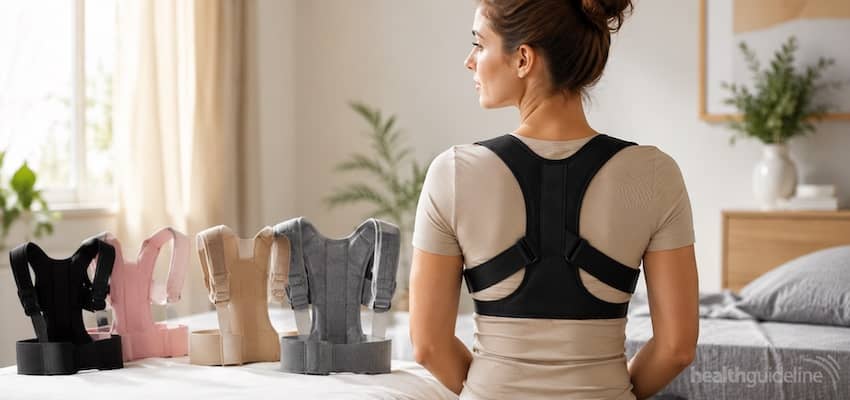
Quick Picks
Best overall:
ComfyBrace Posture Corrector
Comfortable, hugely popular, lifetime warranty, easy on the wallet.
Best for beginners:
Truweo Posture Corrector
The simplest strap to put on and the cheapest way to start.
Best smart trainer (no strap):
Upright GO 2
A sensor that buzzes when you slouch and tracks progress in an app.
Best lightweight everyday:
Gaiam Restore Posture Corrector
A padded, low-profile strap from a well-known wellness brand.
Reality check: a corrector is a reminder, not a cure. Pair short daily sessions with strengthening exercises.
If your shoulders round forward after a long day at a desk, a posture corrector can be a genuinely useful nudge toward sitting and standing taller. But the marketing around these braces oversells them, so this guide does two things: it recommends five real, currently available options for different needs and budgets, and it’s honest about what a brace can and can’t do — backed by what physical therapists and the research actually say.
Do posture corrector braces actually work?
Posture corrector braces don’t permanently fix your posture on their own. They work as a physical reminder that cues you to straighten up, building short-term awareness of your alignment. The evidence for lasting change is mixed, so clinicians recommend wearing one briefly each day alongside strengthening exercises — not as a standalone cure.
That’s the honest headline. The rest of this article covers which brace fits which person, how to use one without doing more harm than good, and when you should skip the brace and see a professional instead. There’s a fuller look at the evidence further down.
How we chose these posture correctors
These picks are based on hands-off research rather than a lab test: we compared design and coverage (upper-back only vs. full-back vs. sensor-based), comfort and breathability, ease of putting the brace on solo, fit range, and the balance of positive and critical feedback across major retailers. We prioritized products that are genuinely available on Amazon at the time of writing, and we deliberately included different types of corrector so you can match one to your actual need. We also cross-checked our guidance on effectiveness and safe wear-time against physical-therapy sources.
Top posture correctors at a glance
| Product | Best for | Type / key feature | Approx. price* | Rating | Link |
|---|---|---|---|---|---|
| ComfyBrace | Most people; everyday use | Upper-back shoulder strap; fits ~30–43" chest; lifetime warranty | Under $30 | Check on Amazon | View |
| Truweo | Beginners; tight budgets | Simple upper-back strap; on/off like a backpack | ~$20–25 | Check on Amazon | View |
| FlexGuard | Firmer support; desk workers | Shoulder corrector + lower-back band; multiple sizes | ~$30 | Check on Amazon | View |
| Upright GO 2 | Tech-minded users | Strapless sensor; vibrates on slouch; app tracking | $70+ | Check on Amazon | View |
| Gaiam Restore | Discreet everyday wear | Padded mesh shoulder strap; one size fits most | ~$20–30 | Check on Amazon | View |
01 / Best overall
1. ComfyBrace Posture Corrector — Best overall
The ComfyBrace is a lightweight figure-eight shoulder brace and one of the most popular posture correctors on Amazon. It gently draws your shoulders back to reduce slouching, fits chest sizes of roughly 30–43 inches, and comes with a lifetime warranty. Breathable fabric makes it easy to wear discreetly under clothing for short daily sessions.
Key features:
- Adjustable figure-eight straps
- breathable, soft fabric
- wide one-size-fits-most range (~30–43″)
- lifetime warranty.
Pros:
- Comfortable and low-profile under clothes
- broad fit range
- strong warranty
- budget-friendly
- huge amount of buyer feedback to read through.
Cons:
- Can press on the armpits if over-tightened
- a little awkward to put on by yourself at first
- provides light support only, not structural correction.
Best for: Most people who want a comfortable, affordable everyday corrector for mild-to-moderate rounded-shoulder posture.
02 / Best for beginners
2. Truweo Posture Corrector — Best for beginners
The Truweo is a simple, no-frills upper-back strap that’s easy to put on like a backpack — a good entry point if you’ve never used a corrector. It targets the shoulders and clavicle to counter rounded-shoulder posture. There’s little rigid structure or lumbar support, so it suits mild slouching rather than firm correction.
Key features:
- Minimalist upper-back design
- hook-and-loop shoulder straps
- lightweight
- put on and adjust in seconds.
Pros:
- Very easy to put on and take off
- discreet under clothing
- among the cheapest options
- forgiving for first-timers.
Cons:
- Minimal structure and no lower-back support
- sizing can feel tight on larger frames
- upper-back focus only.
Best for: First-time users and anyone on a tight budget who wants the simplest possible option.
03 / Best for firmer, full-back support
3. FlexGuard Posture Corrector — Best for firmer, full-back support
FlexGuard combines a shoulder posture corrector with a lower-back support band, so it covers both the upper back and the lumbar region. That makes it a firmer, more structured option for people who want more than a light shoulder pull — useful during long desk days — though it’s bulkier and less discreet than minimalist straps.
Key features:
- Combined shoulder-and-lumbar design
- adjustable straps and waistband
- available in multiple sizes
- breathable fabric.
Pros:
- Supports the upper and lower back together
- firmer, more structured feel
- size options for a better fit
- suits longer wear during desk work.
Cons:
- Bulkier and harder to hide under clothing
- can feel restrictive
- more support than mild slouchers actually need.
Best for: Desk workers and anyone who wants firmer upper- and lower-back support in a single brace.
04 / Best smart posture trainer
4. Upright GO 2 — Best smart posture trainer
The Upright GO 2 skips straps entirely: a small sensor sticks to your upper back and vibrates when you slouch, pairing with a phone app that tracks your posture and sets training goals. It trains awareness rather than physically holding you in place, and it’s the priciest pick here — better suited to tech-minded users.
Key features:
- Strapless adhesive sensor
- real-time vibration feedback
- iOS/Android app with tracking and training plans
- rechargeable battery.
Pros:
- Discreet and nothing worn over clothes
- actively builds awareness through feedback
- app charts your progress
- a genuinely different approach to correction.
Cons:
- The most expensive option here
- needs a phone, app and recharging
- adhesive pads wear out and need replacing
- offers no physical support if that’s what you want.
Best for: Tech-minded users who’d rather train posture awareness than wear a strap. (Manufacturer claims about how fast it works are marketing, not independent proof — see the evidence section below.)
05 / Best lightweight everyday pick
5. Gaiam Restore Posture Corrector — Best lightweight everyday pick
From the well-known wellness brand Gaiam, the Restore is a padded, breathable shoulder strap designed to sit comfortably under clothes for everyday wear. Adjustable mesh straps pull the shoulders back without digging in, and the one-size-fits-most design keeps things simple. Like other straps, it’s a gentle reminder rather than a rigid brace.
Key features:
- Padded, breathable mesh straps
- adjustable fit
- low-profile under clothing
- from an established wellness brand.
Pros:
- Comfortable padded straps that resist chafing
- discreet for all-day wear
- simple to adjust
- recognizable brand.
Cons:
- One-size design won’t suit every body
- gentle support only
- not built for firm correction or lower-back needs.
Best for: Everyday wearers who want a comfortable, low-profile strap from a known brand.
What to look for when buying a posture corrector
The area you need to support
Correctors target different regions. Most are upper-back straps that pull the shoulders back to fight a rounded, hunched look. Some add a lumbar band for the lower back, and sensor devices simply cue you to reset. Figure out where your slouch actually comes from — rounded shoulders and a forward-drifting neck point to an upper-back strap; a lower-back ache when sitting points to something with lumbar support.
Comfort and breathability
This matters more than any feature, because an uncomfortable brace is one you’ll never wear. Look for soft, breathable material and padded straps that won’t dig into your armpits, especially if you plan to wear it under a shirt for stretches at a time.
How easy it is to put on
You’ll usually be putting the brace on yourself, so avoid complicated designs. A strap you can slip on like a backpack and adjust in seconds is far more likely to become a habit than a contraption with a dozen buckles.
Fit and sizing
A corrector only works when it fits. Many are “one size fits most,” but check the chest or torso measurements against your own — several popular models run tight on larger frames. When a product offers multiple sizes, measure first and order accordingly.
Flexible strap vs. structured brace
Light straps are best for mild slouching and general awareness. More structured braces with rigid supports give a firmer hold that some people prefer for desk work, but they’re bulkier and easier to over-rely on. Firmer isn’t automatically better.
Price
Simple straps typically run from about $15 to $35, while sensor-based trainers cost considerably more. A higher price mostly buys electronics and app features, not better posture — so match the spend to how you’ll actually use it.
Do posture correctors really work? What the evidence says
So, do they actually work? The honest answer from clinicians is: only partly, and only as one piece of the puzzle. Physical therapists at the Hospital for Special Surgery describe posture correctors as tools that build proprioception — your sense of where your body is in space — so you notice when you’ve slumped and can reset. That awareness is real and useful, but it isn’t the same as permanently retraining your posture.
The research is genuinely mixed. A 2019 systematic review in BMC Musculoskeletal Disorders looked at 37 studies of wearable posture devices and found that most tested whether the technology worked, not whether it produced lasting clinical improvement. A 2025 review in Prosthetics and Orthotics International examined 10 studies covering about 450 people and found that orthotic devices could improve spinal-alignment measures for forward head posture — but the studies were mostly medium quality, and none followed participants beyond three months. In short: some short-term signal, and very little long-term proof.
There’s also a catch experts consistently flag: lean on a brace too hard and the muscles that should be holding you upright can switch off. That’s why physical therapists and physicians — including guidance summarized by GoodRx, whose article was reviewed by a licensed physical therapist and a physician — recommend wearing a corrector for limited periods and pairing it with exercises that strengthen the upper back, shoulders and core. The brace is the training wheels; your muscles do the riding.
How to use a posture corrector safely
Start small. Most manufacturers and clinicians suggest wearing a corrector for about 15 minutes at first, then gradually building up to roughly 30–60 minutes a day as your body adjusts. Wearing one all day, every day is not recommended — overuse is what can lead to muscle reliance. Don’t sleep in a posture corrector. Use it during the activities where your posture actually slips, like desk work or scrolling on your phone, and take it off once you’ve built some awareness. Most importantly, treat it as a companion to movement: regular breaks to stand and stretch, plus targeted strengthening, do more for your posture than any strap.
When to see a professional
A posture corrector is a wellness aid, not a medical treatment. Talk to a doctor or physical therapist before relying on one if you have back or neck pain that is severe, persistent, or getting worse; pain that radiates into your arms or legs, or comes with numbness, tingling or weakness; pain that started after a fall or injury; or a diagnosed spinal condition such as scoliosis or significant kyphosis. These situations need a proper assessment — a brace bought online isn’t a substitute, and the right exercises or care will depend on what’s actually going on.
Frequently asked questions
Do posture correctors actually fix your posture?
Not by themselves. A corrector cues you to straighten up and builds short-term awareness of your alignment, but evidence for permanent change is limited. Lasting improvement comes from strengthening the muscles that hold you upright. Think of a corrector as a reminder you pair with exercise, not a one-step fix.
How long should you wear a posture corrector each day?
Start with about 15 minutes and build up to roughly 30–60 minutes a day. Wearing one for hours on end, every day, is discouraged because your muscles can start to rely on the support. Use it during posture-challenging tasks like desk work, then take it off.
Can you sleep in a posture corrector?
No. Posture correctors are designed for waking use while you sit, stand or move, and physical therapists advise against wearing them to bed. Sleeping in one offers no proven benefit and can restrict comfort and circulation. For sleep, focus instead on a supportive mattress and pillow setup.
Can a posture corrector weaken your muscles?
It can, if you overuse it. When a brace does the work of holding you upright for long stretches, the muscles that should do that job can become less active over time. That’s why clinicians recommend short daily sessions combined with strengthening exercises rather than all-day wear.
Do posture correctors help with back or neck pain?
Some people feel temporary relief because the brace reduces the slouching that strains the neck and upper back. But the evidence is mixed, and a corrector doesn’t treat the underlying cause of pain. If pain is persistent, severe or spreading, see a healthcare professional rather than relying on a brace.
How soon will you see results?
Some brands advertise changes within a couple of weeks, but this varies a lot between people and isn’t guaranteed. Any early “results” are usually improved awareness rather than structural change. Consistent use alongside strengthening, over weeks to months, is what tends to make a difference.
Medical disclaimer: This article is for general information only and is not medical advice. Talk to a qualified healthcare professional about your specific situation.