Zamst A2-DX Ankle Brace Review (2026): Is It Worth It?
The Zamst A2-DX is the best pick for anyone with a real history of ankle sprains or chronic instability who plays cutting-and-jumping sports — it’s Zamst’s strongest brace and genuinely controls the inward/outward rolls that cause sprains. If you want something lighter for everyday wear, the Aircast A60 is the low-profile alternative; the Med Spec ASO is the best-value lace-up; the McDavid 195 is the budget choice; and the Bauerfeind MalleoTrain is best for chronic aches and swelling.
If you’ve rolled your ankle badly — or keep rolling it — you’ve probably landed on the Zamst A2-DX. It’s the brace NBA guard Stephen Curry has worn on both ankles since his 2011 ligament surgery, and it shows up on nearly every “best ankle brace” list. But it’s also one of the priciest and bulkiest options out there, so the real question is whether it’s right for you. This review covers exactly who the A2-DX is built for, its honest pros and cons, how to get the sizing right, and four alternatives worth considering at different support levels and budgets.
How we chose
We compared ankle braces on the things that actually matter for a sprain-prone ankle: how well they limit inversion and eversion (the inward/outward rolls behind most sprains), the strength of the injury-prevention evidence, comfort and mobility, fit and sizing, and real-world feedback from athletes, athletic trainers, and post-injury users. Every product below was verified as currently sold on Amazon at the time of writing, and the medical claims are grounded in sports-medicine sources rather than marketing copy. We don’t earn a commission on these links — picks are based on fit, not payout.
Top picks at a glance
| Brace | Best for | Support level | Standout feature | Amazon |
|---|---|---|---|---|
| Zamst A2-DX | High/severe sprains & chronic instability; basketball, volleyball | Maximum (rigid guards) | Exo-Grid molded side guards + X-straps | View |
| Aircast A60 | Everyday wear & sprain prevention | Mild–moderate (semirigid) | Low-profile 60° stabilizers, one-strap | View |
| Med Spec ASO | Best-value all-round support | Moderate (lace-up) | Figure-8 straps mimic taping | View |
| McDavid 195 | Budget lace-up support | Moderate (lace-up) | Figure-6 strapping, very light | View |
| Bauerfeind MalleoTrain | Chronic pain, swelling, mild instability | Light (compression knit) | Medical-grade knit + gel pads | View |
01 / Best overall for serious ankle support
Zamst A2-DX — Best overall for serious ankle support
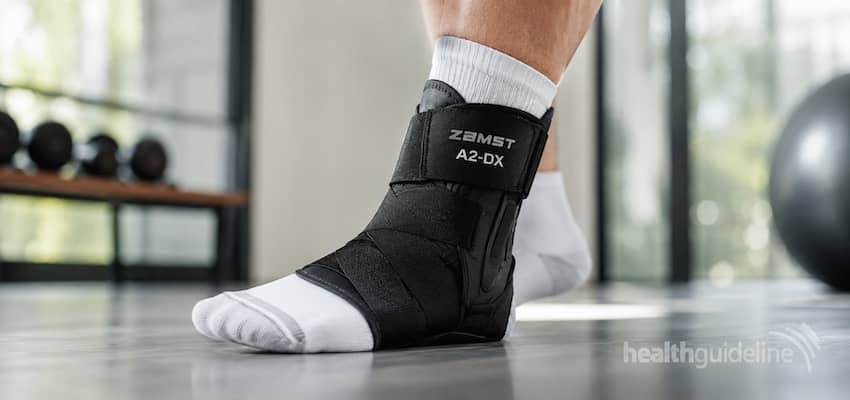
The Zamst A2-DX is Zamst’s strongest ankle brace, built for high ankle sprains, chronic instability, and cutting-and-jumping sports. Rigid Exo-Grid guards block the inward and outward rolls that cause sprains, while a pre-curved shape and dual X-strap stabilizers keep you moving. It’s the best choice if you’ve had real sprains and want maximum protection.
How it works. Two molded exterior guards (Zamst calls this Exo-Grid) sit on either side of the ankle to resist inversion and eversion, while the X-strap stabilizers add three-way support and an anti-slip plantar strap keeps the foot from sliding forward. The brace is left/right-specific for an anatomical fit, uses a rear-entry design that’s easy to adjust, and is pre-curved so you keep near-normal up-and-down motion. It’s rated for moderate-to-severe and high ankle sprains and chronic ankle instability.
The Stephen Curry connection. The A2-DX is closely associated with Steph Curry, who has a longstanding endorsement deal with Zamst and has worn one on each ankle since his 2011 ankle surgery. Worth keeping in perspective: it’s a paid endorsement, so treat it as a signal that pros trust the brace, not as independent proof — the design and evidence below matter more.
Key features:
- Exo-Grid molded side guards
- dual X-strap stabilizers (3-way support)
- left/right-specific design
- pre-curved for range of motion
- breathable, low-profile, anti-microbial materials
- sizes S–XL.
Pros:
- The strongest, most reassuring support of this group
- genuinely controls the sprain motion
- anatomical left/right fit
- keeps good mobility for a rigid brace
- trusted by athletes and post-op users.
Cons:
- The most expensive option
- bulkier — some people size up their shoe or wear a thin sock underneath
- takes a little practice to put on and dial in
- can feel like overkill for a minor tweak
- usually sold as a single brace, not a pair.
Best for: Basketball, volleyball, soccer and football players, and anyone with a history of moderate-to-severe or high ankle sprains or chronic instability.
Not for: A first-time minor sprain, or anyone who wants the lightest, least-noticeable support — the Aircast A60 or a compression sleeve makes more sense there.
Zamst A2-DX Ankle Brace — view on Amazon (check current price; select your side + size)
02 / Best low-profile brace for everyday wear
Aircast A60 — Best low-profile brace for everyday wear
The Aircast A60 is a low-profile semirigid brace that gives lighter support for daily wear and sprain prevention. Molded 60-degree side stabilizers guard against rolls while allowing normal up-and-down motion, and a single strap makes it quick to put on. It slips into most shoes with minimal bulk.
Pros:
- Slim enough for most shoes
- fast one-strap application
- breathable
- good for daily prevention and mild instability
- a well-studied semirigid design.
Cons:
- Milder support — not enough for severe instability or high-grade sprains
- the single strap can loosen during hard play
- the side stabilizers rub some users.
Best for: Everyday activity, lighter sports, or stepping down from a stronger brace as you recover.
Aircast A60 Ankle Support — view on Amazon (check current price; select your side + size)
03 / Best value lace-up
Med Spec ASO — Best value lace-up
The Med Spec ASO is a lace-up stabilizer widely recommended by athletic trainers. Figure-8 straps mimic athletic taping to limit inversion, and the bilateral design fits either foot. It’s a proven, affordable middle ground: more adjustable than a sleeve, less bulky than rigid-guard braces, and easy to re-tighten mid-game.
Pros:
- A trainer and clinic favorite
- figure-8 straps give real inversion control
- fits either foot
- affordable
- low-profile enough for most shoes.
Cons:
- Lace-up takes longer to put on
- laces and straps loosen over time and need re-tightening
- less rigid than guard-style braces
- check the size chart, as fit runs specific.
Best for: Reliable, budget-conscious sprain support and recovery across most sports.
Med Spec ASO Ankle Stabilizer — view on Amazon (check current price; select your size)
04 / Best budget lace-up
McDavid 195 — Best budget lace-up
The McDavid 195 is a budget-friendly lace-up with a figure-6 strap system that simulates athletic tape. The manufacturer cites an independent university study in which athletes had roughly three times fewer injuries while wearing it. It’s lightweight, fits inside shoes, and adjusts without unlacing — solid value for sprain protection.
Pros:
- Great value
- very light
- strapping replaces taping
- adjustable without unlacing
- fits in cleats and high-tops.
Cons:
- Less rigid than the Zamst
- the “3x fewer injuries” figure is manufacturer-cited rather than independent consensus
- strap durability varies with heavy use
- some find it runs warm.
Best for: Budget buyers who want tape-like support they can re-tighten mid-game.
McDavid 195 Ultralight Ankle Brace — view on Amazon (check current price; select your size)
05 / Best for chronic pain and swelling
Bauerfeind MalleoTrain — Best for chronic pain and swelling
The Bauerfeind MalleoTrain is a medical-grade knit sleeve focused on compression and comfort rather than rigid lockdown. It helps ease pain and swelling, supports proprioception, and two pads cushion the ankle bones. It’s best for chronic aches, mild instability, arthritis, or recovery days when you want gentle support instead of maximum restriction.
Pros:
- Comfortable medical-grade compression
- helps pain and swelling
- supports proprioception
- low-profile and machine-washable
- FSA/HSA eligible.
Cons:
- Not a lockdown brace — it won’t stop a hard roll the way rigid guards do
- the pull-on knit is snug to get on
- needs correct sizing for the right compression
- pricier than a basic sleeve.
Best for: Chronic ankle aches, arthritis, swelling, mild instability, or gentler recovery-day support.
Bauerfeind MalleoTrain — view on Amazon (check current price; select your side + size)
What to look for when buying an ankle brace
Match the support level to your injury
Ankle supports run along a spectrum: compression sleeves (light, for aches and swelling), lace-up braces (moderate, tape-like control), semirigid braces with molded stabilizers (moderate, like the Aircast A60), and rigid-guard braces (maximum, like the Zamst A2-DX). More support means more restriction and bulk, so pick the least you need for your situation rather than the most.
First sprain vs. recurring instability
This is the biggest factor. The evidence for bracing is strongest for people who’ve already sprained an ankle or have chronic instability. If you’re recovering from a significant sprain or roll your ankle repeatedly, a stronger brace like the A2-DX or a lace-up ASO makes sense. For a one-off minor tweak, a lighter option is usually enough.
Sport, footwear, and fit
Rigid braces can be tight inside low-top shoes or cleats — many A2-DX users size up half a size or wear a thin sock under the brace. Lace-ups and the low-profile Aircast tend to fit more easily. Also check whether a brace is left/right-specific (Zamst, Aircast, Bauerfeind) or bilateral (ASO, McDavid), and always follow the manufacturer’s size chart, which is usually keyed to your shoe size.
Do ankle braces actually work? What the evidence says
Lateral (inversion) ankle sprains are among the most common injuries in sports, and after a first sprain a meaningful share of people go on to develop chronic ankle instability. That’s where bracing earns its keep.
The honest picture from sports-medicine research: braces are best at preventing recurrent sprains, not first-ever ones. Systematic reviews suggest bracing can cut the recurrence rate by roughly half, and one 2025 review reported a large reduction in recurrent injuries and a smaller reduction in first-time injuries, along with less severe sprains when they do happen. The American Academy of Family Physicians notes there’s good evidence that semirigid braces help prevent sprains in high-risk sports like basketball and soccer, and that functional braces are recommended over immobilization for treating acute sprains. The American Academy of Orthopaedic Surgeons similarly says taping or a brace can help avoid repeat sprains if you’ve had them before.
Two caveats keep this honest. First, no brace truly “prevents” injury — it reduces risk. Second, a brace works best alongside rehab and balance (neuromuscular) training; studies find bracing and balance training each reduce recurrence by a similar amount, and combining them is better than relying on hardware alone. A brace is a tool, not a cure. For more on healing, see our guide to ankle sprain recovery time.
When to see a professional
See a doctor, physical therapist, or athletic trainer — rather than self-treating with a brace — if you can’t bear weight on the ankle, have severe swelling or bruising, feel numbness or tingling, notice an obvious deformity, or if pain and instability aren’t improving after a couple of weeks. These can signal a more serious ligament tear or fracture that needs proper evaluation. A brace can support recovery, but it isn’t a substitute for a diagnosis.
Frequently asked questions
Is the Zamst A2-DX worth it?
For the right person, yes. If you’ve had moderate-to-severe or high ankle sprains, or you deal with chronic instability in cutting-and-jumping sports, the A2-DX offers the strongest, most reassuring support of the popular options. If you only need light everyday protection, a cheaper, lighter brace like the Aircast A60 is the smarter buy.
What ankle brace does Stephen Curry wear?
Stephen Curry wears the Zamst A2-DX — one on each ankle — and has since his 2011 ankle surgery. Curry has a longstanding endorsement deal with Zamst, so it’s a paid partnership as well as a personal choice. It’s a fair signal that the brace holds up at an elite level, but the design and clinical evidence matter more than the celebrity name.
Does the Zamst A2-DX help with high ankle sprains?
It’s designed for exactly that. The A2-DX is Zamst’s strongest brace, rated for high ankle sprains and chronic instability, with rigid Exo-Grid guards that limit the inward and outward rolls behind most sprains. It supports recovery and helps reduce re-injury risk, but a suspected high ankle sprain should still be evaluated by a professional.
Can you wear the Zamst A2-DX in basketball shoes?
Yes, though it’s on the bulkier side. Many players wear it comfortably in high-tops; some size up half a size or wear a thin sock under the brace to fine-tune the fit. If you play in low-tops or tight cleats, a slimmer option like the Aircast A60 or a lace-up ASO may fit more easily.
Do ankle braces weaken your ankles over time?
There’s no strong evidence that braces weaken healthy ankles, and they don’t appear to increase knee injuries. The best approach is to pair a brace with strengthening and balance exercises so you build stability rather than relying on the brace alone — especially once you’re past the acute phase of an injury.
How do I choose the right size?
Follow the manufacturer’s size chart, which is usually based on your shoe size. Note that the Zamst A2-DX, Aircast A60, and Bauerfeind MalleoTrain are left/right-specific, while the Med Spec ASO and McDavid 195 fit either foot. When you’re between sizes, check the brand’s guidance — for compression sleeves, sizing down gives firmer compression.
Medical disclaimer: This article is for general information only and is not medical advice. Ankle braces support recovery and injury prevention but don’t replace professional care. Talk to a qualified healthcare professional about your specific situation, especially after an acute injury.