Liquid Collagen vs Powder: Which Is Better in 2026?
Updated September 2026 · evidence-based comparison
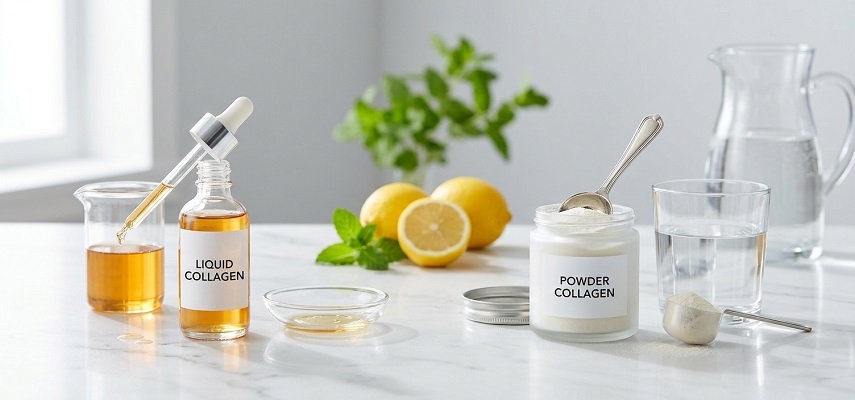
Liquid collagen vs powder: neither format has been proven to work better simply because it is liquid or dry. Both can deliver hydrolyzed collagen peptides, and there is no good human head-to-head evidence showing that pre-mixed liquid collagen is absorbed better than collagen powder mixed into a drink. For most people, the practical choice comes down to dose, ingredients, convenience, cost per serving and product quality.
Quick answer: is liquid collagen or powder better?
Best for convenience
Liquid collagen
Ready-to-drink shots or bottles can be easier when you do not want to measure or mix a serving.
Best for flexibility
Collagen powder
Powder lets you choose what to mix it with and makes it easier to compare the amount of collagen per serving.
What matters most
The label, not the format
Compare the collagen dose, source, added ingredients, allergens, quality testing and how consistently you can take it.
JUMP TO A SECTION
Liquid collagen vs powder: what is the actual difference?
The main difference is the delivery format. Liquid collagen is already dissolved or suspended in a drink, while collagen powder is dry until you mix it into water, coffee, a smoothie or food. Either format may contain hydrolyzed collagen peptides, so “liquid” by itself does not tell you that the collagen is more effective, more concentrated or better absorbed.
| Factor | Liquid collagen | Collagen powder |
|---|---|---|
| Form | Pre-mixed drink, shot or concentrate | Dry powder mixed before use |
| Absorption evidence | No high-quality head-to-head evidence proves the liquid format is superior | No high-quality head-to-head evidence proves powder is superior |
| Dose flexibility | Usually tied to the bottle or serving size on the label | Often easier to measure and adjust within label directions |
| Added ingredients | May contain flavors, sweeteners, acids, preservatives, vitamins or other ingredients | May be single-ingredient or flavored; check the label |
| Convenience | Ready to drink and easy to take away from home | Requires mixing, but can be added to many foods and drinks |
| Storage | Depends on the product; some opened liquids require refrigeration | Typically stored dry according to label directions |
| Best comparison metric | Collagen grams per serving, ingredient list and cost per gram | Collagen grams per serving, ingredient list and cost per gram |
Bottom line: if two products provide a similar type and amount of hydrolyzed collagen, the fact that one starts in a bottle and the other starts as powder does not by itself establish a meaningful biological advantage. Choose the format you can use consistently and evaluate the actual Supplement Facts panel.
If you prefer powder, our collagen powder guide covers that format in more detail. For ready-to-drink options, see our guide to liquid collagen drinks.
Is liquid collagen absorbed better than powder?
There is no strong human evidence that pre-mixed liquid collagen is absorbed better than collagen powder simply because it is liquid. Oral collagen products commonly use hydrolyzed collagen, which has already been broken into smaller peptides. Powder is usually dissolved in a liquid before it is swallowed, so claims that a ready-made drink automatically has superior bioavailability need evidence from direct comparisons.
A 2024 randomized crossover study found that after people consumed hydrolyzed collagen dissolved in water, collagen-related amino acids and small peptides appeared in the bloodstream. The study compared collagen sources and molecular weights, not commercial liquid versus powder formats, so it cannot be used to claim that one dosage form wins. Read the study on PubMed.
Watch for marketing language. “Liquid absorbs faster,” “100% bioavailable” or similar claims can sound scientific, but the relevant question is whether the exact product and dose were compared with powder in people. A format claim is not the same as clinical evidence.
Does collagen supplementation actually work?
The evidence is promising in some areas but not settled. Research has focused much more on oral hydrolyzed collagen peptides than on liquid-versus-powder format. Recent reviews report possible benefits for skin hydration and elasticity and some musculoskeletal outcomes, but study quality, product differences, short follow-up periods and industry funding make the size and reliability of those benefits uncertain.
What does the evidence say about skin?
A 2026 updated meta-analysis of 35 randomized controlled trials involving 2,534 participants found statistically significant improvements in skin hydration and elasticity with oral collagen peptides. The same analysis found that apparent improvements in wrinkles and dermal density were not robust after more rigorous sensitivity analyses, and it emphasized substantial differences between studies. See the 2026 review.
There is also important conflicting evidence. A 2025 systematic review and meta-analysis of 23 randomized trials found benefits when all studies were pooled, but no significant skin-aging benefit in non-industry-funded studies or in the higher-quality trials. The authors concluded that current clinical evidence did not support collagen supplements for preventing or treating skin aging. See the American Journal of Medicine analysis on PubMed.
What should you take from conflicting reviews?
It is reasonable to say that oral collagen peptides may improve some measured skin outcomes, especially hydration and elasticity, but the evidence does not justify promising dramatic wrinkle reversal or assuming every product will work. The studies evaluate different collagen sources, doses, peptide profiles and added ingredients, so results from one formulation should not automatically be applied to another.
If your main goal is skin appearance, our collagen supplement for sagging skin guide discusses product-selection issues, but collagen should not be treated as a proven anti-aging therapy.
What about joints, bone and muscle?
A 2026 umbrella review covering 16 systematic reviews, 113 randomized trials and 7,983 participants reported favorable findings across several dermal and musculoskeletal outcomes, while noting mixed results in other health areas. That broad evidence base is about collagen supplementation, not about whether a bottle is superior to a scoop. Read the umbrella review on PubMed.
What about hair and nails?
Claims about collagen specifically causing hair growth remain much less certain than the marketing suggests. Recent reviews of oral nutraceuticals for hair loss evaluate many multi-ingredient products, which makes it difficult to isolate collagen as the active cause of any improvement. If hair loss is your main concern, see our separate guide to collagen for hair growth and consider an evaluation for common medical or nutritional causes rather than relying on collagen alone.
How should you choose between liquid collagen and powder?
Choose by comparing the actual serving, ingredient list and routine. Since format alone does not establish superior absorption or results, a practical decision is more useful than a “liquid always wins” or “powder always wins” rule.
- Check the collagen amount per serving. Compare grams of collagen or collagen peptides rather than bottle size, scoop size or marketing terms.
- Identify the collagen source. Common sources include bovine, porcine, chicken and marine/fish collagen. Source matters for dietary preferences and allergies.
- Read the full ingredient list. Liquid products may include sweeteners, flavors, acids, preservatives or added vitamins; powders may be plain or flavored. Neither format is automatically “cleaner.”
- Compare cost per meaningful serving. Do not compare only the sticker price. Divide the price by the number of servings, then consider how much collagen each serving provides.
- Look for independent quality testing when available. The NIH Office of Dietary Supplements notes that programs such as NSF and USP perform quality testing, although a quality seal does not prove that a supplement is effective.
- Pick the routine you can realistically follow. A portable liquid may suit travel or a busy schedule; a powder may fit better if you already make coffee, smoothies or yogurt every day.
For apples-to-apples shopping: compare the same four things across products — collagen grams per serving, source, other ingredients and cost per gram. Those details are more informative than the words “liquid,” “premium,” “beauty blend” or “advanced absorption” on the front label.
Some liquid formulas use branded collagen complexes rather than collagen alone. If you are considering one of those products, our Liquid BioCell collagen guide explains why you should judge the exact formulation rather than assuming it is equivalent to plain hydrolyzed collagen.
Liquid collagen vs powder: pros and cons
Liquid collagen may suit you if…
- You value grab-and-go convenience
- You dislike measuring or mixing powder
- You prefer a flavored ready-to-drink product
Collagen powder may suit you if…
- You want to mix collagen into your own food or drink
- You want easier side-by-side dose comparisons
- You prefer the option of a simple unflavored formula
Neither list proves effectiveness. These are practical differences in how the products are used. Clinical results depend on far more than whether collagen comes pre-mixed or as powder.
Are liquid collagen and collagen powder safe?
Collagen supplements are dietary supplements, not FDA-approved medicines. The U.S. Food and Drug Administration does not approve dietary supplements for safety and effectiveness before they are sold. The FDA advises consumers to discuss supplements with a doctor, pharmacist or other healthcare professional because supplements can cause side effects, interact with medicines or be inappropriate in some situations. FDA consumer guidance.
Check before you start
- Allergies: marine collagen can be unsuitable for people with fish allergies; other animal sources may conflict with dietary or religious restrictions.
- Pregnancy, breastfeeding, medical conditions or medicines: ask a qualified healthcare professional before using a supplement because the exact formula may include ingredients beyond collagen.
- Unexpected symptoms: stop using the product and seek medical advice if you develop a concerning reaction.
The NIH Office of Dietary Supplements recommends reading the Supplement Facts panel and notes that third-party quality seals can help verify identity and manufacturing quality, but they do not guarantee safety or effectiveness. NIH ODS supplement quality guidance.
The verdict: liquid collagen or powder?
Powder is not automatically more effective, and liquid is not automatically better absorbed. If the collagen type and dose are comparable, the most important differences are usually practical: what else is in the formula, how much collagen you get, how much it costs per serving, whether it fits your dietary needs and which format you will use consistently.
If convenience is your priority, a well-labeled ready-to-drink product can make sense. If you want more control over what you mix collagen with and a simple way to compare servings, powder may be the easier choice. Either way, treat collagen as an optional supplement with an evolving evidence base — not as a proven replacement for a balanced diet, medical treatment or established skin-care measures.
Frequently asked questions
Is liquid collagen more effective than powder?
No good human evidence shows that collagen is more effective simply because it comes pre-mixed as a liquid. Most research evaluates oral collagen peptides, not liquid-versus-powder dosage forms. Compare the amount and type of collagen, added ingredients, product quality and your ability to take it consistently rather than assuming the bottle itself creates a benefit.
Does liquid collagen absorb faster than powder?
That claim has not been established by strong head-to-head human trials. Hydrolyzed collagen peptides can be absorbed after oral intake, but powder is commonly dissolved before consumption. Research on peptide absorption does not prove that a commercial ready-to-drink liquid has a clinically meaningful absorption advantage over an equivalent powder mixed with water.
How much collagen should I take?
There is no single universally established daily collagen dose for every goal, and research trials have used different formulations and amounts. Follow the directions for the exact product and discuss supplementation with a healthcare professional if you have a medical condition, take medications, are pregnant or breastfeeding, or are using collagen for a specific health concern.
Can I put collagen powder in hot coffee?
Many hydrolyzed collagen powders are designed to dissolve in hot or cold drinks, but follow the manufacturer’s directions for the specific product. Mixing powder into coffee changes the delivery method, not necessarily its effectiveness. Also consider the rest of your drink if you are trying to limit added sugar, creamers or other ingredients.
Is marine collagen better than bovine collagen?
There is not enough high-quality evidence to say that one animal source is universally better for all outcomes. Source affects the collagen profile, dietary suitability and allergy considerations, while individual products also differ in processing and peptide composition. Choose based on the evidence for the exact formulation, your dietary needs and any allergies.
How long does collagen take to work?
Trials that report skin changes commonly run for several weeks, often around 8 to 12 weeks or longer, but results vary and not everyone will notice a benefit. A 2026 meta-analysis found some skin outcomes appeared time-dependent, while evidence for structural changes such as wrinkles remained inconsistent. Do not treat a fixed timeline as a guarantee.
Is collagen FDA approved?
No. Collagen supplements sold as dietary supplements are not FDA-approved for safety and effectiveness before marketing. Manufacturers are responsible for meeting applicable requirements, and the FDA can take action against unsafe or noncompliant products. That is why label review, reputable manufacturing and professional advice matter when choosing any supplement.
This article is for general information only and is not medical advice. Talk to a qualified healthcare professional about your specific situation.