Aircast A60 Ankle Brace Review: Is It the Right Support for You?
Aircast A60 review · support, fit & comfort
The Aircast A60 is a strong pick for most people who want a lightweight, low-profile brace to prevent ankle rollovers or steady a mildly unstable ankle. It slips inside normal shoes and applies in seconds with one strap. It is not the right tool for a fresh moderate-to-severe sprain or for anyone who needs firm, adjustable lockdown.
If your sport or job involves a lot of footwork, your ankles take the hit. Ankle sprains are among the most common musculoskeletal injuries, and some people develop lingering instability afterward. That is exactly the gap a preventive brace like the Aircast A60 is built to fill. Below is an honest look at what it does well, where it falls short, how to size it, and three alternatives if it is not the right match.
Quick picks
All-day comfort / swelling
Bauerfeind MalleoTrain
A compression-knit approach for chronic instability and swelling.
How we evaluated the A60
We assessed the Aircast A60 against the manufacturer’s specifications and current retail listings, then weighed the factors that matter for an ankle brace: its type and level of support, fit inside everyday shoes, comfort and breathability for long wear, ease of application, and value. We also considered the medical context of when a brace can help and when it cannot.
Aircast A60 at a glance vs. its main rivals
Prices are approximate and move often—always check the current price before ordering. The support levels below are relative comparisons, not medical grades.
| Brace | Best for | Support level | Standout feature | Approx. price | Link |
|---|---|---|---|---|---|
| Aircast A60 | Prevention & mild instability | Mild / low-profile | 60° stabilizers; fits inside shoes | ~$30–$50 | Check price → |
| Med Spec ASO | Maximum support on a budget | Firm (lace-up) | Figure-eight straps; trainer favorite | ~$30–$45 | Check price → |
| Bauerfeind MalleoTrain | Chronic instability & swelling | Compression knit | Medical-grade knit + gel pads | ~$90–$150 | Check price → |
| Zamst A2-DX | High-impact sports | Firm (semi-rigid) | Dual straps + side stays | ~$60–$85 | Check price → |
Choose the least support that meets the job. The A60 is a preventive, mild-support brace. If you need more rigid control after a significant injury, choose a different level of support with advice from a clinician.
Aircast A60 review: what it is and how it works
OUR RATING: 4.3 / 5
Aircast A60 Ankle Support Brace
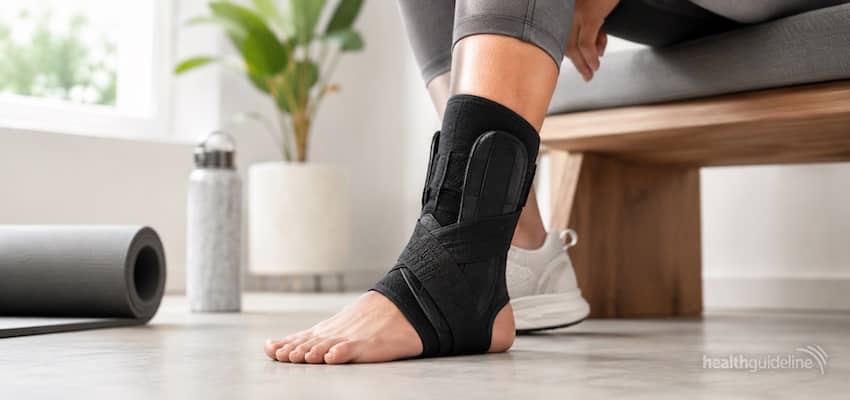
Quick answer: The Aircast A60 is a slim, single-strap ankle support with rigid guards molded at a 60-degree angle on each side of the ankle. They resist the inward roll (inversion) behind many sprains while allowing the forward-and-back movement needed to walk, run, or jump. It is designed for prevention and mild chronic instability, not to immobilize a serious injury.
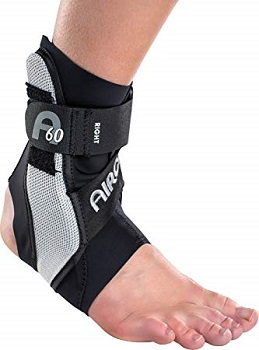
Instead of the time-consuming lacing of a traditional brace, the A60 uses a single strap that tightens in seconds. The shell is lined with breathable, latex-free Breath-O-Prene fabric, and the brace is deliberately low profile so it can fit inside a lace-up shoe. Its two molded side stabilizers sit over the weaker parts of the ankle to limit excessive side-to-side motion without blocking normal flexion. A waterproof version can be worn in water and rinsed clean afterward.
Key features
- Molded 60° stabilizers on both sides for rollover (inversion) protection
- Single adjustable strap that applies in seconds
- Breath-O-Prene breathable, latex-free fabric
- Low-profile fit for use inside most athletic footwear
- Left- and right-specific sizes: Small, Medium and Large
- Standard and waterproof versions available
Pros
- Genuinely low profile and easier to fit inside normal shoes than most braces
- Fast, fuss-free single-strap application
- Comfortable, breathable and light enough for extended wear
- Targeted protection against the sideways rollover that causes sprains
- Waterproof option adds flexibility for wet conditions
Cons
- Mild support only; not enough for a fresh moderate-to-severe sprain
- Side-specific, so you must order the correct foot and buy two for both ankles
- One strap offers less fine adjustment than a lace-up brace
- Can feel snug if your ankle is swollen
- May feel less reassuring than a rigid brace in high-cutting sports
Best for: Preventing ankle sprains during sport, supporting a mildly unstable or “trick” ankle, or easing back into activity after a settled sprain when a professional has cleared you.
Choose the correct left or right foot and size before ordering. Confirm the model, seller, and current price on the listing.
Aircast A60 sizing chart
Sizing is based on shoe size, and each brace is made for a specific foot. If you are between sizes and using the brace purely for sport, the snugger size may give a slimmer fit. If your ankle is currently or often swollen, factor that in—do not size down merely to get more compression.
| Size | Men’s shoe size | Women’s shoe size |
|---|---|---|
| Small | Up to 7 | 5–8.5 |
| Medium | 7.5–11.5 | 9–13 |
| Large | 12+ | 13.5+ |
Ordering reminder: Select the correct foot—Left or Right—when you order. A left brace will not fit correctly on the right foot.
Three alternatives to the Aircast A60
01 / MAXIMUM SUPPORT ON A BUDGET
Med Spec ASO
The lace-up ASO is one of the most commonly recommended ankle braces among trainers and physical therapists. Its ballistic-nylon body, laces, and figure-eight straps provide firm, adjustable support that outmuscles the A60. It is a common option after a Grade I–II sprain or for court sports, although it is bulkier in the shoe and takes longer to put on.
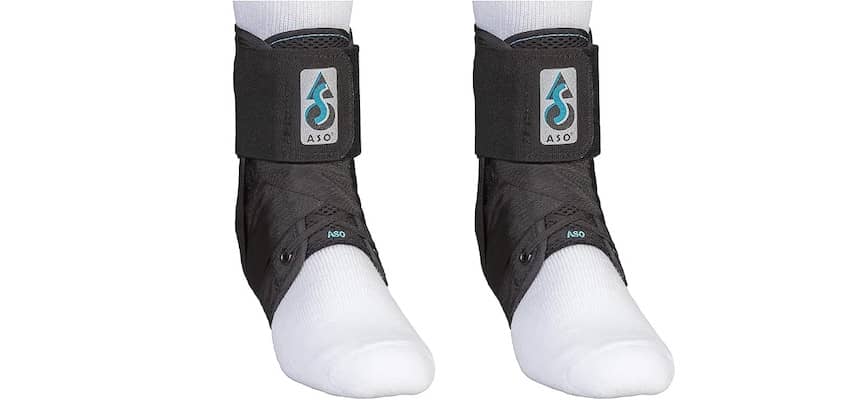
Best for: Firmer, adjustable support at a relatively accessible price.
Read our full ASO ankle brace review.
02 / CHRONIC INSTABILITY & SWELLING
Bauerfeind MalleoTrain
The MalleoTrain takes a different approach: a medical-grade compression knit with viscoelastic pads designed to cushion the ankle and help manage swelling and proprioception. It is the most comfortable option here for all-day and post-recovery wear and is genuinely discreet, but it is also the priciest and can be fiddly to pull on over a sore ankle. Sizing runs XS–XXL and is measured above the ankle bones.
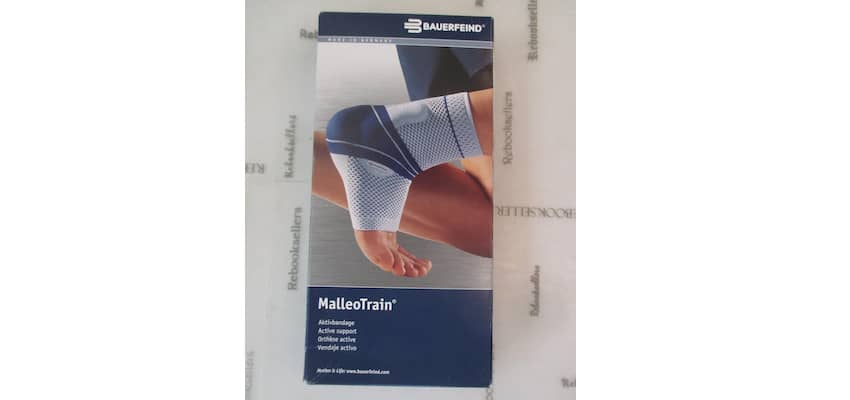
Best for: Chronic instability, swelling, and comfortable all-day support.
03 / HIGH-IMPACT SPORTS
Zamst A2-DX
When you need more than mild support but still need to move, the A2-DX uses dual stabilizing straps and firmer side support to control both low and high ankle motion. It is popular for basketball, volleyball, and other cutting sports, and for returning to play with confidence. It is heavier and pricier than the A60, and it is more brace than a casual user needs.
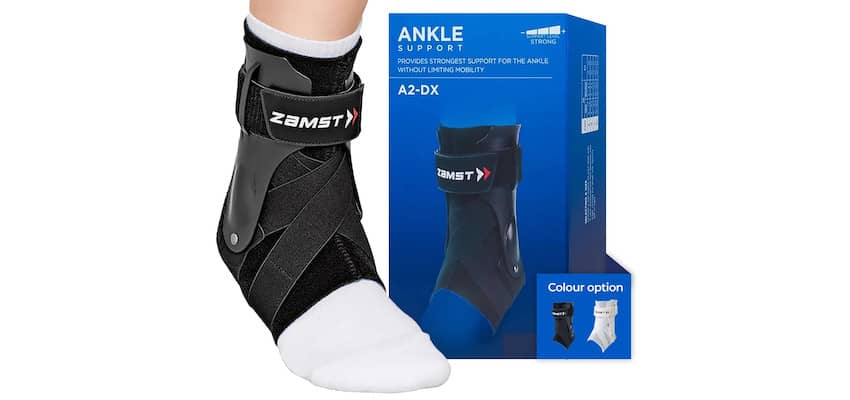
Best for: High-impact or cutting sports that call for firmer support.
See our full Zamst A2-DX review.
Staying in the Aircast family? Aircast also makes the higher-support AirSport and the rigid Air-Stirrup if you like the brand but need more stabilization than the A60 offers.
What to look for when buying an ankle brace
Match the support level to the job
Braces range from light compression sleeves, through low-profile stabilizers like the A60, to firm lace-ups and semi-rigid braces. More support usually means less motion and more bulk. Choose the least support you need for your situation, not automatically the most.
Side-specific vs. universal fit
Some braces, including the A60, are shaped for a specific foot; others fit either foot. Anatomically shaped braces can feel more precise, but they mean ordering the correct side—and two units if you want support for both ankles.
Will it fit in your shoe?
If a brace will not fit inside the footwear you actually wear, you are unlikely to use it. Low-profile designs are worth prioritizing for sport and work. Some people also size up their shoes with built-in ankle support to accommodate a brace.
Breathability and prevention vs. recovery
Breathable fabric matters for long or hot wear. Be clear on the goal: preventing a first or repeat sprain calls for a different brace than recovering from a significant one. The latter usually needs firmer support and professional guidance.
About ankle sprains: when a brace helps, and when to see a professional
Most mild ankle sprains can be managed at home. Rest, ice, compression, and elevation can help limit swelling in the first 48 hours, and a brace may provide consistent daytime support as the ankle heals. Early functional movement is generally preferred over prolonged immobilization for recovery, which is part of why supportive braces can have a role.
A brace is not a treatment for a serious injury
The A60 is a preventive and mild-support tool. See a healthcare professional if pain, swelling, or trouble moving lasts more than a few days. Seek prompt care if you cannot put weight on the ankle or have severe swelling, an obvious deformity, or numbness; these can signal a fracture or a more serious tear.
Frequently asked questions
Is the Aircast A60 good for a sprained ankle?
The A60 offers mild support and is best for preventing sprains, managing mild chronic instability, or easing back into activity once a sprain has calmed down. For a fresh moderate-to-severe sprain, a clinician may favor firmer support, such as a lace-up brace or a walking boot.
Does the Aircast A60 come in left and right versions?
Yes. The A60 is anatomically shaped for a specific foot, so you must choose Left or Right at checkout. Sizing is Small, Medium, or Large based on shoe size, and there is also a waterproof version for wet conditions.
Can you wear the Aircast A60 while running or inside shoes?
Yes. The A60 is deliberately low profile and designed to fit inside most lace-up athletic shoes without much bulk. Many runners and court-sport players use it for prevention; see our best ankle brace for running guide for a running-specific comparison.
Do ankle braces weaken your ankle over time?
There is no strong evidence that normal use of a functional support brace like the A60 weakens a healthy ankle. Concerns about weakening relate more to prolonged full immobilization, such as time in a cast or boot. Bracing is commonly paired with strengthening and balance work guided by a professional.
Aircast A60 vs. ASO: which ankle brace is better?
They suit different needs. The A60 is lighter and lower profile, making it a better fit for prevention and mild instability. The lace-up Med Spec ASO provides firmer, more adjustable support that is often preferred after a sprain or for demanding sports. Choose the A60 for comfort and prevention; choose the ASO for maximum support.
Sources and editorial scope
Product descriptions were assessed against the supplied article, manufacturer specifications, and retail listings. Prices, stock, seller details, and exact variants can change. This article is an editorial buying guide, not a substitute for medical advice or an individual assessment.
Medical disclaimer: This article is for general information only and is not medical advice. Talk to a qualified healthcare professional about your specific situation.