Simien Tennis Elbow Brace Review + 4 Best Alternatives (2026)
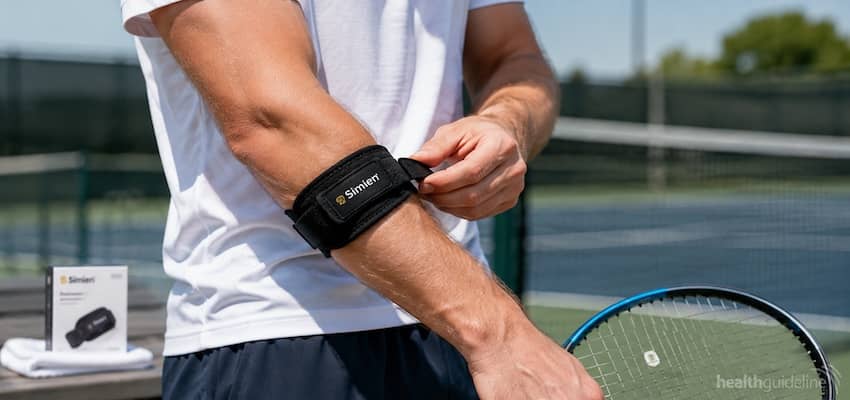
The Simien Tennis Elbow Brace (2-Count) is our best-value pick — a firm gel-pad counterforce strap sold as a pair with a wrist sweatband, so it’s easy on the wallet for everyday relief.
Best-value pick
Simien Tennis Elbow Brace (2-Count)
Best overall strap
Bodyprox Elbow Brace 2 Pack
Best premium
Bauerfeind EpiTrain
Best full sleeve
POWERLIX Elbow Brace
You don’t have to play tennis to get tennis elbow. Typing, lifting, gardening, plumbing, and racket sports all put repetitive strain on the tendons that attach to the outside of your elbow — and a good brace can take the edge off while you recover. This guide reviews the popular Simien Tennis Elbow Brace in detail, then lines up four well-made alternatives so you can match a brace to your arm, your budget, and the way you actually use it.
Is the Simien Tennis Elbow Brace worth buying?
Yes — for most people the Simien is a capable, affordable counterforce strap. The firm gel pad delivers steady pressure over the forearm tendons, the hook-and-loop strap adjusts easily, and the two-pack adds real value. Its limits are the one-size fit, which may not suit very large forearms, and a natural-rubber logo that isn’t latex-free.
How we chose
We focused on braces that are currently sold on Amazon.com in the US and genuinely suit tennis and golfer’s elbow. We prioritised the thing that matters most for this condition — firm, adjustable pressure over the forearm tendons — alongside comfort, fit range, build quality, and honest value. We also checked our guidance on managing tennis elbow against medical authorities including the American Academy of Orthopaedic Surgeons and Cleveland Clinic. We don’t earn commissions on the links below, and no brand paid for placement.
Best tennis elbow braces at a glance
| Brace | Best for | Type & standout feature | Price band | Link |
|---|---|---|---|---|
| Simien Tennis Elbow Brace (2-Count) | Best value / two-pack | Counterforce strap; firm gel pad, comes as a pair + sweatband | Budget | View on Amazon |
| Bodyprox Elbow Brace 2 Pack | Best overall strap | Counterforce strap; contoured EVA pad, very secure fastener | Budget | View on Amazon |
| Sleeve Stars Tennis Elbow Brace | Best fit range | Counterforce strap; 3 interchangeable straps, fits ~9″–23″ | Budget | View on Amazon |
| Bauerfeind EpiTrain | Best premium | Knit sleeve; silicone massage inserts, made in Germany | Premium | View on Amazon |
| POWERLIX Elbow Brace | Best full sleeve | Compression sleeve; 4-way-stretch knit, even all-round pressure | Budget–mid | View on Amazon |
01 / Best value
Simien Tennis Elbow Brace (2-Count) BEST VALUE
The Simien Tennis Elbow Brace is a strap-style counterforce band with a firm gel compression pad and a hook-and-loop closure. It targets the extensor tendons just below the elbow to reduce strain during gripping and lifting. Sold as a two-pack with a wrist sweatband and an e-book, it’s strong value for everyday relief.
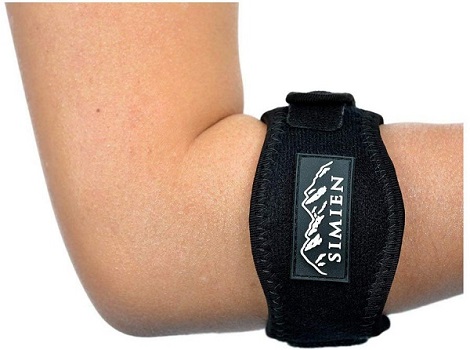
Simien’s design is deliberately simple: a wide strap wraps the upper forearm, and a gel pad concentrates pressure onto the muscle bulge so the sore tendon attachment gets a break. The gel gives a firmer, more consistent squeeze than the air-bladder pads found on some cheaper straps, and because it wraps only a small band of the arm, it breathes well and doesn’t trap heat the way a full neoprene sleeve can.
Key features
- Counterforce strap with a gel compression pad (65% neoprene / 35% nylon)
- Adjustable hook-and-loop strap; one size fits most, left or right arm
- Ships as a two-pack, plus a wrist sweatband and a bonus e-book
- Compact, breathable footprint that layers over a compression sleeve if needed
Pros
- Firm, steady pressure from the gel pad
- Excellent value — two braces plus extras
- Breathable and low-bulk under sleeves
- Simple to position and adjust on the fly
Cons
- One-size design may not suit very large forearms
- The logo uses natural rubber, so it’s not latex-free
- A strap targets one spot — it won’t warm the whole joint like a sleeve
Best for: anyone who wants a proven, budget-friendly counterforce strap — and likes having a spare in the pair.
02 / Best overall strap
Bodyprox Elbow Brace 2 Pack BEST OVERALL STRAP
Bodyprox’s Elbow Brace is a two-pack counterforce strap with a contoured EVA foam pad and a secure hook-and-loop fastener. It applies targeted pressure to the forearm tendons for tennis or golfer’s elbow, stays put during activity, and its simple, durable build makes it an easy, reliable pick for most people.
This is the strap we’d point most first-time buyers toward. The thick EVA pad hugs the contour of the forearm rather than sitting on it, the straps grip firmly without digging in, and it was listed as an Amazon’s Choice item at the time of writing. Bodyprox also spells out pad placement clearly — pad facing outward for tennis elbow, inward for golfer’s elbow — which takes the guesswork out of setup.
Key features
- Two-pack counterforce straps with a contoured EVA compression pad
- Durable nylon / spandex / SBR blend built for repeated use
- Strong hook-and-loop straps that resist loosening mid-activity
- Works for both tennis (lateral) and golfer’s (medial) elbow
Pros
- Very secure, stay-put fit
- Comfortable contoured pad
- Two braces in the box
- Clear placement instructions
Cons
- Single fit range — check the size chart for very slim or large arms
- Foam pad is firm; a few users prefer a softer gel feel
Best for: most people who want one dependable, no-fuss strap for sport, work, or daily tasks.
03 / Best fit range
Sleeve Stars Tennis Elbow Brace BEST FIT RANGE
The Sleeve Stars Tennis Elbow Brace is a counterforce strap with a gel pressure pad that ships with three interchangeable straps to fit forearms from roughly 9 to 23 inches. That wide, fully adjustable range makes it a standout for very slim or larger arms, and it comes in several colours.
Fit is where this one shines. Most straps assume an average forearm; Sleeve Stars includes multiple strap lengths so you can dial in a snug hold whether your arm is petite or well above average. It was a top seller in its category at the time of writing, and the gel pad plus adjustable “bandit” straps make it easy to reposition as pain or activity changes through the day.
Key features
- Counterforce strap with a targeted gel compression pad
- Three interchangeable straps — fits roughly 9″–23″ forearms
- Fully adjustable hook-and-loop closure
- Multiple colour options
Pros
- Exceptional fit range for unusual arm sizes
- Easy to reposition and re-tension
- Single-brace option keeps the price low
Cons
- Sold as a single brace, not a pair
- Swapping straps to find your size takes a little trial and error
Best for: anyone with very slim or larger-than-average forearms who struggles to get a one-size strap to sit right.
04 / Best premium
Bauerfeind EpiTrain BEST PREMIUM
The Bauerfeind EpiTrain is a medical-grade knit sleeve, made in Germany, with two silicone inserts that massage the tendon area as you move. Its breathable, graduated-compression fabric resists slipping and skin irritation better than neoprene. It’s the priciest option here, but a strong choice for chronic pain and all-day wear.
This is a different class of product from the straps above. Instead of a single pressure point, the EpiTrain uses an anatomically knitted sleeve with pressure-reduced edges and two contoured silicone pads that gently knead the sore tissue during movement. The knit is soft, breathable and moves with you, which is why many people who wear a brace all day — or who find neoprene itchy — end up here. It’s sized (0–6) by forearm circumference, so measure before you order.
Key features
- Breathable knit sleeve with graduated compression
- Two anatomically shaped silicone massage inserts
- Pressure-reduced edges that resist slipping and rolling
- Seven sizes (0–6) — measure your forearm to fit
Pros
- Premium build and materials; made in Germany
- Comfortable for long, all-day wear
- Softer on skin than neoprene straps
- Precise, size-specific fit
Cons
- Much pricier than the strap options
- Must measure and order the correct size
- A sleeve is fiddlier to put on than a wrap-around strap
Best for: chronic or persistent elbow pain, all-day wear, or anyone who wants a medical-brand sleeve over a budget strap.
05 / Best full sleeve
POWERLIX Elbow Brace Compression Sleeve BEST FULL SLEEVE
The POWERLIX Elbow Brace is a pull-on compression sleeve rather than a strap, using a four-way-stretch knit to deliver even pressure and warmth across the whole joint. It suits arthritis, general soreness, and desk work where a full sleeve feels better than a targeted band, and it moves freely without slipping.
If a strap feels too pinpoint for you, a sleeve spreads gentle, warming compression over the entire elbow. POWERLIX’s four-way-stretch fabric wicks sweat, stays put with an anti-slip design, and allows a full range of motion — handy for typing, light workouts, or simply keeping a stiff joint warm through the day. It’s the most versatile “all-round support” option in this list.
Key features
- Pull-on compression sleeve with 4-way-stretch knit fabric
- Even, warming pressure across the whole elbow joint
- Breathable, sweat-wicking and anti-slip
- Available in multiple sizes for a snug fit
Pros
- Comfortable, warming all-round support
- Great for arthritis and general soreness
- Full range of motion; unobtrusive under sleeves
Cons
- Doesn’t concentrate pressure on the tendon like a counterforce strap
- Pull-on fit means you must get the size right
Best for: people who prefer a full sleeve for arthritis, warmth, and all-day comfort over a targeted strap.
What to look for in a tennis elbow brace
The right brace depends less on brand and more on how it fits your arm and your day. Here are the factors that actually matter.
Brace type: strap vs. sleeve
A counterforce strap puts firm pressure on one spot — the muscle just below the elbow — and is best for gripping tasks and racket sports. A compression sleeve spreads gentler, warming pressure across the whole joint and often feels better for arthritis or desk work. Many people own one of each.
Pad type: gel, foam, or air
On a strap, the pressure pad does the work. Gel and dense EVA foam pads give a firm, consistent squeeze; older air-bladder pads can feel less stable. If you want targeted counterforce, look for a solid gel or foam pad.
Fit and adjustability
A one-size strap suits average forearms, but if yours is very slim or large, choose a brace with a wide fit range (like Sleeve Stars) or a sized sleeve (like the EpiTrain). A brace that won’t sit snugly can’t do its job.
Material and breathability
Neoprene straps are durable but warmer and can irritate sensitive skin; knit sleeves breathe better and feel softer. If you have a latex allergy, check the materials — some braces (including the Simien logo) use natural rubber.
Closure and stay-put security
Strong hook-and-loop straps that don’t loosen mid-activity make a real difference. If a brace slides down your arm, the pad drifts off the target and the relief goes with it.
How to wear a tennis elbow brace
- Sit the strap about two to three finger-widths (roughly 1–2 inches) below the elbow crease.
- Centre the pad over the muscle bulge on the back of the forearm — for golfer’s elbow, position it on the inner side instead.
- Gently clench your fist, then tighten the strap so it’s snug but never cutting off circulation.
- Wear it during activities that trigger pain; remove it at rest, and take it off if you feel numbness, tingling, or the hand changing colour.
About tennis elbow (and what a brace can — and can’t — do)
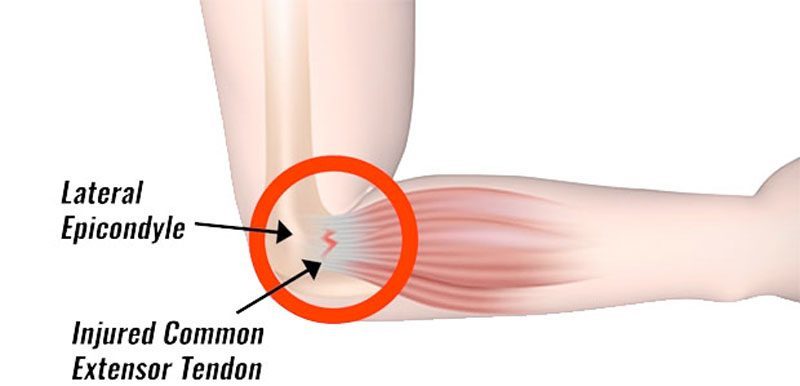
Tennis elbow — medically, lateral epicondylitis — is an overuse injury of the tendons that attach your forearm muscles to the outer elbow, and Cleveland Clinic notes that most people improve with a few months of non-surgical care and rest. Despite the name, it isn’t mainly a tennis problem: the majority of cases show up in non-players, often from repetitive work or hobbies, and by some clinical estimates racket-sport players account for only around 5% of cases seen. It affects roughly 1–3% of adults in a given year, most commonly between the ages of about 35 and 55.
Here’s the honest part about braces. According to the American Academy of Orthopaedic Surgeons, a brace worn over the back of the forearm can help relieve symptoms by resting the muscles and tendons — but a counterforce strap is a comfort and support aid, not a cure. Research suggests these straps can ease symptoms in the short term without changing how the tendon heals, while stronger evidence supports progressive forearm-strengthening exercises, alongside rest and load management, as the mainstay of recovery. The good news: the AAOS notes that roughly 80–95% of people improve without surgery. A brace can make the weeks in between a lot more comfortable.
When to see a professional
A brace is for mild, activity-related aches — not a substitute for care when something’s clearly wrong. Consider seeing a doctor or physical therapist if you have:
- Severe pain, or pain that keeps worsening or wakes you at night
- Numbness, tingling, or weakness in the hand, or dropping things
- Visible swelling, locking, or pain that followed an injury or fall
- No improvement after several weeks of rest, ice, and a brace
Frequently asked questions
Is the Simien tennis elbow brace any good?
Yes — for most people it’s a capable, affordable counterforce strap. The firm gel pad delivers steady pressure, the strap adjusts easily, and the two-pack adds value. Its limits are the one-size fit, which may not suit very large forearms, and a natural-rubber logo that isn’t latex-free, so anyone with a latex allergy should pick another brace.
How does a tennis elbow brace work?
A counterforce brace sits over the muscle just below the elbow and applies pressure across the forearm extensor tendons. According to the American Academy of Orthopaedic Surgeons, this rests the muscles and tendons and can reduce symptoms by shifting strain away from the sore attachment point at the outer elbow during gripping and lifting.
Where should a tennis elbow strap sit on your arm?
Position the strap about two to three finger-widths (roughly one to two inches) below the elbow crease, centred over the muscle bulge on the back of the forearm. Tighten it while gently clenching your fist so it’s snug but never cutting off circulation. Re-check the fit whenever your pain or activity changes.
Counterforce strap vs. compression sleeve — which is better?
Counterforce straps concentrate pressure on the tendon origin and shine during gripping or racket sports. Compression sleeves spread gentle, warming pressure across the whole joint, which many prefer for arthritis, general soreness, or desk work. Neither cures tennis elbow, and plenty of people own both and switch depending on the task at hand.
How long should you wear a tennis elbow brace each day?
Most people wear a counterforce strap during activities that trigger pain — typing, lifting, racket sports — rather than around the clock. Take it off during rest, and remove it if you notice numbness, tingling, or colour changes in the hand. If you’re unsure how long to wear one for your case, ask a clinician.
Do tennis elbow braces actually cure tennis elbow?
No. Braces are a comfort and support aid, not a cure. Research suggests counterforce straps can ease symptoms in the short term but don’t change how the tendon heals. Stronger evidence favours progressive forearm-strengthening exercises, alongside rest and load management, as the mainstay of recovery — with a brace helping you stay comfortable meanwhile.
Can you sleep in a tennis elbow brace?
Counterforce straps generally aren’t meant for sleep, since a tight band on a relaxed arm can restrict circulation with no activity to protect against. If night pain is an issue, a looser compression sleeve for warmth, or advice from a clinician about night splinting, is usually a better route than a tight strap.
Medical disclaimer: This article is for general information only and is not medical advice. Talk to a qualified healthcare professional about your specific situation.