Best Ankle Brace for Running: 6 Top Picks for 2026
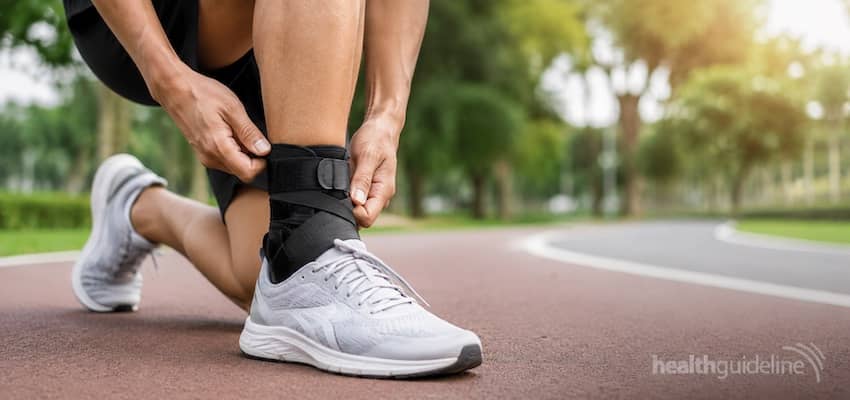
For most runners, the Med Spec ASO Ankle Stabilizer is the best all-round ankle brace for running — its lace-up boot and figure-8 straps control the side-to-side rolling that causes most running sprains, yet it still fits inside a running shoe.
Also great: the ultra-slim Aircast A60 for minimal bulk, and the budget-friendly BraceUP wrap for light support.
If you keep rolling the same ankle, an ankle brace can be one of the simplest ways to run with more confidence. But braces are not magic, and the right one depends on why you want it. This guide picks the six best ankle braces for running in 2026 — spanning maximum-support lace-ups, slim strap braces that vanish inside a shoe, premium compression, and cheap-and-cheerful wraps — and explains, honestly, what a brace can and can’t do for a runner.
The single most useful thing to know up front: the research behind ankle braces is strongest for preventing re-sprains in people who have already sprained an ankle — not for preventing a first injury, and not as a substitute for building strength and balance. More on that below.
How we chose
We didn’t lab-test these braces ourselves. Instead, we prioritised models that are consistently recommended by podiatrists and physical therapists, backed by published research on ankle bracing, and — critically — real products that are currently sold on Amazon in the US. We weighted four things: the level of support (from light compression to rigid lace-ups), how well the brace fits inside a running shoe, breathability and comfort over distance, and value for money. We deliberately included options across a wide price range and support range, because the “best” brace for a chronic ankle-roller is very different from the best one for mild post-run soreness. Prices and availability change constantly, so we link out to each live listing rather than quote a fixed price.
Best ankle braces for running at a glance
| Brace | Best for | Support level | Standout feature | Approx. price |
|---|---|---|---|---|
| Med Spec ASO Best overall | History of rolled ankles | Moderate–high | Figure-8 straps that mimic taping | ~$30–35 |
| Aircast A60 Best low-profile | Slim fit & prevention | Mild | Single strap, ultra low-profile | ~$30–45 |
| McDavid Ultralight Best lightweight | Light everyday support | Moderate | Featherweight & breathable | ~$25–35 |
| Bauerfeind Sports Best premium | Comfort & compression | Light–moderate | Medical-grade AirKnit + strap | ~$60–90 |
| McDavid 195 Best max support | Serious instability | High | Spring-steel side stays | ~$30–40 |
| BraceUP Best budget | Light support on a budget | Light | Cheap, adjustable wrap | ~$12–18 |
01 / Best overall
1. Med Spec ASO Ankle Stabilizer — Best overall
The Med Spec ASO is the ankle brace most physical therapists and reviewers reach for first. Its lace-up boot plus figure-8 stabilizing straps mimic an athletic tape job to limit the inward rolling that causes most running sprains, yet it stays low-profile enough to fit inside a normal running shoe. For the vast majority of runners, it’s the best place to start.
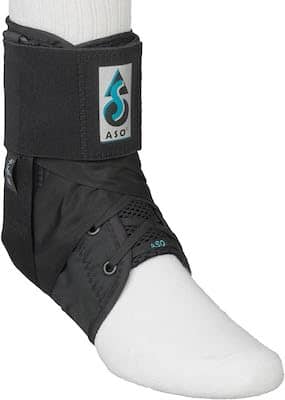
Key features:
- ballistic-nylon lace-up boot
- figure-eight stabilizing straps
- woven elastic cuff closure
- CoolFlex padding
- bilateral design (fits either foot).
Pros
- proven, trusted design
- strong control of side-to-side rolling
- fully adjustable
- fits in most shoes
- excellent support for the price.
Cons
- laces take longer to put on than a single strap
- can feel warm on long summer runs
- more bulk than a thin sleeve.
Best for: runners with a history of rolled ankles or ongoing instability who want dependable, taping-like support.
Want to compare more of this style? See our guide to the best lace-up ankle braces.
02 / Best low-profile brace for running shoes
2. Aircast A60 — Best low-profile brace for running shoes
The Aircast A60 is the pick when you want protection without bulk. A single strap replaces lacing, and two rigid stabilizers moulded at a 60-degree angle guard against rolling, while the slim Breath-O-Prene shell slides easily into a running shoe. Support is milder than a lace-up, so it suits injury prevention and everyday confidence more than active recovery.
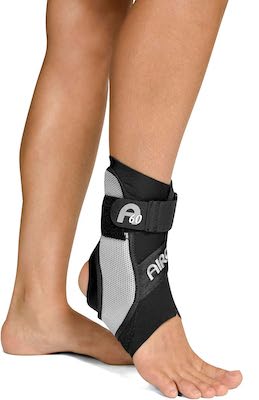
Key features:
- 60° moulded side stabilizers
- single wrap strap (on in seconds)
- breathable Breath-O-Prene fabric
- very low profile
- foot-specific (left or right).
Pros
- minimal bulk
- fast on and off
- breathable
- great for daily prevention and light instability.
Cons
- mild support only — not for a recovering or badly unstable ankle
- sold per foot and by size, so order carefully
- pricier than a basic wrap.
Best for: runners who want light, unobtrusive protection, or who are stepping down from a bigger brace.
We go deeper on this one in our Aircast A60 review.
03 / Best lightweight & breathable
3. McDavid Ultralight (Figure-8) — Best lightweight & breathable
McDavid’s Ultralight uses a single layer of polyester with figure-8 straps and side stabilizers to deliver moderate support at a barely-there weight. It breathes well and all but disappears inside a shoe, which makes it a comfortable everyday choice for runners who want more than a compression sleeve but less than a rigid lace-up.
Key features:
- single-layer polyester
- figure-8 straps
- dual side stabilizers
- hook-and-loop closure
- wearable on either foot
- lightweight and breathable.
Pros
- very light and cool
- easy to adjust
- fits either foot
- strong value.
Cons
- less rigid than the ASO or 195
- the velcro can pill with heavy use
- support is moderate, not maximal.
Best for: runners who want light, breathable support for regular training miles.
04 / Best premium / compression
4. Bauerfeind Sports Ankle Support — Best premium / compression
Bauerfeind’s Sports Ankle Support pairs medical-grade knit compression with an adjustable figure-8 taping strap, so it stabilizes the joint without changing your natural running gait. Made in Germany from breathable AirKnit fabric, it’s the premium option for runners who want support plus the circulation and proprioception benefits of true compression — if you don’t mind the higher price.
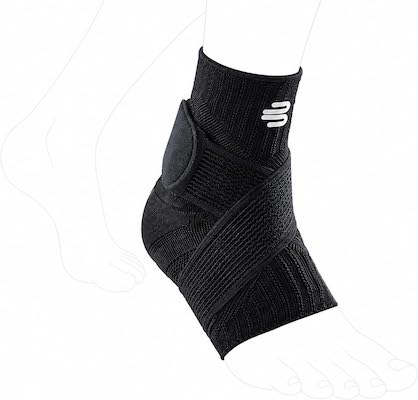
Key features:
- 3D AirKnit compression knit
- integrated adjustable figure-8 strap
- low-profile (fits in shoes)
- moisture-wicking
- made in Germany.
Pros
- comfortable all-day compression
- doesn’t restrict your gait
- durable and washable
- the brand also markets it for shin-splint relief.
Cons
- expensive
- support is compression plus a light strap rather than rigid stabilization
- sized by foot and colour, so check before ordering.
Best for: runners who prioritise comfort, compression and gait-friendly support over maximum rigidity.
Note: Bauerfeind’s shin-splint pain figures are the manufacturer’s own clinical-survey claim, not an independent finding.
05 / Best maximum support
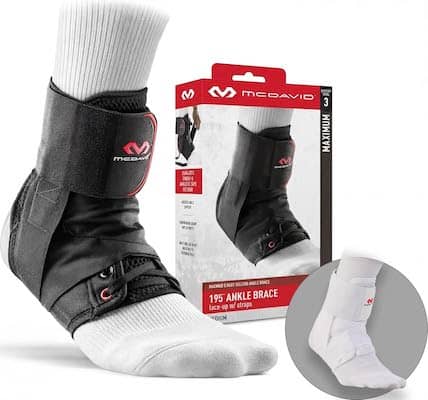
5. McDavid 195 (Level 3) — Best maximum support
When you need the most support short of a rigid orthopaedic brace, the McDavid 195 lace-up adds spring-steel side stays and a figure-6 strap system that simulates a full athletic tape job. McDavid cites an independent university study in which athletes wearing the 195 had roughly three times fewer injuries. It’s a structured brace, so expect more bulk and heat than the slimmer options here.
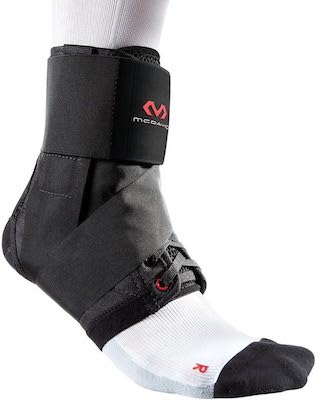
Key features:
- spring-steel side stays
- lace-up plus figure-6 straps
- simulates athletic taping
- adjustable without re-lacing
- fits either ankle.
Pros
- maximal lace-up support
- very secure
- trusted by athletes
- adjust on the fly without removing your shoe.
Cons
- the bulkiest brace here
- hottest on long runs
- overkill for mild needs
- takes the longest to put on.
Best for: runners with significant instability, or returning from a bad sprain once a professional has cleared them to run.
Note: the “3x fewer injuries” figure is from a study cited by McDavid, not our own testing.
If a rolled ankle has left you with lingering tendon pain, it’s worth reading about braces for peroneal tendonitis and Achilles tendonitis too.
06 / Best budget
6. BraceUP Adjustable Ankle Brace — Best budget
The BraceUP wrap is the easy, low-cost entry point: a neoprene-blend brace with two figure-8 compression straps you can tighten to taste. Support is light-to-moderate — enough for mild soreness, warmth and a little confidence on easy runs — but it won’t control serious rolling the way a lace-up brace will. For the price, it’s hard to complain.
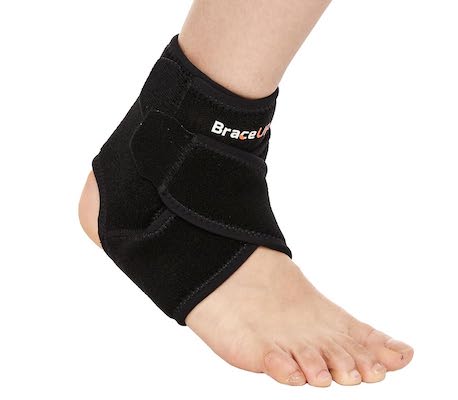
Key features:
- neoprene-blend wrap
- two adjustable figure-8 straps
- one-size fit for either foot
- breathable
- hand washable.
Pros
- very affordable
- simple and fast to apply
- adjustable compression
- good for light support and warmth.
Cons
- light support only
- a one-size wrap won’t fit every ankle perfectly
- not for instability or active recovery.
Best for: budget-minded runners who want light compression and mild support for easy runs or all-day wear.
What to look for in an ankle brace for running
Support level: sleeve, strap, or lace-up?
This is the biggest decision. A thin compression sleeve gives warmth and light support but little protection against rolling. A strap brace like the Aircast A60 adds rigid side stabilizers with minimal bulk. A lace-up brace with figure-8 straps — the ASO, the McDavid 195 — controls side-to-side (inversion/eversion) movement best, which is exactly the movement that sprains ankles. If your ankle actually rolls, lean toward a lace-up. For mild soreness, a sleeve or wrap is usually enough.
Will it fit inside your running shoe?
A brace only helps if you’ll actually wear it on a run, and a bulky brace that won’t fit your shoe stays in a drawer. Low-profile designs (Aircast A60, Bauerfeind, McDavid Ultralight) are made to sit inside athletic footwear. With a bigger lace-up, you may need to loosen your shoe’s laces or size up half a size. If you’re shopping for footwear too, our roundup of sneakers with good ankle support pairs well with a brace.
Breathability and materials
Running generates heat and sweat, so breathable fabric matters more than it does for everyday wear. Knitted fabrics (like Bauerfeind’s AirKnit) and ventilated designs stay cooler over distance than thick neoprene. If you run long or in heat, prioritise breathability and moisture-wicking.
Adjustability and fit
Look for straps you can re-tension on the move, and check the sizing method. Most braces size by the circumference around your ankle bone, not your shoe size — measure with a soft tape and follow the specific brand’s chart. Some braces (notably the Aircast A60) are foot-specific, so you’ll need to choose left or right.
When you might need more than a brace
If your ankle feels genuinely unstable, or you’re coming back from a significant injury, a semi-rigid or hinged brace may be more appropriate than anything on this list — see our guide to semi-rigid ankle braces. And if pain is the main issue rather than instability, a brace is only part of the answer; a professional assessment comes first.
Do ankle braces actually help runners?
Mostly yes — but with an important caveat. The strongest evidence is for preventing re-sprains, not first-time ones. Once you’ve sprained an ankle, your risk of doing it again jumps sharply — one often-cited figure puts it at roughly 3.5 times the risk of someone who’s never been injured. Systematic reviews find that bracing (or taping) can cut the risk of a recurrent ankle sprain by roughly 50–70% in people with a prior sprain, and semi-rigid and lace-up braces do this without meaningfully hurting athletic performance. For a runner who’s never had ankle trouble, the benefit is smaller and less certain.
A common worry is that bracing might overload the knee. Reviews of the evidence have not found an increase in knee injuries from wearing an ankle brace during normal activity. Another worry is that a brace “weakens” the ankle; there’s no good evidence for that either. The most durable protection comes from treating a brace as external support while you rebuild strength and balance — a brace complements calf and ankle strengthening, balance work, sensible mileage progression, and well-fitted shoes; it doesn’t replace them.
When to see a professional instead of reaching for a brace
An ankle brace is for support and prevention, not for pushing through an injury. Don’t try to run through a fresh sprain, sharp pain, marked swelling, or an ankle that keeps giving way — those are signs to stop and get assessed. See a qualified healthcare professional if you have significant pain or swelling, can’t bear weight comfortably, or your ankle repeatedly buckles despite support. And whatever brace you choose, break it in on easy training runs first; never debut a new brace on race day, because a brace that feels fine for a mile can rub badly after ten.
Frequently asked questions
Do ankle braces actually work for running?
The evidence is strongest for preventing re-sprains, not first-time ones. Systematic reviews find that bracing lowers recurrent ankle-sprain risk by roughly 50–70% in people who’ve already sprained an ankle, and generally without hurting performance. If you’ve never had an ankle problem, the protective benefit is smaller and less certain.
Can you run with an ankle brace on?
Yes — if you’ve been cleared to run and the brace feels stable rather than painful. Choose a low-profile model that fits inside your running shoe, and always test a new brace on training runs first. A brace that feels comfortable for one mile can start to rub after ten, so never debut one on race day.
Which ankle brace is best for running?
For most runners, the Med Spec ASO is the best all-round starting point: its lace-up boot and figure-8 straps control rolling well yet still fit in a running shoe. Want minimal bulk? Choose the Aircast A60. On a budget? The BraceUP wrap. Need maximum support? The McDavid 195.
Will wearing an ankle brace weaken my ankle over time?
There’s no good evidence that a brace weakens your ankle. Think of it as external support while you rebuild strength and balance, not a permanent crutch. The most lasting protection comes from pairing a brace with calf, ankle and balance exercises, then gradually reducing how much you rely on it as your stability improves.
Lace-up brace or compression sleeve for running?
A lace-up brace with figure-8 straps (like the ASO) controls side-to-side rolling far better and suits unstable or recovering ankles. A thin compression sleeve is lighter and comfier but mainly provides warmth and mild support. If your ankle actually rolls, choose the lace-up; for mild soreness or light compression, a sleeve can be enough.
What size ankle brace should I get?
Most brands size by the circumference around your ankle bone, not your shoe size, so measure with a soft tape and follow that specific brand’s chart. Some braces — the Aircast A60 among them — are also foot-specific, so check whether you need a left or right before ordering.
Medical disclaimer: This article is for general information only and is not medical advice. Talk to a qualified healthcare professional about your specific situation.