Best Knee Brace for Torn Meniscus: 5 Picks (2026)
2026 buying guide · meniscus support, fit & recovery
The best knee brace for a torn meniscus depends on what you actually need from it. A soft compression sleeve can make a swollen or achy knee feel more supported, while a hinged brace adds side-to-side stability. After meniscus repair surgery, a range-of-motion brace may be prescribed to protect the repair. No brace can reconnect torn meniscal tissue or replace diagnosis and rehabilitation.
Quick picks
Best hinged overall
Shock Doctor Ultra 875
Substantial bilateral hinges and crossing straps for people who want an OTC brace with more structural support.
Premium comfort
Bauerfeind GenuTrain S
A breathable medical-grade knit with side hinges and adjustable straps; notably less bulky than heavy neoprene braces.
Post-op ROM option
BraceAbility ROM
Adjustable flexion and extension stops for recovery plans that specifically require controlled knee motion.
How we chose these knee braces
We treated “best knee brace for torn meniscus” as several different use cases rather than one universal ranking. We prioritized products with current US listings, clear manufacturer specifications, adjustable fit, and a distinct role: hinged stability, lower-bulk support, post-operative range control, or simple compression. We did not use customer star ratings to rank the products because ratings and review counts change.
Medical context was checked against the American Academy of Orthopaedic Surgeons (AAOS), Mayo Clinic and a Mass General Brigham meniscus-repair rehabilitation protocol. The AAOS guideline emphasizes diagnosis, meniscus preservation when surgery is indicated, and an important role for physical therapy; it does not identify one consumer knee brace as the best treatment for every tear.
Important: “Meniscus brace” is a shopping category, not a diagnosis. A brace that is appropriate for an isolated, stable tear may be wrong after a surgical repair or when ligament damage, arthritis, a root tear, or a locked knee is also present.
Best knee braces for a torn meniscus at a glance
| Brace | Our category | Support design | Price tier | Key caution |
|---|---|---|---|---|
| Shock Doctor Ultra 875 | Best hinged overall | Bilateral hinges + X-Fit straps | Mid-range | Bulkier than a sleeve |
| Bauerfeind GenuTrain S | Best premium comfort | Compression knit + side hinges + straps | Premium | Side and sizing matter |
| BraceAbility ROM | Best for prescribed motion control | Adjustable ROM hinges | Mid-range | Do not set ROM limits yourself after surgery |
| Modvel Compression 2-Pack | Best budget compression | Pull-on knit sleeve | Budget | Contains latex |
| NEENCA Professional Knee Brace | Best value stabilizer sleeve | Compression sleeve + side stabilizers | Budget / mid-range | Less rigid than true metal hinges |
If your knee is stable and your clinician has not prescribed motion restriction, more brace is not automatically better. A heavy hinged or ROM brace can be unnecessary for some isolated tears. Comfort, swelling control and a rehabilitation plan may matter more than maximum rigidity.
The five Knee Brace for Torn Meniscus
01 / BEST HINGED OVERALL
Shock Doctor Ultra Knee Support with Bilateral Hinges
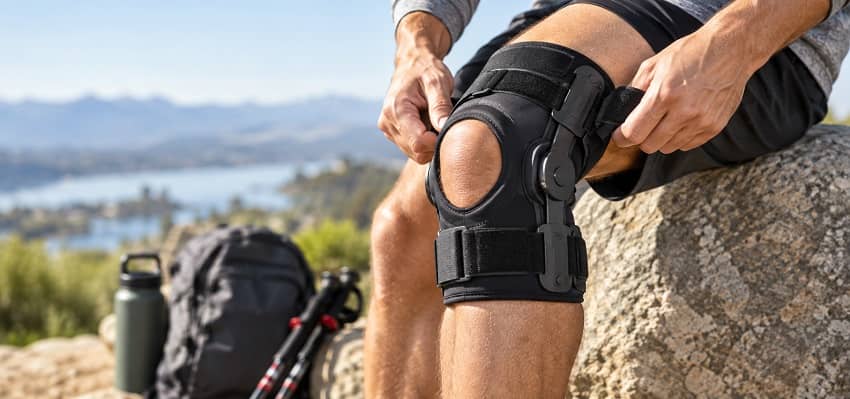
If you have been told that a hinged brace is appropriate, the Shock Doctor Ultra Knee Support with Bilateral Hinges (model 875) is the most balanced OTC option in this group. Shock Doctor specifically lists meniscus injuries among its intended uses, and the brace combines bilateral hinges, hyperextension stops, patellar support and a crossing strap system.
Shock Doctor Ultra Knee Support — view on Amazon
Key features
- Bilateral support hinges with hyperextension stops
- X-Fit crossing strap system for adjustable compression
- Open-patella support area
- Stretch mesh behind the knee for flexion
Pros
- More side-to-side stability than a compression sleeve
- Multiple adjustment points help fine-tune fit
- Manufacturer explicitly includes meniscus injuries in its use cases
Cons
- Noticeably bulkier and warmer than a knit sleeve
- May be excessive for a stable isolated tear
- Correct sizing is essential to keep hinges aligned
Best for: People seeking a substantial hinged OTC brace after a clinician has confirmed that added medial/lateral stability is appropriate.
Who it is not for: Anyone whose surgeon has prescribed a specific post-op range-of-motion protocol, or people who only need light compression for a stable knee.
02 / BEST PREMIUM COMFORT
Bauerfeind GenuTrain S Hinged Knee Brace
The Bauerfeind GenuTrain S is the premium pick for people who want hinged guidance without the feel of a thick athletic neoprene brace. Bauerfeind lists meniscus injuries among its indications. Its medical-grade compression knit, viscoelastic patella pad, side hinges and circular strap system provide a blend of compression and mechanical stabilization while preserving knee movement.
Bauerfeind GenuTrain S — view on Amazon
Key features
- Breathable compression knit
- Medial and lateral side hinges
- Adjustable circular strap system
- Viscoelastic pad around the kneecap
Pros
- Lower-bulk feel than many heavy hinged braces
- Combines compression with side guidance
- Breathable materials suit longer wear better than thick neoprene for many users
Cons
- Premium price tier
- Left/right and size selection require extra attention
- Amazon availability can vary by exact size and side
Best for: People who value breathable knit comfort and want more guidance than a basic sleeve.
Who it is not for: Buyers who want the least expensive solution or people needing surgeon-set flexion/extension limits after a repair.
03 / BEST FOR PRESCRIBED MOTION CONTROL
BraceAbility Torn Meniscus ROM Knee Brace
The BraceAbility Torn Meniscus ROM Knee Brace belongs in a different category from everyday support braces. Its hinges can limit flexion and extension at selected settings, which can be useful when a surgeon or physical therapist has given a specific range-of-motion plan after a meniscus repair or another knee procedure.
BraceAbility Torn Meniscus ROM Knee Brace — view on Amazon
Key features
- Adjustable flexion and extension settings
- Removable internal hinges
- Wraparound neoprene construction
- Wide size range, including plus sizes
Pros
- Can match a clinician-defined range-of-motion plan
- More size options than many consumer braces
- Manufacturer states the components are latex-free
Cons
- More cumbersome for normal day-to-day activity
- ROM settings can be misused without professional instructions
- Not a “stronger is better” upgrade for an uncomplicated stable tear
Post-op warning: Do not copy another person’s hinge settings or choose your own flexion limit after meniscus repair. Surgical technique, tear location and repair strength can change the rehabilitation protocol.
Best for: Post-operative or injury recovery when a clinician specifically wants controlled knee flexion/extension.
Who it is not for: Someone self-treating an undiagnosed knee injury or simply looking for comfortable exercise support.
04 / BEST BUDGET COMPRESSION
Modvel Compression Knee Brace 2-Pack
The Modvel Compression Knee Brace is a simple pull-on sleeve rather than a structural brace. That distinction is its advantage for buyers who mainly want compression, warmth and a more supported feeling during daily activity. It is less restrictive and less expensive than hinged models, but it does not provide the same side-to-side control.
Modvel Compression Knee Brace 2-Pack — view on Amazon
Key features
- Pull-on 3D knit compression sleeve
- Silicone grip waves intended to reduce slipping
- Multiple sizes and color options
- Sold as a two-pack on the linked Amazon listing
Pros
- Low-profile under clothing
- Simple to put on when a pull-on sleeve is suitable
- Budget-friendly compared with hinged braces
Cons
- No rigid hinges or controlled range-of-motion stops
- Pull-on fit cannot be loosened as easily if swelling changes
- Contains latex
Latex allergy warning: Modvel lists nylon, spandex and latex in the material information for this sleeve. Choose a confirmed latex-free option if you have a latex allergy.
Best for: Mild symptom support and compression when the knee is stable and no motion restriction has been prescribed.
Who it is not for: People who need a prescribed post-op brace or substantial mechanical stability.
05 / BEST VALUE STABILIZER SLEEVE
NEENCA Professional Knee Brace
The NEENCA Professional Knee Brace sits between a plain compression sleeve and a heavy hinged brace. The current Amazon listing describes a compression sleeve with a patella gel pad and side stabilizers. That can appeal to buyers who want more structure than a basic knit sleeve without stepping up to large metal hinges.
NEENCA Professional Knee Brace — view on Amazon
Key features
- Compression sleeve construction
- Patella gel pad
- Side stabilizers rather than heavy metal hinges
- Non-slip elements listed with the current Amazon product
Pros
- More structured than a plain compression sleeve
- Lower bulk than full bilateral-hinge braces
- Widely available through the brand’s Amazon storefront
Cons
- Side stabilizers do not provide the same rigidity as true hinges
- Product-family variations make exact model checking important
- Not appropriate for surgeon-prescribed ROM restrictions
Best for: Buyers who want a middle ground between a basic sleeve and a bulky hinged brace.
Who it is not for: People who specifically need rigid medial/lateral hinges, compartment unloading, or controlled post-operative range of motion.
Does a knee brace actually help a torn meniscus?
A knee brace can help with symptom support, compression, confidence or motion control, but its value depends on the tear and treatment plan. AAOS guidance emphasizes accurate diagnosis and rehabilitation rather than a universal brace prescription. After surgical meniscus repair, some protocols use a locked or range-limited brace, while many non-operative cases focus on activity modification and physical therapy.
The important distinction is what the brace is trying to accomplish. A compression sleeve can make a swollen knee feel more supported. A hinged brace can add medial/lateral stability when instability is part of the problem. A ROM brace can enforce a surgeon’s movement limits. An unloader brace is a different category used to shift load away from one knee compartment, more often in osteoarthritis or selected compartment-specific problems.
What current orthopedic guidance supports
The 2024 AAOS guideline for acute isolated meniscal pathology states that physical therapy may be beneficial for non-displaced isolated tears treated non-operatively and for people recovering from meniscal surgery. It also notes that displaced tears restricting motion may need earlier surgical evaluation. The guideline does not recommend buying a brace as a substitute for assessment.
For a broader overview of knee-support designs, see our knee brace guide. If a clinician has specifically recommended hinges, compare our hinged knee brace guide. For lighter support, our knee compression sleeve guide explains the trade-offs.
What type of knee brace is best for a torn meniscus?
There is no single best brace type for every meniscus tear. Choose the least restrictive design that meets the actual treatment goal. A stable, non-operative knee may only need symptom support; a knee with associated instability may benefit from hinges; and a repaired meniscus may require a surgeon-defined ROM brace. The diagnosis should drive the brace, not the other way around.
Compression sleeve: for light symptom support
A compression sleeve is the simplest option. It does not stop twisting or control knee range of motion, but it can provide warmth, mild compression and a sense of support. It is most reasonable when the knee is stable and no clinician has prescribed a more protective device. A sleeve is also easier to fit under everyday clothing.
Hinged brace: for added medial and lateral stability
A hinged brace adds side structures intended to resist unwanted side-to-side movement while allowing bending and straightening. This can be useful if the meniscus injury is accompanied by instability or if a clinician wants more mechanical support during activity. Hinges do not “hold the meniscus together,” and they are not required for every isolated tear.
If you are comparing higher-support options, see our knee brace for MCL tear guide as well. Ligament injuries and meniscus injuries can occur together, but brace needs may change when a ligament is involved.
Range-of-motion brace: for a prescribed post-op plan
A ROM brace has adjustable stops that can limit flexion and/or extension. This is a medical-rehabilitation tool rather than a general comfort brace. For example, Mass General Brigham’s meniscal repair protocol uses a locked brace and restricted flexion early in recovery, with progression depending on physician guidance. Your surgeon’s protocol takes priority over any generic schedule.
For a different type of motion-restricting device, our knee immobilizer guide explains what an immobilizer does and why it is not interchangeable with a functional hinged brace.
Unloader brace: mainly for compartment-specific loading problems
An unloader brace is designed to shift load away from one side of the knee. That makes it more relevant when compartment-specific osteoarthritis or degenerative loading is part of the problem than for a straightforward acute tear. These braces are more complex to fit, and side selection matters. If arthritis is a major part of the diagnosis, see our knee braces for osteoarthritis guide.
Open or closed patella?
The patella opening is mostly a fit and comfort feature rather than a meniscus treatment. An open-patella brace can make kneecap alignment easier to see and may reduce pressure directly over the patella. A closed design distributes fabric across the front of the knee. Choose the version that fits securely without painful pressure or rubbing.
Wraparound or pull-on?
Wraparound braces are easier to loosen or retighten when swelling changes and can be simpler to put on if pulling a tight sleeve over the foot is difficult. Pull-on sleeves are lower-profile but depend more on exact circumference sizing. Neither design is automatically superior; the best choice is the one you can fit correctly and wear as directed.
How should a knee brace fit with a torn meniscus?
A knee brace should feel secure without causing numbness, tingling, color change, coldness, new swelling below the brace or sharply increased pain. Hinges should track along the sides of the knee rather than sitting too far forward or behind the joint. Recheck the fit after several minutes of walking because swelling and strap tension can change.
- Measure exactly where the brand says. Different braces use knee-center, thigh or calf circumference, and some are side-specific.
- Center the brace before tightening. Align the patella opening or pad, then make sure side hinges or stabilizers sit beside the knee joint.
- Tighten gradually. Secure enough to prevent slipping, but not so tight that circulation or sensation changes.
- Walk and recheck. If permitted, take a few steps and sit down once or twice. Look for bunching behind the knee, hinge pressure and migration.
- Follow the treatment schedule. Do not assume that a sports brace should be worn overnight or that a post-op brace should be unlocked because it feels comfortable.
Remove the brace and reassess if you develop persistent numbness, tingling, a cold or discolored foot, increasing calf swelling, worsening pain, or skin injury from pressure. Seek urgent medical advice when symptoms suggest a circulation problem, blood clot, infection or a significant new injury.
When should you see a professional for a suspected meniscus tear?
See a healthcare professional when knee pain or swelling persists, motion is limited, or the knee repeatedly catches, locks or gives way. Mayo Clinic advises medical evaluation when the knee is painful or swollen or cannot move normally. A mechanically locked knee deserves prompt assessment because a displaced tear can restrict range of motion and may change treatment.
Get prompt or urgent help for these signs
- You cannot bend or straighten the knee because it feels mechanically blocked.
- The knee is very swollen after an injury or you cannot bear weight.
- The knee is hot and inflamed and you also have a fever.
- You develop new calf pain/swelling, chest pain or shortness of breath after surgery or immobilization.
- Your foot becomes numb, blue/grey, unusually cold or weak.
AAOS notes that MRI is the preferred imaging method for acute meniscal tears when imaging is needed, and that physical examination tests can also contribute to diagnosis. Buying a brace before establishing what is injured can delay the treatment that actually matters.
Frequently asked questions
What is the best knee brace for a torn meniscus?
There is no single best brace for every meniscus tear. For OTC hinged support, the Shock Doctor Ultra 875 is our most balanced pick. A compression sleeve may be enough for a stable knee, while a ROM brace should be used when a clinician prescribes motion limits after surgery. Match the brace type to the treatment goal.
Will a knee brace heal a torn meniscus?
No. A brace cannot reconnect torn meniscal tissue. It may provide compression, improve the feeling of stability, limit certain movements or protect a surgical repair as part of a clinician-directed plan. Healing potential depends on the tear pattern, location, blood supply, age of the tissue and treatment. Rehabilitation remains important with or without surgery.
Is a hinged knee brace better than a compression sleeve for a meniscus tear?
A hinged brace provides more mechanical side support, but that does not make it better for every tear. A stable isolated meniscus injury may only need light symptom support, while added hinges can be useful when instability is also present. A compression sleeve is lower-profile and simpler. Ask your clinician which function your brace needs to provide.
Should I wear a knee brace after meniscus surgery?
Only according to your surgeon’s protocol. Meniscus-repair rehabilitation varies by tear location, repair technique and other procedures performed. Some protocols use a brace locked in extension with limited flexion early on, while other operations may follow different rules. Do not change hinge settings, weight-bearing status or wear time based on a generic online schedule.
Can I sleep in a knee brace for a torn meniscus?
Do not assume that daytime support should continue overnight. If you had surgery, follow the exact sleep and brace instructions from your surgical team. If you are managing a tear without surgery, ask a healthcare professional whether overnight use is necessary. A brace that is too tight during sleep can cause pressure or circulation problems.
How tight should a meniscus knee brace be?
The brace should be snug enough to stay in position without causing numbness, tingling, increased pain, skin injury, or changes in foot color or temperature. Hinges and stabilizers should remain aligned as you bend the knee. If the brace slides despite tightening, recheck the size rather than continuing to overtighten it.
Can I keep exercising with a torn meniscus if I wear a brace?
A brace is not permission to train through pain, locking or swelling. Activity depends on the tear, symptoms and treatment plan. Pivoting, deep flexion and impact may aggravate some injuries, while controlled exercise is often part of rehabilitation. Follow the activity and return-to-sport plan given by your clinician or physical therapist.
This article provides general information, not medical advice. A qualified healthcare professional should diagnose your knee problem and advise whether a brace, physical therapy, medication, activity modification or surgery is appropriate.