Best Knee Brace for Hiking: 4 Picks for 2026
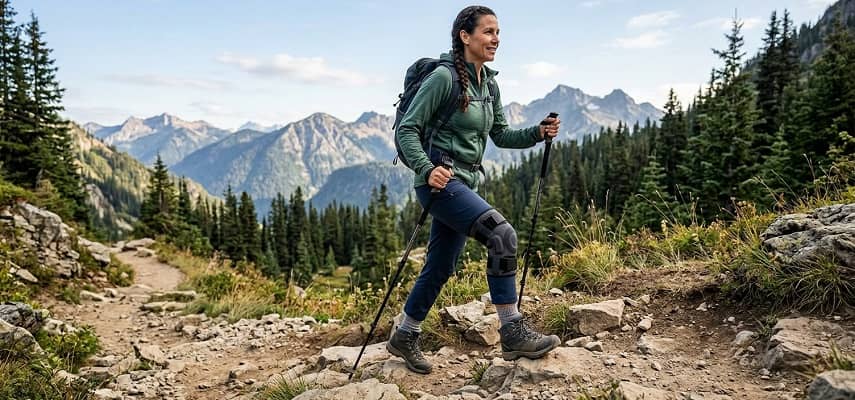
2026 hiking guide · support, fit & downhill comfort
The best knee brace for hiking is the one that matches why your knee needs support. For most hikers who want breathable compression without a bulky hinge, the Bauerfeind Sports Knee Support is our best overall pick. Hikers who need more structure should discuss a hinged brace with a clinician, while a lightweight sleeve or patellar strap can make more sense for less demanding support needs.
The 4 best knee braces for hiking
Best overall
Bauerfeind Sports Knee Support
Breathable compression, a contoured patellar pad and a stay-put upper grip make it a strong all-round active-support option.
Best value sleeve
CAMBIVO 2 Pack
A budget-friendly pair of pull-on sleeves for hikers who want light compression and minimal bulk.
Best hinged support
Shock Doctor 875
Bilateral hinges and wrap straps provide substantially more structure, but the extra bulk is not necessary for every hiker.
Minimal-support pick: The Bodyprox Patella Tendon Strap is the fourth pick for hikers who specifically want a small strap below the kneecap rather than a full sleeve. It is not a substitute for a brace when broader joint stability is needed.
JUMP TO A SECTION
How we chose these hiking knee braces
We compared current manufacturer specifications, current U.S. Amazon listings, hiking-specific use cases, and recent expert roundups. We prioritized four things that matter on a trail: support matched to the problem, freedom of movement, heat and moisture management, and a fit that is unlikely to become irritating after several miles. We deliberately chose different brace types instead of filling the list with four similar compression sleeves.
This is a research-based comparison, not a head-to-head field test. Category labels such as “best overall” are editorial judgments based on construction and hiking suitability, not clinical rankings. Product availability and exact variants can change, so confirm the model and size on Amazon before ordering.
Best knee braces for hiking at a glance
| Product | Best for | Support design | Trail trade-off |
|---|---|---|---|
| Bauerfeind Sports Knee Support | Best overall for active hiking | Compression knit + contoured patellar pad | Premium price; precise sizing matters |
| CAMBIVO 2 Pack | Lightweight value | Pull-on compression sleeve | Less structure than a hinged or wrap brace |
| Shock Doctor 875 | Higher-structure support | Bilateral hinges + X-Fit straps | Bulkiest and warmest option here |
| Bodyprox Patella Tendon Strap | Minimal targeted support below kneecap | Adjustable patellar strap | Does not stabilize the whole knee |
There is no universal “hiking brace.” A sleeve, patellar strap and hinged brace solve different problems. If your knee gives way, locks, swells repeatedly, or hurts enough to change your gait, get the cause assessed instead of choosing support only by online reviews.
The 4 best knee braces for hiking — reviews
01 / BEST OVERALL
Bauerfeind Sports Knee Support
The Bauerfeind Sports Knee Support — view on Amazon is our best overall hiking pick because it combines a low-bulk compression knit with a contoured pad around the kneecap, while Bauerfeind’s GripTech upper zone is designed to keep the support from sliding during movement. That combination makes more sense for long active days than a heavy hinge for hikers who do not need rigid support.
Key features
- Breathable 3D AirKnit compression fabric
- Omega Pad around the kneecap
- Integrated silicone gripping zone at the top
- Either-knee design with multiple sizes
Pros
- Lower profile than a hinged brace
- Breathable knit is suited to extended activity
- Patellar pad provides more structure than a plain sleeve
- Machine-washable construction
Cons
- Premium price compared with basic sleeves
- Measurement-based sizing takes more care
- Silicone gripping zones can irritate some skin
Best for: Hikers who want breathable, moderate support for long days and prefer a sleeve-style profile with more patellar structure than a basic compression sleeve.
Skip it if: You have diagnosed ligament instability that requires a prescribed hinged or functional brace, or you know silicone grip bands irritate your skin.
02 / BEST VALUE SLEEVE
CAMBIVO 2 Pack Knee Compression Sleeves
The CAMBIVO 2 Pack Knee Compression Sleeves — view on Amazon are the value pick for hikers who mainly want light compression, warmth and a layer that fits easily under hiking pants. The 3D-knit sleeves use silicone grip rings at the top and come as a pair, but they do not provide the lateral structure of a hinged brace.
Key features
- Pull-on 3D knitted compression construction
- Double anti-slip silicone grip rings
- Thin profile for hiking pants and everyday wear
- Sold as a two-pack
Pros
- Light and easy to pack
- Low-profile design does not add hinge bulk
- Two sleeves are useful if both knees need compression
- Current U.S. listing specifically includes hiking among intended activities
Cons
- No straps or hinges for major instability
- Pull-on sizing gives less adjustment than a wrap brace
- Contains latex according to current product information
Latex note: Current CAMBIVO product information lists latex in the material blend. If you have a latex allergy or sensitivity, choose a verified latex-free alternative and confirm the exact material label before purchase.
Best for: Hikers who want inexpensive, lightweight compression and do not need a high-structure brace.
Skip it if: Your knee buckles or you have been told you need ligament-focused support; a simple sleeve is not designed to replace that level of bracing.
03 / BEST HINGED SUPPORT
Shock Doctor 875 Ultra Knee Support with Bilateral Hinges
The Shock Doctor 875 Ultra Knee Support — view on Amazon is the most structured option here. Its bilateral hinges, aluminum stability stays and X-Fit straps are designed to limit unwanted motion while allowing knee flexion. That can be useful for appropriately selected instability, but the extra weight, warmth and bulk make it overkill for hikers who only want mild compression.
Key features
- Bilateral support hinges with hyperextension stops
- Tempered aluminum stability stays
- X-Fit wrap strap system
- Stretch mesh behind the knee for flexion
Pros
- Most lateral structure of the four picks
- Adjustable wrap straps help fine-tune the fit
- Hyperextension stops add a feature plain sleeves do not provide
- Current manufacturer page lists the model as in stock
Cons
- Bulky for long hikes and warm weather
- More complicated to fit than a sleeve
- Not appropriate merely because a hike includes steep descents
Use-case warning: A hinged brace is a medical-style support, not a default hiking accessory. If you are recovering from a ligament injury, surgery or recurrent instability, ask your clinician whether this level of support is appropriate and how long to wear it.
Best for: Hikers who have already been advised that a hinged brace is suitable and want more structural support than a compression sleeve offers.
Skip it if: You only have occasional mild soreness and mainly want a breathable layer for long-distance walking.
For a deeper look at this exact model, read our Shock Doctor 875 review. You can also compare other constructions in our hinged knee brace guide.
04 / BEST MINIMAL PATELLAR STRAP
Bodyprox Patella Tendon Knee Strap 2 Pack
The Bodyprox Patella Tendon Knee Strap 2 Pack — view on Amazon is the minimalist choice. It sits below the kneecap and uses an adjustable hook-and-loop closure with silicone-gel padding. Because it leaves most of the knee uncovered, it is cooler and less restrictive than a sleeve, but it only makes sense when targeted patellar-tendon support is what you actually need.
Key features
- Adjustable hook-and-loop fastening
- Silicone gel padding
- Vented interior
- Two straps per pack
Pros
- Very light and packable
- Leaves the back of the knee uncovered
- Easy to adjust without removing hiking pants in many setups
- Low purchase cost compared with full braces
Cons
- Does not provide whole-knee compression
- Does not control side-to-side instability
- One-size design will not suit every leg
Best for: Hikers specifically looking for a small below-patella strap rather than full-knee compression or hinge support.
Skip it if: You need broad stability, have swelling around the whole knee, or do not know why your knee hurts. A narrow strap targets a narrow use case.
For other options in this category, see our patellar tendon strap guide.
How do you choose a knee brace for hiking?
Choose by support need first, then trail comfort. A light compression sleeve can add warmth and a sense of support without much bulk. A patellar strap targets the area below the kneecap. Hinged braces add side-to-side structure and may be appropriate for certain injuries or instability, but they are heavier and should not be selected simply because a trail is steep.
1. Match the brace type to the problem
If you have a diagnosed knee condition, use the brace type recommended for that condition rather than a generic “maximum support” label. The American College of Rheumatology/Arthritis Foundation guideline, for example, recommends tibiofemoral bracing for some people with knee osteoarthritis whose pain, instability or walking difficulty is substantial enough to justify an assistive device. It also emphasizes the importance of tolerability and correct fitting.
For broader background on brace types, see our knee brace guide.
2. Prioritize breathability on long, warm hikes
Hiking adds hours of heat, sweat and repetitive flexion. Thin knit sleeves usually ventilate better than thick neoprene hinged braces. If your route is hot or humid, pay attention to the fabric behind the knee, where bunching and moisture can quickly become uncomfortable.
3. Check whether it stays up without over-tightening
A brace that slides down every mile is distracting; a brace tightened enough to cause numbness or color change is unsafe. Silicone grippers can help a sleeve stay in place, while wrap straps allow more adjustment, but each can irritate skin. Try the brace on a short walk before committing to an all-day hike.
4. Think about pants, base layers and packability
A slim sleeve generally fits under hiking pants. Hinged models may need looser pants or may be easier to wear over a thin base layer if the manufacturer permits it. If the brace is only a backup, consider whether you can carry it easily and put it on trail-side without removing boots or multiple clothing layers.
5. Measure exactly where the brand tells you
Knee-brace sizing is not standardized. Bauerfeind asks for circumferences above and below the knee; other sleeves use a single circumference; hinged braces may use a different landmark. Do not transfer your size from one brand to another.
Why do knees often hurt more when hiking downhill?
Downhill walking asks the knee to absorb more energy and control the body as it descends. Biomechanical studies have found substantially greater knee-joint loading during downhill walking than level walking. One classic study estimated tibiofemoral compressive loads averaging about 8 times body weight during downhill walking versus 3.9 times body weight on level ground. Those laboratory estimates do not mean every hiker experiences injury, but they help explain why descents can provoke symptoms.
Trekking poles can reduce knee loading on descents
In a small laboratory study of downhill walking, hiking poles reduced several measures of knee loading by roughly 12% to 25% compared with walking without poles. Another study found that reducing step length and walking speed can also reduce lower-extremity loading during graded walking.
Practical takeaway: a knee brace is only one tool. For long descents, consider shorter steps, a controlled pace, trekking poles when appropriate, and adequate leg strength. AAOS notes that strengthening the muscles supporting the knee can reduce stress on the joint and help with shock absorption.
If you already like compression sleeves, our PowerLix knee sleeve review covers another low-profile option.
How should a hiking knee brace fit?
- Measure before ordering. Follow the exact brand’s measurement points and size chart rather than using your pants size or a different brace brand.
- Test it at home first. Bend, sit, climb stairs and walk for 15–30 minutes. The brace should stay in place without pinching behind the knee.
- Do a short local walk. Check for slipping, skin irritation and pressure points before taking the brace on a remote or all-day hike.
- Watch circulation and sensation. Remove or loosen the brace if you develop numbness, tingling, unusual coldness, discoloration or increasing pain. Seek medical advice if symptoms persist.
- Reassess after sweating. Moisture changes friction. A brace that feels fine for ten minutes may rub after several hours.
Trail test before the big trip. The best time to discover that a sleeve rolls down, a hinge catches your pants, or a silicone grip irritates your skin is on a short walk close to home—not halfway through a long descent.
When should you see a professional about hiking knee pain?
Get medical assessment if knee pain is severe, follows a significant injury, repeatedly returns, or comes with swelling, locking, catching, giving way, inability to bear weight, or a visible change in the joint. A brace may support an appropriate treatment plan, but it should not be used to hide symptoms that need diagnosis.
If you have osteoarthritis or a previous ligament injury, a physical therapist, sports-medicine clinician or orthopedic professional can help match the brace to the condition and check whether strengthening, gait changes or another treatment matters more. The Arthritis Foundation specifically advises getting help choosing the right type and fit when using braces for knee arthritis.
Frequently asked questions
What is the best knee brace for hiking?
For most hikers who want breathable support without a rigid hinge, we prefer the Bauerfeind Sports Knee Support because it combines compression, a contoured patellar pad and a stay-put upper grip. That does not make it the best choice for every knee problem. Instability, patellar-tendon pain and arthritis may call for different brace types.
Should I wear a knee brace for hiking downhill?
Not automatically. Downhill walking increases knee loading, but a brace should match a specific need rather than the slope alone. If you hike comfortably without instability or persistent pain, a brace may be unnecessary. If symptoms occur, consider shorter steps and trekking poles, and have recurrent or significant pain assessed before relying on a brace.
Is a compression sleeve or hinged knee brace better for hiking?
A compression sleeve is lighter, cooler and less restrictive, so it is generally easier to wear for long distances. A hinged brace provides more structural control and may be appropriate for certain injuries or instability. More support is not automatically better: choose the brace type for the condition, not simply for the difficulty of the trail.
Can trekking poles help reduce knee stress while hiking?
They can. In a small laboratory study, using hiking poles during downhill walking reduced several measured knee forces and moments by about 12% to 25%. Technique and terrain still matter, and poles are not treatment for an injured knee, but they are a useful non-brace strategy for reducing lower-limb loading on descents.
How tight should a knee brace be for hiking?
It should feel secure and remain in position without causing numbness, tingling, discoloration, unusual coldness or increasing pain. Follow the manufacturer’s sizing and fitting instructions, because brace systems differ. Test the fit during a short walk before a long hike, and stop using the brace if concerning symptoms appear.
Can I wear a knee brace all day on a hike?
Some activity braces are designed for extended wear, but comfort and skin tolerance vary. Follow the product instructions and any clinician guidance. On a long hike, periodically check for rubbing, swelling, numbness and slipping. If a brace becomes painful or alters your gait, remove it when safe and reassess the fit.
This article is for general information only and is not medical advice. Talk to a qualified healthcare professional about your specific situation.