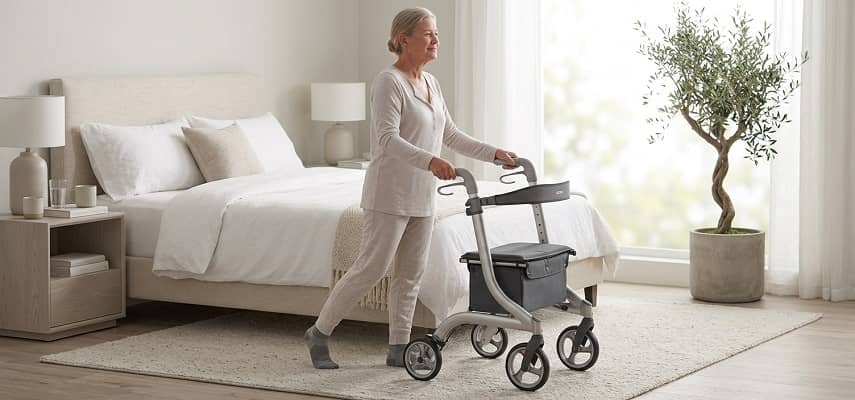
Rollator Walker With Seat: 5 Best Picks for 2026

2026 mobility guide · fit, comfort & safety
A rollator walker with a seat is a four-wheel mobility aid that rolls continuously, uses hand brakes for control, and gives you a place to stop and rest. For most buyers, the right model depends on fit, braking ability, wheel size, frame weight, seat comfort, and where it will be used—not on a single “best” specification.
Quick picks
Best overall
Drive Nitro Sprint
Large 10-inch front wheels, a 350-pound capacity, one-hand side fold, and an integrated slowdown brake make it the most versatile all-rounder here.
Comfort pick
Medline Empower
A wider memory-foam seat, 8-inch wheels, and convenience accessories make this the comfort-focused choice for regular resting.
Best for travel
Stander Space Saver
A roughly 14.5-pound standard frame and very compact fold make it easier to store and lift than the heavier steel options.
How we chose these rollator walkers with seats
This is a desk-research comparison, not a claim that we personally tested each walker. We checked current manufacturer specifications and Amazon US product listings, then compared the details that matter most in daily use: weight capacity, wheel size, seat design, brake system, frame weight, folding method, storage, and available fit ranges. Category labels such as “best overall” are our editorial judgment based on those verified features, not the result of a clinical head-to-head trial.
We also considered the practical question behind the search: Can the intended user control a four-wheel walker safely and comfortably? A rollator is not simply a standard walker with a seat added. Because it rolls on four wheels, the user needs enough balance, hand function, and brake control for the device. A physical therapist, occupational therapist, or other qualified clinician can help choose and fit the right mobility aid when there is uncertainty.
If you are still comparing walker types, see our guide to the best walkers for seniors.
Best rollator walkers with seats at a glance
| Rollator | Best for | Wheel / seat design | Capacity | Main trade-off |
|---|---|---|---|---|
| Drive Nitro Sprint | Mixed indoor and outdoor use | 10-inch front wheels; padded 18 × 10-inch seat | 350 lb | About 19 lb and larger than compact travel models |
| Medline Empower | Seat comfort and convenience | 8-inch wheels; wide memory-foam seat | 300 lb | Bulkier than a minimalist travel rollator |
| Stander Space Saver | Car travel and compact storage | 6-inch wheels; narrow rest seat | 250 lb | Smaller wheels and seat are less suited to rough routes or long rests |
| Drive Medical 7.5-inch Rollator | Straightforward everyday value | 7.5-inch casters; 12 × 12-inch padded seat | 350 lb | Steel frame is heavier than ultralight options |
| Medline Steel Rollator | Simple indoor and smooth-surface use | 6-inch wheels; padded seat and backrest | 350 lb | Basic feature set and smaller wheels |
Do not choose by weight capacity alone. A walker can be strong enough on paper and still be the wrong height, too wide for the home, too heavy to lift into a car, or difficult for the user to brake. Fit and control matter as much as the headline capacity.
The Five Rollator Walker With Seat
01 / BEST OVERALL
Drive Medical Nitro Sprint Rollator
The Drive Medical Nitro Sprint is the most versatile option in this shortlist for a buyer who wants one rollator for home, paved outdoor routes, appointments, and routine errands. Drive lists a 350-pound capacity, 10-inch front wheels, a padded seat, one-hand side-to-side folding, and an integrated slowdown-brake function. The trade-off is that it is not the lightest or smallest walker here.
Drive Medical Nitro Sprint Rollator — view on Amazon
Key features
- 350-pound manufacturer-listed weight capacity
- Large 10-inch front wheels
- Padded 18 × 10-inch seat
- Integrated slowdown-brake function plus parking control
- One-hand side-to-side folding frame
- Standard, hemi, and tall product options listed by Drive
Pros
- Larger front wheels than the basic 6- and 7.5-inch models here
- 350-pound capacity without moving to a bariatric-style frame
- Side-fold design stays relatively tidy for transport
- Multiple height families make fit easier to match
Cons
- Standard model is around 19 pounds, so it is not an ultralight lift
- Large wheels and a full-size frame can feel bulky in tight rooms
- Optional holders and other accessories may be separate purchases
Best for: A buyer who wants a full-featured rollator for a mix of indoor use and paved outdoor walking, provided the dimensions and brake operation suit the user.
Who should skip it: Someone who needs the lightest possible walker for frequent lifting, has very tight indoor spaces, or has been advised to use a more stable standard walker rather than a four-wheel rollator.
02 / COMFORT PICK
Medline Premium Empower Rollator
The Medline Premium Empower Rollator stands out when the seat is more than an occasional emergency perch. Current Medline and Amazon information lists 8-inch wheels, a 300-pound capacity, a wide memory-foam seat, and convenience features such as storage and a cup holder. The flip-up seat can also provide more standing room at a counter or sink, but the feature-rich design is bulkier than a compact travel model.
Medline Premium Empower Rollator — view on Amazon
Key features
- 300-pound listed weight capacity
- 8-inch wheels
- Wide, padded memory-foam seat
- Seat can lift up to create closer standing access
- Storage and cup-holder features
- Adjustable handle and seat-height features on the listed model
Pros
- More seat cushioning than basic rollators
- 8-inch wheels balance indoor maneuverability with paved outdoor use
- Flip-up seat is useful when approaching counters or sinks
- Built-in convenience accessories reduce the need for add-ons
Cons
- 300-pound capacity is lower than the 350-pound Drive and Medline steel options here
- Bulkier than the Stander travel pick
- Buyers at either end of the height range should check the exact seat and handle adjustments carefully
Best for: People who expect to use the seat regularly and value padding, storage, and everyday convenience more than minimum folded size.
Who should skip it: Anyone who needs more than a 300-pound capacity, prioritizes the lightest possible frame, or cannot comfortably operate the brakes and folding mechanism.
About Microban: Medline markets antimicrobial product protection on some Empower components. That treatment is intended to help protect the product from stains and odors; it should not be treated as protection for the user against illness.
03 / BEST FOR TRAVEL
Stander Space Saver Rollator
The Stander Space Saver Rollator is the portability pick. Stander lists the standard version at about 14.5 pounds with a 250-pound capacity, 6-inch wheels, and a compact folded footprint. It is easier to store in a car or closet than heavier full-size designs, but that portability comes with a smaller rest seat and less wheel diameter for uneven outdoor terrain.
Stander Space Saver Rollator — view on Amazon
Key features
- About 14.5 pounds for the standard size
- 250-pound listed weight capacity
- 6-inch wheels
- Compact folding design for storage and transport
- Standard and short size families
- Narrow built-in seat intended for rest stops
Pros
- One of the lightest mainstream rollators in this shortlist
- Folds much smaller than a conventional steel rollator
- Short and standard versions help cover different user heights
Cons
- 250-pound capacity is the lowest in this five-model comparison
- 6-inch wheels are less forgiving on rough pavement than larger casters
- The narrow seat is better for short breaks than long seated periods
Best for: Frequent car travel, small storage spaces, and users who can safely manage a compact 250-pound-capacity rollator.
Who should skip it: People above the listed capacity, those who want a roomy seat, or anyone regularly walking over rough or highly uneven outdoor surfaces.
04 / STRAIGHTFORWARD VALUE
Drive Medical 4-Wheel Rollator with 7.5-Inch Casters
The classic Drive Medical 4-Wheel Rollator with 7.5-inch casters is the no-frills alternative to the Nitro Sprint. Drive lists a 350-pound capacity, an 18.5-pound steel frame, a 12 × 12-inch padded seat, a removable padded backrest, hand brakes, and under-seat storage. It covers the basics well, but its traditional frame is heavier than an ultralight travel rollator and has a more limited handle-height range.
Drive Medical 4-Wheel Rollator with 7.5-Inch Casters — view on Amazon
Key features
- 350-pound listed weight capacity
- 7.5-inch casters
- 18.5-pound steel frame
- 12 × 12-inch padded seat
- Removable hinged padded backrest
- Under-seat storage pouch and folding frame
Pros
- 350-pound capacity in a simple, familiar design
- 7.5-inch casters are larger than basic 6-inch wheels
- Padded seat, backrest, and storage are included
Cons
- Steel frame is not especially light for car loading
- 12 × 12-inch seat is smaller than comfort-focused alternatives
- Manufacturer-listed handle range may not suit very tall users
Best for: Buyers who want a proven, straightforward four-wheel design with a 350-pound capacity and do not need premium folding or oversized front wheels.
Who should skip it: Very tall users who fall outside the handle range, frequent travelers who need a lighter lift, or people who regularly encounter rough outdoor terrain.
05 / SIMPLE STEEL OPTION
Medline Steel Rollator Walker with Seat
The Medline Steel Rollator Walker with Seat is a simple choice for indoor use, clinics, shopping centers, and smooth paved paths. The current Amazon listing specifies a 350-pound capacity, 6-inch wheels, a foldable steel frame, adjustable handles, and a padded seat. It costs you some terrain capability and refinement compared with larger-wheel models, but the straightforward design may be exactly what some buyers want.
Medline Steel Rollator Walker — view on Amazon
Key features
- 350-pound listed weight capacity
- 6-inch wheels
- Foldable steel frame
- Adjustable handle height
- Padded seat and backrest
- Storage beneath the seat
Pros
- 350-pound capacity
- Simple controls and conventional folding design
- Seat, backrest, and storage cover the everyday essentials
Cons
- 6-inch wheels are less suited to rough pavement than larger-wheel models
- Steel construction is not the lightest for lifting
- Fewer premium comfort and folding features than higher-spec models
Best for: Straightforward daily use on relatively smooth indoor and outdoor surfaces when a basic 350-pound-capacity rollator fits the user correctly.
Who should skip it: Buyers prioritizing rough-terrain performance, very compact travel storage, or a larger premium seat.
Is a rollator walker with a seat right for you?
A rollator can be useful for someone who is able to walk but wants continuous rolling support, hand brakes, and a place to rest. It is not automatically the safest walker type for every person. Mayo Clinic notes that a standard walker provides the most stability, while four-wheel walkers move more continuously and usually include brakes and a seat. If you have frequent falls, major weakness, a new injury, or uncertainty about how much weight you need to place through the device, ask a clinician or physical therapist to recommend the appropriate aid.
The device should match the user—not the other way around. A rollator that moves too quickly, cannot be braked comfortably, or encourages the user to lean far forward can create a new safety problem. A physical or occupational therapist can assess gait, strength, balance, home layout, and device fit.
What should you look for when buying a rollator walker with a seat?
The best rollator is the one that fits the user’s body and environment and can be controlled confidently. Before comparing cosmetic features, check handle and seat height, width, brake reach, wheel size, frame weight, folded dimensions, capacity, and whether the walker must fit through narrow doorways or into a specific vehicle.
1. Handle height and walking posture
Handle height affects how close you can stay to the frame and how much you bend forward. MedlinePlus advises that walker handles should be near hip level, with the elbows slightly bent when holding them. Use the exact manufacturer adjustment range rather than assuming “one size fits all,” and ask a therapist to check the fit if posture still looks or feels awkward.
2. Seat height, width, and comfort
A built-in seat is only useful if the user can sit down and stand up safely. Compare seat height and width with the user’s body size and leg length. A very low seat may be difficult to rise from; a high seat may leave the feet poorly supported. A deeper, wider padded seat can be more comfortable for longer rests, but it generally adds bulk.
3. Wheel size and usual terrain
Small wheels keep a rollator compact and agile on smooth indoor floors. Larger wheels generally roll more easily over thresholds, sidewalk joints, and minor surface irregularities, but they also make the frame larger. No ordinary rollator should be treated as an “all-terrain” vehicle: wet, loose, steep, or badly broken surfaces can still be unsafe regardless of wheel diameter.
4. Brake reach and hand strength
The user should be able to squeeze both hand brakes, hold them while slowing, and lock and release the parking brakes without excessive effort. Brake adjustment matters. Mayo Clinic warns that brakes that are worn or adjusted too loosely or tightly can increase fall risk. Test the exact walker before relying on it if grip strength, arthritis, numbness, or hand coordination is a concern.
5. Frame weight and folding method
If the rollator will go in and out of a car several times a week, frame weight may matter more than an extra accessory. Also look at how the frame folds, whether it stays folded, and the actual folded dimensions. A walker that is easy to use at home but too heavy for a caregiver to lift is not a practical travel solution.
6. Width, capacity, and storage
Check the overall width against the narrowest doors and passages the user regularly encounters, and stay within the manufacturer’s stated weight limit. Storage is convenient for light personal items, but it should not be overloaded or used in a way that changes the walker’s balance. Keep frequently used items accessible without requiring the user to twist or reach unsafely.
How do you fit and use a rollator more safely?
Safe rollator use starts with the right device and the right adjustment. The goal is to walk upright and close enough to the frame to control it, while keeping both hands available for the handles and brakes. The following checklist is general guidance; follow the exact manufacturer instructions and any advice from your physical or occupational therapist.
- Choose the right walker type first. If the user has fallen recently, cannot control a rolling frame, or needs to place substantial weight through the walker, get professional advice before choosing a four-wheel rollator.
- Adjust the handles. With the user standing upright in normal walking shoes, the grips should sit around hand/hip level and allow a slight bend at the elbows. Follow the model’s instructions for the final setting.
- Test both brakes before walking. Confirm that each brake slows its wheel and that both parking brakes engage and release securely. Do not use a rollator with damaged or poorly adjusted brakes.
- Stay close to the frame. Do not push the walker far ahead and chase after it. Take controlled steps and slow down for turns, thresholds, slopes, wet areas, or uneven ground.
- Lock the brakes before sitting or standing. Park on a firm, level surface, engage both parking brakes fully, and make sure the walker cannot roll before transferring to or from the seat.
- Keep both hands available while walking. Use the bag or basket for light items rather than carrying objects in your hands. Keep home pathways clear and wear supportive, nonslip footwear.
- Inspect the walker regularly. Check wheels, fasteners, frame locks, seat, and brakes. Replace or repair worn parts according to the manufacturer’s instructions.
Important seat safety: A normal rollator seat is for stationary rest. Do not have another person push you while you are seated unless the device is specifically designed and labeled to convert into a transport chair. Do not take a rollator onto stairs or escalators.
MedlinePlus recommends keeping both hands on the walker, checking the wheels or tips regularly, and avoiding stairs and escalators unless you have been specifically trained for them. Mayo Clinic also advises keeping the walker close rather than pushing it too far ahead.
When should you speak with a professional?
If you or the intended user has had a recent fall, new dizziness, new weakness, pain that changes walking, numbness, a sudden change in balance, or difficulty controlling the brakes, it is worth getting the cause and the mobility aid assessed rather than simply buying a different walker. The CDC reports that more than 14 million older adults—about one in four people age 65 and older—report a fall each year, and many falls can be prevented.
A physical therapist can assess gait, strength, balance, and device technique; an occupational therapist can also help with home setup and daily activities. If footwear is part of the problem, our guide to shoes for elderly people with balance problems covers fit and stability considerations.
Get urgent medical help after a fall or walking problem when there is a possible head injury, severe pain, visible deformity, inability to bear weight, new confusion, fainting, chest pain, one-sided weakness, or other sudden neurological symptoms. A mobility aid should not be used to delay evaluation of a new serious symptom.
Frequently asked questions
What is the difference between a rollator and a standard walker?
A rollator usually has four wheels, hand brakes, and a built-in seat, so it rolls continuously as you walk. A standard walker has no wheels or may have only front wheels depending on the design, and it generally offers more inherent stability. The right choice depends on balance, strength, gait, and how much support is needed.
Is a rollator safer than a regular walker?
Not for everyone. A rollator can make walking smoother and provide a seat, but its four wheels mean the user must control the frame and brakes. Mayo Clinic notes that a standard walker provides the most stability. If falls, weakness, or poor brake control are concerns, a therapist can help determine which walker type is safer for that individual.
Can you sit on a rollator walker?
Yes, if the model is designed with a seat and the user is within its stated limits. Before sitting, move to a firm, level surface and fully engage both parking brakes. A standard rollator seat is for stationary rest; it should not be pushed with someone seated unless the device is specifically designed as a rollator/transport-chair combination.
What wheel size is best for a rollator walker with a seat?
There is no single best wheel size. Six-inch wheels keep a walker compact for smooth floors and paved surfaces, while 8- to 10-inch wheels generally handle thresholds and minor pavement irregularities more easily. Larger wheels also add bulk, so choose for the user’s real environment rather than assuming “bigger is always better.”
How do I know what height rollator I need?
Start with the manufacturer’s handle-height range and fit instructions. MedlinePlus advises that walker handles should be near hip level with the elbows slightly bent when the user holds the grips. If the user still stoops, reaches, or cannot stay close to the frame after adjustment, ask a physical or occupational therapist to check the fit.
Can a rollator walker with a seat be used outdoors?
Many can be used on firm, paved outdoor surfaces if the manufacturer permits it and the user can control the walker. Larger wheels may make sidewalk joints and small irregularities easier to negotiate, but wet, steep, loose, or badly broken terrain can still be hazardous. Slow down, keep the rollator close, and avoid surfaces that exceed the device or user’s ability.
This article is for general information only and is not medical advice. Talk to a qualified healthcare professional about your specific situation, mobility needs, falls, or choice of walking aid.