5 Best Hinged Ankle Braces (2026): Support for Sprains, Instability & Recovery
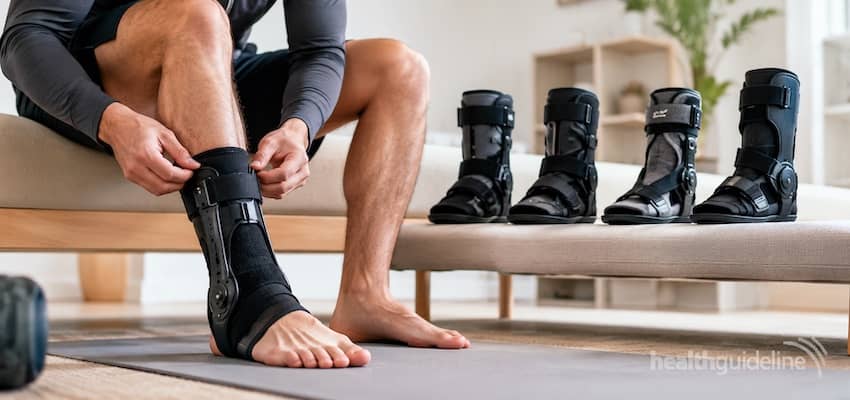
For most people, the Med Spec ASO Flex Hinge is the best overall hinged ankle brace — it combines a proven figure-eight strap system with an articulated shell for strong side-to-side control. Also great: the Active Ankle T2 for jumping and cutting sports, and the Össur Rebound for transitioning out of a walking boot after an injury or surgery.
A hinged ankle brace uses rigid or semi-rigid uprights connected by a hinge beside the ankle bones. That design physically limits the side-to-side rolling (inversion and eversion) that causes most sprains, while still allowing the up-and-down motion you need to walk, run, and jump. This guide compares five genuinely hinged braces that are currently sold, explains who each one suits, and shows how to pick the right level of support for your ankle.
Is a hinged ankle brace worth it?
If your ankle rolls, gives way, or you’re recovering from a moderate-to-severe sprain, a hinged brace offers more real stability than a soft sleeve. Reviews of previously injured athletes have found that braces and taping cut the risk of a repeat sprain by roughly 50–70%, and semi-rigid braces reduce sprains with little effect on performance. A brace supports and protects — it works best alongside rehab, not instead of it.
How we chose
We focused only on braces with a true articulating hinge (not soft compression sleeves), and prioritized models that are real, currently available, and well established with clinicians and athletes. We weighed the level and type of support, how well the brace fits inside a shoe, comfort for all-day or in-game wear, adjustability, and value across a range of needs — from court sports to post-surgical recovery. Medical context is drawn from Mayo Clinic and peer-reviewed sports-medicine literature. We don’t accept payment for placement, and every pick includes an honest look at its downsides.
Top hinged ankle braces at a glance
| Brace | Best for | Key feature | Price |
|---|---|---|---|
| Med Spec ASO Flex Hinge | Best overall / high ankle sprains | Figure-8 straps + articulated shell | Mid-range |
| Active Ankle T2 | Court & jumping sports | Rigid U-shell + bilateral hinge | Budget-friendly |
| DonJoy Velocity (ES) | Chronic instability | Rigid uprights, 3 support levels | Mid-range |
| Össur Rebound Ankle Brace | Transitioning out of a boot | Dual-axis hinges + width adjust | Premium (DME) |
| Brace Align Semi-Rigid Ultra Active | Everyday value support | Single-action hinge, PDAC L1906 | Value |
01 / BEST OVERALL
Med Spec ASO Flex Hinge
The ASO Flex Hinge pairs Med Spec’s proven figure-eight strapping system with an articulated internal plastic shell, so it resists inversion and eversion while still allowing natural up-and-down foot motion. The shell is built into a ballistic-nylon boot that flexes to your ankle’s shape, and the figure-eight straps capture the heel to limit rolling. It’s the most supportive brace in the ASO line and a strong pick for high (syndesmotic) ankle sprains.
Key features
- internal hinged plastic shell
- figure-eight nylon stabilizing straps
- elastic cuff
- heel-capture design
- fits left or right
- sizes XS–XXL.
Pros
- excellent medial/lateral control
- genuinely good for high ankle sprains and chronic instability
- articulated shell adds comfort
- trusted clinical brand.
Cons
- bulkier than a soft sleeve
- pricier than basic braces
- takes a moment to lace and strap.
Best for: chronic instability, high ankle sprains, aggressive cutting and pivoting sports.
02 / BEST FOR COURT & JUMPING SPORTS
Active Ankle T2
The Active Ankle T2 uses a rigid U-shaped shell with an anatomical bilateral hinge that blocks side-to-side rolling while letting the foot move up and down freely. A single quick-fit strap makes it fast to put on over a sock, and the low-bulk shell works with low- or high-top shoes. It’s a longtime favorite for volleyball, basketball, and cheer, where jumping and landing put ankles at risk.
Key features
- rigid U-shaped shell
- anatomical bilateral hinge
- feather-light EVA padding
- single adjustable strap
- worn over a sock
- fits left or right.
Pros
- strong impact protection
- very quick on and off
- budget-friendly
- durable build.
Cons
- rigid feel that some runners dislike
- hand-wash only
- single strap is less customizable than a lace system.
Best for: jumping and cutting court sports, prophylactic use, and anyone with a history of rolling an ankle.
03 / BEST FOR CHRONIC INSTABILITY
DonJoy Velocity (ES)
The DonJoy Velocity is a low-profile brace with rigid uprights and anatomically designed bilateral hinges that allow normal dorsiflexion and plantarflexion while limiting inversion and eversion. Its R3 (rapid-rigid-ratcheted) wrap adds circumferential compression around the tibia and fibula, and it comes in three support levels (ES, MS, LS) plus standard or wide calf sizing, so you can match the rigidity to your situation.
Key features
- rigid uprights
- bilateral hinges
- R3 compression wrap
- three support levels
- standard/wide calf
- left or right
- low-profile.
Pros
- clinical-grade support
- adjustable support levels
- fits inside most shoes
- well suited to lingering instability.
Cons
- premium price
- the ES model can feel stiff at first
- you must select the correct model and size.
Best for: chronic ankle instability, return-to-sport, and anyone who wants adjustable rigidity.
04 / BEST FOR TRANSITIONING OUT OF A WALKING BOOT
Össur Rebound Ankle Brace
The Össur Rebound is a semi-rigid hinged orthosis built to bridge the gap between a walking boot or cast and normal shoes. Dual-axis hinges preserve a more natural gait while limiting side-to-side motion, an adjustable width extender accommodates swelling, and an optional stability strap lets you dial support up or down as you recover. It’s a standout for grade 2–3 sprains and post-surgical recovery.
Key features
- semi-rigid thermoformed shell
- dual-axis hinges
- open-front closure
- width adjustability
- optional stability strap
- left or right.
Pros
- excellent for post-boot and post-op recovery
- adjustable as you heal
- low-profile for a rigid brace.
Cons
- premium price
- sold mainly through orthopedic/DME suppliers rather than a standard Amazon listing (verify before buying)
- more brace than casual users need.
Best for: stepping down from a boot after a fracture or surgery, and higher-grade sprains needing controlled support.
Availability note: The Össur Rebound Ankle Brace is primarily stocked by DME/orthopedic suppliers.
05 / BEST VALUE EVERYDAY SUPPORT
Brace Align Semi-Rigid Ultra Active
This semi-rigid brace uses a bilateral single-action hinge and a slim footplate to control inversion and eversion while allowing front-to-back motion, making it a versatile everyday option for sprains, tendonitis, and lighter sport. It’s PDAC-verified (L1906) and comes from a small US business that offers a free video fitting session to help you get the fit right.
Key features
- semi-rigid exterior
- bilateral single-action hinge
- EVA comfort padding
- slim footplate
- hook-and-loop straps
- fits left or right
- PDAC L1906.
Pros
- strong value
- comfortable for all-day wear
- PDAC-coded
- small-business support and fitting help.
Cons
- less rigid than hard-shell or clinical braces
- not ideal for severe instability
- a lesser-known brand.
Best for: everyday support, mild-to-moderate sprains or instability, and recreational activity.
What to look for when buying a hinged ankle brace
Support level and rigidity
Match the brace to the injury. Rigid-shell braces (like the Active Ankle T2) give the most side-to-side protection and suit jumping sports and significant instability. Semi-rigid hinged braces (Össur Rebound, Brace Align) balance support with comfort and are easier for all-day wear. If you only need mild compression, a hinged brace may be more than you need — a lace-up or sleeve could be a better fit.
Hinge type
“Hinged” can mean a rigid bilateral hinge, dual-axis hinges, or a single-action hinge. All of them share the same goal: allow the foot to move up and down (dorsiflexion and plantarflexion) while blocking the inward and outward roll that stretches the outer ankle ligaments. More rigid hinges resist rolling more aggressively; softer semi-rigid hinges trade a little control for comfort and range of motion.
Will it fit in your shoe?
Low-profile braces are designed to fit inside athletic shoes, but a roomier or high-top shoe helps a lot. Recovery-focused braces are bulkier; you may need a half-size up or a wider shoe. If you plan to wear the brace to work or in cleats, check the profile carefully.
Closure system, side, and sizing
Closures range from a single quick strap to figure-eight straps and lace-plus-strap hybrids. Some braces fit either foot; others are side-specific, so confirm left versus right before ordering. Measure your ankle circumference and follow the brand’s size chart (many run XS–XXL), and account for swelling if you’re bracing a fresh injury.
Materials and breathability
If you have a latex or neoprene sensitivity, check the materials — several braces are neoprene-free and use moisture-wicking fabrics. Breathability matters most for long wear and hot conditions.
Related options: stirrups and hard shells
Hinged cuffs aren’t the only choice. Semi-rigid stirrup braces (such as the Aircast A60) sit lower-profile and are popular for everyday support and prevention, while rigid hard-shell braces (like the Mueller Hg80) prioritize maximum protection. If you’re weighing options, our guide to the semi-rigid ankle brace breaks down the differences.
Understanding ankle sprains and instability
An ankle sprain happens when you roll or twist the ankle — usually inward — stretching or tearing the ligaments that support the outer side of the joint, according to Mayo Clinic. Sprains are among the most common injuries in active people; by some estimates there are around two million new ankle sprains each year in the United States, with the highest rates in cutting and jumping sports such as basketball, volleyball, and football. Once you’ve sprained an ankle, it’s more prone to re-injury, and repeated sprains can lead to chronic instability.
This is where external support helps. A hinged brace limits the extreme inward and outward motion that causes rolling and can improve your awareness of where the joint is in space. In previously injured athletes, sports-medicine reviews have reported that bracing and taping reduce the risk of a repeat sprain by roughly 50–70%, and that semi-rigid and laced braces reduce both first-time and recurrent sprains without meaningfully hurting performance.
Two honest caveats: a brace supports and protects the joint — it doesn’t heal it. For a fresh injury, early care (rest, ice, compression, and elevation) and, for most sprains, a course of rehab to rebuild strength and balance are what actually restore the ankle. Bracing works best as part of that plan, not as a replacement for it. See our related guides on ankle sprain recovery time and high ankle sprain recovery, and if you’re shopping for supportive footwear, our picks for tennis shoes with arch support.
When to see a professional
A brace is not a substitute for a proper evaluation. Based on Mayo Clinic guidance, see a healthcare professional if you:
- can’t put weight on the ankle or walk more than a few steps;
- have an obvious deformity, or heard or felt a “pop” or “crack” at the time of injury;
- have severe pain, major swelling, numbness, or the ankle looks bruised and unstable;
- see no improvement after about a week of home care.
These can be signs of a more serious ligament tear or a fracture that needs imaging and treatment. When in doubt, get it checked.
Frequently asked questions
Do hinged ankle braces actually work?
Yes — external ankle supports have solid evidence behind them. Reviews of athletes with a previous sprain found that braces and taping cut the risk of a repeat sprain by roughly 50–70%, and semi-rigid braces reduce both first-time and recurrent sprains with little effect on performance. A brace supports and protects; it works best combined with rehab, not instead of it.
Can you wear a hinged ankle brace inside a shoe?
Most low-profile hinged braces — the ASO Flex Hinge, DonJoy Velocity, and Active Ankle T2 among them — are designed to fit inside athletic shoes, though a roomier or high-top shoe helps. Bulkier recovery braces such as the Össur Rebound also fit most shoes but may need a half-size up or a wider shoe.
Hinged vs lace-up ankle brace — which is better?
It depends on the job. Lace-up braces are lighter and great for mild support and “I can walk but don’t fully trust it yet” moments. Hinged braces add rigid uprights that better resist rolling, so they’re generally preferred for chronic instability, higher-grade sprains, and high-impact cutting or jumping sports.
Can you run or play sports in a hinged ankle brace?
Many hinged braces allow the up-and-down motion you need to walk, run, and jump while blocking side-to-side rolling. Rigid-shell models like the Active Ankle T2 suit jumping and cutting sports; some people find very rigid braces less comfortable for distance running and prefer a semi-rigid or lace-up option there.
How long should you wear an ankle brace after a sprain?
It varies with severity. Mild sprains may only need support for a couple of weeks, while more significant sprains can take 10–12 weeks to heal and often benefit from bracing during activity plus rehab. Because a sprained ankle is more prone to re-injury, many athletes keep bracing during sport for longer. Ask your clinician about your situation.
How do I choose the right size and side?
Measure your ankle circumference and note your shoe size, then follow the brand’s chart — sizes commonly run XS–XXL. Some braces fit either foot; others are side-specific, so confirm left versus right before buying. If you’re between sizes, factor in swelling and check the maker’s recommendation.
Medical disclaimer: This article is for general information only and is not medical advice. Talk to a qualified healthcare professional about your specific situation, especially before using a brace to treat an injury.