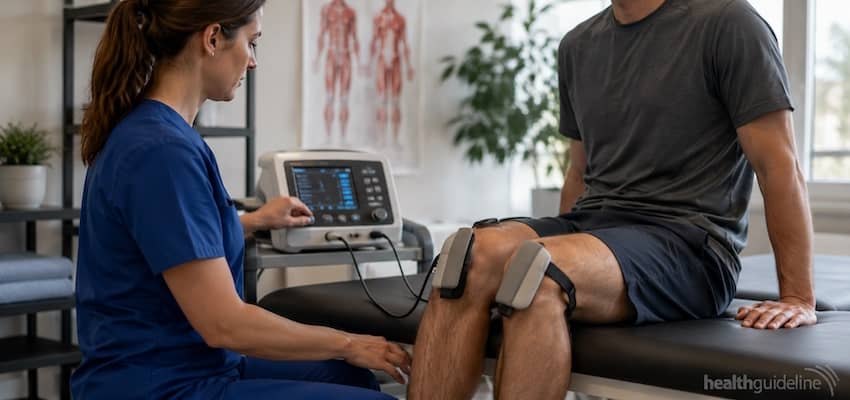
Medial Meniscus Tear: Symptoms, Treatment & Exercises

Medial meniscus tear guide · updated September 9, 2026
Quick answer: A medial meniscus tear is damage to the C-shaped fibrocartilage on the inner side of the knee. It can cause inner-joint-line pain, swelling, stiffness, catching, locking, or a giving-way sensation. Many tears are treated first with activity modification and rehabilitation, while displaced tears that block motion or repairable acute tears may need earlier surgical assessment.
Medial meniscus tear: key points
Common symptoms
Pain, swelling, catching
Pain is often felt along the inner knee joint line. Stiffness, swelling and difficulty fully bending or straightening the knee can follow.
Diagnosis
Exam first, MRI when needed
History and physical examination matter. For suspected acute meniscal tears, AAOS identifies MRI as the preferred imaging test because of its accuracy.
Treatment
Not every tear needs surgery
Rehabilitation is often appropriate when the knee is not truly locked. Tear pattern, symptoms, activity level and whether the tear is acute or degenerative change the plan.
JUMP TO A SECTION
What is a medial meniscus tear?
A medial meniscus tear affects the meniscus on the inner side of the knee. Each knee contains a medial and lateral meniscus — wedge-shaped pieces of fibrocartilage between the femur and tibia that help distribute load, absorb shock and contribute to knee stability. A tear may occur suddenly with twisting or pivoting, or develop gradually as the tissue changes with age.
The location matters because the meniscus does not have the same blood supply throughout. According to the American Academy of Orthopaedic Surgeons (AAOS), the outer one-third has a richer blood supply and is often called the red zone. The inner two-thirds has much less blood flow, so tears there have less biological capacity to heal back together.
Important distinction: “Medial meniscus tear” describes the injured structure, not one single injury pattern. A small stable tear, a displaced bucket-handle tear, a meniscal root tear and an age-related degenerative tear can require very different management.
Acute traumatic tear vs. degenerative tear
| Feature | Acute traumatic tear | Degenerative tear |
|---|---|---|
| Typical onset | Sudden pivot, cut, twist or direct injury | Gradual symptoms or pain after a relatively minor twist |
| Common context | Sports or other loaded knee rotation | Age-related tissue change, sometimes with osteoarthritis |
| Key treatment question | Is the tear displaced, blocking motion or repairable? | Can symptoms improve with exercise-based rehabilitation and management of the whole knee? |
| Surgery | May be considered earlier for selected displaced or repairable tears | Often not the first choice when symptoms can be managed with rehabilitation |
What causes a medial meniscus tear?
Acute tears often happen when the knee rotates while it is bent and carrying weight. Pivoting, cutting, changing direction or rising from a deep bend can load the meniscus. Meniscal injuries can also occur with other knee injuries, including anterior cruciate ligament (ACL) injury. In older adults, a relatively small twist may be enough to irritate or tear tissue that has become more degenerative over time.
Common tear descriptions include radial, flap, horizontal, complex and bucket-handle tears. The label alone does not determine treatment; clinicians also consider whether the tear is stable or displaced, its exact location, the condition of the surrounding cartilage, your symptoms and your activity goals.
What are the symptoms of a medial meniscus tear?
The classic symptom is pain or tenderness along the inner joint line of the knee. Swelling and stiffness may develop over hours or days rather than immediately. Some people report catching, clicking, a giving-way sensation or difficulty moving the knee through its full range.
- Inner-knee or joint-line pain, especially with turning, squatting or loaded bending
- Swelling or a feeling of tightness in the knee
- Stiffness and reduced ability to bend or fully straighten the knee
- Catching, clicking or a sensation that something is moving inside the joint
- A feeling that the knee may give way
- In some cases, true locking — the knee becomes mechanically blocked and cannot fully move
Clicking is not the same as a locked knee. Painless clicking can occur for many reasons. A knee that physically cannot fully straighten after an injury is more concerning, particularly if a displaced meniscal fragment is suspected.
How is a medial meniscus tear diagnosed?
Diagnosis starts with the story of how symptoms began and a physical examination. A clinician may check joint-line tenderness and use maneuvers such as the McMurray or Thessaly test. AAOS states that joint-line tenderness, McMurray and Thessaly testing can help diagnose acute meniscal tears and may be more useful when combined.
Do you need an MRI?
Not every painful knee needs immediate MRI. When an acute meniscal tear is suspected and imaging is needed, the 2024 AAOS clinical practice guideline recommends MRI as the preferred imaging modality because of its high accuracy. X-rays do not show the meniscus itself but may help identify fractures or osteoarthritis and other causes of knee pain.
Do not treat an MRI report in isolation. Imaging findings need to match your symptoms and examination. The old idea that an MRI “grade” by itself dictates surgery is too simplistic; treatment decisions should be based on the whole clinical picture.
What is the treatment for a medial meniscus tear?
Many medial meniscus tears do not require immediate surgery. Initial care commonly focuses on reducing aggravating load, controlling pain and swelling, restoring comfortable motion, and rebuilding strength and function. Surgery becomes more relevant when the knee is mechanically blocked, the tear is displaced or repairable, or significant symptoms continue despite appropriate rehabilitation.
Early self-care
For a new injury, temporarily stop activities that sharply increase pain — especially twisting, pivoting and deep loaded bending. Cold therapy can help with pain and swelling. The NHS advises using an ice pack wrapped in a towel for up to 20 minutes at a time and avoiding direct skin contact. If you need a reusable option, see our guide to ice packs for knees.
Short-term compression or a knee support may feel helpful for swelling or confidence, but a brace does not repair a torn meniscus. If you are comparing support options, our knee brace for torn meniscus guide explains the differences between sleeves and more structured braces.
Physical therapy and rehabilitation
Physical therapy can help restore knee motion, quadriceps and hip strength, balance and tolerance for daily or sport-specific loading. The goal is not to “push the tear back together” with exercise. Instead, rehabilitation improves the muscle support and movement capacity around the knee while symptoms settle and the treatment plan becomes clearer.
What does the evidence say for degenerative tears?
In the ESCAPE randomized clinical trial, 321 adults aged 45 to 70 with degenerative meniscal tears were assigned to arthroscopic partial meniscectomy or exercise-based physical therapy. At five years, physical therapy remained noninferior to surgery for patient-reported knee function, with comparable radiographic osteoarthritis progression between groups.
What exercises are used for a medial meniscus tear?
Meniscus rehabilitation is usually progressed from comfortable range-of-motion and muscle activation toward strengthening, balance and functional loading. The exact exercises depend on pain, swelling, tear type, whether surgery was performed and any restrictions from your clinician. Avoid using a generic online routine as a substitute for postoperative instructions.
- Gentle knee motion. Heel slides or other controlled bending-and-straightening movements are often used to maintain range as symptoms allow. After a repair, your surgeon or physical therapist may place strict limits on how far you can bend.
- Quadriceps activation. Quad sets — tightening the front-thigh muscles with the knee supported — are commonly used early to restore muscle control without requiring a deep knee bend.
- Straight-leg raises. When you can keep the knee straight without pain or lag, a therapist may use straight-leg raises to strengthen the quadriceps while limiting knee movement.
- Hip and posterior-chain strength. Bridges and other hip-focused exercises may be added to improve lower-limb control and reduce reliance on the painful knee.
- Balance and functional loading. Later phases may include supported single-leg balance, step work, controlled squats and sport- or job-specific drills when the knee tolerates them.
Which exercises should you avoid?
Early in recovery, movements that sharply increase pain, swelling, catching or instability should be reduced. Deep loaded knee flexion, forceful pivoting and high-impact activity can place substantial stress through the meniscus. The right restrictions depend on your tear and treatment; after a surgical repair, protecting the repair can require more specific limits on weight bearing and knee bending.
Stop and get advice if exercise causes true locking, a sudden loss of motion, repeated giving way, rapidly increasing swelling or sharp worsening pain. Mild muscle effort is different from provoking the injured joint.
When is surgery considered for a medial meniscus tear?
Surgery is not automatic for a meniscus tear. For acute isolated tears, AAOS notes that displaced or displacing tears that restrict knee motion may benefit from earlier surgical intervention, and symptomatic tears with good repair potential may also be considered for early repair. When surgery is indicated, preserving as much functional meniscal tissue as possible is an important goal.
Meniscus repair vs. partial meniscectomy
Meniscus repair uses sutures or other fixation to preserve the torn tissue when the pattern and location make healing realistic. Recovery is longer because the repaired tissue needs protection while it heals. Partial meniscectomy removes an unstable damaged portion that cannot be repaired. It usually allows faster early recovery, but it removes some shock-absorbing tissue, so modern guidance emphasizes meniscal preservation when feasible.
Acute and degenerative tears are not the same surgical question. The 2024 AAOS acute meniscus guideline specifically excludes chronic or degenerative tears, meniscal root tears and tears that occur with major associated injuries such as ACL tears. Degenerative-tear decisions should be interpreted using evidence specific to that population.
How long does a medial meniscus tear take to heal?
There is no reliable single healing time for every medial meniscus tear. Recovery depends on whether the tear is traumatic or degenerative, its location and stability, whether it is repaired or trimmed, the condition of the rest of the knee, and the physical demands you want to return to.
AAOS notes that rehabilitation after meniscus repair commonly takes about 3 to 6 months, while recovery after a partial meniscectomy is often shorter, around 3 to 6 weeks. Those are broad reference ranges, not return-to-sport clearance. Strength, swelling, motion, confidence and task-specific testing still matter.
For nonsurgical care, improvement can also take weeks to months rather than a few days. If symptoms are not clearly improving, if normal activities remain limited or if the knee repeatedly swells or catches, reassessment is reasonable.
When should you see a doctor for a suspected meniscus tear?
Arrange an assessment if knee pain is interfering with normal activities or sleep, is getting worse, keeps returning, or is not improving with sensible self-care. A clinician can also check for ligament injury, fracture, osteoarthritis or another cause of knee pain that can mimic a meniscus problem.
Get urgent medical help for these signs
- Very severe knee pain after a fall or injury
- Inability to walk or put weight on the leg
- A hot, swollen knee, especially with fever or feeling unwell
- Inability to bend or straighten the knee
- A knee that has changed shape or looks out of place
- Tingling, numbness or loss of sensation in the leg or toes after injury
Frequently asked questions
Can a medial meniscus tear heal without surgery?
Some tears can improve without surgery, especially when symptoms settle and the knee is not mechanically locked. Healing potential is better in the outer, better-supplied portion of the meniscus, but symptom improvement does not always mean the tissue has anatomically rejoined. Rehabilitation and clinical follow-up are often used to guide recovery.
Where does a medial meniscus tear hurt?
Pain is often felt along the inner joint line of the knee, although some people feel discomfort deeper in the joint or toward the back. Turning, squatting, loaded bending and getting up from a low position may aggravate symptoms. Location alone cannot confirm the diagnosis because several knee conditions cause similar pain.
Can you walk with a torn medial meniscus?
Many people can still walk after a meniscus tear, but walking may be painful or limited by swelling, stiffness or instability. If you cannot bear weight after an injury, have severe pain, or the knee is physically blocked from bending or straightening, seek urgent assessment rather than trying to walk through it.
Does a medial meniscus tear always show on MRI?
MRI is the preferred imaging test for suspected acute meniscal tears when imaging is needed, but the scan still has to be interpreted alongside symptoms and examination. MRI can also show meniscal changes that are not the main cause of pain, particularly in older adults with degenerative knee changes.
Is a knee brace necessary for a meniscus tear?
Not necessarily. A sleeve or brace may provide compression, warmth or a sense of support, but it does not repair the torn tissue. Whether a brace is useful depends on your symptoms, associated injuries and treatment plan. After surgery, use only the brace and range-of-motion instructions prescribed by your surgical team.
What is the difference between meniscus repair and meniscectomy?
A meniscus repair preserves the torn tissue by fixing it back together when the tear has suitable healing potential. A partial meniscectomy trims away damaged unstable tissue that cannot be repaired. Repair usually requires a longer protected rehabilitation period, while meniscectomy often has a faster early recovery but removes some meniscal tissue.
Are squats bad for a medial meniscus tear?
Deep or heavily loaded squats may aggravate symptoms early, especially when the knee is swollen or painful. Squatting is not automatically forbidden forever; controlled squat variations may be reintroduced during rehabilitation when appropriate. After a meniscus repair, follow the surgeon or physical therapist’s specific bending and weight-bearing restrictions.
This article is for general information only and is not medical advice. Talk to a qualified healthcare professional about your specific injury, medicines, exercise plan, imaging results and return to work or sport.