Slip Resistant Work Shoes: 6 Best Picks for 2026
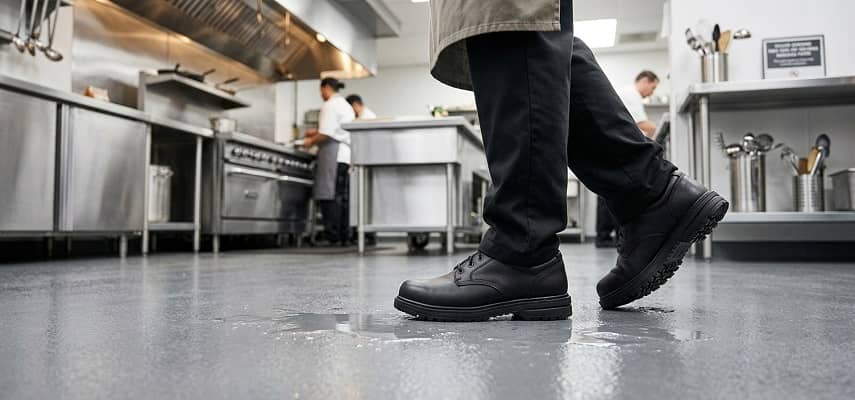
2026 work-shoe guide · grip, comfort & safety
Slip resistant work shoes should match the floor hazards you actually face. For most food-service, healthcare and hospitality workers, we like the Shoes For Crews Everlight as a lightweight all-rounder. If you want a leather upper and unusually broad width choices, consider the New Balance 626v2. If your hazard assessment also requires toe protection, skip soft-toe restaurant shoes and look at a rated safety-toe model such as the Timberland PRO Powertrain Sport.
Quick picks
Best overall
Shoes For Crews Everlight
Lightweight, water-resistant work sneaker with an ASTM-rated slip-resistant outsole and easy-clean tread.
Wide-foot pick
New Balance 626v2
Leather work shoe with an internal shank, ABZORB cushioning and multiple width options.
Safety-toe option
Timberland PRO Powertrain Sport
Alloy-toe work sneaker for jobs that need more than slip resistance alone.
JUMP TO A SECTION
How we chose these slip resistant work shoes
We reviewed the old article, then rebuilt the shortlist around current manufacturer specifications and active U.S. Amazon product pages. We prioritized explicit slip-resistance testing or manufacturer performance claims, work-appropriate upper materials, cushioning and support, fit options, cleanability, and whether the shoe adds other protection such as an alloy safety toe. Category labels are editorial judgments based on those published specifications, not results from a head-to-head laboratory or wear test.
Why the list is shorter now: a smaller group of well-documented models is more useful than a long roundup filled with ordinary sneakers, discontinued shoes or vague “non-slip” claims. Current stock and seller availability can change, so confirm the exact size and model before ordering.
Best slip resistant work shoes at a glance
| Shoe | Best for | Slip-resistance evidence | Main trade-off |
|---|---|---|---|
| Shoes For Crews Everlight | Food service, healthcare, hospitality | ASTM F3445-24 SRO / F2913-24 testing listed by brand | Soft toe; knit upper is not a safety shoe |
| New Balance 626v2 | Leather upper and wide-size choices | 626v2 listing cites ASTM F2913 slip-resistant outsole | Heavier and less breathable than mesh |
| Skechers Work Cessnock | Lightweight, easy-on work sneaker | Skechers lists an SRO-rated slip-resistant outsole | Soft mesh gives less spill protection than leather |
| Crocs On The Clock | Easy-clean slip-on | ASTM F2913-24 tested and F3445-24 certified | Slip-on fit is less adjustable than laces |
| KEEN Utility PTC Oxford | Professional leather service shoe | Oil- and slip-resistant non-marking outsole; KEEN.WET TRAX | More substantial build than a lightweight sneaker |
| Timberland PRO Powertrain Sport | Jobs that also require toe protection | Timberland lists a slip-resistant outsole plus alloy safety toe | Safety toe adds weight and may be unnecessary for service-only jobs |
The six best slip resistant work shoes in this guide
01 / BEST OVERALL
Shoes For Crews Everlight
The Everlight is our all-round pick for restaurant, hospitality and healthcare floors because it combines a lightweight work-sneaker build with a purpose-designed slip-resistant outsole. Shoes For Crews currently lists ASTM F3445-24 SRO traction, easy-clean tread, extra EVA cushioning and a water-resistant upper. It is a soft-toe shoe, so it is not the choice for jobs requiring impact protection.
Shoes For Crews Everlight — view on Amazon
Key features
- ASTM F3445-24 SRO TRACTIONiQ outsole listed by Shoes For Crews
- Easy-clean tread intended to reduce debris buildup
- Lightweight foam cushioning
- Water-resistant, breathable knit upper
Pros
- Purpose-built for service environments rather than adapted from a running shoe
- Lightweight for workers who move continuously
- Men’s and women’s versions, including wide options
Cons
- Soft toe provides no impact or compression protection
- Water-resistant treatment is not the same as waterproof construction
Best for: Food-service, healthcare, hospitality and public-service workers who want a lightweight, service-specific slip-resistant sneaker.
Who should skip it: Workers whose employer requires a safety toe, puncture resistance, metatarsal protection or another specific PPE rating.
02 / BEST FOR WIDE FEET & LEATHER
New Balance 626v2
The 626v2 is a strong option if you prefer a leather upper and need more width choice than a typical restaurant sneaker provides. The current Amazon listing describes an all-leather upper, internal shank, ABZORB crash-pad cushioning and an ASTM F2913 slip-resistant lug outsole. New Balance also offers women’s 626v2 versions, so check the exact listing rather than assuming the men’s size conversion will fit.
New Balance 626v2 — view on Amazon
Key features
- Leather upper
- Internal shank for midfoot structure
- ABZORB crash-pad cushioning
- Oil-resistant outsole properties also listed on the Amazon product page
Pros
- Leather is easier to wipe clean than open mesh
- Broad width range is useful for hard-to-fit feet
- Structured feel suits workers who dislike very soft knit shoes
Cons
- Leather is warmer and less breathable than knit
- Soft toe; not a substitute for protective-toe footwear
Best for: Workers who want slip-resistant traction in a traditional leather athletic-work-shoe shape, especially when wide or extra-wide sizing matters.
Who should skip it: Anyone prioritizing maximum ventilation or a very light, flexible upper.
See our dedicated New Balance slip resistant shoes guide for more brand-specific options.
03 / LIGHTWEIGHT EASY-ON PICK
Skechers Work Relaxed Fit: Cessnock
The Cessnock works well for people who want the feel of a flexible athletic shoe without traditional laces. Skechers lists a roomy Relaxed Fit shape, Air-Cooled Memory Foam insole, fixed stretch laces and an SRO-rated slip-resistant outsole for wet, dry, oily and greasy surfaces. The mesh upper favors airflow and low weight over spill resistance.
Skechers Work Cessnock — view on Amazon
Key features
- SRO-rated slip-resistant outsole listed by Skechers
- Relaxed Fit toe and forefoot shape
- Air-Cooled Memory Foam cushioned insole
- Fixed stretch laces for quick on/off
Pros
- Light, flexible feel
- Roomier fit than many narrow work sneakers
- No need to retie conventional laces during a shift
Cons
- Mesh is less protective against liquid spills than leather
- Stretch-lace fit is less tunable than a full lace-up
Best for: Food-service and service workers who value a flexible, easy-on sneaker and do not need a safety toe.
Who should skip it: Workers exposed to frequent splashes who need an easily wiped leather or molded upper.
For more brand-specific nursing options, see our Skechers nurse shoes guide.
04 / BEST EASY-CLEAN SLIP-ON
Crocs On The Clock Work Slip-On
Crocs On The Clock is a practical choice for workers who want an enclosed, molded slip-on that is easy to wipe clean. Crocs lists an enclosed toe and heel, Crocs Lock slip-resistant tread, enhanced arch support, and current ASTM F2913-24 testing with ASTM F3445-24 certification. Its trade-off is fit adjustment: there are no laces to fine-tune heel or instep hold.
Crocs On The Clock Work Slip-On — view on Amazon
Key features
- ASTM F2913-24 tested and ASTM F3445-24 certified
- Crocs Lock slip-resistant tread
- Enclosed toe and heel
- Molded upper that is simple to wipe down
Pros
- Easy to clean after messy shifts
- Current slip-resistance test/certification information is clearly published
- Unisex sizing covers many workers
Cons
- No lace adjustment
- Molded clog-style feel is not for everyone
Best for: Kitchens, food prep, healthcare and service jobs where easy cleaning and quick on/off matter.
Who should skip it: People who need a precise lace-up fit or employer-required safety-toe protection.
05 / PROFESSIONAL LEATHER PICK
KEEN Utility PTC Oxford
The PTC Oxford is the dressier option in this guide. KEEN positions it for service and duty work, with a water-resistant leather upper, compression-molded EVA midsole, plush footbed, and oil- and slip-resistant non-marking outsole with KEEN.WET TRAX traction. It is a soft-toe shoe, but its leather Oxford profile suits workplaces where a black athletic sneaker looks too casual.
KEEN Utility PTC Oxford — view on Amazon
Key features
- Oil- and slip-resistant non-marking rubber outsole
- KEEN.WET TRAX traction system
- Water-resistant leather upper
- Compression-molded EVA midsole
Pros
- More professional appearance than a mesh sneaker
- Leather upper is practical to wipe clean
- Service-specific traction and comfort features
Cons
- Heavier-looking and less airy than knit sneakers
- Soft toe does not address impact/compression hazards
Best for: Front-of-house, hospitality and service workers who want a black leather shoe with work-specific traction.
Who should skip it: Workers who prefer ultra-light knit sneakers or need protective-toe footwear.
06 / BEST SAFETY-TOE OPTION
Timberland PRO Powertrain Sport Alloy Toe Work Sneaker
The Powertrain Sport is included for a different job than the five soft-toe picks above. Timberland lists an alloy safety toe, slip-resistant polyurethane outsole and Anti-Fatigue cushioning; current versions also list electrical-hazard or static-dissipative configurations depending on the exact model. If your workplace hazard assessment calls for protective footwear, this is the type of specification set to compare instead of assuming any restaurant shoe is sufficient.
Timberland PRO Powertrain Sport Alloy Toe — view on Amazon
Key features
- Alloy safety toe
- Slip-resistant polyurethane outsole
- Anti-Fatigue cushioning technology
- Wide sizes available on current Timberland versions
Pros
- Adds impact protection that soft-toe service shoes do not provide
- Athletic work-shoe shape is less bulky than many boots
- Designed for industrial work rather than only restaurant floors
Cons
- Heavier than soft-toe knit work shoes
- Exact EH/SD rating varies by Powertrain Sport version; check the model label
Check the exact safety label. “Powertrain Sport” is a family with multiple versions. Match the safety-toe and electrical/static rating to your employer’s hazard assessment rather than relying on the product name alone.
Best for: Warehouse, light-industrial, maintenance or mixed-duty jobs where slip resistance and a protective toe are both needed.
Who should skip it: Restaurant or hospital workers whose dress code permits lighter soft-toe shoes and whose hazard assessment does not require a safety toe.
What does “slip resistant” actually mean?
A tread pattern alone does not prove that a shoe is slip resistant. ASTM F2913-24 is a laboratory test method that measures the dynamic coefficient of friction between whole footwear and test surfaces under controlled conditions. ASTM F3445-24 is a performance specification that sets minimum slip-resistance requirements using that whole-shoe test method. Even certified footwear is not “slip-proof” in every real workplace.
479,480 cases involving days away from work
The U.S. Bureau of Labor Statistics reports 479,480 private-industry cases involving days away from work due to falls, slips or trips in 2024. Footwear is only one part of prevention; floor maintenance, spill control, housekeeping, lighting and work practices also matter.
Are slip resistant work shoes OSHA approved?
Do not shop by an “OSHA approved non-slip” slogan. OSHA’s general-industry foot-protection rule, 29 CFR 1910.136, requires protective footwear when specific hazards such as falling or rolling objects, sole puncture or electrical hazards are present. Whether you need a soft-toe slip-resistant shoe, safety-toe footwear or another protective feature depends on the workplace hazard assessment and employer requirements.
Slip resistance and safety-toe protection solve different problems. A soft-toe restaurant shoe can have excellent traction and still provide no protection against falling objects. Conversely, a safety-toe shoe still needs suitable traction for the floor contaminants in your workplace.
How to choose slip resistant work shoes
- Start with your employer’s requirements. Ask whether you need soft-toe footwear, a protective toe, electrical-hazard protection, static-dissipative footwear, puncture resistance, waterproofing or another specific standard.
- Match traction to the real contaminant. Wet tile, grease, detergent solution, oil and outdoor mud are different hazards. Prefer a model with published test information rather than relying on the word “rubber.”
- Choose an upper you can maintain. Knit is lighter and more breathable; leather and molded uppers are usually easier to wipe down. Water-resistant does not mean waterproof.
- Get the fit right. Your heel should stay secure, toes should not be compressed, and the shoe should not slide on your foot when you pivot. Wide sizing can matter as much as length.
- Inspect the outsole regularly. Worn tread, hardened rubber, cuts or packed-in debris can reduce traction. Replace footwear when the outsole no longer has the condition needed for the job.
Cushioning, support and long shifts
More foam is not automatically better for every worker. A very soft shoe can feel comfortable initially but may not provide the structured feel some people prefer for repeated lifting, standing or turning. Compare heel security, midfoot support, toe room and the stability of the platform. If your work is primarily healthcare, our best shoes for healthcare workers and best shoes for nurses guides cover broader comfort considerations.
Restaurant and kitchen work
For kitchens and food service, prioritize a tread that can be cleaned easily, an upper compatible with your spill exposure, and a secure fit for fast pivots. If you specifically want women’s styles, see our women’s non-slip restaurant shoes guide.
Work socks matter too
A shoe that fits correctly with a thin sock may feel cramped with a thick work sock. Try the exact combination you will wear on shift. For heavier footwear and boot-based jobs, our work-boot sock guide explains cushioning and moisture-management trade-offs.
How to keep slip resistant soles working well
Cleaning the outsole is part of traction maintenance. Food debris, grease, soap film, mud and other material can pack into tread channels and change the way the shoe contacts the floor. Follow the shoe manufacturer’s cleaning instructions, remove debris from the tread, allow the shoe to dry properly, and avoid aggressive chemicals or heat unless the brand says they are safe for that model.
Do not sand or cut the outsole to “make it non-slip.” Altering the tread can damage the shoe, shorten its life and invalidate the manufacturer’s tested design. If the outsole is worn smooth, replacement is the safer option.
Frequently asked questions
What are the best slip resistant work shoes?
For a broad food-service, healthcare or hospitality use case, the Shoes For Crews Everlight is our overall pick because it is lightweight and currently carries published ASTM slip-resistance information. The best choice changes with your job: New Balance 626v2 suits wide-fit leather buyers, Crocs On The Clock favors easy cleaning, and Timberland Powertrain Sport adds a safety toe.
What is the difference between non-slip and slip resistant shoes?
In everyday retail language, “non-slip” and “slip resistant” are often used for the same idea, but no footwear prevents every slip. A more useful question is whether the exact model has published testing or certification, such as ASTM F2913/F3445 information, and whether that test is relevant to your workplace surface and contaminants.
Does a rubber outsole automatically mean a shoe is slip resistant?
No. Rubber is only one part of the outsole system. Compound, tread geometry, contact area, contaminants and the floor surface all affect friction. Look for explicit slip-resistance test information or a work-shoe manufacturer’s published rating rather than assuming any rubber-soled sneaker is appropriate for a greasy or wet workplace.
Are oil resistant and slip resistant the same thing?
No. Oil resistance can describe how an outsole material resists degradation when exposed to oil, while slip resistance describes traction performance. A shoe may mention both properties, but one term does not automatically guarantee the other. Read the exact product specification and test standard instead of treating the labels as interchangeable.
Do I need a safety toe in addition to slip resistance?
Only if your job hazards and employer requirements call for it. OSHA 1910.136 addresses protective footwear where there are hazards from falling or rolling objects, sole puncture or certain electrical exposures. Restaurant and healthcare workers may only need soft-toe slip-resistant footwear, while warehouse or industrial workers may require a rated safety toe as well.
How often should slip resistant work shoes be replaced?
There is no universal replacement interval. Replace the shoe when the tread is worn smooth, the outsole is damaged or hardened, the upper no longer holds your foot securely, or the shoe cannot be cleaned enough to restore the intended tread contact. Workers who walk on abrasive surfaces may need replacement sooner than workers on smooth indoor floors.
Workplace footwear requirements vary by job and hazard assessment. Follow your employer’s safety policy and the exact manufacturer instructions for the footwear you use.