Non Slip Socks: 6 Best Grip Socks for 2026
2026 buying guide · grip, fit & everyday safety
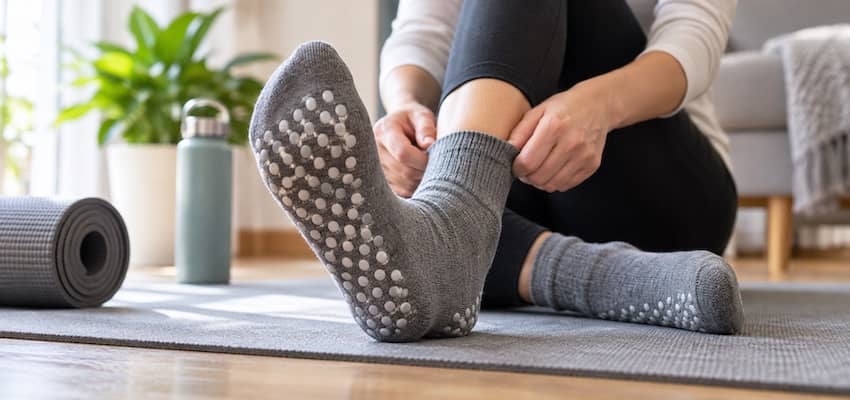
Non slip socks can add traction on smooth indoor floors and exercise mats, but the right pair depends on where you will wear them. For most people, the best choice is a snug sock with broad grip coverage that does not twist underfoot. For older adults with a meaningful fall risk, grip socks should not be treated as a guaranteed substitute for supportive, well-fitting footwear.
Quick picks
Best everyday crew
ZAKASA Grip Socks
A crew-height, unisex option with grippers underfoot and more coverage than low-rise studio socks.
Best value for Pilates
yeuG Pilates Socks
A multi-pair studio option for barre, Pilates and yoga without paying premium single-pair pricing.
Best warm option
Bulinlulu Fuzzy Grip Socks
Soft, warm slipper-style socks with bottom grippers for colder indoor use rather than workouts.
JUMP TO A SECTION
How did we choose the best non slip socks?
We treated this as a desk-research buying guide rather than a hands-on laboratory test. We prioritized current U.S. availability, grip coverage, sock profile, sizing approach, warmth, studio suitability and whether the design matches a clear use case. We also checked current medical guidance before making any claims about fall prevention.
The shortlist intentionally mixes everyday crew socks, low-rise Pilates socks, five-toe socks and fuzzy slipper socks. Those categories are not interchangeable: a warm home sock can be a poor workout choice, while a thin studio sock may not provide enough warmth or coverage for someone who wants a slipper substitute.
Which non slip socks are best at a glance?
For general indoor use, start with a secure crew sock that keeps the grip surface flat beneath the foot. For Pilates, yoga or barre, a lower-profile sock usually interferes less with ankle movement. For cold floors, fuzzy gripper socks add warmth but can be bulky and are usually less practical for exercise.
| Product | Best for | Design | Approx. price band* | Before you buy |
|---|---|---|---|---|
| ZAKASA Non Slip Grip Socks | Everyday crew coverage | Unisex crew gripper sock | About $10–$20 | Choose the size rather than assuming one-size fit |
| yeuG Pilates Socks | Value studio multipack | Low-profile grip socks | About $10 | Designed mainly around women’s studio use |
| TAVI Savvy Grip Socks | Premium Pilates/barre | Low-rise grip + arch band | About $15–$30 | Single-pair premium pricing is common |
| ToeSox Full Toe Low Rise | Five-toe movement | Separate toes + low-rise grip | About $15–$20 | Five-toe fit takes more time to put on |
| Bulinlulu Fuzzy Socks | Warm indoor wear | Plush slipper sock + grippers | About $15–$20 | Too bulky for many shoes and workouts |
| Ozaiic Pilates Socks | Low-profile studio use | Breathable grip sock | About $10–$15 | One-size formats can fit people differently |
Important for older adults: Grip socks are not proven as a stand-alone fall-prevention solution. CDC and National Institute on Aging guidance emphasizes properly fitted, nonskid footwear, home-safety changes, strength and balance work, medication review and vision care as parts of fall prevention.
The six best non slip socks to consider in 2026
01 / BEST EVERYDAY CREW
ZAKASA Non Slip Grip Socks
ZAKASA is the most versatile everyday pick in this list because it uses a conventional crew-sock shape instead of a ballet-style or fuzzy slipper profile. The current listing is sold in multiple sizes and marketed for men and women, making it a more practical starting point for households that want ordinary-looking indoor grip socks.
ZAKASA Non Slip Grip Socks — view on Amazon
Key features
- Crew-height design for more ankle coverage than studio socks
- Grip pattern under the foot for traction on smooth indoor surfaces
- Current listing offers men’s and women’s sizing options
- Suitable for home, hospital-style indoor use and light studio activity
Pros
- More conventional fit than most yoga socks
- Multiple size and color options
- Good choice when low-rise socks feel too exposed
Cons
- Still lacks the heel structure and support of a shoe
- A loose or oversized sock can twist and move the grips out of position
Best for: General indoor wear when you want a grippy crew sock rather than a fuzzy slipper sock or specialized Pilates design.
Who should skip it: Someone who needs prescribed footwear, ankle support or a shoe with a firm heel counter for fall-risk management.
02 / BEST VALUE FOR PILATES
yeuG Pilates Socks for Women
The yeuG multipack is a straightforward value choice for Pilates, barre and yoga. It has remained prominent in current Amazon U.S. marketplace tracking in 2026 and costs less per pair than premium single-pair studio socks. Choose it for variety and basic studio traction, not for structured foot or ankle support.
yeuG Pilates Socks for Women — view on Amazon
Key features
- Multi-pair pack aimed at Pilates, yoga and barre
- Low-profile design that leaves the ankle relatively free
- Grippy sole pattern for mats and smooth studio floors
- Compact enough for a gym or studio bag
Pros
- Low cost per pair compared with premium studio brands
- Useful if you attend several classes each week
- Easy to rotate between washes
Cons
- Less size-specific than specialist sock brands
- Not designed to replace supportive footwear for walking
Best for: Pilates or barre users who want several pairs for the price of one or two premium studio socks.
Who should skip it: People who need a highly specific shoe-size range, full ankle coverage or warm plush fabric.
03 / BEST PREMIUM STUDIO SOCK
TAVI Savvy Grip Socks
TAVI’s Savvy is the polished studio option in this guide. The current design combines a low-rise profile with a grip sole, supportive arch band and heel tab. TAVI also lists GOTS-certified organic cotton in the sock blend. It is a better fit for dedicated Pilates or barre users than for someone simply wanting inexpensive house socks.
TAVI Savvy Grip Socks — view on Amazon
Key features
- Low-rise studio profile
- Non-slip grip sole
- Supportive arch band
- Heel tab to reduce rubbing at the Achilles
Pros
- Purpose-built for studio movement
- More refined fit details than basic multipacks
- Brand provides clear care and material information
Cons
- Premium price for a single pair
- Low-rise coverage is not ideal if warmth is the priority
Best for: Regular Pilates, yoga or barre users who care about a more structured studio-sock fit.
Who should skip it: Value-focused buyers who mainly want several pairs for casual indoor use.
04 / BEST FIVE-TOE DESIGN
ToeSox Full Toe Low Rise Grip Socks
ToeSox is the distinctive pick for people who prefer each toe to move separately. The current Full Toe Low Rise uses a five-toe construction, non-slip sole, fitted heel, arch band and protective heel tab. That setup can feel closer to barefoot movement than a conventional sock, but it takes longer to put on.
ToeSox Full Toe Low Rise Grip Socks — view on Amazon
Key features
- Five separate toe pockets
- Patented non-slip grip sole
- Fitted heel and arch-support band
- Low-rise profile with heel tab
Pros
- Lets the toes spread individually
- Clear size chart with several size choices
- Current manufacturer page gives detailed material and care information
Cons
- Five-toe construction is slower to put on
- Not everyone likes fabric between the toes
Best for: Yoga, Pilates and barre users who already like five-toe socks or want more independent toe movement.
Who should skip it: Anyone with limited hand dexterity or toe sensitivity that makes separate toe pockets difficult or uncomfortable.
05 / BEST WARM HOME SOCK
Bulinlulu Fuzzy Socks with Grips
Bulinlulu’s fuzzy gripper socks are designed for a different job than the studio picks: warmth. The plush construction and rubber-style bottom grippers make them a practical cold-floor option for lounging or indoor wear. Their biggest tradeoff is bulk, so they are less suitable for shoes, hot weather or exercise classes.
Bulinlulu Fuzzy Socks with Grips — view on Amazon
Key features
- Plush fuzzy construction for warmth
- Non-slip rubber grippers on the bottom
- Adult slipper-sock format
- Best suited to indoor lounging and cold floors
Pros
- Warmer than thin studio grip socks
- Soft slipper-like feel
- Current marketplace tracking shows the model remains active
Cons
- Bulky for athletic shoes
- May feel too warm for exercise or warm climates
Best for: Cold indoor floors, lounging and people who prioritize warmth over a barefoot studio feel.
Who should skip it: Pilates users, people who sweat heavily at the feet or anyone planning to wear the socks inside fitted shoes.
06 / BEST SIMPLE STUDIO OPTION
Ozaiic Pilates Socks for Women
Ozaiic is a long-running Amazon studio option with a low-profile design aimed at Pilates, yoga, barre and dance. Current 2026 marketplace data still shows the ASIN active. It is a practical middle ground between a very cheap multipack and a premium branded studio sock, though its one-size approach can create fit variation.
Ozaiic Pilates Socks for Women — view on Amazon
Key features
- Low-profile grip sock for barefoot-style workouts
- Current listing describes breathable cotton construction
- Grip pattern for indoor studio surfaces
- Marketed for Pilates, barre, ballet, dance and home use
Pros
- Established, widely listed studio sock
- Lower profile than crew or fuzzy socks
- Moderate price position
Cons
- One-size fit will not suit every foot equally well
- Less everyday warmth and coverage than a crew sock
Best for: Someone who wants a familiar, low-profile Pilates grip sock without moving to a premium single-pair brand.
Who should skip it: Anyone who needs precise size selection or prefers a crew-length sock.
What should you look for when buying non slip socks?
The most important buying factors are fit, grip placement and intended use. A sock that looks very grippy can still be a poor choice if it is loose enough to rotate around the foot. Match the sock profile to the activity, then check size range, fabric weight, care instructions and whether you need warmth or breathability.
1. Grip coverage should stay under the foot
Look for grippers that cover the main contact areas beneath the heel and forefoot. More importantly, the sock should fit closely enough that the grippers do not rotate toward the side of the foot. Replace socks if the grip material is peeling, worn smooth or no longer contacting the floor reliably.
2. Choose the right height for the job
Low-rise socks are useful for Pilates and barre because they keep the ankle relatively free. Crew socks provide more coverage for everyday indoor wear. Fuzzy slipper socks prioritize warmth. There is no single best height; the right one is the profile that stays put without bunching or sliding.
3. Treat sizing as a safety feature
A grip sock should be snug but not painfully tight. Excess fabric can wrinkle under the sole or let the sock twist. On the other hand, an overly tight cuff can be uncomfortable and may leave deep marks. Use the manufacturer’s size chart when available instead of relying only on “one size fits most.”
4. Match the fabric to temperature and activity
For exercise, lighter socks with a secure fit are usually more comfortable than plush fleece. For cold floors and lounging, fuzzy socks can be pleasant but may trap more heat. If you have reduced sensation in your feet, skin problems or circulation concerns, ask a clinician or podiatrist what footwear is appropriate rather than choosing solely by softness.
Related guides: If traction is needed for work or prolonged walking, socks may not be the right category. See our slip-resistant work shoes guide, shoes for older adults with balance problems and Velcro shoes for older adults.
Do non slip socks prevent falls?
Non slip socks can increase traction compared with ordinary socks on some surfaces, but current evidence does not justify treating them as a guaranteed fall-prevention device. A 2021 rapid review found no strong or conclusive evidence that hospital non-slip socks prevent falls, while later studies have produced mixed results. Fall prevention should be broader than footwear alone.
What the evidence says
A rapid review of hospital studies reported mostly negative or equivocal findings and raised infection-control concerns when socks are reused or transferred between surfaces. Global falls-prevention guidelines have also stated that robust evidence is not available to recommend grip socks as a stand-alone hospital fall-prevention strategy.
A small 2025 randomized trial in 42 older women found improvements in some balance measures with certain nonslip-sock models, but it did not show an acceptable effect on the number of falls. That makes the evidence interesting, but not strong enough to promise that a particular pair will prevent a fall.
What is safer for an older adult at risk of falling?
For an older adult with a real fall risk, footwear is only one part of the plan. CDC reports that more than one in four U.S. adults age 65 or older falls each year and lists poor footwear among multiple modifiable risk factors. Its STEADI footwear guidance favors properly fitted shoes with traction, heel stability and support.
National Institute on Aging guidance similarly recommends nonskid, rubber-soled, low-heeled shoes and advises against walking on stairs or floors in ordinary socks or smooth-soled slippers. If someone has recurrent falls, dizziness, neuropathy, foot pain or mobility problems, ask a healthcare professional or physical therapist to assess the broader fall risk.
Seek medical attention after a fall if there may be a head injury, fracture, severe pain, inability to stand, new weakness, confusion, loss of consciousness or other concerning symptoms. Repeated falls or new balance problems also deserve medical assessment.
For more support-oriented options, see our walker guide for seniors. If the concern is swelling rather than traction, our compression socks guide covers a different category of sock with different goals.
How do you keep grip socks working well?
Keep the grip surface clean, follow the manufacturer’s wash instructions and avoid high heat when the brand advises air drying or low-temperature drying. Dirt, fabric softener residue and worn grip material can change traction. Inspect both the sock fabric and grippers regularly, especially if the socks are used by someone with mobility concerns.
- Wash as directed. Many studio brands recommend gentle washing and avoiding fabric softener because it can leave residue.
- Dry carefully. High heat can shorten the life of elastic fibers and grip materials, so check the care label.
- Check the sole. Replace socks if the grippers peel, crack, wear smooth or no longer sit flat under the foot.
- Keep hospital-style socks personal. Do not share used socks, and wash them after use according to the care label.
Frequently asked questions
Are non slip socks safer than walking barefoot?
It depends on the surface, fit and person. Grip socks can add traction on some smooth indoor floors, but laboratory and hospital research has not shown that every non-slip sock is safer than barefoot walking. For an older adult with fall risk, properly fitted nonskid shoes are generally the more supportive option for routine walking.
What are the best non slip socks for elderly adults?
For occasional indoor use, look for a correctly sized sock with broad underfoot grips that stays flat without twisting. However, an older adult with balance problems, neuropathy or previous falls should not rely on grip socks alone. CDC fall-prevention guidance favors sturdy, properly fitted nonskid footwear and a broader assessment of fall risks.
Can you wear grip socks for Pilates and yoga?
Yes, many grip socks are designed specifically for Pilates, barre and yoga studios. Choose a low-profile pair that stays snug through the heel and forefoot, and make sure the grips contact the mat rather than rotating around the foot. Some instructors or studios may have their own footwear rules, so check before class.
Can non slip socks be worn inside shoes?
Thin grip socks may fit inside roomy shoes, but the grip pattern can add friction and bulk. Fuzzy slipper socks are usually too thick for fitted footwear. If the sock causes pressure, bunching or heel lift inside the shoe, switch to a normal sock and use a properly fitted shoe with a nonskid outsole.
Do hospitals use non slip socks to prevent falls?
Many hospitals use non-slip or traction socks, especially when patients do not have appropriate footwear available. However, research on whether the socks themselves prevent falls is mixed, and international guidelines do not support treating them as a stand-alone fall-prevention intervention. Hospital policies may combine them with supervision and other safety measures.
How often should you replace grip socks?
There is no universal replacement schedule because wear depends on the fabric, grip material, washing and frequency of use. Replace a pair when the grippers are peeling or worn smooth, the sock twists because it has stretched, holes develop, or the fit no longer keeps the grip surface flat under the foot.
This article provides general information, not medical advice. Talk to a qualified healthcare professional about recurrent falls, balance problems, circulation concerns, neuropathy or the safest footwear for your situation.